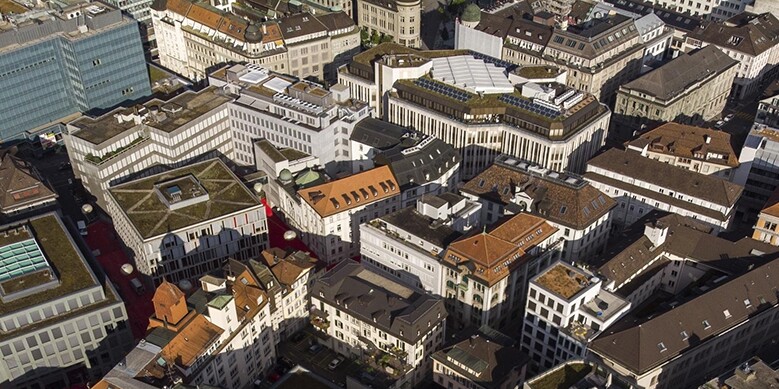
Since 1996, the district court of St. Gallen has been split between two locations. A solution that was never intended to last. While the offices are housed in the Bohl 1 property, the court sessions are held at Neugasse 3/5. This division not only makes work processes more difficult, but also no longer meets today’s requirements in terms of security and functionality. With the planned move to the Schützengasse 1 property, the court will finally have a modern and coherent home.
A building for the future
Schützengasse 1 is owned by the Canton of St. Gallen and will be extensively renovated and modernised for its new purpose. The feasibility study has confirmed that the building is ideally suited to the needs of modern court operations. By bringing all services together at one location, not only can work processes be simplified, but security requirements can also be implemented in line with the times. The current rental solution at Neugasse 3/5 will therefore become obsolete, which will bring long-term financial benefits for the canton.
Financing and costs at a glance
The total costs for the project amount to around CHF 27 million. This amount includes CHF 8.5 million for the transfer of the property from financial to administrative assets. The actual costs for the renovation and conversion of the building amount to CHF 19.5 million according to a rough cost estimate. This investment is supplemented by a one-off compensation payment of CHF 780,000 from the City of St. Gallen. The elimination of the rental costs for Neugasse 3/5 will also provide long-term relief for the canton’s finances.
Start of construction and schedule
The construction project is scheduled to start in 2027. Completion and occupation are planned for the end of 2028. In the foreseeable future, the District Court of St. Gallen will therefore have a building that not only meets current requirements, but also takes future developments in the justice sector into account.
The largest district court in the canton
With around 3,300 court cases a year, the district court of St. Gallen is the most important of the canton’s seven district courts. It deals with cases in the areas of civil and criminal law and has a well-established team of currently 43 permanent employees. These include district court judges, court clerks, clerical staff and auditors. In addition, 14 part-time district judges are involved in handling the cases. These extensive tasks require an infrastructure that fulfils today’s requirements for efficiency, security and flexibility.
Security as an integral part
In addition to merging the locations, the security system is a central element of the project. Court operations today must meet high standards in order to ensure the integrity of proceedings and the protection of all parties involved. The new property will be remodelled in such a way that these requirements are met and all security-relevant aspects can be taken into account.
A win-win situation for everyone involved
The planned relocation of the St. Gallen district court not only represents an upgrade for the judicial centre, but also a sustainable investment in the quality and future viability of the cantonal court system. The optimisation of processes, the modernisation of the infrastructure and the energy-efficient refurbishment are steps towards efficient and resource-saving operations. At the same time, the parties to the proceedings benefit from a modern environment that facilitates negotiations and processes within an appropriate framework.
