Tag: Kapazität

  • Plans for Bern’s West railway expansion project are on the table

    Plans for Bern’s West railway expansion project are on the table

    Bottlenecks occur time and again at the Bern railway junction, which have an impact on all long-distance traffic in Switzerland. With the Federal Expansion Plan 2025 (AS25), such bottlenecks will be eliminated and rail operations in Switzerland will be further optimised: There will be more stable and more connections between Bern and Zurich, a half-hourly service to Lucerne and Neuchâtel, and more trains on the Bern-Thun line. In future, there will be an S-Bahn train every quarter of an hour between Bern and Münsingen, and there will also be more connections between Bern and Burgdorf.

    Various projects planned
    Five sub-projects are planned for the overall AS25 project “Performance improvement Bern West”:
    – the Holligen disentanglement with the 1.7 km long new Holligentunnel
    – the Aebimatt stabling facility
    – the west end of Bern railway station
    – the Europaplatz Nord stop
    – the Steigerhubel passerelle for pedestrian and bicycle traffic

    The new Europaplatz Nord stop also includes a new pedestrian subway for the city of Bern. A separate planning approval procedure will be submitted later to the Federal Office of Transport (FOT) for the west end of Bern station.

    Construction work will take twelve years
    Construction is scheduled to start in spring 2025. The new station with the project name Europaplatz Nord will go into operation in 2028 and will thus replace the existing Stöckacker stop located a few hundred metres to the west. Passengers are expected to travel through the Holligentunnel for the first time in 2034. As things stand today, it will take until 2036 for the entire project to be completed.

    In February 2023, SBB submitted the dossier for the planning approval procedure to the Federal Office of Transport. The public consultation will take place in Bern from 15 May 2023 to 13 June 2023.

    As things stand today, the estimated costs for the “Bern West service enhancement” amount to around CHF 750 million (+/- 10%). The project will be financed through the federal government’s extension step 2025 (AS25).

    Information room opens its doors
    An information room will be open during the planning period so that residents and interested parties can obtain comprehensive information about the project. It is located in the BLS building at Stöckackerstrasse 25 in 3018 Bern.

    Further information on the project can be found at sbb.ch/bernwest

  • Plans for “Unbundling Gümligen South” are on the table

    Plans for “Unbundling Gümligen South” are on the table

    In order to be able to implement the service improvements ordered in the Federal Expansion Plan 2025 (AS25), a new railway tunnel is to be built near Gümligen. Together with other projects from the AS25, the “Unbundling Gümligen South” will make it easier for trains to cross. In the long term, this will make it possible to run a quarter-hourly service on the Berne-Muensingen S-Bahn, coupled with a half-hourly service on the Berne-Langnau S-Bahn, as well as additional capacities for long-distance traffic and freight traffic in the Aare Valley. The “unbundling of Gümligen South” provides passengers with more stability in the timetable and, together with other projects, more connections.

    450 metres of tunnel for easier crossing of trains
    Specifically, SBB is planning a new, 450-metre-long railway tunnel underneath the existing railway line between Muri and Rüfenacht/Allmendingen, in the Hüenli forest. In order to be able to operate the new tunnel, SBB must also replace the existing Gümligen signal box and relocate the transmission line in the affected area.

    Around 5 years construction time
    As things stand today, construction is scheduled to begin in May 2024. The new transmission line is scheduled to go into operation one year later and the new signal box another year later. Passengers are expected to travel through the new tunnel for the first time in mid-2028; according to current planning, it will take until the end of 2029 to complete the entire project.

    In December 2022, SBB submitted the dossier for the planning approval procedure to the Federal Office of Transport. The planning documents will be open to the public from 1 May 2023 to 30 May 2023 at the municipal administrations of Muri bei Bern, Allmendingen, Worb, Ostermundigen, Vechigen, Stettlen and Krauchthal.

    The estimated costs for the “Unbundling Gümligen South” are around CHF 200 million (+/- 10%). The project is being financed through the federal government’s 2025 expansion stage.

    Further information on the project can be found at sbb.ch/guemligen.

  • Lucerne bypass relieves road network

    Lucerne bypass relieves road network

    In the past ten years, traffic to and from Lucerne has increased by around 20 percent. Further growth is forecast – but the A2 and A14 are already reaching their capacity limits. At the Rotsee junction outside Lucerne, the traffic flows of the A2 north-south axis and the A14 from Zurich-Zug meet. On the city thoroughfare, regional and local destination and source traffic are added. In order to ease the situation, the federal government wants to significantly improve the traffic situation on both motorways with the Lucerne bypass. Without the bypass, alternative traffic on the subordinate road network would increase, and as a result, public transport would also be impeded.

    The core element of the bypass consists of two two-lane tunnels with a length of 3760 metres in the northbound direction and 3850 metres in the southbound direction, which pass under the city of Lucerne and the Reuss river. In the north, the connection points are in the Ibach area and in the south in the Grosshof area (Lucerne-Kriens). The planned tunnel bypass is primarily intended to accommodate transit traffic.

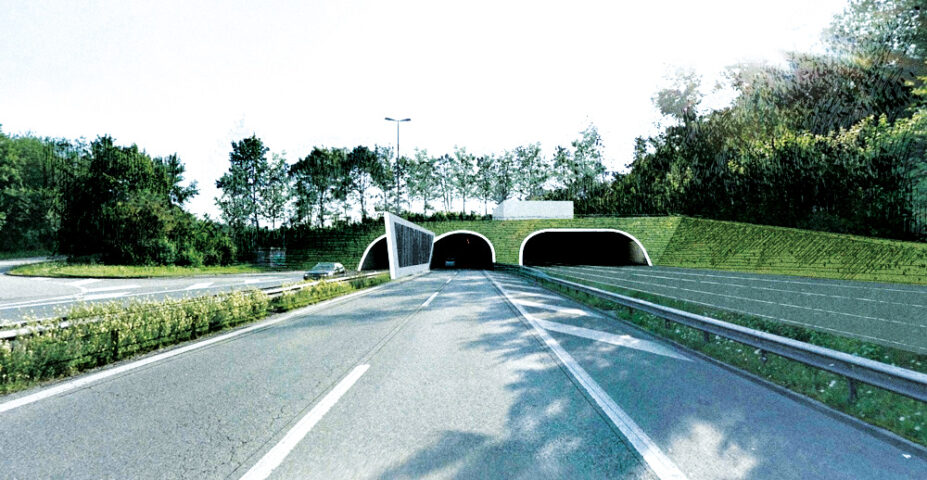
    In addition, it is planned to expand the A14 in the north from four lanes today to six lanes in the future from the Rotsee junction to the Buchrain junction. To achieve this, the Rathausen tunnel will be extended with a third tube. The structures will be adapted at the Rotsee junction. At the Rotsee junction, the A2/A14 Basel lane will be widened to two lanes in the direction of Zug in order to eliminate the existing bottleneck.

    Between the Rotsee junction and the Lucerne-Kriens junction, the A2 will become an urban motorway serving exclusively the destinations, sources and domestic traffic of the Lucerne conurbation. Emmen Süd, Luzern-Zentrum and Luzern-Kriens are connected to it. If necessary, for example in the event of an incident or during maintenance and repair work, the urban motorway serves as an alternative route to the bypass and vice versa.

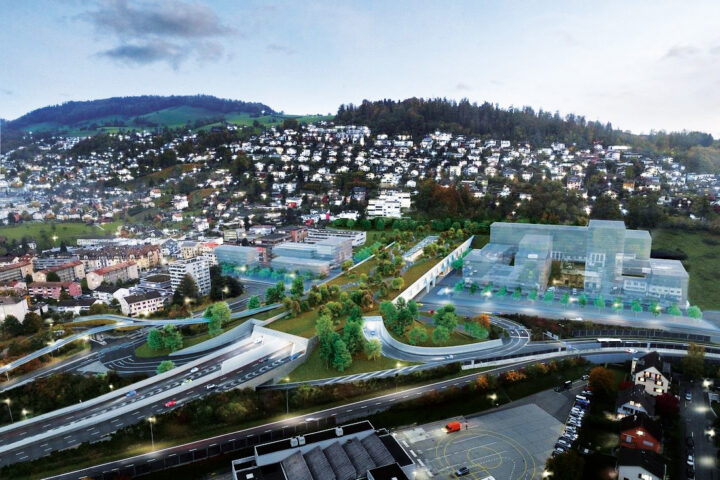
    The Grosshof bridges as the new gateway to the city of Kriens.

    In the south, the Spier tunnel between the Lucerne-Horw and Hergiswil junctions is to be re-marked with three lanes in each direction. The third lane will extend the entry and exit lanes. The new Grosshof bridges will provide the town of Kriens with a new gateway: a park with paths from Sonnenberg to Kriens, Horw and Lucerne is planned on the roof. Below the bridge, a diverse mix of uses is to be created, including cafés, shops and commercial space.

    The Lucerne bypass envisages the construction of three new road wastewater treatment plants (SABA) in Rathausen, at the Rotsee junction and at Grosshof-Kriens. Thanks to these, the wastewater from the motorway will be cleaned in an ecological way before it flows into the surrounding water bodies.

    The Bypass relief project is intended to improve the flow of traffic on the motorways and ensure the functionality of the north-south axis. It will also create alternative routes in case of accidents or maintenance work. Central Switzerland and the Lucerne agglomeration will benefit from better accessibility, and the urban motorway will be relieved of through traffic. Last but not least, safety for all road users will be increased.

    The Rathausen tunnel will be extended with a third tube.

    The total costs amount to CHF 1.8 billion and are financed by the federal government. If everything goes according to plan, the bypass should be open to traffic in about 2035 after about 12 years of construction – subject to the still pending planning permission.