Tag: Klimagerecht

  • Werkstadt Zurich: Transformation into a climate-friendly neighbourhood

    Werkstadt Zurich: Transformation into a climate-friendly neighbourhood

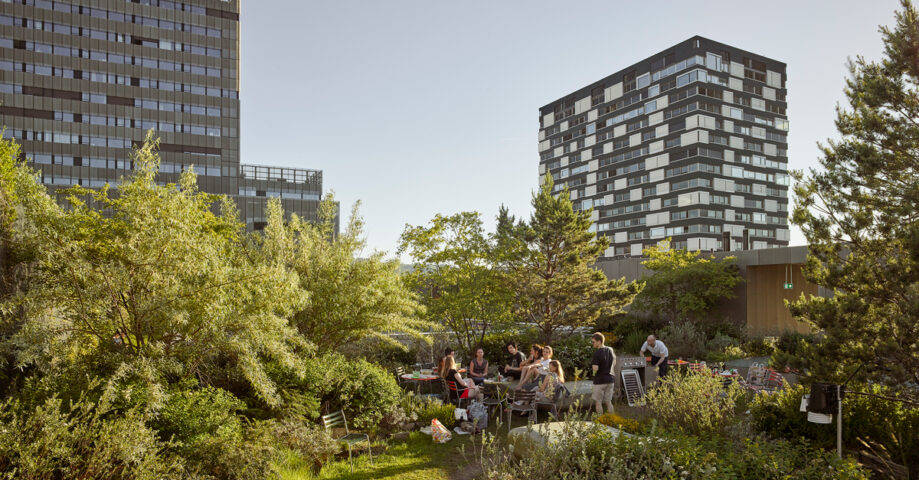
    SBB is transforming the 42,000-square-metre Werkstadt site in Zurich into a vibrant urban space, to be completed by 2035. This will preserve the fabric of its historic buildings, which will one day be joined by both new buildings and extensions to create an exciting cluster. The transformation of the former SBB workshops will be exceptionally sustainable, featuring climate-conscious building measures, circular economy elements and an innovative energy concept.

    Developing existing buildings
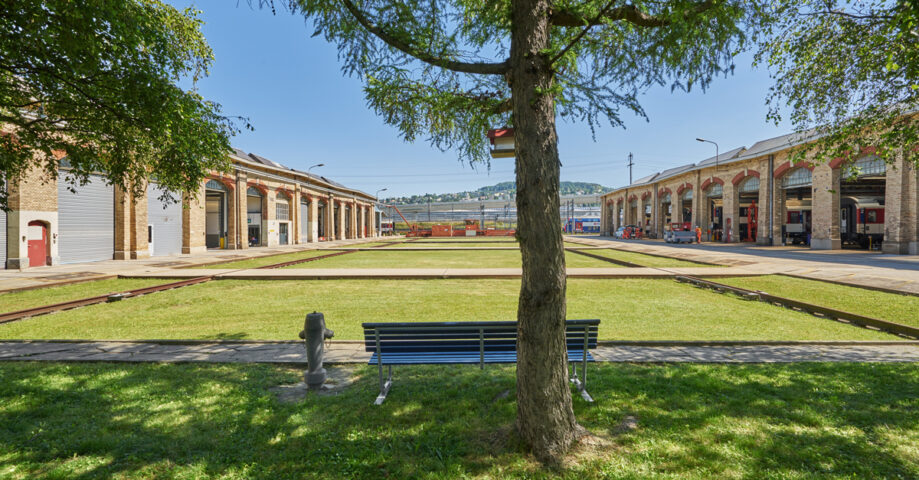
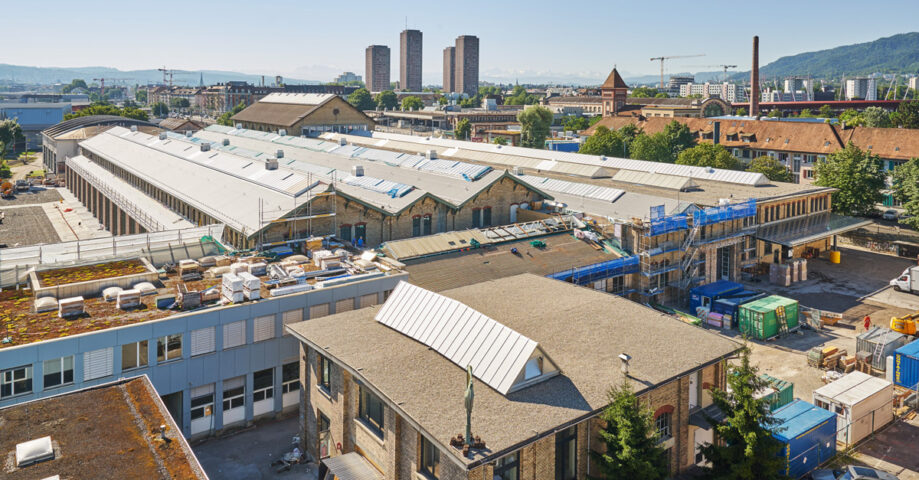
    In close coordination with the monument preservation authorities, the existing buildings will be gradually renovated and joined by new buildings and extensions in the coming years. At the heart of the site, the former carriage workshop ‘Building Q’ will allow for a diverse usage mix under one roof from 2023. The development will offer an exciting interplay between the fabric of historic buildings, structural densification and public use of outdoor space.
    © SBB AG, Martin Zeller

    Environmentally friendly construction
    ‘SBB wants to be climate-neutral by 2030, and climate-compatible construction is an important factor in achieving this objective,’ said Gabriele Bühler, Project Manager at SBB. Various climate-conscious building measures have been incorporated into the planning of the site. That includes configuring the new buildings to promote the circulation of cool air currents. Where possible, the roof water will be allowed to seep into an above-ground system for further cooling. Surfaces will remain unsealed where possible. The transformation follows a systemic approach that considers the building along its entire life cycle. The aim is to keep CO2 emissions as low as possible. To ensure circularity, all construction components are recorded on the Madaster platform. There is also a particular focus on reusing components. 

    Energy concept: 100% renewable
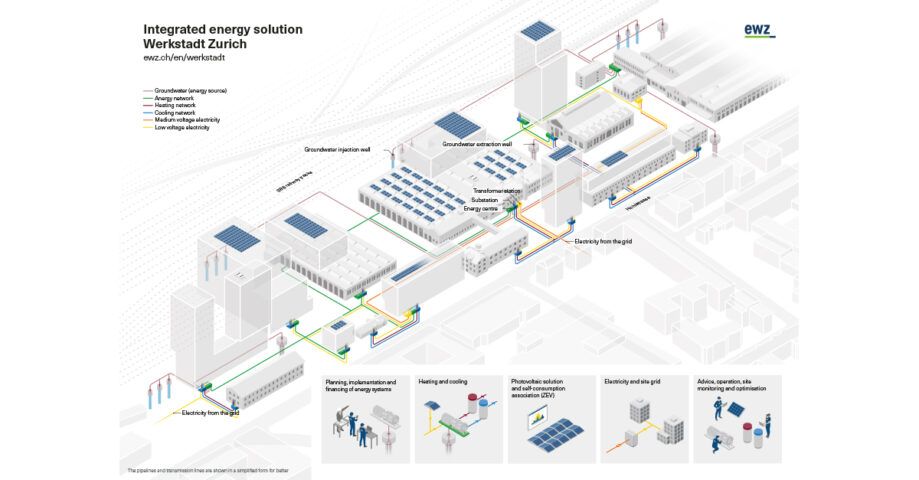
    ewz was able to win SBB’s public tender with an energy solution based on 100 per cent renewable energies. Groundwater, which is collected in four wells on the site, serves as a source of heating and cooling. From these wells, the water flows to the energy centres in the larger buildings, which house heat pumps and cooling machines that bring the water to the required temperature. An anergy network connects all the buildings and ensures that excess energy is exchanged between the building groups. For example, excess heat or cold in one building can be used in another. This system also has the advantage of not requiring groundwater boreholes in every building: the smaller buildings are connected to the energy centres via a local heating network. Heating and cooling is generated without any CO₂ emissions, as the rest of the electricity also comes from renewable sources. The use of a monovalent energy system will ultimately lead to a CO2 reduction of over 2,100 tonnes per year.
    High self-consumption of solar power
    ewz also plans, finances, creates and operates the transformer systems and medium-voltage lines to supply the site with electrical energy. ‘Some of the electricity that the people in the Werkstadt use on the site is produced there using photovoltaics,’ explains Markus Fischer, Head of Sales at ewz Energy Solutions. To this end, SBB and ewz want to make the best possible use of the roof areas for solar power production. Both the roof of Building Q, at the centre of the site, and the roofs of other buildings with a suitable structure and orientation for generating solar power are to be kitted out with photovoltaic systems. SBB requires its tenants on the site to form a self-consumption association (ZEV). ‘When completed, the ZEV will consist of around 300 parties that will use locally produced electricity on the site. This allows us to achieve a high self-consumption rate, which, in turn, makes a significant contribution to the cost-effectiveness of the photovoltaic systems,’ says Markus Fischer. He expects self-consumption on the Werkstadt site to be almost 100 per cent when completed.
    © SBB AG, Martin Zeller

    The benefits of contracting
    For the owner, this form of collaboration has various benefits, including keeping financial risks and management costs very low. If a system fails, ewz makes sure it gets back into operation as quickly as possible. To ensure that the system can be operated efficiently, ewz will start undertaking energy-related operational optimisations shortly after commissioning. As part of an ongoing process, the systems will be optimised and adapted to the actual needs relating to their use. By extension, this ensures that they consume as little energy as possible, generate minimal costs and offer maximum convenience for users.

    Werkstadt Zürich is a successful example of a forward-looking approach to repurposing a historic industrial site. With the targeted renovation and expansion of existing buildings and a ground-breaking energy concept, the developers – together with the planners and ewz – are creating added value for future users and the environment alike. Find out more about the Werkstadt site’s innovative energy concept here.

    https://www.ewz.ch/en/business-customers/real-estate.html

  • New white paper on ‘Climate-conscious building’

    New white paper on ‘Climate-conscious building’

    Climate change is causing summer temperatures to rise in Switzerland. This is particularly apparent in densely built cities with extensive sealed surfaces. Buildings and their surroundings must be designed to offer a comfortable quality of life in the climate of the future. ewz’s new white paper on ‘Climate-conscious building’ offers an overview of this topic. The publication serves as a knowledge base and inspiration for construction in the context of climate change and is free to download here.

    Focus on cities
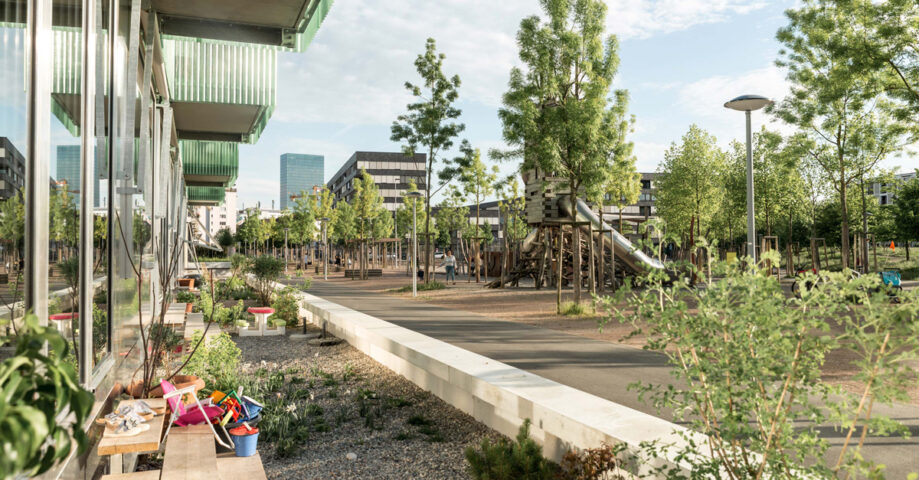
    Green spaces with shady trees and cold air corridors intended to bring cooling are often either entirely absent or inadequate, meaning heat islands form in urban areas – where temperatures can be up to ten degrees higher at night than in surrounding areas. A catalogue of measures tailored to each specific location is needed to counteract this heat island effect. Important principles for eco-friendly urban planning and building include building position and sizing, green areas, facades and roofs, and shading.

    Copyright Roland Bernath

    Moderate window proportions
    It’s not just exterior spaces that need to be planned and built in a climate-conscious way, but also the buildings themselves. To keep interiors as cool as possible when external temperatures rise, parameters such as building orientation, window surface areas and the building’s retention capacity are critical, starting at the design stage. Solid ceilings and floors, for example, store heat due to their mass and the room temperature rises more slowly. Windows also need special attention. Large-scale glazing is beneficial in that it lets abundant natural daylight into the interior and keeps solar heat input high in winter. In summer, however, this heat is undesirable. It is therefore recommended to avoid floor-to-ceiling windows as far as possible, and to strike a balance between aesthetics and comfortable temperatures. A window proportion of up to 30 per cent in residential buildings and up to 40 per cent in office buildings is a benchmark.

    Ventilation and cooling
    During long periods of hot weather, even a well-planned building heats up. It is extremely effective to dissipate the accumulated heat at night. This can be achieved by cross-ventilation, for example. Even better is to design a building that develops a chimney effect. Ventilation flaps in the façade – adjacent to the windows, for example – allow cool outside air to enter the interior and then discharge through an opening in the roof by way of the stairwell. Solutions like this entail no or minimal additional costs and work more efficiently than air conditioning units.

    Unlike residential buildings, today’s office buildings are often equipped with cooling systems. This is due to the high internal loads produced by users and IT infrastructure, not to mention the high proportion of glass in the façades. There are office buildings whose requirements for cooling and heating energy are now already identical. By 2100, office buildings could require up to ten times more energy for cooling than for heating, depending on climatic developments. This would presumably increase operating costs significantly and make it more difficult to operate buildings economically.

    An array of local energy sources
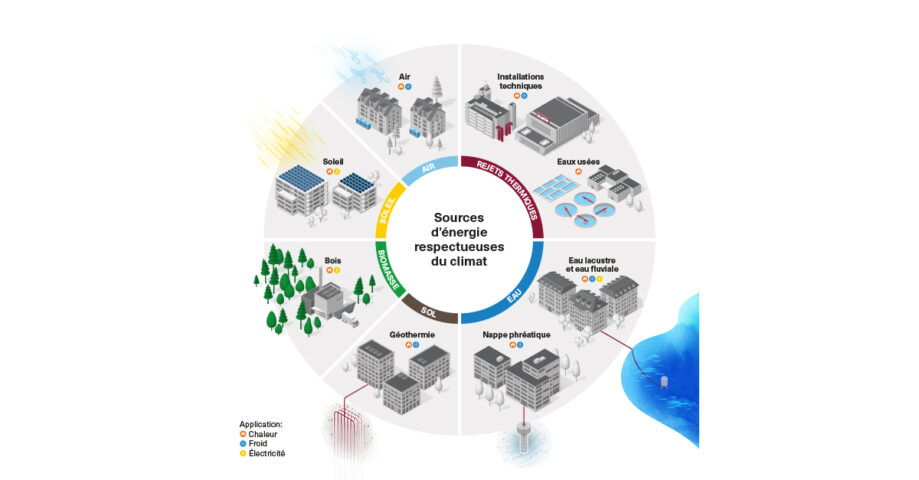
    Environmentally friendly passive cooling is ideal for meeting the basic cooling requirements of office and residential properties. Known as free cooling, there are various energy sources in Switzerland that are suitable for this.

    Geothermal heat accessed via probes is often used. In winter, thermal energy from the ground is used as a heat source, while in summer it serves also for cooling, because required temperatures are significantly below room temperatures. Lake water is another particularly suitable energy source, as the many Swiss lakes provide a valuable thermal storage mass. Because their shores are often densely populated, the lake water can be efficiently used to supply numerous buildings.

    Whether it comes from geothermal probes, lake water or other sources, it is crucial that cooling uses as little energy as possible. So it’s a good idea for building owners, investors and architectural specialists to discuss this issue with an energy service provider such as ewz as early as possible and see which options are feasible. This enables the construction of buildings that can offer high comfort levels even in the hot summers of the future, without placing an additional burden on the environment.

    Environmentally friendly heating remains important
    It is important to bear in mind that the cooling energy needed for residential buildings is relatively low compared to the heating required. Decarbonisation of heat supply must therefore remain a priority in order to achieve net zero. Sustainable heating is not a problem nowadays, with various technically mature and economically attractive renewable heating systems available.

    The ‘Climate-conscious building’ white paper provides in-depth information, detailed insights and a range of best-practice examples highlighting specific solutions for tackling this issue. The new white paper is free to download for all interested parties.

    https://www.ewz.ch/en/business-customers/real-estate.html