Tag: klimagerechtes Bauen

  • Preventing heat islands in the planning stage

    Preventing heat islands in the planning stage

    Climate change is causing problems for cities, especially in summer. “Heat island” has become a ubiquitous topic. However, those who plan larger neighbourhoods can avoid heat accumulation. The decisive factors here are the setting of the buildings in line with their surroundings, the choice of materials for façades and outdoor areas, green spaces and clever shading. The effects of these factors should actually be taken into account at an early planning stage. For this, however, architects would have to consult computer models that can calculate the impact of the decisive factors for a specific location. The problem with the existing models is that the calculation is time-consuming and costly. For this reason, they are usually not used at an early stage. The Lucerne University of Applied Sciences and Arts (HSLU) has now developed a new interactive neighbourhood climate modelling (QKM), which is limited to phase-specific information and delivers results in seconds. The project was financed by the Infinite Elements Foundation and the HSLU.

    Things have to move fast in the planning phase
    For large-scale construction projects, architectural firms usually apply in an elaborate competition procedure under high time pressure. “They have to consider a multitude of requirements in their design, one of which is the microclimate,” explains simulation expert Prof. Markus Koschenz from the Lucerne University of Applied Sciences and Arts. High costs and two-day waiting times would be out of the question for the architects in this creative work phase. But this is exactly what they would have had to accept up to now if they wanted to include the complex calculations. So what happens if you win a competition project and only then realise that the building placement was chosen in an unfortunate way? After all, the jury has decided in favour of the proposed solution; fundamental adjustments are no longer envisaged in the phase after the jury’s decision – even if the subsequent calculation of the microclimate would suggest this. In short, the dilemma cannot be solved this way. Now, warmer summer temperatures are already causing problems for people today. Warming in the coming years and decades will increase, which can be life-threatening, especially for older people. And buildings that are being planned now will still be standing in fifty years. Ignoring all this in the planning process seems negligent.

    Results in seconds
    “What is needed is an instrument for calculating the microclimate that is cheaper and, above all, can deliver results very quickly,” says Koschenz. His core team with Andrii Zakovorotnyi, Reto Marek and an external Revit specialist developed this instrument at the Lucerne University of Applied Sciences and Arts. He explains: “Existing methods use generally applicable computational fluid dynamics (CFD) instruments. These instruments can be used by specialists to develop machines, investigate flows on aircraft or determine the microclimate in neighbourhoods. They are powerful but also correspondingly complex. Our model concentrates on the aspect of the neighbourhood climate and we work with algorithms that calculate quickly,” says Koschenz, explaining the striking difference in calculation speed. It takes seconds or at most a few minutes to calculate the effects of a change. The tool can be used by the planners themselves from the first step in the planning process. With little effort, for example, one can compare two variants of façade design or the planting of trees in an inner courtyard. And not just for one summer day, but for an entire summer period.

    Checking the model with measurements
    The information on the planned buildings, their position, the materials used or the type and position of green spaces and trees is obtained by the interactive neighbourhood climate modelling from the planning tool Revit, which is already used in architecture and landscape planning offices. From this, the physical model calculates the effect of radiation, shade, heat storage properties of materials, air flow, vegetation and time of day on the neighbourhood climate. Images with colour scales show the results in an intuitively understandable way.

    Koschenz’s team proved that the model works correctly with measurements in the Suurstoffi district in Rotkreuz and also compared the results with those of existing commercial software. Koschenz is extremely satisfied with the results: “We can say that the agreement with both the measurements and the results of other software was high. This means that our tool is much faster with the same accuracy.

  • “co-operate” – a model for climate-friendly construction

    “co-operate” – a model for climate-friendly construction

    As far as the sparing use of resources and the reduction of CO2 emissions are concerned, the campus that is taking shape on the Empa site in Dübendorf should certainly become a model student – from the top to the bottom, from the roofs to a depth of 100 metres, where the earth probes of a unique experimental seasonal energy storage system end. In summer, these “tubes” will store the waste heat from, for example, the refrigeration machines, ventilation systems and laboratory equipment, and then use it in winter for heating or for the production of hot water. The goal: to reduce the CO2 emissions of the buildings on the entire campus to a minimum and at the same time explore this innovative technology for a sustainable energy future.

    Minimising greenhouse gas emissions: This aspiration also shapes the constructions of the new campus. The three-storey building to the right of the entrance is a unique “wood-concrete car park” whose ceilings are a sophisticated construction of spruce beams and slabs with concrete overlay. According to the construction company Implenia, this hybrid construction method made it possible to reduce the thickness of the concrete layers to about one third. A significant saving was made on the “climate polluter” cement: around 9,300 m2 of concrete ribbed ceilings were replaced with wooden beam ceilings – also a contribution to the current trend of replacing concrete, where possible and sensible, largely with constructions made of wood.

    According to Kevin Olas, Head of Real Estate at Empa, one of the challenging aspects of this project was the cleverly integrated installation of lighting, electrical lines and waste water pipes, so as not to detract from the aesthetics of this sophisticated hybrid construction. In addition, the planning also had to take future aspects into account: With a view to climate change, the multi-storey car park was planned as a modular construction made of demountable prefabricated parts – with a view to a more distant future in which individual mobility may play a lesser role than it does today. Then parts of the building could also be converted into workshops or for other purposes.

    Urine as raw material for fertiliser
    In this future, environmentally friendly recycling will also determine building: Not only steel, concrete or wooden elements can be recycled in a climate-friendly way, but also human “raw materials”. Take urine, for example: in the large laboratory building at the centre of “co-operate”, “NoMix” toilets have been installed, which experts from the Eawag Water Research Institute have developed over the past few years. Without changing the usual use, they separate human urine from the so-called black water from faeces, flushing water and toilet paper.

    Because urine contains valuable nutrients such as nitrogen, phosphorus and potassium, it can be used to produce fertiliser for agriculture. In a process specially developed by Eawag, the raw material is first stabilised in the basement of the NEST building using a biological process, thus losing its strong odour. An activated carbon filter removes all drug residues before the liquid is finally evaporated – to produce a high-quality fertiliser called “Aurin”, which is marketed by the Eawag spin-off Vuna GmbH. 1000 litres of urine produce 100 litres of this fertiliser, which since 2018 has also been approved by the Federal Office for Agriculture for use on edible plants.

    Many mosaic stones for a good carbon footprint

    In addition to the inconspicuous urine collection system, many obvious details document the campus’ claim to be a signpost for environmentally friendly construction. Photovoltaic installations will massively increase the campus’ own electricity production. And on more than 14,000 m2 of floor space, people move on recycled asphalt with a high proportion of 80 percent recycled material in the base layer and 20 percent in the thin surface layer.

    At the same time, the landscape architects have freely dispensed with asphalt in order to design close to nature: Previously sealed areas are “liberated”, such as Ludwig-Tetmajer-Strasse on the Empa site. “This ‘car park asphalt desert’ will become a green and shady zone,” explains Kevin Olas. And behind the large new buildings, biodiversity is also being promoted with diverse plants and trees – thanks to selected heat-resistant species that will also feel at home in future climate conditions.

  • Werkstadt Zurich: Transformation into a climate-friendly neighbourhood

    Werkstadt Zurich: Transformation into a climate-friendly neighbourhood

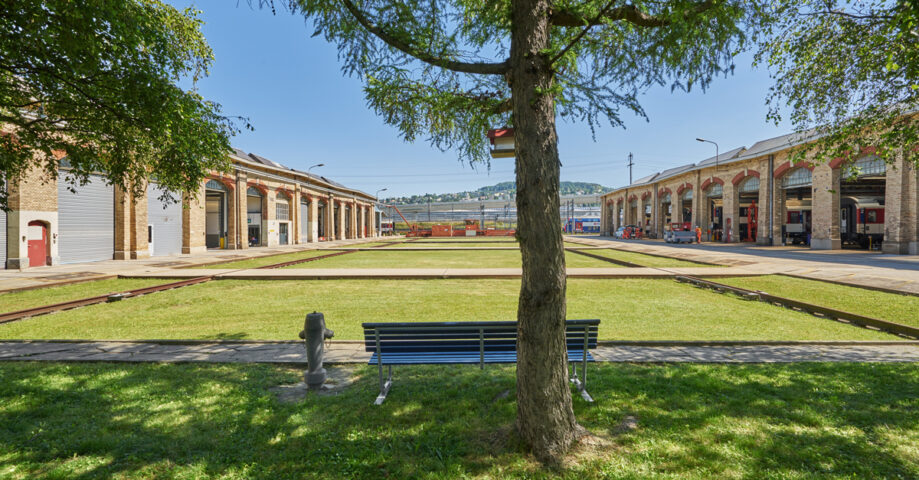
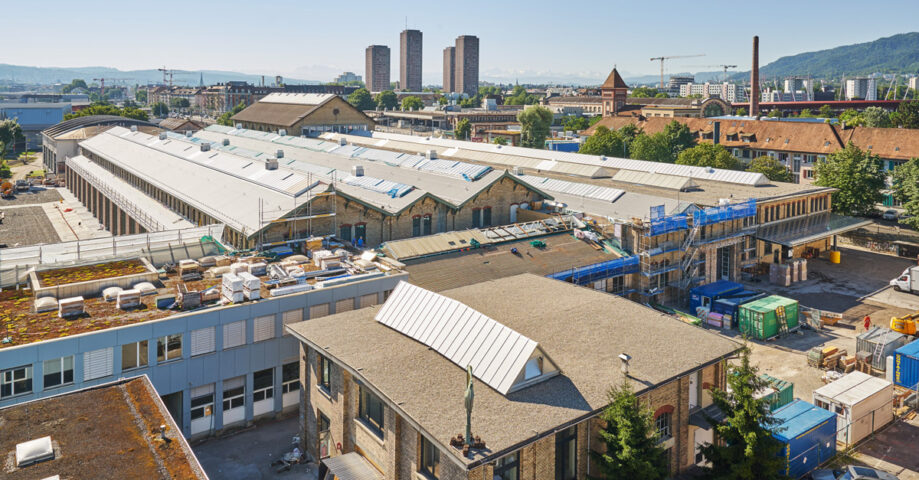
    SBB is transforming the 42,000-square-metre Werkstadt site in Zurich into a vibrant urban space, to be completed by 2035. This will preserve the fabric of its historic buildings, which will one day be joined by both new buildings and extensions to create an exciting cluster. The transformation of the former SBB workshops will be exceptionally sustainable, featuring climate-conscious building measures, circular economy elements and an innovative energy concept.

    Developing existing buildings
    In close coordination with the monument preservation authorities, the existing buildings will be gradually renovated and joined by new buildings and extensions in the coming years. At the heart of the site, the former carriage workshop ‘Building Q’ will allow for a diverse usage mix under one roof from 2023. The development will offer an exciting interplay between the fabric of historic buildings, structural densification and public use of outdoor space.

    © SBB AG, Martin Zeller

    Environmentally friendly construction
    ‘SBB wants to be climate-neutral by 2030, and climate-compatible construction is an important factor in achieving this objective,’ said Gabriele Bühler, Project Manager at SBB. Various climate-conscious building measures have been incorporated into the planning of the site. That includes configuring the new buildings to promote the circulation of cool air currents. Where possible, the roof water will be allowed to seep into an above-ground system for further cooling. Surfaces will remain unsealed where possible. The transformation follows a systemic approach that considers the building along its entire life cycle. The aim is to keep CO2 emissions as low as possible. To ensure circularity, all construction components are recorded on the Madaster platform. There is also a particular focus on reusing components. 

    Energy concept: 100% renewable
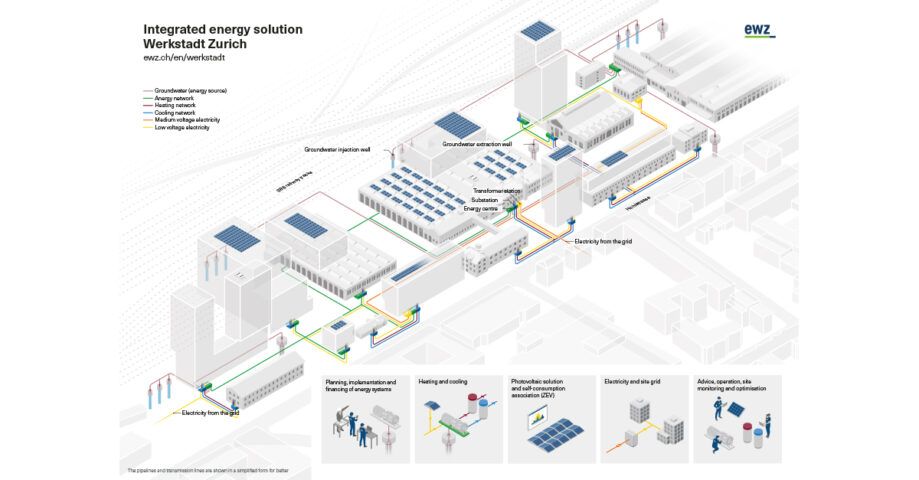
    ewz was able to win SBB’s public tender with an energy solution based on 100 per cent renewable energies. Groundwater, which is collected in four wells on the site, serves as a source of heating and cooling. From these wells, the water flows to the energy centres in the larger buildings, which house heat pumps and cooling machines that bring the water to the required temperature. An anergy network connects all the buildings and ensures that excess energy is exchanged between the building groups. For example, excess heat or cold in one building can be used in another. This system also has the advantage of not requiring groundwater boreholes in every building: the smaller buildings are connected to the energy centres via a local heating network. Heating and cooling is generated without any CO₂ emissions, as the rest of the electricity also comes from renewable sources. The use of a monovalent energy system will ultimately lead to a CO2 reduction of over 2,100 tonnes per year.

    High self-consumption of solar power
    ewz also plans, finances, creates and operates the transformer systems and medium-voltage lines to supply the site with electrical energy. ‘Some of the electricity that the people in the Werkstadt use on the site is produced there using photovoltaics,’ explains Markus Fischer, Head of Sales at ewz Energy Solutions. To this end, SBB and ewz want to make the best possible use of the roof areas for solar power production. Both the roof of Building Q, at the centre of the site, and the roofs of other buildings with a suitable structure and orientation for generating solar power are to be kitted out with photovoltaic systems. SBB requires its tenants on the site to form a self-consumption association (ZEV). ‘When completed, the ZEV will consist of around 300 parties that will use locally produced electricity on the site. This allows us to achieve a high self-consumption rate, which, in turn, makes a significant contribution to the cost-effectiveness of the photovoltaic systems,’ says Markus Fischer. He expects self-consumption on the Werkstadt site to be almost 100 per cent when completed.

    © SBB AG, Martin Zeller

    The benefits of contracting
    For the owner, this form of collaboration has various benefits, including keeping financial risks and management costs very low. If a system fails, ewz makes sure it gets back into operation as quickly as possible. To ensure that the system can be operated efficiently, ewz will start undertaking energy-related operational optimisations shortly after commissioning. As part of an ongoing process, the systems will be optimised and adapted to the actual needs relating to their use. By extension, this ensures that they consume as little energy as possible, generate minimal costs and offer maximum convenience for users.

    Werkstadt Zürich is a successful example of a forward-looking approach to repurposing a historic industrial site. With the targeted renovation and expansion of existing buildings and a ground-breaking energy concept, the developers – together with the planners and ewz – are creating added value for future users and the environment alike. Find out more about the Werkstadt site’s innovative energy concept here.


    https://www.ewz.ch/en/business-customers/real-estate.html