Tag: Klimaneutralität

  • Political roadmap to climate neutrality in Switzerland

    Political roadmap to climate neutrality in Switzerland

    POLIZERO’s final report takes an unusually clear look at Swiss climate policy. The next ten years are crucial for the economy, energy supply and society. The research team modeled numerous paths. The phase-out of fossil fuel technologies, a massive expansion of district heating and solar capacity and the rapid introduction of electromobility form the foundation for the net-zero target.

    A look at Europe shows that, especially in uncertain times, targeted harmonization with EU standards will become a success factor. In particular, integration into a common energy market and harmonized regulations strengthen security of supply and accelerate innovation.

    From strategy to scaling
    The window for far-reaching decisions is closing. From 2035, the focus will shift to scaling up climate-friendly technologies. Model calculations show that wind and bioenergy, synthetic fuels and CO₂ capture from industry and waste will take center stage. Switzerland can reduce its dependence on energy imports in winter and at the same time facilitate industrial change through investments and mandatory requirements, for example for the replacement of old heating systems.

    Support measures and innovation incentives act as start-up aid, but will be supplemented in a targeted manner by stricter regulatory instruments and the expansion of emissions trading. Steady but adaptable policies remain necessary to absorb geopolitical uncertainties and technological surprises.

    Flexible implementation, clear perspective
    The study recommends a balanced approach instead of radical individual steps. If Switzerland succeeds in combining its own credible initiatives with consistent EU coordination, the chances of achieving the net zero target are intact. It remains crucial that any strategy remains flexible. The faster world markets and research change, the more important adaptability becomes.

    Achieving climate neutrality does not require a perfect recipe, but rather a clearly defined direction and political perseverance. The decisive steps must be taken now. For a Switzerland that will help shape Europe in terms of climate protection and innovation.
  • New findings from 45,000 building permits

    New findings from 45,000 building permits

    The white paper “Retrofitting the Future, The Costs, Timelines, and Strategies Shaping Swiss Real Estate”, which was produced in collaboration with E4S, combines comprehensive data analyses with practical recommendations for action. The aim is to paint a realistic picture of renovation activity in Switzerland. The researchers have systematically investigated the dynamics of renovations, both in terms of speed and costs as well as the type of projects.

    Findings from 45,000 building permits
    By analyzing more than 45,000 building permits issued, the report provides a detailed overview of the actual pace of renovation in Switzerland for the first time. The results show that positive trends are definitely emerging. At the same time, however, it is clear that only a small proportion of renovations are directly aimed at improving energy efficiency. This means that the transition to more climate-friendly buildings has so far remained incomplete.

    Strategic importance of real estate funds
    A central aspect of the report is the role of real estate investment vehicles (REIVs) in achieving the climate targets by 2050. In order to achieve these targets, REIVs must mobilize an average of 13 percent of their net assets, or CHF 28.3 billion, for energy improvements. However, the study points to major differences between the individual market players when it comes to implementing these investments. Some will have to go far beyond the average requirement.

    New tools for well-founded decisions
    The white paper is part of a series of CRML initiatives designed to provide decision-makers with a solid data basis.

    PRESS Scoresa comprehensive ESG rating system for over 126 Swiss real estate funds that takes environmental and social criteria into account.

    PRESS Index: The first sustainable stock market index based on ESG performance metrics, creating transparency in the real estate sector.

    ES Score Whitepaper: An in-depth analysis of 20,000 buildings managed by REIVs to identify regional differences and prioritize investments.

    These tools have a common goal, they make change in the real estate sector measurable and highlight areas for action that often remain hidden. This creates a basis on which decision-makers can not only react, but also proactively steer.

    Focus on future-oriented strategies
    “By combining current data and project typologies, we can move from a theoretical and retrospective view to a concrete and prospective reading of ongoing changes,” explains Dr. Nathan Delacrétaz, one of the authors of the report. Together with his colleagues, Professors Eric Jondeau and Fabio Alessandrini, he makes it clear that it is not enough to simply manage the status quo for existing buildings.

    The researchers emphasize that REIVs will have to focus more on three strategic approaches in future: adapting their portfolios through targeted acquisitions and sales, renovating existing buildings and developing new, energy-efficient properties. The targeted upgrading of underperforming properties will also play a key role in improving the sector’s energy balance in the long term.

    Quantitative basis for the real estate turnaround
    The white paper provides a rare insight into the actual dynamics of renovation and construction activities in Switzerland. It makes it clear that building permits are a key indicator of progress towards climate neutrality, but also a warning. Only if these renovations are specifically geared towards energy efficiency and climate neutrality can the targets set be achieved.

  • BLKB Fund Management AG launches sustainable property fund

    BLKB Fund Management AG launches sustainable property fund

    BLKB Fund Management AG, the Binningen-based subsidiary of Basellandschaftliche Kantonalbank(BLKB), has launched its first sustainable property fund. According to a press release, the BLKB (CH) Sustainable Property Fund will primarily invest in energy-efficient properties in Northwestern Switzerland and the neighbouring regions of Bern, Central Switzerland and Zurich. It is aimed at qualified investors who wish to invest in a high-quality property portfolio with a predominantly residential focus.

    The initial issue has a volume of up to CHF 160 million. BLKB also intends to invest in the fund. The proceeds of this issue are to be used to acquire a property portfolio with a market value of CHF 177 million. The portfolio, for which BLKB has already acquired seven of the eight properties in the past two years, consists of energy-efficient properties in good locations. It is characterised by a high proportion of residential properties with a low vacancy rate. Currently, 80 per cent of the property assets in the BLKB (CH) Sustainable Property Fund are located in Northwestern Switzerland.

    “The launch of the sustainable property fund with a focus on Northwestern Switzerland is an important milestone. The property sector offers attractive yield opportunities for investors and at the same time has a major impact on energy efficiency, which is particularly relevant for climate neutrality,” Michel Molinari, CEO of BLKB Fund Management AG, is quoted as saying in the press release.

    The subscription period is expected to run from 24 June to 23 July 2025 with payment on 30 July 2025.

  • Online tool for climate-neutral industrial processes

    Online tool for climate-neutral industrial processes

    Industry is facing the challenge of converting its processes from fossil fuels to renewable energies. High-temperature heat pumps offer an energy-efficient solution for temperature ranges from 100 to 200°C in particular. They can not only provide process heat, but also generate cooling at the same time, which makes them particularly attractive for many branches of industry.

    Interactive technology map for companies
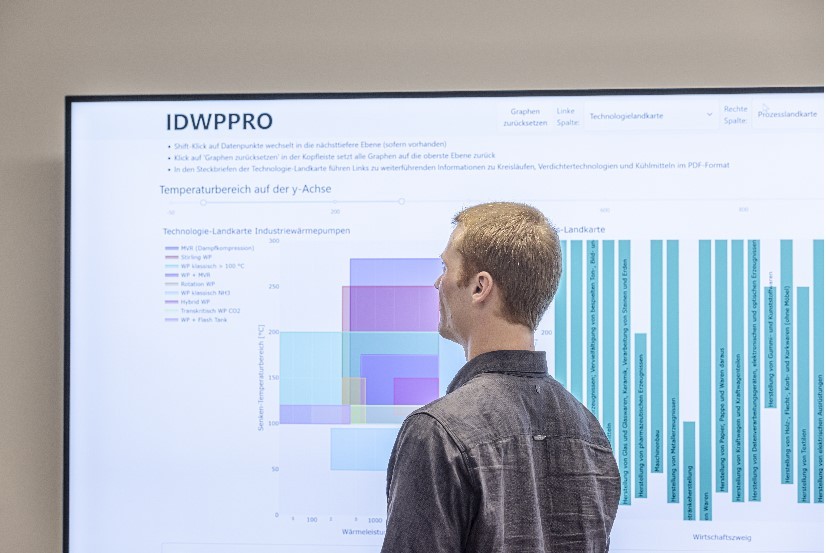
    In the research project “Identification of industrial heat pumps for process heat”, Fraunhofer ISE has developed an online tool that provides companies with targeted support in selecting the right heat pump technology.

    The tool offers

    • Visualisation of the available heat pump technologies in the temperature range and output
    • Allocation of heat pumps to specific industrial processes (e.g. cleaning, drying, cooling)
    • Interactive retrieval options for process temperatures in various industries
    • Detailed fact sheets on circulation processes, compressor technologies and refrigerants

    A contribution to climate-neutral industry
    The online tool is part of the Fraunhofer research topic “Climate-neutral industry”, which supports companies on their way to a CO₂-neutral energy supply.

    This includes:

    • Optimisation of potential energy savings
    • Utilisation of industrial waste heat
    • Integration of renewable energies (e.g. photovoltaics for in-house power supply)
    • Storage solutions for heating, cooling and electricity

    Special attention is also paid to the treatment of industrial waste water, which not only contains waste heat but often also valuable residual materials such as metals or acids. These can be efficiently recycled using modern recovery technologies.

    Participate and contribute data
    The data pool of the online tool is constantly being expanded. Manufacturers of heat pumps and industrial companies can get in touch with Fraunhofer ISE to integrate their data into the platform and thus drive development forward.

    With this new digital solution, Fraunhofer ISE offers companies an effective tool for decarbonising industrial processes and increasing energy efficiency – a decisive step on the way to climate-neutral production.

  • Bio-inspired “Solar Gate” regulates buildings in a climate-neutral way

    Bio-inspired “Solar Gate” regulates buildings in a climate-neutral way

    In nature, plant structures adapt intelligently to their environment, and these principles are now also being utilised in architecture. Researchers at the Universities of Freiburg and Stuttgart have developed the “Solar Gate”, a façade system that reacts to changes in humidity and temperature without the need for mechanical or electrical components.

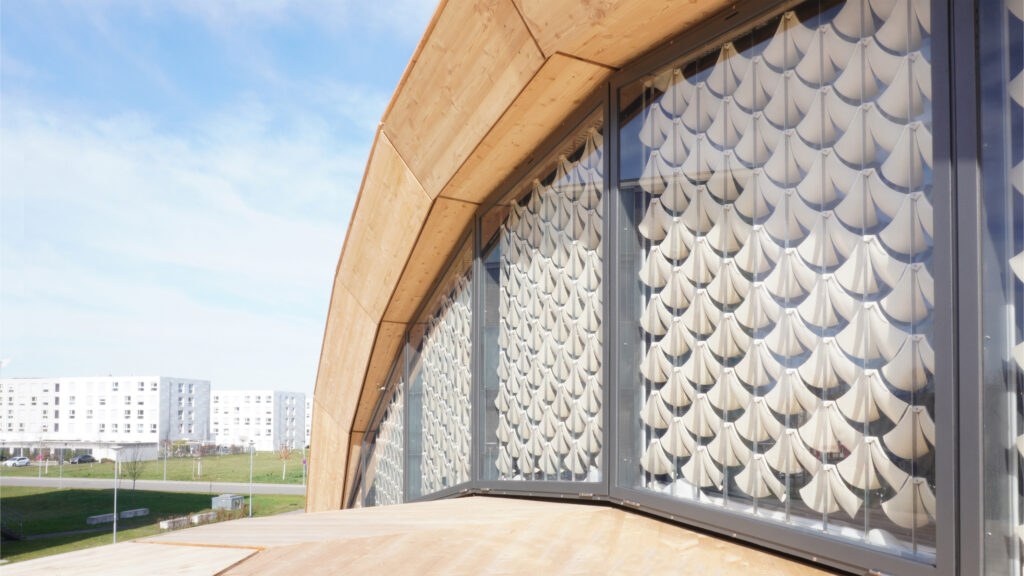
    This adaptive shading system was installed on the livMatS Biomimetic Shell, a research building at the University of Freiburg. It is based on hygromorphic materials that open and close independently like pine cones. As a result, the system lets sunlight into the building in winter for natural heating and protects against excessive heat in summer – completely energy self-sufficient.

    4D printing enables intelligent façades
    The secret behind the innovation lies in the combination of bio-based cellulose materials and state-of-the-art 4D printing technology. Cellulose, a renewable and abundant raw material, reacts to fluctuations in humidity by expanding or contracting. The research team has utilised this natural property to develop a two-layer structure that automatically adapts depending on the weather.

    The elements produced using 4D printing curl up and open in high humidity, while they flatten and close in dry conditions. The “Solar Gate” thus offers a completely new way of regulating buildings in a climate-neutral way.

    Energy-efficient construction of the future
    The building sector is responsible for a large proportion of global CO₂ emissions. Buildings can significantly reduce their energy consumption for heating, cooling and ventilation using intelligent, bio-based materials. The “Solar Gate” shows how natural principles and modern manufacturing technologies can lead to sustainable architectural solutions.

    With this innovative shading system, the researchers prove that sustainable construction methods can not only be environmentally friendly, but also efficient and cost-effective. The future of architecture could therefore be a great deal closer to nature.

  • New technologies for geothermal utilisation developed in Switzerland

    New technologies for geothermal utilisation developed in Switzerland

    Researchers at ETH are fully utilising energy from underground to generate electricity and heat. Several research groups at the university are exploring the possibilities of geothermal energy, the ETH announced in a press release. According to the statement, Switzerland is better prepared for the utilisation of geothermal energy than it was a few years ago in terms of technology, regulations and public acceptance.

    A group led by Stefan Wiemer, Professor at the Department of Earth and Planetary Sciences at ETH and Director of the Swiss Seismological Service, is conducting research in the BedrettoLab on minimising earthquake risks in so-called enhanced geothermal systems. A sensor-supported system monitors the creation of the necessary artificial cracks in which water heats up. The knowledge gained in the BedrettoLab is being utilised in the planning of the geothermal pilot power plant in Haute-Sorne JU.

    The group led by Martin Saar, Professor of Geothermal Energy and Geofluids in the Department of Earth and Planetary Sciences at ETH, is exploring the possibilities of closed raw circuits in which CO2 circulates. These so-called deep closed-loop advanced geothermal systems could be “a climate-friendly alternative to CO₂-intensive reserve gas power plants”, Saar explains in the press release. The group has also already patented so-called CO2-Plume Geothermal Systems. These combine the permanent storage of CO2 in rock with its utilisation for the production of heat and electricity. The storage of process and summer heat from buildings in rock, which can be used for heating in winter, is also being investigated.

  • New projects for decarbonisation of the gas industry to start in 2025

    New projects for decarbonisation of the gas industry to start in 2025

    EPFL and the French-speaking Swiss gas supplier Gaznat have signed a framework agreement to expand their collaboration, according to a press release. This provides for three calls for tenders for research and development projects that can make a significant contribution to a clean gas supply. The first call is scheduled for early 2025.

    The winning projects will be selected by a scientific advisory board consisting of four representatives from both sides. These include Gaznat CEO Gilles Verdan, Wendy Lee Queen and Yasmine Calisesi from the EPFL Energy Centre and EPFL Vice President Edouard Bugnion. A programme manager will coordinate the tenders and support the selected projects.

    EPFL and Gaznat have already jointly financed 17 projects in three calls for proposals. Gaznat opened its innovation lab in Aigle in 2023.

    Gaznat, based in Lausanne, procures and transports gas for partner companies in western Switzerland. The company aims to make its supply climate-neutral by 2050. “Thanks to our research and development collaboration with EPFL, we are getting closer to our goal of climate neutrality and can decarbonise our industry,” Gaznat Chairman of the Board of Directors René Bautz and CEO Gilles Verdan are quoted as saying in the press release.

  • Buildings as carbon sinks

    Buildings as carbon sinks

    The construction industry is one of the largest CO2 emitters in the world. However, projects such as “Beyond Zero” and the “Mining the Atmosphere” initiative could turn the tide. The aim is not only to reduce the harmful greenhouse gas, but to actively bind it in building materials. These materials, which are being tested in the new NEST unit, could revolutionise concrete and insulation materials and have the potential to make the construction industry climate-neutral or even CO2-negative.

    Technology undergoing practical testing
    Nathalie Casas from Empa explains that “negative emissions technologies” (NET) are the key to achieving climate targets: “We need to remove excess CO2 from the atmosphere in order to achieve the 1.5-degree target. NETs, which already work in the laboratory and are now being used in the construction industry, will help us achieve this.” Casas emphasises the urgency of taking action as emissions continue to rise.

    Sustainability in the construction industry
    Corinne Reimann from Implenia sees NET as a great opportunity for the construction industry: “The new materials will finally enable us to make decisive progress in the area of sustainability. The industry has enormous leverage here, but also challenges. Price and acceptance will be crucial.” Reimann emphasises that the functionality and cost-effectiveness of new materials must be ensured in order to enable their widespread use.

    The contribution of architects and planners
    Christoph Kellenberger, co-founder of OOS, sees the early involvement of architects and planners as a decisive factor: “With our knowledge, we can help develop the right building materials from the outset and integrate them into construction practice. We also need to publicise the potential of CO2-storing materials in the industry and show what effects can be achieved with them.” For Kellenberger, the key to success lies in transparent knowledge transfer and practical solutions.

    Political framework conditions and social responsibility
    In addition to technological innovation, the construction industry also requires political and economic framework conditions. According to Casas and Kellenberger, clear cost transparency is necessary in order to promote the widespread use of NET. CO2 emissions must be priced fairly and subsidies could help to offset the initial higher costs of the new materials. “The transformation will only succeed if everyone pulls together – politics, business and society,” says Casas.

    The “Beyond Zero” project shows that it is possible to turn buildings into carbon sinks. However, this requires not only technological solutions, but also the will of politics, business and society to break new ground. The construction industry has the opportunity to develop from one of the largest CO2 emitters into a pioneer of the climate transition – and the potential to do so already exists today.

  • Energy City strengthens climate policy with new certification standards

    Energy City strengthens climate policy with new certification standards

    The Energiestadt association wants to support its 644 member municipalities and cities on the path to climate neutrality in future. In 30 years of commitment, much of what was initially considered progressive has become the standard, writes Energiestadt in a corresponding press release. In order to continue to act as a pacesetter, certification and support for members should be consistently focussed on the net-zero target.

    The Energiestadt label recognises cities and municipalities for their sustainable energy and climate policy. In future, the certification process will place particular emphasis on net-zero relevant strategies and measures. The press release cites the phasing out of natural gas for heating and the promotion of electromobility as examples. To receive the highest accolade of Gold City, in future it will be necessary to prove that strategies and measures are being consistently pursued and are compatible with the net-zero target. At the same time, Energiestadt wants to simplify the certification process for smaller municipalities.

    “With the new instruments, Energiestadt is strengthening its role as a leading competence centre for local energy and climate policy in Switzerland,” said Maren Kornmann, Co-Managing Director of Energiestadt, in the press release. “Energiestadt is the only organisation to offer a comprehensive package for the planning, implementation and monitoring of net-zero measures at local level.”

  • Energy City Association focuses on net zero

    Energy City Association focuses on net zero

    The Energiestadt association wants to support its 644 member municipalities and cities in the future, particularly on the path to climate neutrality. In 30 years of commitment, much of what was initially considered progressive has been established as the standard, writes Energiestadt in a corresponding press release. In order to continue to act as a pacesetter, certification and support for members should be consistently geared towards the net-zero target.

    The Energiestadt label recognizes cities and municipalities for their sustainable energy and climate policy. In future, the certification process will place particular emphasis on net-zero relevant strategies and measures. The press release cites the phasing out of natural gas for heating and the promotion of electromobility as examples. In future, in order to receive the highest accolade of Gold City, it must be proven that strategies and measures are being consistently pursued and are compatible with the net-zero target. At the same time, Energiestadt wants to simplify the certification process for smaller municipalities.

    “With the new instruments, Energiestadt is strengthening its role as a leading competence center for local energy and climate policy in Switzerland,” said Maren Kornmann, Co-Managing Director of Energiestadt, in the press release. “Energiestadt is the only organization to offer a comprehensive package for the planning, implementation and monitoring of net-zero measures at local level.”

  • University of St.Gallen installs new photovoltaic system

    University of St.Gallen installs new photovoltaic system

    The University of St.Gallen(HSG ) will be installing another photovoltaic system this summer. According to a press release, the new system will be installed on the roofs of the Alumni House and the Hans Ulrich Auditorium on the grounds of the Holzweid Continuing Education Center(WBZ). With this new installation, the HSG is underlining its efforts to achieve net-zero climate neutrality by 2030, according to the press release.

    The plant will be financed, built and operated by St.Galler Stadtwerke (sgsw). It is expected to generate an annual output of 83,000 kilowatt hours, which, according to HSG, corresponds to the annual requirements of 20 single-family homes. The roof areas used were determined by HSG students in a Master’s project and examined for their suitability.

    “We are delighted that the plant can be realized after a long period of planning,” Michael Domeisen, Managing Director of the HSG Foundation, one of the owners of the WBZ buildings, is quoted as saying in the press release. “It is important that as many of us as possible make a contribution to sustainable electricity production. The roofs are ideally suited for the construction and operation of a photovoltaic system.”

  • Paradigm shift in energy planning

    Paradigm shift in energy planning

    Numerous countries have committed to being climate-neutral by 2050. For building and energy systems, this requires a rapid transition from fossil fuels to renewable energies and greater networking of different sectors. Buildings, mobility, industry, electricity, heat and synthetic fuels must interact and be planned in an integrated manner. Matthias Sulzer from Empa and Michael Wetter from the Lawrence Berkeley National Laboratory argue that the current planning processes do not do justice to this complexity and that a paradigm shift is therefore necessary.

    Current planning process – a silo mentality
    Today’s planning processes are organised by discipline, which leads to inefficient and suboptimal results. Engineers and architects work one after the other instead of collaborating across disciplines. This linear, “waterfall” approach leaves little room for iteration and optimisation in the overall system. Sulzer emphasises that this approach is no longer sufficient to meet the requirements of future, flexible energy systems.

    Inspiration from the chip industry
    Sulzer and Wetter propose a planning approach inspired by the chip industry. The electronics and computer scientist Alberto Sangiovanni-Vincentelli has revolutionised chip manufacturing with his “platform-based design”. This concept uses different levels of abstraction for the holistic analysis and optimisation of systems and creates universally valid, modularly combinable models. This model could also be applied to building and energy systems in order to automate and modularise planning.

    Advantages of a model-based planning process
    A model-based planning process would mean that models are used not only to analyse, but also to specify and build systems. These blueprints could be combined in a modular way to clearly define the design and functionality of a system. This would revolutionise planning, construction and operating processes and promote the necessary digitalisation and automation to achieve the ambitious decarbonisation targets.

    Pilot project at Empa
    The EU project GOES, led by Empa, is a first step towards the application of platform-based design in the energy sector. A pilot plant with 144 geothermal probes is being developed on the Empa campus in Dübendorf as the first application of this concept. The aim is to define the various abstraction levels of decision-making and to standardise the interfaces.

    The implementation of an automated and modular planning process is crucial for achieving climate neutrality by 2050, and Sulzer and Wetter are convinced that this paradigm shift will significantly increase the flexibility and efficiency of energy systems. The approach offers a promising solution to meet the challenges of decarbonisation and ensure security of supply.

  • Basel region becomes a hub for hydrogen

    Basel region becomes a hub for hydrogen

    H2-HUB Switzerland, a business association based in Basel and founded in February, wants to turn the Basel region into a hydrogen hub for the country. According to a press release, green hydrogen is to be produced using solar, water and wind energy and distributed throughout Switzerland. This should support the goal of making Switzerland climate-neutral.

    “The EU has been driving forward the development of a hydrogen economy for years,” said Dirk Mulzer, COO of Industrielle Werke Basel(IWB), in the press release. “Funding programmes have already been initiated throughout Europe. Switzerland must not miss the boat.”

    In February 2024, IWB, the petrol station operator Fritz Meyer AG/AVIA, GETEC, Port of Switzerland, the energy company VARO and the Basel Chamber of Commerce therefore founded the H2-HUB Switzerland association in Basel. The aim of the association is to develop the Rhine ports of Muttenz BL and Birsfelden BL as a centre for the production, import and distribution of hydrogen for Switzerland.

  • CKW starts up new wood-fired heating centre in Schüpfheim

    CKW starts up new wood-fired heating centre in Schüpfheim

    CKW is replacing the old heating centre in Chlosterbüel in Schüpfheim with a new, high-performance wood-fired heating centre. The ground-breaking ceremony was held on 29 February, CKW announced in a press release. The new energy centre will be operated mainly with firewood from the region. A hybrid boiler system for oil and electricity is planned to cover peak loads.

    The centrepiece of the new plant is a combined heat and power plant with gasification technology. This will not only generate climate-neutral heat, but also climate-neutral electricity. “The greater the heat requirement, the higher the electricity production,” Rafael Mesey, Head of New Energies at CKW, is quoted as saying in the press release. “This means that we also produce valuable winter electricity at full load in winter.”

    Civil and structural engineering work for the new plant is due to be completed this year. The installation and commissioning of the technical equipment is planned for early 2025. The storage tank and chimney system will then also be installed.

    Parallel to the construction work for the plant, CKW is also tackling the construction of a new district heating pipeline. “Construction work will start on both sides so that the new heating centre can also be connected to the old network as quickly as possible,” explains Mesey. The construction work should be completed by August 2025. Mesey estimates that the first heat could then be supplied from the new centre.

  • Pratteln is supplied with climate-neutral heat

    Pratteln is supplied with climate-neutral heat

    The cooperative Elektra Baselland(EBL) has entered into a far-reaching agreement with the energy and property service provider Getec Switzerland to supply heat to the greater Pratteln area. According to a press release, waste heat from the nearby Getec Park.Swiss industrial park at the Schweizerhalle site will be utilised for this purpose. This energy source is to be combined with existing resources from the waste heat from the Rhine sewage treatment plant, wood from local forests and recycled wood to supply residential, office, commercial and public buildings with heat. “The possible scope of services is pretty much in line with demand,” Markus Vögele, Project Manager at EBL, is quoted as saying in the press release.

    Waste heat from Getec Park.Swiss, which is operated by Getec, is to be channelled into the collaboration to the tune of at least 26.5 gigawatt hours of electricity per year. This corresponds to the heating requirements of around 4500 households. By processing this amount of heat in the EBL district heating centre, 8300 tonnes of CO2 are to be saved each year. In the long term, the amount of heat is to be doubled.

    “We are delighted that, together with EBL, we will be able to supply Pratteln with climate-neutral heat from the Schweizerhalle area in future and thus make an active contribution to reducing CO2 emissions,” explains Urs Zimmerli, CEO of Getec Switzerland.