Tag: Kohlenstoff

  • Research into concrete as a carbon sink

    Research into concrete as a carbon sink

    Researchers at the Swiss Federal Laboratories for Materials Science and Technology(Empa) want to remove large quantities of excess carbon dioxide from the atmosphere with the Mining the Atmosphere working group. According to a press release, 5 to 10 billion tonnes of carbon could be used annually as concrete aggregate. This would be enough to permanently store the excess CO2 within 100 years after the energy transition and thus bring the atmosphere back to a climate-friendly level. This is estimated to be 400 billion tonnes of carbon or the equivalent of around 1500 billion tonnes of CO2.

    However, surplus renewable energy is needed to realise this. This is the only way to convert the carbon dioxide into methane or methanol and then process it into polymers, hydrogen or solid carbon. “These calculations are based on the assumption that sufficient renewable energy will be available after 2050,” Pietro Lura, Head of Empa’s Concrete and Asphalt Department, is quoted as saying in the press release.

    However, the amount of building materials required worldwide far exceeds the surplus carbon in the atmosphere. “Even if sufficient renewable energy is available, the key question remains as to how these huge amounts of carbon can be stored in the long term,” Lura continues. The researchers see one approach here in the production of silicon carbide, which can be used as a filler in building materials and the production of asphalt. This should bind the carbon in the long term and have excellent mechanical properties. However, Lura describes the production process as extremely energy-intensive. Production still requires considerable material and processing research in order to make it economically viable.
  • Climate-neutral industry – Vision 2026

    Climate-neutral industry – Vision 2026

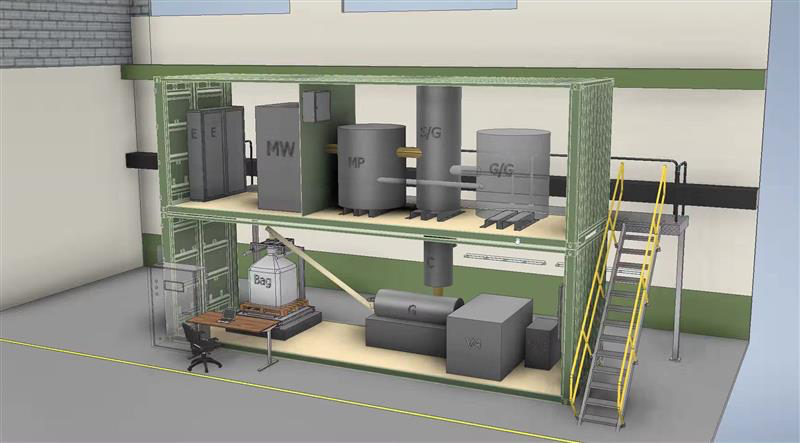
    Founded in 2022, the Association for the Decarbonisation of Industry aims to reduce emissions to a minimum through innovative technology. At the forefront is the methane pyrolysis process, which enables emission-free energy utilisation by splitting hydrogen from methane. The remaining carbon is utilised as a resource, for example as humus in agriculture or as a building material, which binds the carbon in the long term.

    Cooperation between business, research and politics
    Without the cooperation of 16 leading companies, Empa and politicians from the Canton of Zug, the project would hardly be possible. Together, they are contributing to the development and scaling up of the pyrolysis process, which is to be scaled up from laboratory to industrial size by 2026. The partners are providing funding of over CHF 8 million, thereby sending a strong signal for the decarbonisation of industry.

    Methane pyrolysis Reduction of CO2 emissions
    The association is focusing on methane pyrolysis, a process that minimises CO2 emissions when using natural gas. Instead of traditional combustion, hydrogen is obtained from methane, while the carbon is in solid form and therefore does not cause any emissions. This technology could save up to 270 g of CO2 per kilowatt hour produced and is therefore a potential key to the net-zero targets by 2050.

    Sustainable ecosystem without waste
    The association is working to create an ecosystem that optimally utilises all components of the process. Through the circular economy concept, not only hydrogen, but also carbon and waste heat are to be efficiently reused to avoid waste. This holistic strategy creates a model that is ideally suited to a climate-friendly future.

    Membership of the Association for the Decarbonisation of Industry
    Companies that are committed to the climate-neutral future of industry and would like to benefit from the findings of the association can become members. The association is tax-exempt and donations are deductible in the canton of Zug. Members gain access to advanced knowledge and support an initiative that lays the foundations for an emission-free
    industry.