Tag: Konjunktur

  • Swiss companies start the year on a more optimistic note

    Swiss companies start the year on a more optimistic note

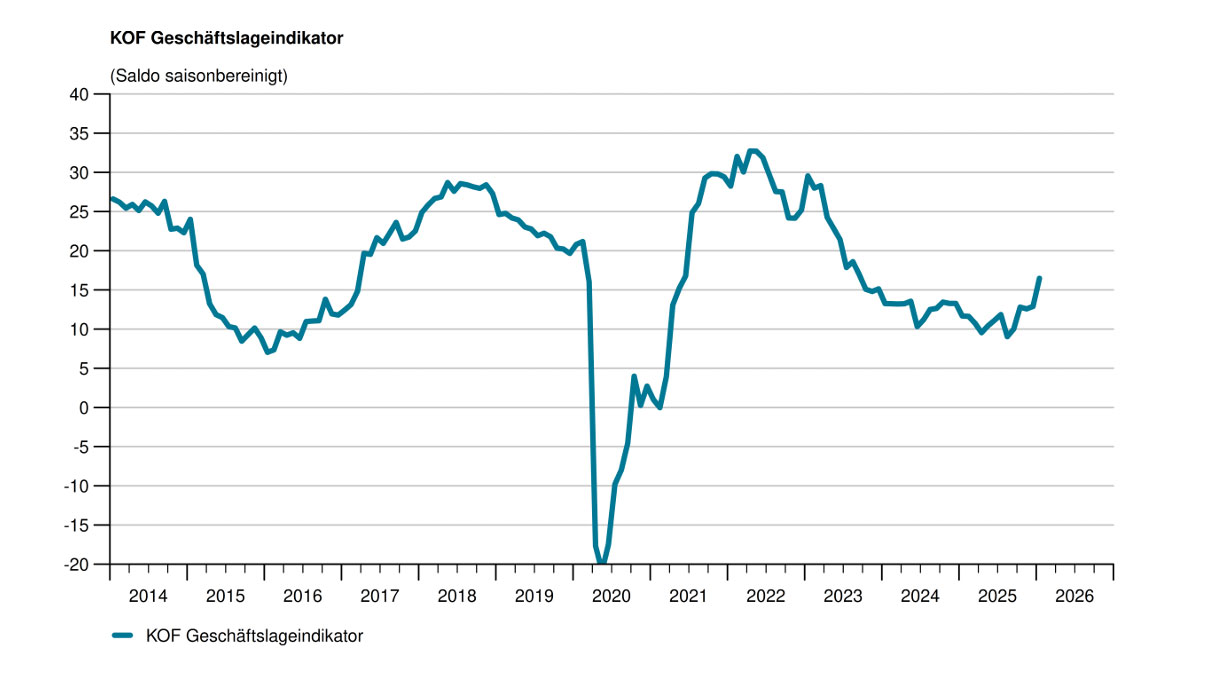
    The KOF Business Situation Indicator rose for the second month in a row in January, signalling a much more favourable starting position than a year ago. The business situation in the manufacturing industry in particular has brightened considerably, indicating a revival in demand and capacity utilisation.

    financial and insurance services, wholesale, catering and construction are also reporting rising business situation indicators, while the retail trade is at least slightly improving. The situation in other services remains largely stable, with only the project planning sector reporting a slight slowdown. Overall, this shows a broad-based improvement across the Swiss economy.

    industry as an anchor of sentiment
    Looking ahead to the next six months, optimism prevails in many sectors. The manufacturing industry in particular is anticipating a further improvement in business activity, confirming its role as an anchor of sentiment at the start of the year.

    expectations have also brightened in the retail trade, construction, financial and insurance services and project planning sectors. By contrast, the hospitality, wholesale and other services sectors are somewhat more cautious about the coming months, although the majority of them remain moderately positive.

    more recruitment
    Many companies are planning to take on additional staff. This is particularly evident in the hospitality industry, which is looking to expand its workforce but is finding it increasingly difficult to find suitable employees.

    the construction industry and the project planning sector are the most likely to report a shortage of skilled labour, which brings existing capacity bottlenecks into sharper focus. For managers and HR managers, this means that competition for qualified labour is continuing to increase in several key sectors.

    moderate momentum without new signs of inflation
    Despite the economic upturn, wage expectations remain stable. As in the October survey, companies expect gross wages to rise by 1.3% on average over the next twelve months, with above-average increases in the hospitality industry, the project planning sector and the construction industry.

    companies are also not expecting a turnaround in consumer prices. The expected inflation rate now stands at 0.9%, practically the same level as in the October survey (1.0%). The picture for monetary and wage policy is therefore one of moderate, well-anchored price and wage developments.

    broad base in the real economy
    The survey is based on around 4,500 companies from the manufacturing, construction and central services sectors, which corresponds to a response rate of around 56%.

    the KOF Business Situation Indicator thus provides a robust picture of the mood among managers. The Swiss private sector is starting 2026 with a broad base, cautious confidence and no discernible inflationary momentum, while at the same time increasing pressure on the labour market in key construction and service sectors.

  • The effects of the pandemic on industry and construction are weakening

    The effects of the pandemic on industry and construction are weakening

    According to a statement from the Federal Statistical Office ( FSO ), production in the secondary sector in Switzerland fell by 4.4 percent year-on-year in the third quarter of 2020. At the same time, sales by Swiss companies in industry and construction fell by 6.3 percent. The coronavirus pandemic is thus "continuing to leave its mark in the secondary sector," write the FSO analysts. Compared to the previous quarter, however, the declines were "only about half as large".

    In the industrial sector, production fell 5.1 percent year-on-year in the quarter under review. A weakening of the decline was observed over the three months. It was the strongest in July at 6.7 percent. In August production was 5.6 percent below the previous year's figure, in September the minus weakened to 3.8 percent.

    In the construction industry, production decreased by 0.4 percent in the third quarter of 2020 compared to the third quarter of 2019. A decline of 7.2 percent was recorded in building construction. In contrast, production in civil engineering and other construction trades increased by 4.6 and 2.9 percent at the same time.

    Sales in industry were 7.9 percent lower in the reporting quarter than in the same quarter of the previous year. Gradually weaker declines between 9.7 percent in July and 5.6 percent in September were observed in the individual three months.

    Sales in the construction industry fell 0.6 percent below the previous year's figure in the third quarter of 2020. Here the range ranged from a minus of 6.9 percent in building construction to a plus of 5.1 percent in civil engineering.

  • The effects of the pandemic on industry and construction are weakening

    According to a report from the Federal Statistical Office ( FSO ), production in the Swiss secondary sector fell by 4.4% in the third quarter of 2020 compared to the previous year. At the same time, the turnover of Swiss companies in industry and construction fell by 6.3 percent. The coronavirus pandemic is thus continuing to "leave its mark on the secondary sector," write analysts at the FSO. Compared to the previous quarter, however, the declines were "only about half".

    In the industrial sector, production declined 5.1% year-on-year for the quarter. A weakening of the decline was observed over the three months. It was strongest in July with 6.7%. In August production was 5.6% below the previous year's figure, while it weakened to 3.8% in September.

    In the construction sector, production decreased by 0.4% in the third quarter of 2020 compared to the third quarter of 2019. A decrease of 7.2% was recorded in building construction. In contrast, production in civil engineering and other construction rose by 4.6% and 2.9%, respectively.

    Industry sales in the quarter under review were 7.9% lower than in the same quarter of the previous year. Gradually weaker declines were observed over the three months between 9.7% in July and 5.6% in September.

    Sales in the construction sector decreased by 0.6% in the third quarter of 2020 compared to the previous year. Here the range ranged from a decrease of 6.9% in building construction to an increase of 5.1% in civil engineering.