Tobias Hofmeier (Swissbau) and Moritz Kistenmacher (Startup Academy) provided the framework for young companies to gain visibility, access to partners and a professional environment. Startups made up almost half of the 70 or so partners in the Swissbau Lab Innovation Village. A clear signal of the importance of entrepreneurial innovation for Swissbau.
For Swissbau, start-ups are not a marginal phenomenon, but a core element of the innovation program. Under the motto “Setting new impulses together”, the aim was to tackle challenges such as climate targets, resource efficiency, productivity pressure and a shortage of skilled workers together. These topics are key and innovation is the key to startups continuing to bring speed and the courage for radically new approaches.
As part of the challenge, the Startup Academy Switzerland provided particularly close support to young companies from the construction and real estate industry. Some startups that were still pitching in the Innovation Lab a few years ago are now present at the trade fair with larger stands. It is precisely this development, from early prototype to established market player, that sets the Challenge in motion and has an impact far beyond the trade fair dates.
Politics and location promotion as a tailwind
The importance of this was underlined by the welcoming address from Cantonal Councillor Kaspar Sutter, Head of the Department of Economic, Social and Environmental Affairs of the Canton of Basel-Stadt. The canton was the patron of Swissbau and supports companies in switching to circular business models with Basel Circular. The fact that the Circular Award was presented here for the first time was logical and makes it clear that the circular economy and climate targets are now at the heart of construction policy.
Sutter emphasized how strongly Basel is geared towards promoting innovation and with programs that provide concrete support for companies and industries. His message has an impact beyond Swissbau. Start-ups are central to every economic ecosystem; without them, new fields of technology would be almost inconceivable. A similar situation is emerging in the construction industry. The industry can only cope with technological and regulatory change if new players with fresh ideas join it.
The canton of Baselland is also consciously focusing on innovation with its location promotion. Thomas Kübler, Head of Location Promotion Baselland, spoke at the finale about framework conditions that should make it easier for start-ups to grow and scale. The repeated partnership in the Swissbau Startup Challenge shows that networks are not only established here selectively, but that long-term ecosystems are built up. A basis from which the industry also benefits after the trade fair.
Construction is central to the Swiss economy, but causes high CO₂ emissions and large amounts of waste. Basel-Stadt is pursuing an ambitious net-zero target of 2037. Such targets permanently increase the pressure and demand for solutions such as those presented by the finalists and further developed in projects and pilot applications.
Six finalists, six answers to the construction turnaround
The six start-ups in the final were Aconitum Swiss, Benetics, Impact Build, Moduvo, Planlabs and Talpa Inspection. They represented different levers of transformation, from digital process optimization to circular materials and rethought construction site communication.
What they have in common is their approach to improving construction and real estate practice in a tangible way and achieving less waste, more efficiency and better data. The ideas on stage at the Swissbau Lab are not visions in a vacuum, but solutions that can already be integrated into projects, construction sites and planning offices today, where they are already having an impact.
Interiors without plastic
Aconitum Swiss has developed a biological material made of polymer collagen that does not require plastic and therefore reduces energy, resources and waste. The aim is to provide permanently healthier solutions for people and the environment. Founder Dr. Vlada Snus goes one step further and uses recycled leather and upcycled building materials such as broken concrete, sand, recycled glass and old roof tiles to produce porous acoustic panels. These panels improve room acoustics, filter air pollutants, viruses and bacteria and help regulate temperature and humidity. The system is recyclable, reduces plastic consumption and is already being used in B2B business in Switzerland, Europe and the Middle East – with potential for further expansion.
Construction site communication without paperwork
Benetics tackled a perennial issue on construction sites: communication and documentation. Instead of clipboards, paper plans, notes and chaotic chat histories, the start-up relies on a cloud-based platform with a smartphone app. The person responsible speaks their instructions into their cell phone, an AI automatically structures the information and stores clear tasks in the system under task, responsibility, deadline, necessary steps and photos.
This is a particular advantage in an international industry. Employees receive their tasks in their own language. This reduces the administrative workload, errors caused by misunderstandings are reduced and the data flows cleanly into existing systems. This has already been demonstrated in the use cases presented, and in future even more construction sites can benefit from the fact that the people on site can concentrate more on what really matters – building.
Robotics and earth material
Impact Build is rethinking building components from the material basis. The ETH start-up wants to produce wall elements without traditional formwork, using robot-assisted production and local resources. The “impact printing” process shoots dense masses of excavated material and rubble onto each other at high speed so that the layers bond over the entire surface and load-bearing elements are created.
The components produced in this way can be cut to size, detailed, coated and modularly combined. They regulate humidity and temperature, are inherently fire-resistant and acoustically effective, and all this with lower material, labor and transport costs. With the Circular Award behind it, Impact Build is now strengthening its position to bring mobile robot factories close to construction sites, reduce emissions and gradually roll out the model internationally.
Circular interior walls
Moduvo has set its sights on the plaster wall as a disposable product. The aim is to make interior walls recyclable without completely turning the practice on its head. The start-up developed prefabricated, wood-based wall systems that are quick to assemble and just as easy to convert or reuse. Ideal for offices with frequently changing layouts. The system is complemented by a timber stud construction kit that can be processed in a similar way to traditional drywall construction. Craftsmen do not have to learn any completely new techniques, but the rules of the game are fundamentally changed with less waste, less gray energy and better life cycle costs. The startup is therefore well positioned to respond to current and future regulations on the circular economy and climate protection and to make new and existing buildings fit for future requirements.
Building services at the touch of a button
Planlabs starts where a lot of planning time and material is tied up, such as in technical building services. The cloud-based platform automates the planning of ventilation, heating/cooling and electrical systems. All systems are taken into account simultaneously with real manufacturer components, local standards, automatic dimensioning and collision checks. The aim is less oversizing, better coordinated systems and significantly reduced planning time. Variants can be run through quickly and sustainability targets can be defined more precisely. What was presented in the final gives planners more freedom for concept work and quality and creates the basis for future projects to be planned in a more robust, resource-efficient and better documented way.
Early warning system for corrosion damage
Talpa Inspection is developing a new type of inspection probe that can be used to detect corrosion damage to concrete structures at an early stage before it becomes a safety-relevant problem. The spin-off team from ETH Zurich is replacing time-consuming, selective on-site measurements and paper protocols with a digital process. The probe systematically records condition data, which is visualized in a 3D digital twin of the structure. This allows the risk of corrosion to be precisely localized and infrastructure operators know where and when they need to intervene in order to renovate bridges and other structures in a targeted manner and extend their service life. Winning the Swissbau Startup Challenge gave Talpa Inspection additional impetus to put this technology into practice on a broader scale.
Countdown 2030
Countdown 2030 is an association of experts from the construction industry around the startups. At its heart is the “Reduction Roadmap Switzerland”. It derives national and sector-specific quotas from a global CO₂ budget, which are to be broken down to municipal level. This allows municipalities to align construction projects and local development with the climate budget. Denmark serves as a role model. There, binding life cycle assessment obligations and ambitious reduction paths have already led to innovation, material substitution and conversions. The message from the Swissbau Lab is that without clear CO₂ quotas, sensible regulation and the interaction between politics, administration and the market, the turnaround in construction will not succeed. However, they open up new scope for the very solutions that were on show in the final.
Circular Award Circularity as a guiding principle
The Circular Award, powered by Basel Circular, was presented for the first time at Swissbau as an award specifically for circular business models. Basel Circular, a partnership between the Canton of Basel-Stadt and other funding institutions, supports companies in the transition from linear to circular models.
Project manager Stefanie Sendes made it clear at the finale that the construction sector is responsible for the largest share of waste generation in Switzerland. Her point remains valid: the circular economy is much more than just recycling. Reuse, reparability, modular products and sufficiency along the entire value chain are crucial, and this is precisely where many of the start-ups presented come in.
The 2026 winners
The Circular Award went to Impact Build, an award that underlines the potential of robotically manufactured components made from recycled materials. Here, resource conservation, industrial scalability and design quality come together directly and create a basis for concrete projects in the coming years.
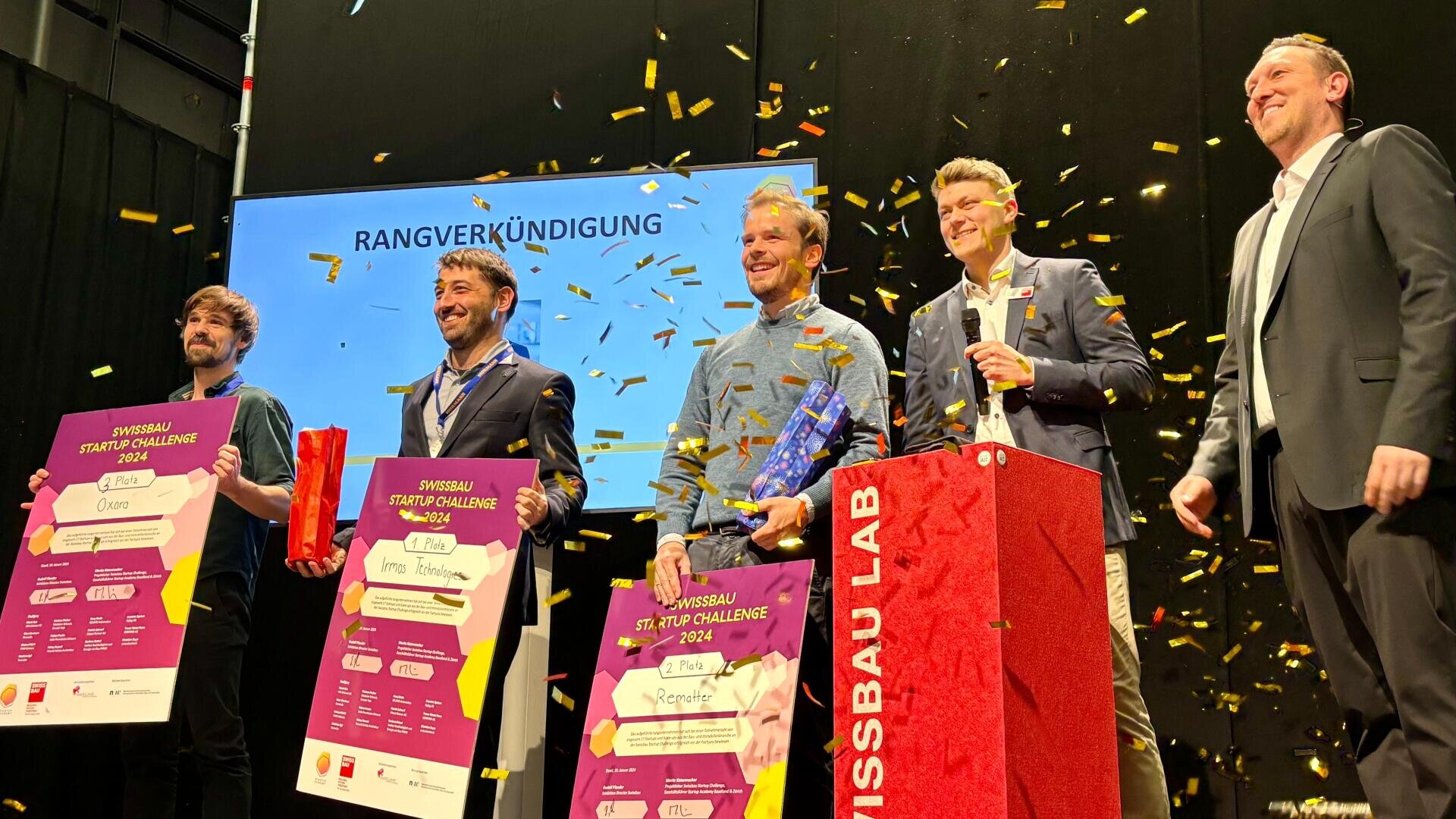
In the Swissbau Startup Challenge itself, third, second and first place were awarded. Impact Build secured third place, Benetics came second with its AI-supported construction site communication and Talpa Inspection was the main winner of the final. This order remains a snapshot, but the real race will only begin once the solutions have proven themselves on the market.
In the end, the Swissbau Startup Challenge proved to be much more than just a stage for pitches. It functioned as a laboratory for the construction turnaround and as a meeting place for startups, established companies, politics and administration. The fact that the construction industry is the winner applies not only in retrospect to the days of the trade fair, but above all when the innovations presented now find their way into the everyday lives of planners, contractors and operators.