Tag: Kunst

  • How Glarus became an architectural jewel

    How Glarus became an architectural jewel

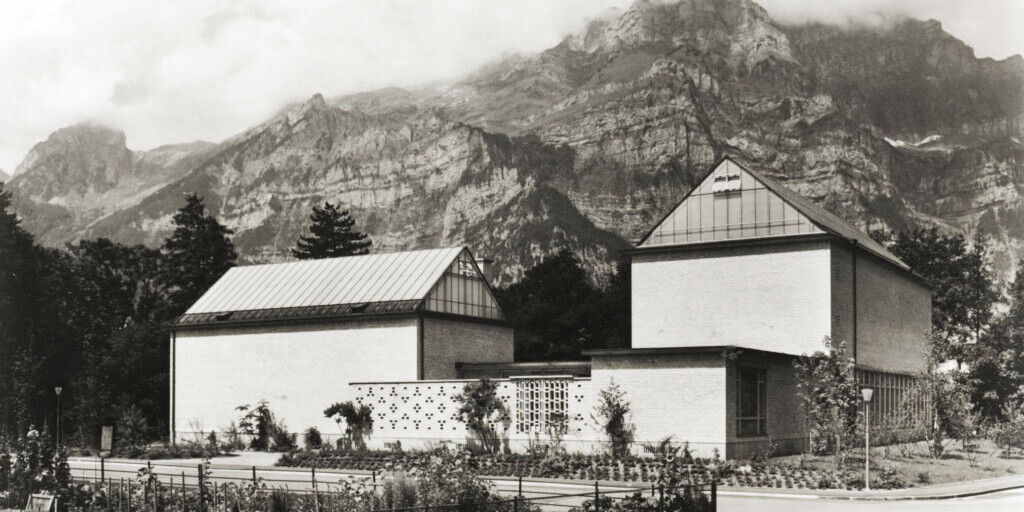
    When the art historian and diplomat Gustav Schneeli was looking for a location for his own museum in 1942, he found the perfect place in Glarus. The Glarus Art Association, which had been considering the idea of its own museum for decades, recognised the opportunity for collaboration. Schneeli made his Symbolist and Impressionist-influenced works available and promised 250,000 francs for a foundation. The foundation stone for today’s Kunsthaus.

    Architectural clarity with vision
    After Schneeli’s death in 1944, the architect Hans Leuzinger developed a project of remarkable consistency. The path led from classical approaches through numerous variations to a finely tuned lighting design. Scandinavian influences, careful site inspections and creative foresight formed a building that consciously distanced itself from monumental representational intentions and blended sensitively into the Glarus valley basin.

    Political hurdles, patient negotiations
    The realisation was anything but straightforward. Disputes over the location, delays caused by the war, critical voices from the administration and the community of heirs as well as the threat of the foundation’s withdrawal jeopardised the project on several occasions. It was only through diplomatic skill, architectural persuasion and tireless commitment that construction could begin on the last possible day, 15 July 1950.

    Art and architecture as a sign of the times
    The opening in 1952 was not only an architectural success, but also a strong signal for Glarus as a cultural centre. A cultural attitude manifested itself in a simple but expressive building that continues to have an impact today. Architect Reto Fuchs’ research reveals this masterpiece and its eventful construction history. The Kunsthaus Glarus stands for masterful architecture, the courage to take a stand and the idea of thinking big about culture in rural areas.

  • The transformation of the Papieri site

    The transformation of the Papieri site

    The Papieri site in Biberist, Solothurn, can look back on a long industrial history: Its existence began in 1862 as the site of the “Papieri” paper mill. After almost 150 years, the factory ceased operations in 2011, most recently owned by the international paper group SAPPI. Subsequently, HIAG from Zurich acquired the 60,000 square metre site – with the aim of creating a lively and diverse quarter.

    However, the industrial spirit that is strongly anchored here is not to be lost: The “Papieri” is to continue to be used for commercial and industrial purposes. The location and general conditions of the area are still ideally suited for this. The site can be reached in a few steps from Biberist Ost railway station. In addition, it is served by the bus stops Biberist Emmenbrücke and Biberist Derendingenstrasse (BSU). Attractive pedestrian and bicycle connections are also planned for the medium term.
    HIAG has worked out a sustainable development strategy in close consultation with the canton, municipalities and other stakeholders. As early as 2013, an urban planning study was carried out in collaboration with five architectural firms. The findings of this study commission formed the basis for the master plan, which was completed in 2015 in consultation with the municipality of Biberist. The partial zone plan revision is currently underway. This is currently undergoing a cantonal preliminary examination.

    The long-term planning envisages a division of the site into two parts: The “West” area near the Biberist East railway station comprises about one third of the total area and is to become an area open to the public with quiet commerce, services, leisure, culture and housing. No concrete residential projects are planned yet. But: “The future usage regulations allow for a residential share in the western area,” says Dominik Ulrich, project developer of HIAG Immobilien Schweiz AG. The eastern area towards Derendingen, on the other hand, will be transformed into a workplace area for the manufacturing industry.

    nightnurse.ch

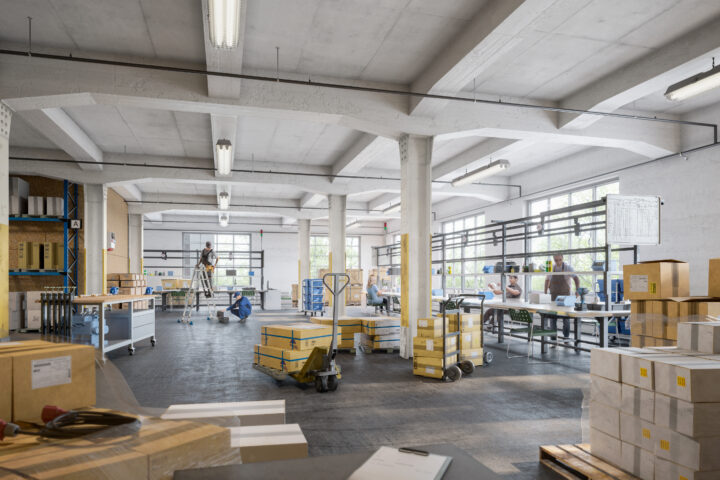
    Access to the publicly accessible western area of the site is already from the southwest. In future, the triangular Papier-Platz will mark the beginning of the site. The square is enclosed by the striking existing building at Fabrikstrasse 1, which will be made fit for the planned transitional uses by mid-2023: On the ground floor, spaces between 160 and 1000 square metres will be rented to commercial and service providers. The rooms on the upper floors are ideally suited for commercial and storage space as well as studios. Offices are also available in the neighbouring building. “The transitional use of Building 1 is planned for up to ten years. The goal is to establish uses that will last in the long term,” explains Ulrich. The dismantling of the machinery was a prerequisite for opening up the area. The machines were successfully sold in recent years and transferred to new owners.

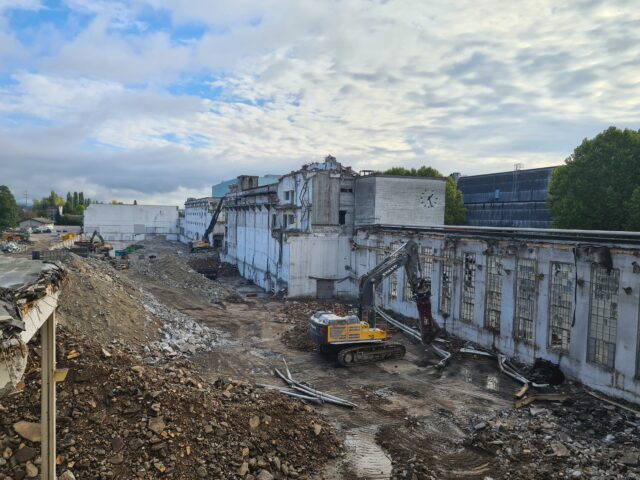
    The centre of the area, and thus the centre, is the square by the canal: Demolition work is currently underway here to create open spaces and breakthroughs in the hall structures. So far, 17,000 tonnes of material have already been removed. HIAG attaches great importance to sustainability: 14,000 tonnes of it will be processed into granulate on site and reused. The deconstruction work is scheduled to be completed by the end of this year. From mid-2023, the construction of a new modern building is planned, which will offer around 15,000 square metres of usable space for trade, production and offices. The first tenants are expected to move in by the end of 2024. According to Ulrich, concrete negotiations are currently underway with prospective tenants.

    Demolition work is currently underway in the middle of the site.
  • Artwork produces solar power

    Artwork produces solar power

    Solar cells can also decorate buildings as objects of art. This is shown by a project that has now been implemented at the NEST research building of the Eidgenössische Materialprüfungs- und Forschungsanstalt ( Empa ) and the EAWAG water research institute. The facades of the building have been fitted with photovoltaic modules, which together result in a work of art.

    To this end, Empa implemented the project called Glasklar, on which it worked together with Zug Estates and students and lecturers from the two departments of Design & Art and Technology & Architecture at the Lucerne University of Applied Sciences and Arts. The latter designed photovoltaic modules in a two-week block event, which visually match the NEST building as design objects. The design was implemented by textile design student Lynn Balli. It was selected for use in the NEST building in an interdisciplinary design competition.

    “If we can arouse the interest of designers in the design of building-integrated photovoltaic modules, we will make an important contribution to greater acceptance of photovoltaic facades and thus promote the expansion of renewable electricity production in Switzerland,” says Björn Niesen, NEST innovation manager Message from Empa quoted.

  • JED gets neon and icons

    JED gets neon and icons

    The JED in Schlieren is to be supplemented by art in architecture, informs a corresponding report on the website of the center in Schlieren. Art in architecture creates identity and meaning and shows the way, it says at the beginning. The owner Swiss Prime Site hired the artists Roland Ammann and Gregory Gilbert-Lodge to realize the works of art in JED.

    Glassblower Roland Amman comes from Neonhaus Ammann and has dedicated himself to the creation of three-dimensional works of art from neon after the lighting industry switched from neon to LED. For the JED he will create three oversized letters, a J, an E and a D. Amman has already installed the first work of art on the ceiling of the Jake barista bar. At first glance, the object, which looks like a fragile shining ball, turns out to be a J on closer inspection, says the report. “I like it when my art has several levels and the hidden only becomes recognizable at a second or third glance,” artist Ammann is quoted there.

    On the wall of the barista bar, visitors can already see the first work of art by Gregory Gilbert-Lodge in the JED. The independent illustrator has provided the bar with an oversized portrait of its namesake Jake in green. Jake is supposed to represent building J and give the bar “a face”, it says in the report.

    Gilbert-Lodge designed portraits of Eve and Didi for buildings E and D. “The fictional characters in the JED should act as icons,” explains the artist in the report. The values and ideas embodied by them, "even an attitude towards life", are what the icons give to the individual buildings, says Gilbert-Lodge.