According to a press release, Helvetia Baloise Holding AG, the insurance company formed in December 2025 from a merger between Helvetia and Baloise, is promoting e-mobility together with its partner Energie 360°. The energy and e-mobility company, which is 96 per cent owned by the City of Zurich, has already taken over more than 150 charging stations in 13 properties, mainly in western Switzerland, the Mittelland and Basel.
As Reto Baschera, head of the mobility group at Energie 360°, emphasises, the expansion is “demand-driven and geared to the requirements of the tenants”. According to the information provided, six further properties are currently in the planning stage, with more to follow gradually. The focus is on a harmonised portfolio approach with a hardware-independent billing solution that takes into account different building types and product characteristics. Helvetia Baloise has a total of around 845 properties in Switzerland with approximately 30,000 apartments.
“For me in strategic procurement at Helvetia Baloise, it was crucial to find a partner who sees electromobility not as a single product, but as an integrated part of a large real estate portfolio,” says Karin Hauser of Baloise Asset Management AG. “In our collaboration with Energie 360°, we particularly appreciate the structured approach, the reliable implementation and the ability to pragmatically map different starting points in our properties.”
A public network of around 30 charging stations for electric cars is to be created in Lucerne by 2035. According to a press release, the focus will be on charging in neighbourhoods. To this end, the city will provide third-party providers with public land and the basic infrastructure, including network access, in return for a concession fee. It intends to refinance its investment of CHF 960,000 through the concession fees in line with the polluter-pays principle.
By 2040, all vehicles registered in the city of Lucerne are to be electric or powered by renewable energy. In order to achieve this goal of the climate and energy strategy, the city of Lucerne and Energie Wasser Luzern(ewl) launched the Green Zones pilot project in April 2024. As part of this, the first public charging stations were installed on Bergstrasse and Eichmattstrasse. The city describes the experience of the five-year project as “consistently positive”.
The measures are part of the overall concept for renewable drives in mobility. It was developed by the Zurich-based consulting and engineering company EBP Switzerland on behalf of the city of Lucerne. The scope of the concept also includes funding programmes for basic and charging infrastructure, which will be financed from the city of Lucerne’s energy fund, or that only emission-free taxis will be granted operating licences from 2033. In addition, parking permits for long-term parking on public land will only be issued for emission-free vehicles from 2040.
AVIA VOLT Suisse AG acquires the charging infrastructure provider Plug’N Roll and expands its charging infrastructure by 2345 charging points. Plug’N Roll customers benefit from access to a Europe-wide network of over 850,000 charging points. Graubünden-based Repower AG, the previous owner of Plug’N Roll, is realigning its focus with Repower E-Mobility.
According to a press release, AVIA VOLT is now reviewing Plug’N Roll’s contracts and business processes. Its 24,600 customers will be seamlessly integrated into the AVIA network. The takeover will enable integrated billing of electrical and fossil energy for Plug’N Roll fleet operators. According to the press release, AVIA VOLT’s system architecture offers compatibility with the software and hardware solutions of many manufacturers.
AVIA VOLT, based in Frauenfeld, is a subsidiary of several Swiss AVIA companies. It sees the takeover as an important step towards establishing itself as a leading service provider in the field of electromobility. “For us, the takeover means a targeted strengthening of our position as a provider of reliable charging infrastructure in Switzerland,” said Martin Osterwalder, Chairman of the Board of Directors of AVIA VOLT.
Plug’N Roll is the e-mobility division of Repower AG. The e-mobility provider has been developing charging infrastructure in public spaces, for company fleets and for real estate since 2012. The Plug’N Roll brand will be used by AVIA VOLT until the end of 2025. Three Plug’N Roll employees will be taken on by AVIA VOLT.
The Europe-wide fast charging station specialist Electra and the property asset manager Procimmo from Renens are working together to expand the charging infrastructure in French-speaking Switzerland. The two companies have started a corresponding collaboration, Electra announced in a press release. As a first step, two fast-charging stations will be installed in Aubonne VD and Gland VD.
The fast-charging station in the Outlet Aubonne shopping centre is being implemented by the Procimmo Real Estate SICAV – Industrial fund. The Procimmo Real Estate SICAV – Commercial PK fund is responsible for the fast-charging station at the Gland BackStage Pub in Gland. The first two charging points have been in operation since December 2024, with two more to follow this quarter.
Electra, based in Paris, is represented in Switzerland by Electra Charging Switzerland AG in Zurich. Together with Procimmo, “we can network Western Switzerland even better and thus upgrade important and central locations with charging stations”, says Alessandro Inderbitzin, General Manager Electra Switzerland & Austria, in the press release. Procimmo CEO Arno Kneubühler, for his part, sees the collaboration with the specialist for fast-charging stations “as a significant step towards expanding and complementing our portfolio with Electra’s strong services”. With their partnership, the two companies want to respond to the increasing demand for fast-charging stations in Switzerland. For Procimmo, the commitment also represents a contribution to an electrified Switzerland.
Energie 360° has opened the largest charging park for electric cars in the canton of Ticino at the Serfontana shopping centre. The park comprises a total of 38 charging points, 18 of which are newly added fast-charging points. These allow electric car drivers to charge their vehicles from 10% to 80% within 20 to 40 minutes while they shop or take a break. With this expansion, Energie 360° is setting another milestone in the promotion of electromobility in the region.
Fast charging with green electricity The new fast charging stations at Centro Shopping offer an impressive charging capacity of up to 400 kilowatts, powered by 100% green electricity. Jörg Wild, CEO and Head of Mobility at Energie 360°, emphasises the importance of this expansion: “Our aim is to rapidly promote electromobility throughout Switzerland. With the new charging park, we are offering our customers one of the largest and most efficient charging parks in Switzerland.”
Over 300 charging locations in Switzerland Energie 360° already operates over 300 charging locations throughout Switzerland and plans, builds and maintains them in collaboration with partners such as Coop, SBB and the Swiss Finance & Property Group. The company pursues the goal of creating sustainable energy and mobility solutions and making electromobility available nationwide. With the new charging park in Chiasso, Energie 360° is sending a clear signal in favour of the future of mobility and the expansion of the charging infrastructure in Switzerland.
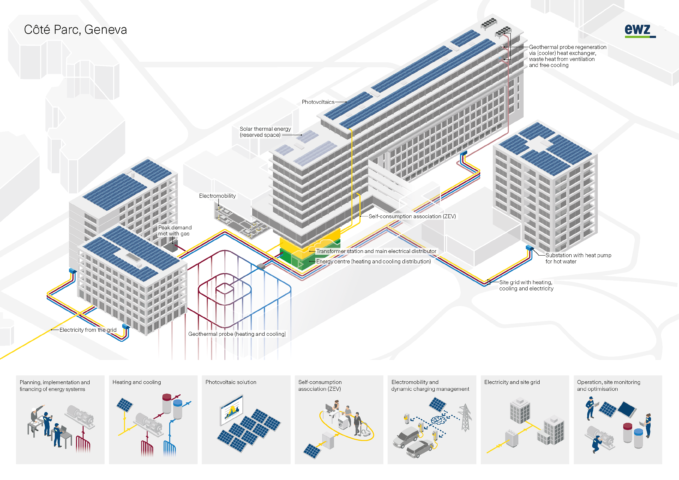
Integrated energy solutions for sites and complexes generate added value for all stakeholders. They intelligently network all of the energy supply components for an ideal interaction of production, consumption and storage within an overall system. This unleashes efficiency potential, increases the degree of self-sufficiency and secures long-term supply to new and existing properties. The new ewz and Faktor Journalisten white paper entitled ‘Integrated energy solutions for sites and complexes’ offers property owners a knowledge base they can use during the planning process.
Components of integrated energy solutions To exploit synergies, you need to plan the energy solution as a networked system from the beginning.
Heating and cooling from local, renewable sources Thermal networks are a good way of supplying sites or complexes with carbon-free or carbon-neutral local heating and cooling. They can be implemented and operated on different scales (for complexes, sites or entire neighbourhoods) and at different temperature levels. The energy for high-temperature networks largely comes from wood or the waste heat generated by waste incineration plants, while networks with low to medium temperature levels often use geothermal heat, lake and river water, ground water and waste heat (from computing centres, for example). The lowest operating temperatures are achieved by anergy networks or low-temperature networks, which also cool buildings in summer with the free cooling method. Various network types can be combined for greater efficiency (see Côté Parc and Greencity).
Harness solar power with a high rate of self-consumption A self-consumption association (ZEV) maximises the amount of energy consumed on site, which means that the photovoltaic installation is paid off quicker. What’s more, solar power is often cheaper than electricity from the public grid for ZEV participants. Local electricity communities (LEG), which are expected to be introduced in 2025 or 2026, enable solar power supply across properties and use the distribution grid.
Microgrids for security in planning and supply Site electricity grids can be used to supply complexes, sites or neighbourhoods with electrical energy. Microgrids, or smart grids fitted with smart components, incorporate both generators and consumers of electricity. They help to ensure grid reliability by selectively switching on consumers, charging storage systems or throttling production.
Charging infrastructure and electromobility – the new standard Electromobility is another important aspect of sustainable sites. To meet the growing demand for electric charging stations, it is a good idea to address construction of the charging infrastructure early on. Load management can help coordinate the electricity requirements of the charging station(s) with that of the other consumers in the building, and to regulate charging.
Storing energy for enhanced efficiency With the share of renewable energies set to increase in the future, energy storage will become increasingly important. For example, electric car batteries configured for bidirectional charging can be used for storage purposes. Stationary battery storage systems are another means of absorbing surplus solar power and making it available again as required. Thermal storage units can be charged with solar power that would otherwise have to be fed into the public grid. This helps prevent peak loads, and also means that heat generators can set up in smaller dimensions. Geothermal probe fields can absorb excess heat (e.g. from solar panels or waste heat) to regenerate the ground and to cool spaces.
Reducing emissions and cutting costs in the long term Continuous energy monitoring is a good way to cut energy costs and reduce greenhouse gas emissions in the long term. Continuous monitoring of the electricity, heating and cooling consumption values in a property, for example, can serve as a basis for adjustment. Energy monitoring is also important for ESG reporting, which is already mandatory for certain companies. By constantly reviewing consumption data and ensuring professional operation, companies have an opportunity to reach their efficiency and environmental targets and to create transparency in their dealings with various stakeholder groups.
‘Energy as a service’ The ‘use, don’t own’ principle is ideally suited to integrated energy solutions for entire complexes or sites. For customers, this not only reduces their investment of time, but also the financial risk, while ensuring a significantly higher security of supply. When a client chooses an‘energy as a service’ model, they outsource the planning, construction, operation and/or financing of the entire energy infrastructure for decades. This also ensures that the systems are operated reliably and efficiently.
Learn more in our new white paperentitled ‘Integrated energy solutions for sites and complexes’.
Electromobility yes, but how to charge? Competent advice is crucial even before the purchase decision is made. When planning and implementing an appropriate charging infrastructure, questions from different areas arise. What is the appropriate charging infrastructure for home, business or on the road?
The e-mobile professional association has perceived the industry’s need for a specialist conference in the field of charging infrastructure and launched a call for papers. Over 25 proposals were received and then voted on in a topic voting. The feedback from the community was clearly focused on the following 5 topics:
– Bidirectional charging – Smart charging – Charging infrastructure in underground car parks – Energy supply 2050 – Charging infrastructure 2050
The moderator, Sarah Andrina Schütz, will guide the participants through the day, while renowned speakers will present solutions for concrete implementation and provide an outlook on the coming trends. In addition, well-known partners will organise an interesting accompanying exhibition. Numerous associations support the congress with the aim of establishing dialogue between the various professionals involved in the electromobility sector.
At the e-mobile Charging Forum, current developments in the charging infrastructure sector will be discussed and an interactive exchange of knowledge and experience will be facilitated.
The canton of Lucerne is increasing its contribution to the Energy 2022 funding program by CHF 3.5 million compared to the previous year to CHF 5.5 million. Together with the basic amount and the federal supplement, a total of around 23 million francs is available. Private individuals can submit their applications for grants to increase energy efficiency and the use of renewable energy in their own four walls from January 10th.
As stated in a communication from the canton, the funding program has been checked and optimized after five years of experience. The inclusion of important interest groups was helpful. “Cooperation with the trade, with the various associations and with the university is important so that we can continue the success story of the energy funding program,” said Fabian Peter, the government councilor responsible for construction, the environment and energy.
The most important changes for the year 2022 include new funding measures such as connection to a heating network with renewable energies, non-automatic wood firing and charging infrastructure for e-mobility in existing apartment buildings. There were also adjustments to the funding rates. Renewals of building insulation are now subsidized with 60 instead of 40 francs per square meter. The subsidy rates for solar thermal systems will be doubled. In addition, there are now flat-rate subsidy rates for building services up to 15 kilowatts, for example for a heat pump, a wood-burning stove or a district heating connection.
Following a public tender, the canton of Zurich decided in favor of the e-mobility provider from Repower as the installer and later operator of the charging infrastructure on the canton's own property. According to a media release , the vehicle fleet in the canton of Zurich is to be converted to non-fossil vehicles by 2030.
Plug'n Roll of Repower has signed with the Canton of a framework agreement. Because it has not yet been established exactly how many charging stations will have to be built for electric vehicles. The partners expect 880 charging stations to be required by 2025. According to the announcement, a total of 765 of these are to be set up with a charging capacity of three to 22 kilowatts. There are also 115 fast charging stations with a charging capacity of 22 to 150 kilowatts. In the canton of Zurich, a total of 1,000 to 1,450 charging stations are expected to be required by 2030.
Plug'n Roll should not just build up the charging network. The Zurich government council has awarded the contract for the procurement and management of the charging stations. The overall order, which is to be fulfilled by 2025, includes delivery, assembly, commissioning, operation, maintenance and troubleshooting of the stations as well as the administration of the energy billing, according to the message from Repower.
NeoVac now uses the NeoVac my Charge app to bill the consumption-based costs for e-charging stations in apartment buildings and areas. According to a media release , the specialist for building and environmental technology based in Oberriet is reacting to the increasing demand for e-charging stations in buildings.
The app was developed by eCarUp AG from Zug. The young company offers a comprehensive software solution for setting up charging infrastructure. Its backend enables billing, monitoring, load management and maintenance of e-charging stations.
With its Switzerland-wide service network, NeoVac prepares the consumption-based energy and water bills for over 400,000 apartments every year. The Rheintaler company has set itself the goal of offering a solution for every billing-relevant measuring point in a building. "The number of new registrations of electric vehicles is increasing significantly and tenants are asking for more and more charging options," says Pascal Welti, Head of Energy Consulting at NeoVac. That's why his company has now launched an app for it.
It enables drivers of electric cars to activate charging stations and pay for the electricity they use. In addition, the charging data is transferred directly to the NeoVac myEnergy app. There, users receive an overview of their personal consumption and a directly accessible energy cost bill.
NeoVac also offers complete solutions for e-mobility infrastructure projects with a nationwide sales and service network. In addition, charging stations could "also be controlled depending on the PV system, battery storage or heat pump". This increases self-consumption and the profitability of photovoltaic systems.
According to a press release,BKW wants to become a full-range supplier in the field of electromobility. A new competence center is to be set up for this purpose. The services of this new center will according to the information include the planning, installation and integration of charging infrastructures. However, BKW will also be responsible for accounting, for example.
With the competence center, BKW is responding to the increasing demand for electric vehicles. This also leads to increasing interest in integrated e-mobility solutions. According to BKW, vehicle manufacturers, garages and the real estate industry are particularly interested in such offers.
"Coupling renewable energy production with the transport sector is one of the opportunities to integrate renewable energies into a reliable energy supply system", Suzanne Thoma, CEO of BKW, is quoted in the press release. "With the expansion of our competencies in the field of electromobility, we are supplementing our existing solutions for decentralized, renewable energy and heat production in buildings and thus offer cross-sector, integrated full-service energy solutions", Thoma continues.
Wir verwenden Cookies zur Unterstützung und Verbesserung unserer Dienste. Mit der Nutzung dieser Website erklären Sie sich mit der Verwendung von Cookies einverstanden. Weitere Informationen finden Sie in unserer Datenschutzerklärung.