Tag: ladestationen

  • Councillors demand right to charging stations in residential buildings

    Councillors demand right to charging stations in residential buildings

    On Wednesday, the Council of States adopted a motion by National Councillor Jürg Grossen by 24 votes to 18. The Federal Council should create binding regulations to ensure access to private charging stations in rented and owner-occupied apartments. The proponents argued that slow charging stations are a key lever for the mobility and energy transition.

    Decarbonization needs infrastructure
    Flavia Wasserfallen emphasized that a lack of charging infrastructure is one of the main reasons for stagnating sales figures for electric vehicles. “Cars need to be charged where they are,” she said. Thierry Burkart also pleaded for a state framework, “combustion engines would never have caught on without charging stations.”

    Property rights versus climate target
    The majority of the Council of States Committee for the Environment, Spatial Planning and Energy opposed a legal obligation. They warned against too much interference in the guarantee of property rights and private autonomy. Daniel Fässler argued that the market should determine where charging infrastructure is created.

    Federal Council’s duty
    The Federal Council had also spoken out against the motion. According to the government, the situation is unclear in the current tenancy and condominium law. Nevertheless, it must now draw up proposals to implement the request.

    Past funding approaches failed
    As part of the last revision of the CO₂ Act, the Federal Council wanted to provide up to CHF 30 million annually for charging infrastructure in apartment buildings and public parking lots. However, this measure failed at the time due to opposition from parliament.

  • Expansion of electromobility in Switzerland

    Expansion of electromobility in Switzerland

    According to a press release, Swiss Post and the fenaco cooperative are moving ahead with their joint plans for a nationwide electric fast-charging network. A total of 50 locations are planned by mid-2025. The capacity is then to be gradually expanded to 300 locations with 1,500 charging stations.

    Private drivers of electric vehicles and company fleets of electric vehicles will find these charging facilities at post offices, Agrola petrol stations and Landi shops, among others. All of them will use 100 per cent local electricity from renewable energy sources, which can be paid for using common payment methods such as Twint and credit cards or a customer card.

    The goal is to be achieved via the PowerUp joint venture. Both partners each have a 50 per cent share in this. The contracts have been signed and submitted to the competition authorities for approval, according to reports.

    PowerUp’s strength is its immediate proximity to workplaces, shops and leisure facilities. The combination with service offerings ensures a safe and well-maintained charging infrastructure with contact persons on site. PowerUp also offers simple pricing with no hidden costs. The partners see their joint commitment to electromobility as a contribution to the federal government’s electromobility roadmap.

  • Energie 360° equips Regensdorf with fast-charging stations

    Energie 360° equips Regensdorf with fast-charging stations

    Since 6 June, visitors to the Zänti shopping centre in Regensdorf have been able to charge their electric vehicles at seven fast-charging stations, Energie 360° informs in a press release. The Zurich-based energy service provider installed the charging stations with a capacity of up to 120 kilowatts as part of a long-term partnership with the Regensdorf centre. “Together with the Regensdorf Centre, we are providing our customers with what is currently the fastest charging solution in a Zurich shopping centre,” Rami Syväri, Head of Mobility at Energie 360°, is quoted as saying in the press release.

    The new charging stations charge the battery of an electric car within 30 to 60 minutes with ecologically produced direct current, depending on the model. “With the new fast-charging stations, we want to meet the needs of our customers and at the same time actively reduce CO2 emissions,” explains Sandro Engeler, head of the Regensdorf centre. Two existing AC charging stations complement the range of charging solutions at Zänti.

    According to Syväri, Energie 360° already operates over 200 locations with charging stations throughout Switzerland. The company finances, plans, builds and maintains the charging stations in cooperation with the owners of suitable sites. All of Energie 360°’s public charging stations can be used with a QR code, app or RFID card and are integrated into the Swisscharge network.

  • The first projects of the Dietiker Smart City project have been implemented

    The first projects of the Dietiker Smart City project have been implemented

    On the evening of September 27, the population of Dietic was informed on the church square about the implementation of the Smart City project developed by the city of Dietikon and the electricity company of the Canton of Zurich ( EKZ ). The inauguration of the first sub-projects took place.

    According to the press release , there is now a charging station for electric cars on Zelgliplatz, which is available while shopping, but can also be used by residents. Electric bikes can be charged in the basement of the two-storey bike house near the train station. A camera detects free parking spaces in the Hedinger car park. Public WiFi is available to the public at the market hall. There, an air measuring station records temperature, humidity and air pollutants such as fine dust or ozone. The station is supplemented by a network of other environmental sensors distributed across the city. In winter, measuring the ground temperature warns of possible black ice.

    "Only networking and the intelligent use of data leads to added value for the population and for the administration, as one strives for in a Smart City," Jörg Haller, Head of Smart City and Public Lighting at EKZ, is quoted as saying.

    The environmental data recorded at the measuring stations should be displayed transparently, for example on monitors in the town hall. "The city's extensive data is already used today for traffic and construction planning," Mayor Roger Bachmann is quoted as saying. "The prize money from the SFOE gave us another boost," continued Bachmann.

    The Smart City project won the main prize in the Smart City Innovation Challenge of the Swiss Federal Office of Energy ( SFOE ) at the beginning of 2021 and thus received funding of CHF 100,000.

  • Photovoltaics: Economic and ecological benefits for real estate owners

    Photovoltaics: Economic and ecological benefits for real estate owners

    Enormous solar potential
    After a steady increase over the years, photovoltaics recorded a record increase in 2020. According to the "Solar energy statistics" of the Federal Office of Energy (SFOE), around 118,000 photovoltaic systems with an output of almost 3 gigawatts were installed at the end of 2020. The strong market growth continued in 2021, so that according to Swissolar, photovoltaics (PV) today covers more than 6 percent of Switzerland's electricity requirements. Experts assume that this trend will continue, not least in view of the efforts towards much more energy independence.

    Ecological and economic advantages
    Photovoltaic systems bring a whole range of advantages for owners of real estate portfolios. On the one hand, they can protect themselves against rising electricity prices. On the other hand, they already meet possible future self-production specifications today. Also with regard to subsidies, new rules will make the production of solar power more attractive in the future. In addition, portfolio owners with their own solar systems benefit from a clear reputation advantage.

    In most cases, PV power from your own roof is cheaper than power from the grid. The fact that power consumption due to heat pumps and electromobility will continue to rise in the future contributes to the financial attractiveness of PV systems. Improving the ecological balance sheet is also becoming increasingly important, because sustainability aspects are part of the strategy of more and more companies. Furthermore, PV systems are also interesting because they increase the value of real estate. If the photovoltaic systems produce more electricity than can be consumed on site, it is possible to use the solar power in other properties.

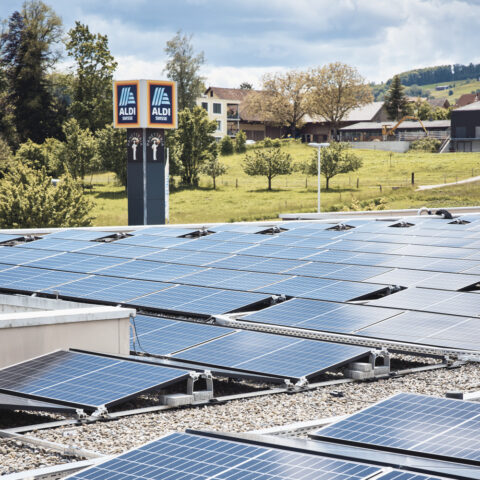
    In the ALDI SUISSE solar project, for example, sustainability and cost-effectiveness play a key role. In just over a year, ewz equipped 68 store roofs between Romanshorn and Geneva with photovoltaic systems. ALDI SUISSE uses most of the solar power itself for its own branch operations. Thanks to the large PV systems, the implemented solution enables a high solar yield with an average self-consumption of 55 to 60 percent.

    High self-consumption increases profitability
    There is already a heat pump in around 90 percent of new buildings, and new registrations of electric cars are continuing to rise sharply. However, heat pumps and electric vehicles are only really low in CO2 if they use renewable electricity. The combination with a photovoltaic system therefore makes sense: Solar power reduces CO2 emissions, and high self-consumption increases the profitability of the PV system. This is because the production costs for solar power are lower than the electricity tariff for households and because the energy suppliers pay a low tariff for the solar power fed into the grid.

    A good way of using a large part of the solar power yourself is to organize several end users in a group for self-consumption (ZEV). These are possible both in rental properties and among property owners. The degree of self-consumption of photovoltaic systems is on average 30 to 40 percent. This value can be significantly increased with self-consumption solutions.

    A large part of the electricity is used on site through the targeted control of consumers such as heat pumps or electric vehicles. The advantage for property owners and their tenants: the cost of solar power, at 8 to 16 centimes per kilowatt hour, is lower than the electricity tariff for households, which costs 15 to 25 centimes per kilowatt hour.

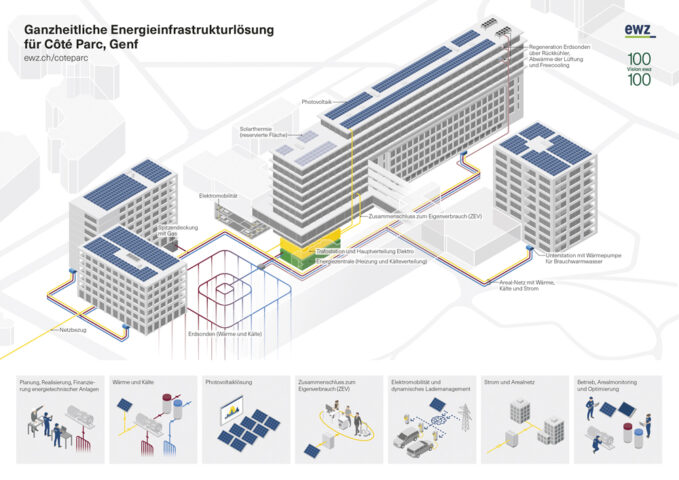
    An interesting practical example of this is the "Côté Parc" project in Geneva. 776 photovoltaic panels on the roofs of the area form the basis for an integrated solar solution with heat pumps, charging stations for electric cars and the area's own power grid, including self-consumption for the users.

    For property owners with large roof areas (from approx. 700 m2), a contracting model is an option worth considering. The provider takes over all services – from planning to financing, implementation to operation over several decades. Including the integration of photovoltaic systems, it is a holistic energy solution with heating, cooling, electromobility and self-consumption models.

    Business customers of ewz can rely on efficient and tailor-made solutions from competent teams with many years of experience. Investment, maintenance and repair costs are not incurred during the contract period. After the end of the contract period – usually 20 to 30 years – the photovoltaic system becomes the property of the customer.

  • The dream of a family home in the country is becoming more and more of a dream

    The dream of a family home in the country is becoming more and more of a dream

    Das Einfamilienhaus erweist sich einmal mehr als Wohntraum Nummer 1 in der Schweiz. Bei Personen im Alter von 25 bis 30 Jahren ist der Wert mit 64 Prozent am höchsten. Stehen soll es auf dem Land. Ländliche Gegenden bleiben mit 48 Prozent Zustimmung auch in diesem Jahr die bevorzugte Wohnumgebung. 90 Prozent der Menschen, die auf dem Land leben, wollen auch in Zukunft dortbleiben. Bei der Stadtbevölkerung zeigt sich ein anderes Bild: Nur 65 Prozent der Befragten erachten die aktuelle Wohnumgebung als den bevorzugten Wohnort. Finanzielle Gründe sind die am meisten genannte Hürde (40%), die gegen einen Umzug spricht. Der Arbeitsweg bleibt trotz vermehrtem Home-Office der zweitwichtigste Hinderungsgrund.

    Kosten und Aussenbereich dominieren bei der Wahl eines Zuhauses – nicht das Home-Office
    Wichtigstes Kriterium bei der Wahl einer Wohnung resp. eines Hauses bleiben die Wohnkosten, gefolgt vom Aussenbereich. Neu abgefragte Kriterien wie das separate Zimmer für Home-Office oder ökologische Faktoren werden kaum als entscheidend genannt, aber von rund der Hälfte der Befragten zumindest als wichtiges Kriterium angesehen. Eine Lademöglichkeit fürs E-Auto, Service-Dienst-leistungen oder Luxuseinrichtung spielen bei der Wahl eines Zuhauses kaum eine Rolle.
    Bezüglich der Lage soll die Traumimmobilie ruhig (66%) und naturnah (66%) stehen. Zudem ist eine gute Anbindung an den öffentlichen Verkehr (51%) gefragt. Hier hat sich im Vergleich zum Vorjahr wenig verändert. Die Nachbarschaft wird von 41 Prozent der Befragten als besonders wichtig angegeben und liegt damit neu auf Rang 4 – zwei Plätze höher als letztes Jahr. Und auch die Nähe zur medizinischen Versorgung gewinnt einen Platz auf Kosten der Nähe zur Kinderbetreuungsstätte oder der Schule.

    Traum vom Eigenheim ungebrochen, scheitert aber meist an Angebot und Finanzierung
    Knapp die Hälfte der Befragten (46%) träumt von einer (weiteren) eigenen Wohnimmobilie. Dabei hat sich der Wunsch bei den jüngeren Befragten im Vergleich zum Vorjahr noch einmal verstärkt. Besonders ausgeprägt ist er nach wie vor bei der heutigen Mieterschaft: 62 Prozent träumen davon, ein Eigenheim zu kaufen. Schwierigkeiten bereiten das knappe Angebot (58%) und die hohen Preise (49%). Hinzu kommen strenge Finanzierungskriterien, welche einer Überhitzung des Immobilienmarktes vorbeugen sollen, aber zunehmend in Kritik geraten. 50 Prozent der Befragten beurteilen die geltenden Kriterien als nicht mehr der heutigen Realität entsprechend und sagen, dass der Kauf auch mit weniger Einkommen möglich sein sollte. «Die Immobilienpreise sind im Vergleich zu den Löhnen überdurchschnittlich gestiegen, was mit den starren Finanzierungsregeln dazu führt, dass sich mittlerweile Neukäufer ihre erste Immobilie erst mit 44 Jahren leisten können. Jüngeren Familien und Paaren wird das Wohneigentum dadurch unter anderem auch systembedingt verwehrt», so Martin Tschopp, CEO von MoneyPark.

    Landleben macht zufrieden, Eigentum noch zufriedener
    Glücklich ist, wer bereits ein Eigenheim hat. Zwei Drittel der Eigentümerinnen und Eigentümer geben an, sehr zufrieden zu sein, während es bei den Mieterinnen und Mietern nur ein Drittel ist. Die Zufriedenheit korreliert mit den Wohnkosten: Zwei Drittel der Eigentümerinnen und Eigentümer wenden weniger als 20 Prozent ihres Einkommens fürs Wohnen auf, während dies bei den Mieterinnen und Mietern nur für einen Drittel gilt. Die Auswertung zeigt zudem, dass Bewohnerinnen und Bewohner ländlicher Regionen eine signifikant höhere Zufriedenheit mit der aktuellen Wohnsituation (58% sind sehr zufrieden) aufweisen als Agglomerations- und Stadtbewohnerinnen und -bewohner (45% resp. 41%). Zudem fällt in der Deutschschweiz (53%) die Zufriedenheit deutlich höher aus als in der Westschweiz (40%) – mit Höchstwerten in der Ostschweiz (61%) und Tiefstwerten in der Genferseeregion (39%).

    Hohe Zufriedenzeit hält vom Verkauf ab
    Wer ein Eigenheim besitzt, möchte dieses auch gerne behalten. Nur drei Prozent der befragten Eigentümerinnen und Eigentümer möchten ihre Immobilie in den nächsten drei Jahren verkaufen. Weitere 15 Prozent planen den Verkauf in vier bis acht Jahren. Ein Blick auf die Altersgruppen zeigt, dass insbesondere Eigentümerinnen und Eigentümer bis zum 40. Altersjahr (24%) und Pensionierte (23%) Verkaufsabsichten hegen. Was primär von einem Verkauf abhält, ist die Zufriedenheit mit der aktuellen Wohnsituation (73%). Auch der Wunsch, das Eigenheim in der Familie weiterzugeben (31%), die emotionale Verbundenheit (30%) und die Annahme, dass der Wert der Immobilie weiter steigen wird (16%), lassen die Befragten von einem Verkauf absehen.
    Über ein Drittel der Befragten (37%) würde eine geerbte Immobilie vermieten und ein weiteres knappes Drittel (29%) würde sie selbst bewohnen. Für einen Verkauf würde sich nur ein knappes Fünftel (19%) entscheiden. «Dass Immobilien eine attraktive Kapitalanlage darstellen, hat sich auch bei Privatpersonen herumgesprochen. Dass deshalb geerbte Liegenschaften oft vermietet und nicht verkauft werden, führt zu einer zusätzlichen Verknappung des Angebots an Wohneigentum», so Dr. Roman H. Bolliger, CEO von alaCasa.ch.

    Jede/r Zweite hat in den letzten beiden Jahren substanziell ins Eigenheim investiert
    Seit dem Ausbruch der Corona-Pandemie anfangs 2020 hat knapp die Hälfte der befragten Eigentümerinnen und Eigentümer (47%) mehr als CHF 10’000.- ins Eigenheim investiert. Jede fünfte Investition (20%) stand unter dem Einfluss der Pandemie. Entweder wurde investiert, weil das Eigenheim wichtiger geworden ist, oder weil aufgrund der Corona-Einschränkungen Geld gespart und so ins Eigenheim investiert werden konnte. Dass das private Draussen wichtiger geworden ist, zeigen sowohl die getätigten wie auch die geplanten Investitionen deutlich: In keinen anderen Bereich wurde häufiger investiert als in den eigenen Garten respektive Aussenbereich (32%). Bäder (28%) und Küchen (27%) belegen die Plätze 2 und 3, dicht gefolgt von Maler- und Gipserarbeiten (26%) sowie neuen Bodenbelägen (25%). Und es geht weiter: 54 Prozent der Eigentümerinnen und Eigentümer planen in den nächsten drei Jahren substanziell in ihr Zuhause zu investieren. Die Bedeutung der Pandemie nimmt dabei ab: Nur für sieben Prozent der geplanten Investitionen ist sie der Auslöser. Dabei zeigt sich bei Solaranlagen eine starke Zunahme von 9 auf 17 Prozent. Auch Ladestationen für Elektroautos, Fassadenrenovationen, neue Fenster und Türen sowie Investitionen in Heizung, Lüftung und Klima werden vermehrt geplant.
    «Investitionen ins eigene Zuhause sind ein ausgezeichnetes Beispiel dafür, weshalb der ganzheitliche Blick auf Eigenheim, Versicherung und Vorsorge so wichtig ist. Investitionen können den Wert einer Liegenschaft steigern oder einfach Freude machen. Im Fall von werterhaltenden Arbeiten lassen sich zudem Steuervorteile realisieren, da diese Kosten abzugsfähig sind. So oder so ist der investierte Betrag aber nicht mehr bar verfügbar. Das gilt es beispielsweise bei der Pensionsplanung zu bedenken. Und natürlich empfehlen wir nach jeder grösseren Investition, die Versicherung zu überprüfen – egal, ob bei einer Photovoltaik-Anlage oder bei einer neuen Gartenlaube», so Ralph Jeitziner, Leiter Vertrieb Schweiz, Helvetia Versicherungen.

    Grüne Hypotheken werden als attraktiv angesehen, aber es fehlt an Wissen
    Es bleibt abzuwarten, ob die aktuell vieldiskutierte Abhängigkeit von fossilen Brennstoffen zu einem weiteren Investitionsschub in energetische Massnahmen führen wird. Heute profitieren nur sieben Prozent der befragten Eigentümerinnen und Eigentümer von einer grünen Hypothek oder einem entsprechenden Abschlag bei den Hypothekarzinsen. Knapp ein Fünftel der befragten Eigentümerinnen und Eigentümer (18%) weiss nicht, ob das Eigenheim die Kriterien für eine grüne Hypothek erfüllt. Nur elf Prozent geben an, dass sich ihre Immobilie qualifiziert. Von ihnen und von all jenen, die bereits eine grüne Hypothek haben, würden 63 Prozent bei einer Verlängerung (wiederum) eine grüne Hypothek wählen.

    Über die Wohntraumstudie
    Die Wohntraumstudie von MoneyPark, alaCasa und Helvetia Versicherungen ist die grösste unabhängige Untersuchung zur Zufriedenheit und zu den Wünschen der Schweizer Bevölkerung bezüglich ihrer Wohnsituation. Seit 2015 geht die Studie einmal im Jahr der Frage nach, wie die «Wohnträume» in der Schweiz konkret aussehen. Befragt wurden 1’001 Personen mit Wohnsitz in der Schweiz mittels repräsentativer Online-Umfrage im Februar 2022.
    Die integrale Studie finden Sie unter www.moneypark.ch/wohntraumstudie

    Kontakt
    Medienanfragen:
    MoneyPark Medienstelle
    press@moneypark.ch
    044 200 75 65

    Über MoneyPark
    MoneyPark ist der führende Spezialist für Hypotheken und Immobilien in der Schweiz und beschäftigt über 300 Mitarbeitende. Das junge Fintech bietet mit der Kombination aus persönlicher Beratung und wegweisender Technologie umfassende und massgeschneiderte Hypotheken- und Immobilienlösungen. Dabei unterstützt MoneyPark seine Kundinnen und Kunden mit unabhängiger Expertise – von der Suche über die Finanzierung, während der Eigentumsphase und beim Verkauf von Immobilien. Für die Finanzierung hält MoneyPark mit Hypothekar- und Vorsorgeangeboten von mehr als 150 Anbietern, darunter Banken, Versicherungen und Pensionskassen, die grösste Finanzierungsauswahl an einem Ort bereit. Die unabhängige Beratung erfolgt entweder in einer der schweizweit mehr als 20 Filialen oder ortsunabhängig via Telefon oder online. Institutionellen Investoren bietet MoneyPark ganzheitliche Hypothekarlösungen dank einem Setup aus leistungsfähigem Vertrieb und effizienter Portfoliobewirtschaftung.

    Über alaCasa.ch
    alaCasa.ch ist ein unabhängiges Expertennetzwerk für Wohnimmobilien und engagiert sich seit über 20 Jahren für eine hohe Dienstleistungsqualität rund ums Wohneigentum. Partner von alaCasa.ch sind professionelle Immobilienexperten für Eigentumswohnungen und Einfamilienhäuser. Sie zeichnen sich aus durch eine fundierte Ausbildung und eine langjährige Berufserfahrung. Dadurch können sie ihre Kunden kompetent und sicher bei Fragen rund um ihre Liegenschaft unterstützen. alaCasa-Partner sind unabhängig, etabliert und verfügen über eine tadellose Reputation.

    Über Helvetia
    Helvetia Versicherungen mit Sitz in St. Gallen hat sich seit 1858 zu einer erfolgreichen internationalen Versicherungsgruppe mit über 12 000 Mitarbeitenden und mehr als 7 Millionen Kundinnen und Kunden entwickelt. In der Schweiz ist Helvetia die führende Schweizer Allbranchenversicherung. Seit jeher ermöglicht sie ihren Kundinnen und Kunden, Chancen wahrzunehmen und Risiken einzugehen – Helvetia ist für sie da, wenn es darauf ankommt. Helvetia ist als beste Partnerin überall dort präsent, wo Absicherungsbedürfnisse entstehen, mit Versicherungs-, Vorsorge- und Anlagelösungen aus einer Hand sowie einfachen Produkten und Prozessen. Mit ImmoWorld bietet Helvetia ihren Kundinnen und Kunden eine umfassende Immobilienplattform kombiniert mit persönlicher Beratung in allen finanziellen Belangen rund um Suche, Kauf, Besitz und Verkauf eines Eigenheims. Dabei behalten die Expertinnen und Experten stets auch Versicherung und Vorsorge im Blick.
  • Canton releases 2.5 million Swiss francs for Uri energy funding program

    Canton releases 2.5 million Swiss francs for Uri energy funding program

    Residents of the canton of Uri can access a total of 2.5 million francs from the Energy Uri 2022 funding program this year. The government council recently passed this sum, according to a media release . This is intended to renovate and insulate buildings, replace old heating systems and finance photovoltaic systems and charging stations for e-cars.

    Building owners can have the insulation of the roof and facade subsidized at 60 francs per square meter. According to the press release, this covers a large part of the total costs. Applicants who also opt for a photovoltaic system integrated into the façade or roof can receive an additional CHF 200 per square meter occupied by modules.

    What is new in this funding period is that the plants must be designed for electricity production in the winter months. "The angle of the modules must be 60 to 90 degrees and thus optimized for the production of valuable winter electricity." The canton wants to increase the spread of photovoltaic systems in facades, "where the electricity production is higher in the winter months with the appropriate orientation". , contribute.

    The funding program also provides for subsidies for consultations. After a free initial consultation at the Energy Office, interested parties can receive 700 francs for more detailed advice on the façade, roof, windows and other parts of the building envelope. The funding amount was increased by CHF 300 this year. Advice on replacing oil heating systems with more sustainable types of heating is CHF 350 for buildings with fewer than five apartments. Owners of six or more apartments receive a subsidy of CHF 700.

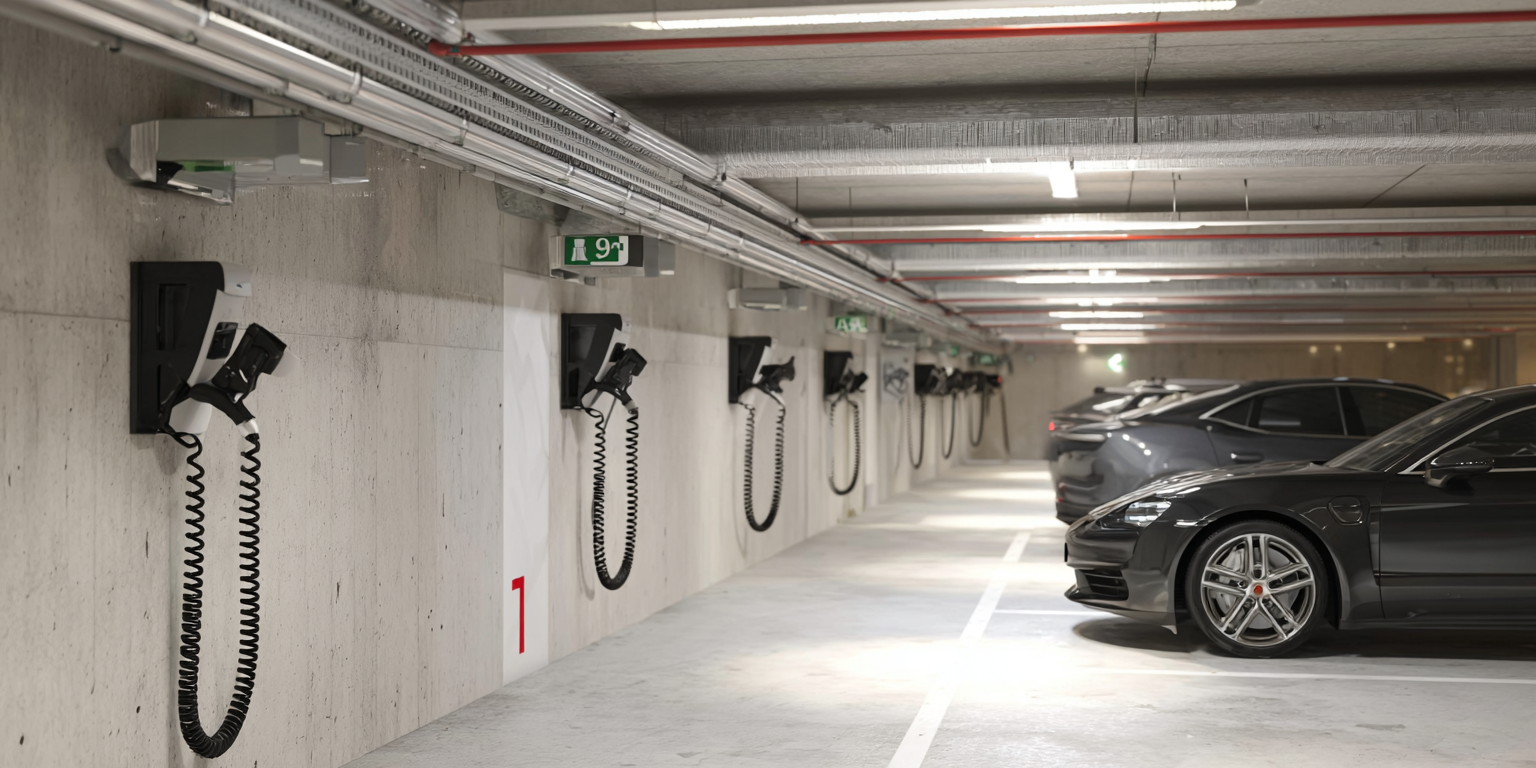
    Owners of apartment buildings who want to equip at least ten parking spaces with charging options for electric cars will be supported with a flat-rate amount of CHF 2,000. This is intended to cover part of the cost of a load management system. This is necessary if several e-cars are to be charged at the same time.

    The canton has been supporting energy-efficient refurbishments in buildings since 2000 with the funding programme. "In the last two years, the funding budget has been fully utilized, which can be seen as a success," says the press release. It proves that owners take their responsibility seriously and make a contribution to the energy transition and climate protection.

  • NeoVac uses the app from eCarUp for charging stations

    NeoVac uses the app from eCarUp for charging stations

    NeoVac now uses the NeoVac my Charge app to bill the consumption-based costs for e-charging stations in apartment buildings and areas. According to a media release , the specialist for building and environmental technology based in Oberriet is reacting to the increasing demand for e-charging stations in buildings.

    The app was developed by eCarUp AG from Zug. The young company offers a comprehensive software solution for setting up charging infrastructure. Its backend enables billing, monitoring, load management and maintenance of e-charging stations.

    With its Switzerland-wide service network, NeoVac prepares the consumption-based energy and water bills for over 400,000 apartments every year. The Rheintaler company has set itself the goal of offering a solution for every billing-relevant measuring point in a building. "The number of new registrations of electric vehicles is increasing significantly and tenants are asking for more and more charging options," says Pascal Welti, Head of Energy Consulting at NeoVac. That's why his company has now launched an app for it.

    It enables drivers of electric cars to activate charging stations and pay for the electricity they use. In addition, the charging data is transferred directly to the NeoVac myEnergy app. There, users receive an overview of their personal consumption and a directly accessible energy cost bill.

    NeoVac also offers complete solutions for e-mobility infrastructure projects with a nationwide sales and service network. In addition, charging stations could "also be controlled depending on the PV system, battery storage or heat pump". This increases self-consumption and the profitability of photovoltaic systems.