Tag: Landschaft

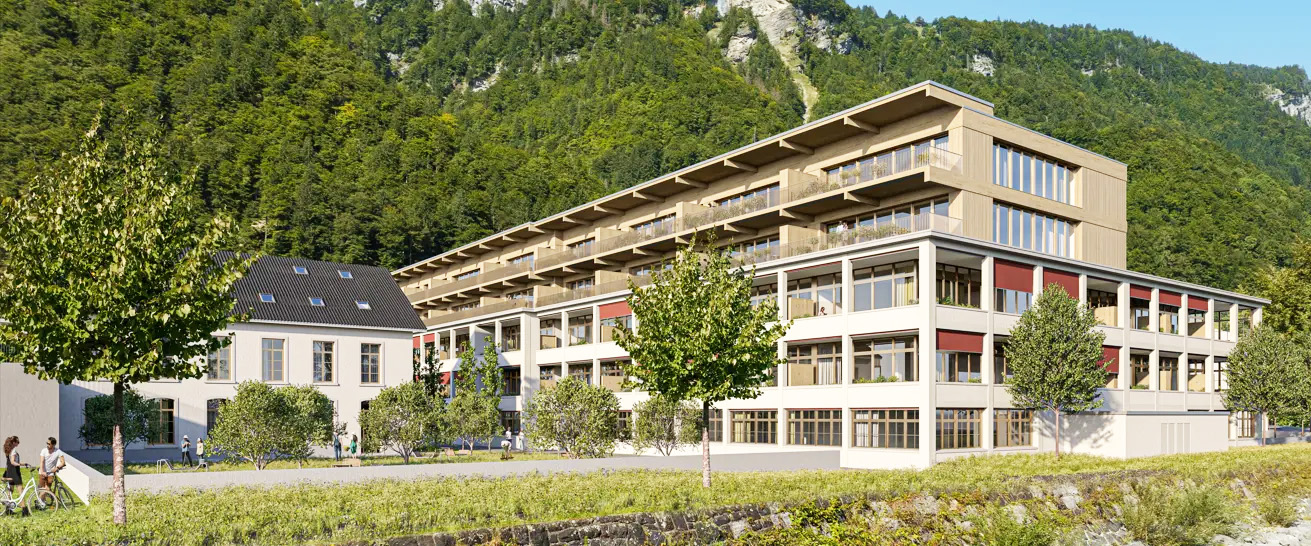
  • The Glarus South residential park sets new standards

    The Glarus South residential park sets new standards

    In the centre of Glarnerland, nestled in the alpine landscape and with a direct S-Bahn connection to Zurich, a pioneering project is taking shape. The Glarus Süd residential park is ready for realisation. The building permit has been granted, the concept has been finalised and the surrounding area is ideally developed. The site is already home to an established health and prevention centre, a café, a hairdressing and beauty salon and versatile event spaces. Schools, shopping facilities, Spitex services and the railway to Braunwald are all within walking distance. The location combines living close to nature with urban connections.

    A pioneering project for new ways of living
    The project focuses on multi-generational living, supplemented by co-living and co-working facilities. The 51 flats are part of a holistic concept that is geared towards social mixing, encounters and shared use. The residential park is operated CO2-neutrally. The energy comes from its own production. The concept addresses key challenges such as demographic change, climate protection and the increasing need for flexible ways of living and working, while at the same time offering attractive prospects for investors who focus on valuable, socially relevant projects.

    Experience meets vision
    Hacontex AG from Zollikon is behind the project. The company, which has its roots in the textile industry, has consistently transformed itself over the last few decades. Today, Hacontex is active in sustainable energy production and property development. Managing Director Hans-Peter Keller and his team rely on entrepreneurial courage, regional roots and economic foresight. With projects in the Zurich agglomeration, in the canton of Schwyz and in Glarnerland, the company addresses future-oriented topics, always in the area of conflict between nature, technology and society.

    A project with a signalling effect
    The Glarus Süd residential park is more than just a property project. It is a stimulus for the region and a model for the sustainable transformation of rural areas. A place for all generations, for work, health, community and innovation is being created in the middle of the mountains. The combination of modern infrastructure, local roots and ecological responsibility makes the project an investment target with long-term added value.

    Now that construction is ready, the go-ahead is imminent. An investor is now being sought who shares the vision and has the courage to back a project that not only promises the future, but also builds it.

  • Plus de Jardins – The pulse of Thun’s new garden quarter Siegenthalergut

    Plus de Jardins – The pulse of Thun’s new garden quarter Siegenthalergut

    A major urban development project is taking shape in the south-west of Thun. The Siegenthalergut, which covers an area of five hectares, is to be transformed into a future-oriented residential neighbourhood for 1500 people over the next few years. Frutiger AG is working closely with the city to develop urgently needed living space for the people of Thun. The aim is for the entire development of the Siegenthalergut to be significantly characterised by the open space. For the design of the outdoor space, the city and Frutiger AG carried out a study contract in accordance with SIA 143. The task was to develop an open space concept for the park, the boulevard along Hohmadstrasse and the other outdoor spaces.

    Winning project “Plus de Jardins
    The centrepiece of the open space design is the “Plus de Jardins” project by the Zurich landscape architecture firm “Skala Landschaft Stadt Raum”, which emerged as the winner of the study contract. It is impressive in terms of both design and ecology and creates the ideal conditions for a versatile public park as a meeting place.

    Public park as a meeting place
    The park, which will cover around 7,100 m², is intended to be a meeting place for the entire neighbourhood. With a large open meadow for sports and play activities, surrounded by groups of trees and a natural stone band that rises up in places to form a seating wall, the park creates an inviting atmosphere.

    Ecological quality and multifunctionality
    The residential alleys between the building plots and the boulevard along Hohmadstrasse not only serve to provide access, but also contribute to a biodiverse quality with their varied design and biodiversity. Multifunctionality and different atmospheres in the various outdoor spaces characterise the concept and support the idea of a neighbourhood that facilitates encounters and creates new open spaces.

    Involvement of the local population
    There is a particular focus on involving the local population. Their needs and concerns are continuously incorporated into the further development of the project. Workshops and surveys were held to ensure that the concerns of the neighbourhood were taken into account in the study contract. The survey of the population was not limited to the topic of outdoor spaces, but also included various topics relevant to the development of this dimension.

    Future steps towards realisation

    The creation of a new zone with planning obligation (ZPP) is necessary for the realisation of the project, which is expected to go to public consultation in the first quarter of 2024. Once the ZPP has been approved by Thun City Council, it will be authorised by the canton. Following approval, a master plan will be drawn up for the entire perimeter, which will form the basis for the development regulations and the architectural competitions.

    Outlook for the construction phase
    The start of the first construction phase is planned for 2027. The Siegenthalergut is a prime example of sustainable urban development. It is characterised by a well thought-out combination of living space, open spaces and communal facilities.

  • Up to 10,000 new jobs in Sisslerfeld

    Up to 10,000 new jobs in Sisslerfeld

    The Sisslerfeld in Fricktal should develop into a place of the future. It is the largest contiguous and zoned industrial area in the canton of Aargau. With the further development of the Sisslerfeld, more companies should settle in the area and 5,000 to 10,000 additional highly qualified jobs should be created.

    The four municipalities involved – Eiken, Münchwilen, Sisseln and Stein – the Fricktal Regio planning association and the canton of Aargau therefore decided at the end of 2018 to tackle the development of the 200-hectare work zone together and in a coordinated manner. Qualitative growth is in the foreground.
    As early as 2019, people who live or work in Sisslerfeld, as well as companies and property owners, were asked about their needs. This resulted in guiding principles for further development.

    From January to September 2020, four teams of specialist planners looked for solutions to implement the guiding principles. In this so-called test planning, the teams dealt with the question of how jobs in Sisslerfeld can grow while traffic can remain bearable and the beauty of the landscape with its local recreational value can be preserved. Experts from the fields of business, society, urban planning, mobility, open space and energy worked together on an interdisciplinary basis. They examined and compared different approaches and discussed their advantages and disadvantages.

    Their solution approaches were intensively and critically discussed by a 16-strong assessment committee in three workshops. In order to give the younger generation enough weight, very young specialists were also represented on this body. The judging panel was chaired by Rainer Klostermann, an architect and urban planner from Zurich. In the test planning, it was important for him to "consider all the ideas and findings on how the Sisslerfeld can be designed as a future place of work, but also as a place to live and play". "On the other hand," Klostermann continues, "it is important to take local needs into account, indeed to protect them." The test planning not only explored how the Sisslerfeld could be developed. "It was just as important to discuss and reconcile different perspectives."

    Following the test planning, the various concerns were brought together to form a coordinated overall picture. The judging panel approved this synthesis in early July 2021. It consists of eight directions and shows how Sisslerfeld could develop sustainably and what course can be set for this today.

    In a next step, these directions will be discussed with the municipalities, the population and the landowners. The results of this dialogue are to be transferred in 2022 to plans that are binding on the authorities and then on the landowners.