Tag: Landwirtschaft

  • Pioneering project: Greenhouse solar system utilises light twice

    Pioneering project: Greenhouse solar system utilises light twice

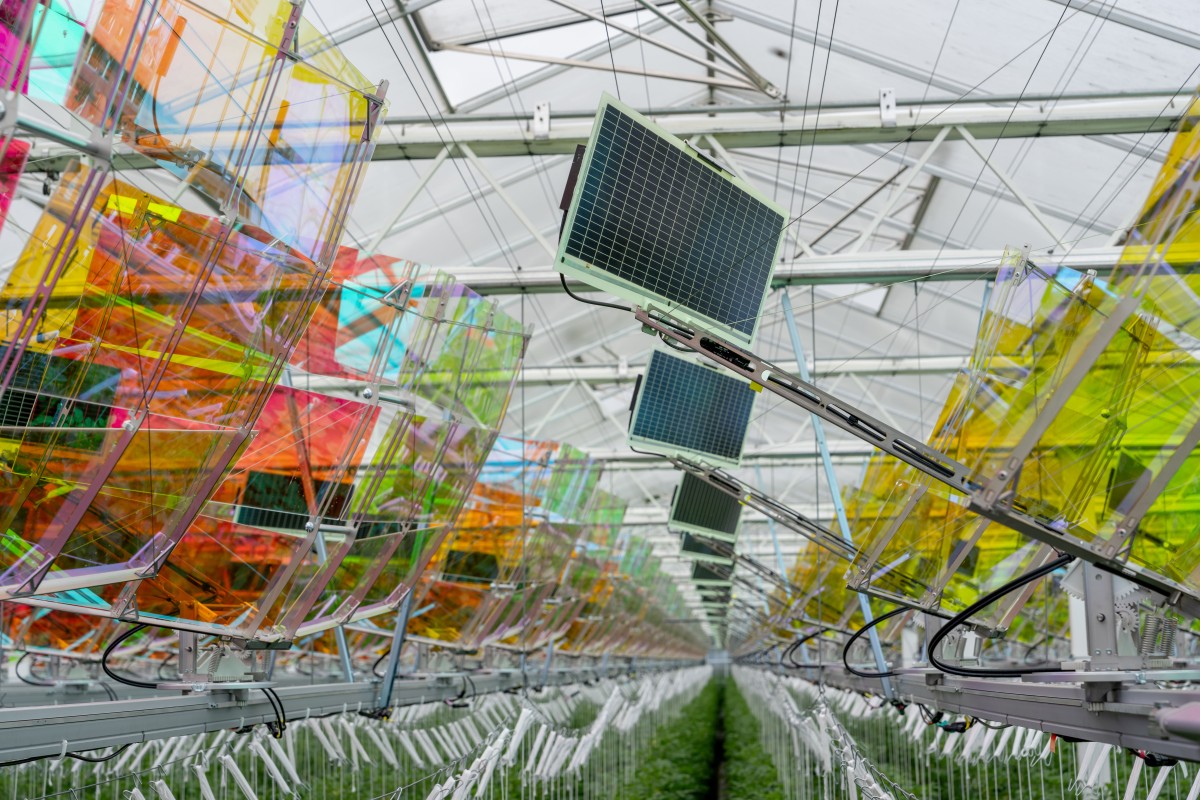
    The start-up Voltiris from Epalinges has installed its largest solar system to date on a greenhouse belonging to Meier Gemüse AG in Rütihof, according to a press release from the canton of Aargau. The solar system is based on a filter technology in which light waves used to generate electricity are filtered out and redirected to a solar panel, while the light required for photosynthesis can enter the greenhouse unhindered. In this way, plants can be grown without any loss of yield and renewable energy can be generated at the same time. The canton of Aargau subsidised the solar system with CHF 50,000.

    The solar plant in Rütihof covers an area of around one hectare and generates around 234 kilowatts of electricity with around 1,730 solar panels. “As a Swiss startup, we are proud that the first and world’s largest plant with our spectral AGRI-PV system has gone into operation here in the canton of Aargau,” said Dominik Blaser, Chief Product Engineer and co-founder of Voltiris, in the press release.

    Thanks to the filter technology, Voltiris’ photovoltaic modules can be used inside greenhouses without casting shadows, unlike conventional solar systems. The concave arrangement of the filter also concentrates the light, allowing it to hit the photovoltaic module with four times the intensity. In this way, a higher energy yield can be achieved than with conventional solar radiation.

    The solar installation is also in line with the cantonal energy strategy, which aims to achieve the net-zero target by 2050 and strengthen security of supply.

    “This plant is an example of how agriculture and energy production can be combined in a meaningful way,” Markus Dieth, member of the cantonal government and Director of Agriculture, is quoted as saying in the press release.

  • AI-based weather forecasts for energy and agriculture

    AI-based weather forecasts for energy and agriculture

    The Zurich-based start-up Jua.ai has closed a Series A financing round totalling over 9 million Swiss francs, according to an article on startupticker.ch. The financing round was led by Ananda Impact Ventures and Future Energy Ventures and supported by existing investors such as 468 Capital and Promus Ventures. Jua plans to use the funding to accelerate the market launch of its Earth Intelligence Platform. This will enable more accurate weather forecasting to help energy traders make faster and more profitable decisions.

    The platform is powered by Jua’s artificial intelligence (AI) model EPT-2.0 and is designed to significantly outperform the weather forecasting performance of conventional numerical weather models and AI models from large technology companies. Precise weather forecasts are particularly important for sectors such as energy, agriculture, aviation and shipping. The AI-based earth simulation is intended to provide a consistent and physically simulating platform to enable reliable decisions in various sectors in the face of increasing weather extremes and weather changes.

    Jua 2024 has already secured around 13 million Swiss francs in its seed financing round. As part of this year’s capital increase, Marvin Gabler, co-founder and architect of EPT-2.0, has now been appointed as the new CEO. He succeeds Andreas Brenner, who has led Jua since its foundation in 2022. With Gabler at the helm, the company intends to focus on scaling its platform in the energy sector and expanding into new markets. “With our Earth Intelligence Platform, we have transformed the world’s most advanced Earth simulation into a real-world decision engine,” Gabler is quoted as saying in the article. “This is a fundamental step towards shaping our planetary future.”

  • Focus on solar technology for agriculture

    Focus on solar technology for agriculture

    The international energy company Eaton and the agrivoltaics specialist Insolight, also based in Lausanne, have agreed on a strategic collaboration to optimise the use of solar power in agriculture. According to a press release, Eaton’s experience in intelligent energy management will be combined with Insolight’s solar technologies. In particular, it will be investigated whether Insolight’s photovoltaic systems can be coupled with Eaton’s battery storage systems (BESS) and charging infrastructure for electric vehicles. Insolight plans to install more than 100 projects with a capacity of 300 megawatt peak by 2026. For its part, Eaton intends to support the projects with technical expertise and product training.

    Both companies will also support the farmers involved in the integration, commissioning and ongoing maintenance of new sustainable energy systems. Insolight’s agrivoltaic systems not only generate electricity that can be used on the farms, but also protect plantations against wind, hail and heavy rain.

    “This collaboration with Eaton represents an important milestone in our endeavour to bring innovative agrivoltaic solutions to the market,” said Luiggino Torrigiani, Head of Marketing and Partnerships at Insolight, in the press release. “By partnering with Insolight, we can extend our capabilities to the agrivoltaic sector, where energy efficiency can have a real impact alongside agricultural productivity,” added Anne Lillywhite, Senior Vice President and General Manager for Energy Transition, Digital and Services at Eaton.

  • "The Energy Act takes us a decisive step further in terms of climate protection"

    "The Energy Act takes us a decisive step further in terms of climate protection"

    What topics do you deal with as the head of the building department of the canton of Zurich?
    Martin Neukom: As a member of the government, I have many different tasks. On the one hand, I lead the construction department with around 1,800 employees. On the other hand, I am a member of the seven-member government, which deals with the important political business from all directorates. As the construction director, I deal with very different topics, from noise protection to agriculture and waste management. Among other things, it is this variety of topics that makes my work exciting.

    How many construction projects are you currently working on?
    There are around 700 construction projects – from the roof renovation of a school building to the PJZ police and justice center, which is currently one of the largest construction sites in Switzerland. We do nature conservation and water protection projects as well as the maintenance of the 1500 kilometers of state roads in the canton. Through spatial planning, we influence development, protect the cultivated land and shape the appearance of the canton.

    To what extent do you benefit from your engineering degree and your master’s degree in solar energy systems for your work as head of the canton’s building management?
    The exchange with the experts in the building department is exciting and enriching. My scientific background helps me understand numerous topics and projects, for example in the energy or environmental protection sector, but also in the construction sector.

    What are the most important construction projects that are currently running in the cantons or that will start in the near future?
    These include the police and justice center as well as the Zurich Center university area with its new buildings for the university and the upgrading of public spaces. The laying of the foundation stone for the Winterthur district facility is planned for this November.

    Several construction projects are underway at the Zurich University of Applied Sciences (ZHAW). Where do you see the greatest challenges and progress here?
    Building in existing structures is a major challenge here. In addition, the space in the densely built-up Winterthur must be used optimally. Various projects have already been successfully completed, for example the university library.

    According to a survey, less than half of homeowners have looked at alternatives to oil and gas when it comes to replacing heating
    The subject of energy is very important to you. The CO2 law failed in the last vote at the ballot box. The canton of Zurich will vote on the energy law in autumn. What goals do you want to achieve with this new law? What are the key issues for residential and commercial property owners?
    With the amendment to the Energy Act, the Canton of Zurich is creating an important basis for effective climate protection in the building sector. In the future, oil and gas heating systems will have to be replaced by climate-neutral heating systems at the end of their service life. In order to avoid high costs and hardship cases, there are exceptions. The canton’s financial contributions to climate-neutral heating will be increased to make the switch easier.

    The homeowners association of the Canton of Zurich has called the referendum. The HEV advocates voluntariness and personal responsibility instead of coercion and regulations. In addition, the HEV says that homeowners have long been assuming their responsibility. How do you react to these arguments?
    Today more than every second oil or gas heater is replaced by a new oil or gas heater at the end of its service life. This means that the canton is not achieving its climate targets. According to a survey in the city of Zurich, less than half of homeowners have looked at alternatives to oil and gas when it comes to replacing heating. In order to achieve the climate targets, binding rules are needed for the replacement of heating systems. The Energy Act takes us a decisive step further in terms of climate protection.

    How confident are you that there will be a YES this time?
    The population in the canton of Glarus has just approved an even more ambitious energy law than we are putting it to the vote in the canton of Zurich. In addition, the canton of Zurich has approved the CO2 law with over 55 percent. I am confident. But it is definitely not going to be a walk, on the contrary.

    The city of Zurich seems to be on track in terms of climate technology. The picture is different in the canton. How do you sensitize the rest of the canton of Zurich to the energy issue?
    It is now more about acting than about raising awareness. The Energy Act would bring us a lot further here.

    When it comes to financial support for solar systems, the canton of Zurich does poorly in a Swiss comparison. When and how do you intend to change that?
    There is indeed a need for action here, and we are working intensively on it. In addition, the Cantonal Council has instructed the Government Council to work out a corresponding template by 2022.

    What does your solution in the mobility sector look like?
    Here, too, net zero must be the goal. This means that there must be no environmentally harmful emissions. The era of fossil internal combustion engines has passed. The sooner they are replaced, the better for the climate and thus for us and future generations. Good cooperation with the Department of Economics, which is in the lead in mobility, is also important to me here.

    Most cantons rely on architects for their master builders. You have appointed Beat Pahud as the new cantonal master builder on August 1, 2021. Critics complain that he did not complete a degree in architecture. What do you reply to them?
    The management of the structural engineering department with its 150 employees does not require a degree in architecture. What it takes: a strong leader with a lot of know-how in the construction sector. Beat Pahud is the ideal cast for this.

  • Holzernte hat 2020 zugenommen

    Holzernte hat 2020 zugenommen

    Mit 4,8 Millionen Kubikmetern wurden 2020 insgesamt 4 Prozent mehr Holz geschlagen als im Vorjahr. Vergleicht man diese Menge mit dem Durchschnitt der Jahre 2016 bis 2019, so resultierte ein Plus von 1 Prozent. Der seit 2016 steigende Trend zu mehr geerntetem Nadelholz setzte sich auch im vergangenen Jahr fort: Dessen Ernte stieg um 8 Prozent auf 3,4 Millionen Kubikmeter.

    Wie das Statistische Bundesamt in der Schweizerischen Forststatistik 2020 weiter dokumentiert, setzte sich dagegen der Rückgang der Laubholzernte weiter fort. Mit 1,4 Millionen Kubikmeter wurden 3 Prozent weniger geschlagen als im Vorjahr. Gleichzeitig werden wegen der Klimaveränderung und des zunehmenden Aufwands bei der Bekämpfung des Borkenkäfers immer mehr Laubbäume neu gepflanzt, vor allem im Mittelland. 563’000 Bäume markierten dort gegenüber 2019 ein Plus von 9 Prozent. Gleichzeitig gingen die Nadelholzpflanzungen mit 430’000 Bäumen um 8 Prozent zurück.

    Ein weiterer Trend ist seit 2016 ungebrochen: In der Schweiz wird immer mehr Hackholz verwendet. 2020 waren es mit 1,2 Millionen Kubikmetern rund 5 Prozent mehr Holz als Hackschnitzel. Dagegen sinkt die Ernte von Energiestückholz stetig: von 0,75 Millionen Kubikmetern im Jahr 2016 auf 0,70 Kubikmeter im Jahr 2020. Das meistgeerntete Holz bleibt Stammholz. Dieses Segment wuchs nach einem starken Rückgang im Vorjahr wieder um 5 Prozent.

    Die Einnahmen der 660 Schweizer Forstbetriebe sanken 2020 um 2 Prozent auf 525 Millionen Franken. Deren Ausgaben nahmen um 1 Prozent auf 569 Millionen Franken ab. Daraus resultierte eine Unterdeckung von rund 44 Millionen Franken. Das sind 5 Prozent mehr als 2019 und 13 Prozent mehr als im Durchschnitt der Jahre 2016 bis 2019.

    Bei den 160 Betrieben aus dem forstwirtschaftlichen Testbetriebsnetz der Schweiz, die eine Vollkostenrechnung führen, verschlechterte sich die Situation im Vergleich zum Vorjahr. Durch erhöhte Kosten und tiefere Erlöse hat sich deren Defizit pro Hektare produktive Waldfläche um 6 Franken auf 66 Franken vergrössert.

  • Dietiker city council presents new energy and climate strategy 2050

    Dietiker city council presents new energy and climate strategy 2050

    The Dietikon City Council has approved the new Energy and Climate Strategy 2050 with seven specific fields of action. The strategy focuses on the expansion of renewable energies, energy efficiency and security of supply, according to a media release .

    Among the seven goals named in the new strategy, the intention to reduce the city administration's energy-related greenhouse gas emissions to zero by 2030 stands out. For the population and companies, the goal of freedom from greenhouse gas emissions then applies to 2040. And by 2050, non-energy-related emissions, such as in agriculture or waste recycling, should be offset with zero emissions or with so-called negative emissions. The concrete implementation should begin immediately. The municipal energy planning will be revised by the end of the year.

    "The strategy allows us to implement climate protection and the energy transition in Dietikon in an even more targeted manner," said City Councilor Anton Kiwic, Head of Building Construction and President of the Energy Commission. Dietikon is thus making its contribution to global efforts to reduce greenhouse gas emissions and for the future quality of the location for the population and the economy.

    A small six-page brochure on the new strategy with many links on climate policy is available on the website of the City of Dietikon. There it says: Dietikon will be climate neutral. To do this, we are reducing greenhouse gas emissions to net zero by 2050 at the latest. In addition, we remain committed to the goals of the 2000-watt society and, as the energy city of gold and smart cities, play a pioneering role in national energy and climate policy.

  • Zürcher Weinland supports first project

    Zürcher Weinland supports first project

    ProWeinland has, according to a media release with AgroCO2ncept selected the first project, with funds from the New Regional Policy ( NRP is supported). AgroCO2ncept is an association of farmers founded in 2012. They had set themselves the goal of reducing their operations' greenhouse gas emissions and spending by 20 percent. This resource project will run until 2022.

    The second goal is now being tackled: the added value is to be increased by 20 percent through the transfer of knowledge and the sale of climate-friendly regional products. To this end, the association has initiated a marketing project that can now be funded. In addition, the association members want to pass on their knowledge to other producers inside and outside the Zurich wine region and thus promote climate-friendly agriculture.

    The Zurich Weinland region has been part of the New Regional Policy of the Canton of Zurich since 2020. The ProWeinland association was entrusted by the canton as the regional project sponsor of the program. Pro Weinland is “very pleased to be able to support and accompany such a promising project in the initial phase of the funding program”.

  • Agricultural Center Salez wins architecture award

    Agricultural Center Salez wins architecture award

    Constructive Alps is awarded to projects that are convincing in terms of sustainable building and renovation in the Alps. Switzerland and Liechtenstein have now awarded this prize for the fifth time, according to a media release . A total of almost 330 projects were submitted. A jury selected ten entries, of which the first three received a total of 50,000 francs. The Salez Agricultural Center took first place.

    The Agricultural Center Salez is one of the projects that show that architecture can combine aesthetics and climate protection, as stated in the communication from the Federal Office for Spatial Development (ARE). The building of the center relies on the simplest possible construction and a long lifespan. Canton and architect Andy Senn would have set new standards in terms of climate efficiency. An assembly hall in Vorarlberg and a mountain inn in Glarus made it into second and third place. In addition to seven recognition prizes, an audience award has also been determined for the first time.

    The Agricultural Center Salez consists of a conference center, farm, state farm and orchard. It is operated by the Agricultural Center SG (LZSG) together with the practical trial plots in Flawil. This also has advice centers in Kaltbrunn and Sargans.