Tag: Lebensqualität

  • Lucerne responds to tax pressure with a billion-euro package

    Lucerne responds to tax pressure with a billion-euro package

    International tax competition is being readjusted by the OECD minimum taxation and is hitting Lucerne hard. The previous advantage of low corporate taxes for internationally active groups will no longer apply. This could result in companies moving away, a drop in investment and a massive loss of tax revenue. Over a billion francs are at stake for the federal government, canton and municipalities – a scenario that Lucerne is not prepared to accept without taking action.

    Strengthening the business location, ensuring quality of life
    The cantonal government is responding with a far-reaching location promotion programme, which comprises around CHF 300 million per year. Around two thirds of this is to flow directly into measures to promote innovation, digitalisation, economic areas and a business-friendly administration. This will also create new opportunities for property developers and investors. In particular in the planning and realisation of forward-looking commercial and infrastructure projects.

    The remaining third is dedicated to quality of life. The measures range from tax relief and family friendliness to the promotion of culture and digital participation, key location factors when it comes to retaining talent and attracting new workers.

    Participatory and forward-looking
    The programme was developed in close consultation with the business community, municipalities and social partners. The public consultation will run until 9 June 2025 via the “e-participation” tool. The final decision lies with the people. The package will be put to the vote in September 2026 and is scheduled to come into force on 1 October 2026.

    Lucerne is sending a strong signal with this proposal. Location promotion is no longer an optional extra, but a strategic duty – and it requires clear, long-term investment.
  • Smart City Strategy Zug

    Smart City Strategy Zug

    The challenges of urban growth, from the climate crisis to transport logistics and urban densification, call for holistic approaches. Zug is focusing on digitalisation as a key strategy. With its strong technological basis and the active involvement of all urban stakeholders, the Smart City Strategy Zug offers innovative answers to the questions of the future.

    Intelligent administration and citizen-centred services
    The city of Zug is striving for an efficient, citizen-centred administration that facilitates access to services and promotes transparency. Digital technologies, such as open data and smart administrative processes, offer citizens access to municipal services regardless of time and place. This customer-friendly approach strengthens the dialogue between the city and the population and makes Zug a pioneer for modern city administration.

    Strengthening social participation and digital skills
    With its smart city strategy, Zug is creating new platforms for the participation of all social groups. Digital channels expand dialogue and promote the right to have a say, especially for younger generations and less mobile people. Educational programmes are designed to improve the digital skills of both the population and the administration and prepare the people of Zug for the opportunities and challenges of the digital transformation.

    Smart mobility for sustainable mobility and quality of life
    Smart mobility is a central pillar of the strategy. Innovative technologies and alternative forms of transport are intended to reduce commuter traffic, cut emissions and improve the quality of life. Zug is focussing on real-time data, intermodal mobility and the expansion of emission-free modes of transport. The goal: clean, safe and sustainable mobility that enriches city life.

    Innovative business location
    With its dynamic start-up scene and innovative sectors such as fintech and blockchain, Zug creates an attractive environment for high-tech companies and qualified specialists. The Smart City strategy strengthens the location’s profile and connects companies that are committed to a sustainable economy and circular processes. In this way, Zug is not only positioned for the future as a place to live, but also as a business location.

    Sustainability and environmental protection through smart technologies
    Promoting energy efficiency and CO2 reduction is a key objective of the strategy. Digital applications such as “smart metering” enable a transparent presentation of energy consumption and promote the conscious use of resources. The city is focussing on the expansion of renewable energies and the intelligent use of existing infrastructure – a clear commitment to climate protection and sustainable urban development.

  • Smart City Winterthur 2030

    Smart City Winterthur 2030

    Since the first smart city strategy in 2018, Winterthur has established itself as one of the most progressive cities in Switzerland. At that time, the focus was on quality of life and resource efficiency, supplemented by topics such as energy, mobility, education and health. With the revision of the strategy towards Smart City Winterthur 2030, the City Council is now focussing on new cross-cutting topics such as innovation, needs orientation and co-creation. These topics are crucial to meeting the requirements of a changing society.

    Two programmes are driving implementation
    The new strategy is being implemented through two programmes, the Innovation Programme and WinLab. The innovation programme supports employees of the city administration in the development and implementation of innovative projects. The aim is to strengthen the culture of innovation within the administration.

    The WinLab, on the other hand, acts as an urban real-world laboratory in which representatives from business, science, civil society and municipal institutions work together. In this creative space, forward-looking solutions for the city are developed and tested. Both programmes create scope for experimentation and promote sustainable innovations that meet the needs of citizens.

    A strategy for the future
    The Smart City Winterthur 2030 strategy comes into force on 1 January 2025 and is part of the long-term goal of shaping Winterthur as a sustainable and adaptable city. The strategy will be reviewed after five years at the latest to ensure that it continues to meet the needs of the city and its population.

  • Future for Munich’s city centre

    Future for Munich’s city centre

    THE VERSE is setting new standards in sustainable urban development. Herzog & de Meuron and ACCUMULATA Real Estate Management are transforming the neighbourhood with a comprehensive approach that integrates social, ecological and economic aspects. The aim is to transform the former Postbank-Karree into a lively, future-oriented centre that offers added value not only to future tenants, but also to residents and passers-by.

    Green space as a green lung
    The centrepiece of the plans is a 2,700 square metre green space inside the quarter. This park-like oasis will not only improve the microclimate, but also create space for recreation and socialising. Clearly structured passages connect the green space with the surrounding streets and make the area accessible and inviting.

    Innovation on the roofs
    The roof landscape of THE VERSE offers much more than just energy efficiency. In addition to photovoltaic systems, there are versatile utilisation areas such as sports fields, terraces and a running track. These areas encourage use by employees and provide a unique view over Munich. The concept seamlessly integrates technology into the design and contributes to LEED Platinum certification.

    Diversity and urban dynamism
    A mix of retail, catering and sports facilities will be created on the ground floor. This diversity revitalises the neighbourhood and supports the local economy. The reduced arcade depth along Paul-Heyse-Strasse creates attractive spaces that attract residents and visitors alike.

    Focus on mobility and resources
    THE VERSE combines a modern mobility concept with resource-conserving construction methods. 900 bicycle parking spaces with showers and optimal public transport connections promote sustainable mobility. At the same time, the partial preservation of the building shell reduces the environmental impact through less demolition work and grey energy.

    A hotspot for working and meeting
    With a conference area for up to 600 people, modern co-working areas and an auditorium, THE VERSE will become a meeting place for companies and professionals. The high-quality digital infrastructure and flexible building technology fulfil the requirements of tomorrow’s working world. THE VERSE shows how sustainable densification can improve urban quality of life. The project integrates modern architecture, green energy and social diversity and makes Munich’s railway station district a pioneer in urban development.

  • Overview of the attractiveness of Swiss residential areas

    Overview of the attractiveness of Swiss residential areas

    UBS has presented its Residential Attractiveness Indicator 2024. According to a press release, the Chief Investment Office Global Wealth Management examined 13 regions in Switzerland. According to the report, ten of these regions have the highest attractiveness for a family with two children and average financial means in their medium-sized centers. They include Locarno TI and Vevey VD as well as the cantonal capitals of Aarau, Chur, Fribourg, Lucerne, Neuchâtel, Sion, Solothurn and St. Gallen. In addition to the medium-sized centers in these areas, top municipalities such as Basel, Interlaken BE and Murten FR are also among the attractive residential areas. The major centers of Bern and Lausanne are also among the top addresses in their region.

    As selection criteria, the big bank chose the local infrastructure, leisure facilities and housing costs. While offers such as a wide range of stores, good medical care, the availability of schools and children’s facilities increase the attractiveness of the first two criteria, as do sports and leisure activities, high housing costs such as rents and ancillary costs clearly limit this. This is just as clear in the Zürchsee municipalities as it is in Lausanne or Lugano. Exceptions among the high-priced municipalities are Schaffhausen, Goldach SG, Rheinfelden AG, Yverdon-les-Bains VD and Delsberg JU. The report shows that families with above-average incomes also prefer to live in city centers.

    To determine the indicator, a weighted average of the infrastructure, leisure and housing costs pillars, supplemented by 35 variables, was calculated for each municipality and each household type.

  • Considerable economic growth. Increasing quality of life

    Considerable economic growth. Increasing quality of life

    The economic development of the Canton of Zurich is impressive. In the last 40 years, the inflation-adjusted gross domestic product (GDP) has more than doubled from CHF 74 billion to CHF 159 billion. Per capita economic output has risen from CHF 65,000 to CHF 101,000, with this growth in value added being largely translated into higher wages. In addition, average working hours have decreased by almost half an afternoon per week since 1991, which has led to a continuous increase in the prosperity of the people of Zurich. Technological progress and innovation have been the driving forces behind this.

    Rising quality of life – differentiated developments
    Economic growth brings with it more than just higher incomes and leisure time. Tax revenues increased, which improved the quality of life in the canton of Zurich in many areas. The OECD uses the “Regional Well-Being Indicators” and the “Better Life Index” to measure quality of life based on eleven different categories. Zurich recorded improvements in education, employment, work-life balance, health and technology. In the areas of safety and housing, the results were mixed, while subjective life satisfaction remained consistently high.

    Decline in environmental pollution despite growth
    Contrary to the traditional correlation between economic growth and resource consumption, the last 30 years have shown a decoupling in rich regions. In the canton of Zurich, real GDP has risen by 69 per cent since 1990, while environmental quality has improved in most areas. Material consumption, recycling rates, air and water quality and the environmental footprint improved. A relative decoupling can be observed in waste quantities, soil sealing and biodiversity. Greenhouse gas emissions in particular have been significantly reduced by 17 per cent since 1990, despite steady economic growth.

    Thought experiment on the effects of zero growth
    In its economic monitoring, the INFRAS research office modelled the possible effects of a scenario without economic growth by 2050. This scenario shows that zero growth would lead to significantly lower incomes and an increased risk of poverty. At the same time, financial challenges would increase as there would be less tax revenue and less money available for social insurance, which would result in distribution conflicts. Although environmental quality would benefit in some areas, the costs would be high and fewer financial resources would be available for environmental protection.

    The canton of Zurich demonstrates that economic growth, quality of life and environmental protection can be successfully combined. The continuous improvement in various areas of life shows that technological progress and sustainable development can go hand in hand. The thought experiment on zero growth illustrates the importance of balanced growth in order to achieve economic, social and environmental goals.

  • Zug uses OECD minimum tax for location promotion

    Zug uses OECD minimum tax for location promotion

    In response to the imminent introduction of a global minimum tax for large international companies from 2024, which could potentially affect the canton’s competitiveness, the canton of Zug has developed plans to compensate for any locational disadvantages. The planned measures include the complete reinvestment of the expected additional revenue of around CHF 200 million per year in three priority areas: social infrastructure, innovative projects and sustainable development initiatives.

    Focus on social and innovative projects
    The planned social measures are aimed at making life more attractive for the population and the local economy. These include investments in needs-based childcare provision, higher contributions to public schools and measures to improve the living and working environment. In the area of infrastructure and innovation, the focus is on future-oriented projects. Initiatives such as the “Blockchain Zug Joint Research Initiative” and the “ETH Learning Factory Zug” are intended to increase competitiveness and quality of life in the canton by promoting sustainable energy supply and storage.

    Legal framework and financial planning
    In order to achieve these goals, the cantonal government is proposing a new “Location Development Act” that will introduce an efficient and flexible system of subsidies for sustainability and innovation. From 2026, CHF 150 million per year is earmarked for subsidies, with the maximum subsidy amount being approved annually by the Cantonal Council from 2029. This approach is intended to provide companies in the canton of Zug with planning and legal certainty.

    Finance Director Heinz Tännler emphasises that the planned measures are essential in order to maintain Zug as a preferred residential and business location. The public consultation on the new law will run until 15 September 2024 and the law is due to come into force on 1 January 2026. These strategic decisions demonstrate Zug’s commitment to maintaining its leading position despite global tax changes and remaining an attractive location for companies and skilled labour.

  • Neue Bauvorschriften zur Lärmbelastung: Chancen für Immobilienentwicklung

    Neue Bauvorschriften zur Lärmbelastung: Chancen für Immobilienentwicklung

    In der Schweiz stehen wir vor der Herausforderung, den Wohnungsmarkt zu erweitern und gleichzeitig die Lebensqualität der Bewohner zu gewährleisten. Insbesondere in städtischen Gebieten mit hoher Lärmbelastung ist es wichtig, einen Kompromiss zwischen innerer Verdichtung und dem Schutz vor Lärm zu finden. Der Nationalrat hat nun eine Lösung vorgeschlagen, die diese beiden Ziele in Einklang bringt.

    Die neuen Bauvorschriften ermöglichen es, in lärmbelasteten Gebieten neue Wohnungen zu errichten, ohne die Gesundheit und das Wohlbefinden der Bewohner zu gefährden. Ein zentraler Punkt ist die Anforderung, dass in jeder Wohneinheit mindestens ein lärmempfindlicher Raum über ein Fenster verfügen muss, bei dem die Immissionsgrenzwerte eingehalten werden. Dies stellt sicher, dass Bewohner trotz der Nähe zu Verkehrswegen oder anderen Lärmquellen einen ruhigen Rückzugsort haben.

    Darüber hinaus müssen die übrigen Räume entweder über eine kontrollierte Wohnraumlüftung verfügen oder es muss ein ruhiger, privat nutzbarer Aussenraum vorhanden sein. Diese Massnahmen tragen dazu bei, den Lärmschutz zu gewährleisten und gleichzeitig die Möglichkeiten für Immobilienentwickler zu erweitern.

    Der Ständerat hatte im Dezember für noch grosszügigere Erleichterungen plädiert, während die Ratslinke eine vorsichtigere Herangehensweise bevorzugte. Letztendlich wurde ein ausgewogener Ansatz gewählt, der den Bedürfnissen sowohl der Bewohner als auch der Immobilienbranche gerecht wird.

    Für Kadermitarbeiter im Fachbereich Immobilien und Standortförderung eröffnen sich durch diese neuen Regelungen interessante Perspektiven. Die Möglichkeit, in lärmbelasteten Gebieten zu bauen, erweitert den Handlungsspielraum und erfordert gleichzeitig eine sorgfältige Planung und Umsetzung. Es ist wichtig, die Bedürfnisse der Bewohner und die gesetzlichen Anforderungen gleichermassen zu berücksichtigen, um nachhaltige und attraktive Wohnprojekte zu realisieren.

    Die Immobilienbranche sollte sich auf diese Veränderungen vorbereiten und die Chancen nutzen, die sich aus der ausgewogenen Balance zwischen innerer Verdichtung und Lärmschutz ergeben. Die Zukunft des Wohnungsbaus in lärmbelasteten Gebieten liegt in der intelligenten Integration von Architektur, Technologie und Nachhaltigkeit – eine Herausforderung, der sich Kadermitarbeiter mit Weitblick stellen können.

  • Sustainability meets quality of life in Spiez

    Sustainability meets quality of life in Spiez

    This development not only meets the needs of singles, couples and families, but also takes into account the requirements of older people through special structural features. In realising the project, the focus is on both the quality of the construction and the use of sustainable materials, without losing sight of a fair price-performance ratio.

    The design of the residential complex is based on modern architectural principles. It consists of five cloverleaf-shaped main buildings and a final building. This configuration forms a central courtyard that is ideal for communal activities. Star-shaped paths provide access to further green and leisure areas. The project accommodates a total of 81 residential units, the majority of which are for rent and 35 units for sale, including four luxury penthouses and two studios.

    Away from the living spaces, the complex offers numerous amenities such as an underground car park with 96 parking spaces, bicycle and technical rooms and studios. But what makes this project stand out is its commitment to renewable energy. At its heart is an ice storage heating system that completely dispenses with fossil fuels. This innovative system utilises an underground water tank as an energy store, from which energy is generated by a heat pump. A solar air absorber optimises this process, making the project a pioneer in sustainable energy concepts.

  • Spatial planning, the measure of all things?

    Spatial planning, the measure of all things?

    Source: Swiss Confederation

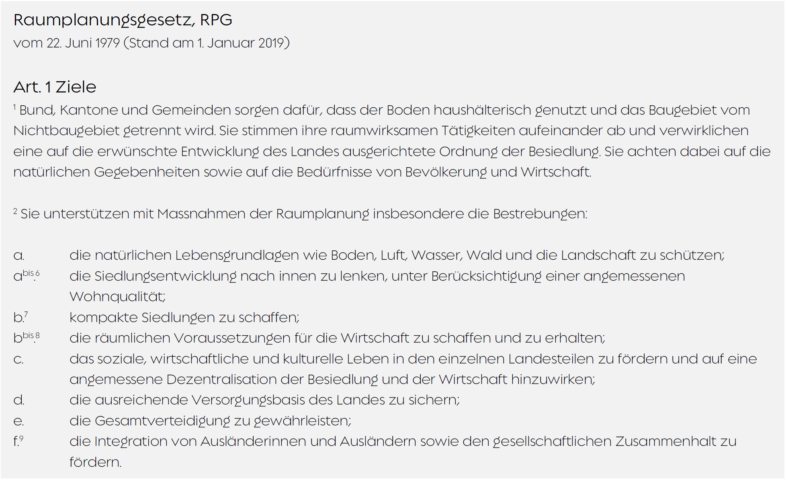
    In reality, however, the cantonal and municipal planning instruments are incomplete, rigid, purely quantitative and do not pursue a three-dimensionally developed picture of the future. The consequences are well known: Inconsistent cityscapes, insufficient densification potential, growing traffic volumes, uncoordinated infrastructural facilities and, finally, a dissatisfied population.

    Forward-looking spatial planning with new concepts is indispensable, because the current sluggish planning instruments of spatial planning are obviously at odds with the dynamic process of urban planning and to date fail to achieve the goals defined in the RPG.

    With the use of the already existing GIS data, the potential impacts on all relevant topics such as interior densification, land use, transport, energy consumption, greenhouse gas emissions and many others could be visualised, evaluated and communicated in a participatory manner throughout Switzerland on the basis of qualitative future scenarios – and beyond the cantonal borders.

    Buildings in the context of spatial planning
    Spatial planning also creates the framework conditions for the development of neighbourhoods and ultimately of the building stock. When we talk about sustainable buildings, it is not enough to look at them in isolation and focus solely on their substance. Buildings are to be understood in their context and thus in consideration of their contribution to the reduction of traffic volume, to densification and to social integration. Following this logic, the two standards SNBS Building Construction for Building and SSREI for Existing Buildings have been developed in Switzerland. In terms of their content, both are unique in an international comparison.

    Source www.ssrei.ch

  • Bern is to get the greenest alley in Switzerland

    Bern is to get the greenest alley in Switzerland

    The Institute of Plant Sciences at the University of Bern wants to contribute to coping with climate change and biodiversity loss. To this end, the institute is tackling a project in Bern’s old town together with business partners and residents. Here, the Postgasse, a listed building, is to be transformed into the greenest alley in Switzerland, the University of Bern informs in a statement.

    “We are supporting residents in greening their own windowsills and outdoor areas with suitable plants,” project initiator Matthias Erb is quoted as saying in the statement. Afterwards, the researchers from the University of Bern want to study the effects of greening on the ambient temperature, biodiversity, water balance and quality of life in the Postgasse. “The collected data and experience from this pilot project should help Bern and other cities in the future to increase their sustainability and attractiveness even more quickly and easily,” explains Armin Komposch from the Institute of Plant Sciences.

    The companies Baumschule Gartenpflanzen Daepp, Ricoterand Zollinger Bio are contributing plants, seedlings and soil to the project. Plant containers with automatic irrigation are contributed by Boum AG. The young Bernese company was founded in 2021 as a spin-off of the University of Bern.

    The official start of the project is a planting day on 6 May. Here, interested residents can pick up plants, soil and pots to green the Postgasse as they see fit. The residents themselves are to take over the subsequent maintenance.

  • Winterthur promotes five new Smart City projects

    Winterthur promotes five new Smart City projects

    In 2023, the city of Winterthur will support a total of five innovative projects that can contribute to sustainable development and to increasing the quality of life in the city. For this purpose, the city is providing a total of 200,000 Swiss francs from the Smart City Winterthur innovation credit, informs the city administration in a corresponding statement. Since the launch of this credit, Winterthur has supported a total of 18 Smart City pilot projects.

    This year, WinEnerGIS is one of the projects that can look forward to receiving funding. In this project, a prototype for a public information platform in the energy sector is being developed. Here, building-specific information on available energy sources will be made available. The project Together on the Trail of the City Climate integrates the population into Winterthur’s temperature measurement network.

    In the Digital Mobility Lab API project, Stadtbus Winterthur and the Digital Mobility Lab of the Zurich University of Applied Sciences are working together. The aim is to develop an interface with which questions from practice can be solved with real data in the future. The first step is to optimise connections when changing trains.

    The Winterthur@Metaverse project is looking into the question of beneficial applications for Winterthur in the Metaverse. If necessary, a first prototype will be developed in the metaverse. Finally, the RPA@DigiWin project is about digitising repetitive tasks of the city administration.

  • Transfer of ownership of the Schützengütli site for residential development takes place

    Transfer of ownership of the Schützengütli site for residential development takes place

    In February 2022, Halter AG acquired the Schützengütli site in Bischofszell with two areas of around 6500 and 1000 square metres. The property, which had served the Schiffli embroidery factory from 1907 and later the glass rectifier construction, passed into the ownership of the Laumann & Co. malt factory and fruit pressing plant in 1946. Essences and syrups were produced here until a few years ago. On 10 February 2023, the revised building and zoning plan of the city of Bischofszell came into force, allowing residential use with a design plan obligation on the site.

    For a lively and attractive Bischofszell
    “With this site development in an intact neighbourhood, we will create attractive living space in a very well-developed location right next to the railway station,” says Rolf Zäch, project manager at Halter Entwicklungen, with conviction. “The development of the site makes a valuable contribution to an attractive Bischofszell.” Thomas Weingart, mayor of Bischofszell, is also pleased about the upcoming development: “The centre of our town continues to develop positively. The town council is pleased about that. We are particularly honoured that Halter AG, a well-known company, will be active in Bischofszell and can contribute its great experience in urban development.”

    Harmonious integration into the neighbourhood and the city
    Around 50 owner-occupied flats are planned, for which the existing buildings will be removed except for individual elements. In a two-stage study contract, the aim is to achieve a high-quality site development that offers future residents a high quality of living and blends harmoniously into the surrounding neighbourhood. Taking economic criteria into account, an urban planning concept for the site will be developed, which will be followed by the architectural design in a second step. The study commissioning process already initiated by Halter Entwicklungen will start this spring.

  • Renewal of the Läbespark retirement home

    Renewal of the Läbespark retirement home

    The four existing main buildings and other auxiliary buildings in the Läbespark retirement home in Biberist are getting on in years: they were built between 1969 and 1995. In order to improve the quality of life for around 100 residents, the cooperative had a refurbishment project drawn up. Phalt Architekten AG, Wam Planer und Ingenieure AG and Neuland ArchitekturLandschaft GmbH were commissioned for this. A committee consisting of representatives of the Biberist community, the responsible cooperative and various experts accompanied the process.

    The alignment project forms the basis for the design plan process and the further project elaboration. The oldest house at Blümlisalpstrasse 12 will be replaced by a new building. The height of this is based on the existing building. Compact small apartments based on the Bonacasa building standard are planned. The 1.5 to 3.5 room apartments will have a wet room with a laundry tower and a loggia facing the park-like inner courtyard. A reduit complements the larger apartments. «The existing restaurant / café Pintli will move into the new building. To do this, we are revitalizing the premises of the former Pintli with commercial and service uses, ”says Ronny Fluri from Bonainvest AG, which takes on the building owner function for the cooperative. A common room is also planned, which should also promote social contact among the residents. The new building will have a parking garage.

    So the previous parking lot can give way to a piazza. “We are thus creating another meeting zone and upgrading the area. Our green park with a small pond will have a herb garden, more seating and various exercise elements that are intended to provide incentives for the residents, ”explains Fluri. The surrounding quarter will be better networked by footpaths. But there is still one problem to be solved: “The building that is being replaced has heating for two more houses. We would like to work with geothermal probes in the future. However, various investigations are still ongoing, ”says Fluri. When this has happened, the other buildings can at least be refurbished in terms of energy. There is still some time until construction begins: work is scheduled to start in 2023. The new building should be ready for occupancy at the end of 2024.