Tag: Lebensqualit$t

  • Aargau shapes the future with a development model

    Aargau shapes the future with a development model

    The canton of Aargau is a dynamic region with a high quality of life and economic attractiveness. In order to secure this strength in the long term, the cantonal government has adopted the 2025-2034 development model (ELB). This formulates clear goals and lines of action that respond to the key challenges of our time: population growth, climate change, digitalisation and a shortage of skilled workers.

    The focus is on actively shaping the further development of the canton in close cooperation with municipalities, companies, research institutions and the population. The guiding principle “Together for Aargau” summarises this collaborative approach. The ambitions in the areas of economy, society, environment and administration can only be successfully realised by working together.

    Three strategic priorities for a strong region
    Think holistically and intensify economic development
    Aargau wants to continue to position itself as an attractive location for companies, research and innovation. To this end, targeted framework conditions are being created to maintain and expand value creation and employment in the canton.

    Shaping space, securing foundations
    In the area of conflict between living, working, mobility and nature, intelligent spatial planning is essential. The aim is to proactively manage conflicts of use and protect natural resources.

    Strengthening efficient municipal structures
    The public sector should act in an efficient, cooperative and citizen-centred manner. Municipal mergers, inter-municipal cooperation and digitally supported services form the basis for this.

    These priorities are underpinned by 30 specific areas of focus that are integrated into the task and finance plan and are reviewed annually.

    Sustainability requires room for manoeuvre
    The financial framework for implementing the strategy is secure. Even if structural deficits are expected from 2026, the well-filled equalisation reserve will allow the continuation of all planned measures until 2034. Tax relief will be reviewed depending on the situation and with a view to the overall financial situation. This ensures that the canton’s room for manoeuvre is also maintained in the long term.

    From vision to implementation
    The EFA will be implemented in stages and is closely linked to medium-term planning. Numerous projects are already underway as part of the existing development agenda, from energy-efficient construction and innovation promotion to integrative housing models. New projects will be initiated, prioritised and provided with suitable resources in future.

    Progress will be reported transparently on an annual basis. This is an important step towards a fact-based and trustworthy location policy. The cantonal government is thus committed to agile, dialogue-oriented management of cantonal development in close coordination with all relevant stakeholders.

    The 2025-2034 development model is much more than a political planning instrument. It is a powerful promise to a population that prioritises quality of life. To companies that are looking for reliability and innovation and to municipalities that want to help shape their future with confidence. Aargau is thus positioning itself as a modern canton with a clear compass. Economically strong, ecologically responsible and socially anchored.
  • Space for the future “An der Aa”

    Space for the future “An der Aa”

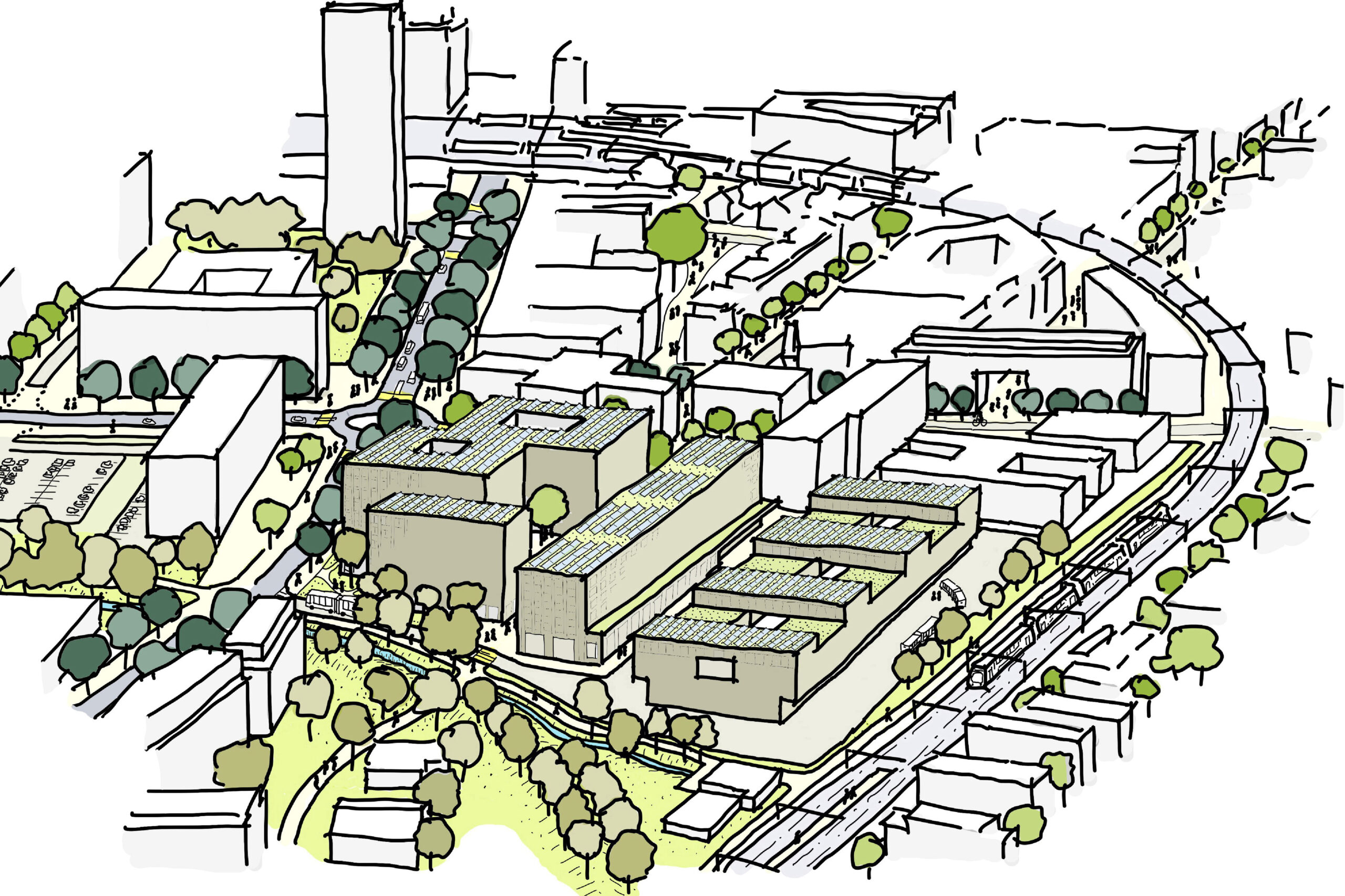
    The “An der Aa” project aims to repurpose and densify the ZVB site. Key elements include increasing the living and working space, a modern infrastructure for public transport and emergency services and opening up the neighbourhood to the local population. Of the planned flats, 40% are to be offered at an affordable price in order to meet the demand for affordable housing in Zug.

    Infrastructure for mobility and emergency services
    In the centre of the new district, a state-of-the-art building will be constructed to house the Zug rescue service and the cantonal administration. The proximity to the new ZVB main base will enable synergies, for example in vehicle maintenance. The new infrastructure will meet the increasing demands of public transport and rescue services and contribute to future-proof mobility.

    Focus on quality of life
    The site is being densified and ecologically upgraded. The Siehbach stream will be uncovered and a barrier-free footpath integrated. Green spaces and public squares will enliven the neighbourhood and provide space for recreation. The Schleifendamm will be secured as a biodiversity-rich oasis for plants and animals and contribute to the quality of life in the neighbourhood.

    Legitimisation and broad support
    Work on the “An der Aa” project has been ongoing for 14 years, involving various stakeholders from politics, administration and the public. With 81.3% approval in March 2024, the people of Zug have given their support to the development plan. Construction is scheduled to begin in 2025 and be completed by 2032. Thanks to this broad support, the neighbourhood will become a flagship for innovative urban development in Zug.

    Future prospects
    The project will change the face of Zug and meet the growing demand for residential and commercial space. The new infrastructure will create capacity for a significantly higher volume of public transport passengers and secure the operation of the emergency services.

  • Greencity Vergé sets new standards in sustainability

    Greencity Vergé sets new standards in sustainability

    Vergé is more than just a residential project, it is a response to the pressing issues of urban coexistence and ecological responsibility. Located in the south of Zurich on a former industrial site, Vergé stands for the transition to a new understanding of housing that both takes into account the needs of its older residents and actively contributes to the quality of urban life.

    Vergé’s design combines modern architecture with ecological sustainability. By using renewable and lightweight materials, the project not only sets design accents, but also makes an important contribution to reducing the ecological footprint. The design of the inner courtyard as a social meeting place and the careful selection of planting promote biodiversity and offer residents a place of retreat in harmony with nature.

    An often underestimated lever lies in the choice of materials for the interior walls. According to Lennart Rogenhofer, Chief Climate Officer at Losinger Marazzi AG, using non-load-bearing interior walls made of lightweight construction instead of concrete can lead to a reduction in CO2 emissions of around 50%. Similar savings can be achieved if a wooden façade is used instead of a concrete and plaster façade. This is in line with the aim of using sustainable and minimally processed raw materials. Losinger Marazzi has also decided to use CO2-reduced concrete in its projects as far as possible. The reduction in grey emissions with a slimmer supporting structure, which minimises the amount of concrete by optimising the slab thicknesses and column grids, is difficult to quantify. Rogenhofer explains: “This is because no ‘non-optimised’ project exists as a comparison.”. Greencity, with the last building site Vergé, impressively demonstrates that the property sector plays a key role in achieving the climate targets. Through the use of heat recovery technologies and integration into the local heating network, the aim is to achieve a largely autonomous energy supply, with certification in accordance with the SNBS Gold Standard.

    By focussing on sustainable and energy-efficient construction, not only can the quality of life of the residents be improved, but a decisive step towards a more sustainable future can also be taken.

    The project is being built by Losinger Marazzi, which has positioned itself as a pioneer in sustainability in the property and construction industry for almost 20 years and is consistently implementing its climate strategy, which follows the strategy of its parent company Bouygues Construction. The company has been SBTi certified since the end of 2023 and remains a leader in sustainability. This certification confirms that the company’s own CO2 reduction targets for direct and indirect corporate emissions (incl. Scope 3) have been calculated in accordance with international standards (GHG Protocol) and are in line with the Paris climate targets. An external, independent auditing company also verifies that the certified companies achieve their targets not through CO2 offsetting, but through actual CO2 reduction. For this reason, a CO2 reduction pathway was already drawn up in 2021 to guide strategic decisions.