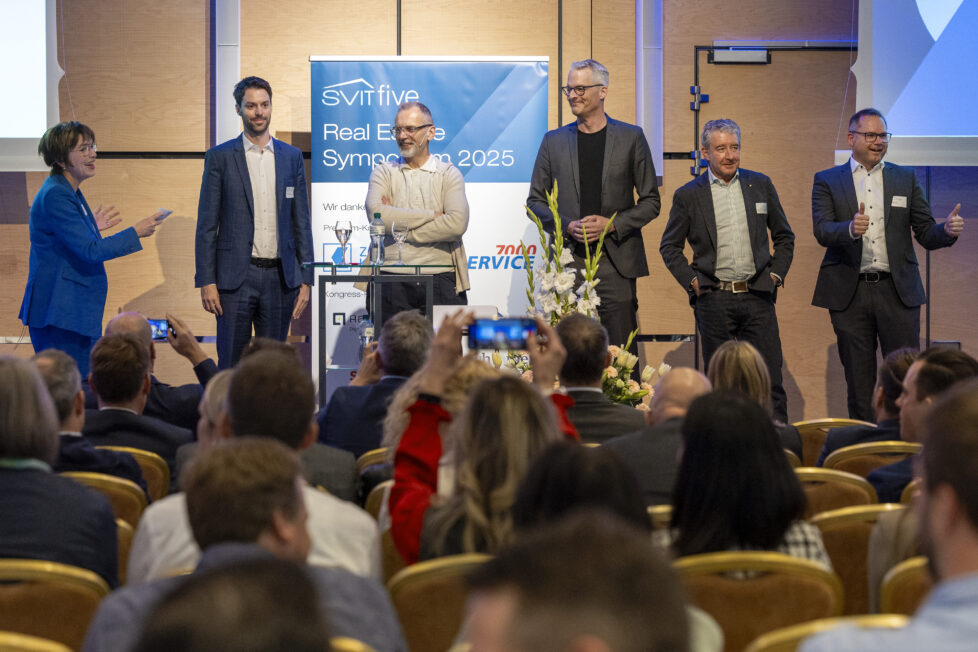
Properties are far more than just built substance. They are an investment, living space, energy consumer and long-term commitment at the same time. In order to secure or even increase their value over decades, professional, holistic life cycle management is required. At the Real Estate Symposium 2025 in Zurich, the five SVIT specialist chambers, the SVIT five, demonstrated how their combined expertise supports owners, investors, project developers and operators throughout the entire property life cycle.
With in-depth expertise, market knowledge and operational competence, they develop forward-looking strategies that are economically viable and at the same time take ecological responsibility into account. The challenges range from regulatory changes and technical developments to changing user needs – topics to which strategic property management must provide targeted answers.
From responsibility to value creation Marie Seiler, CEO of Pensimo Management AG, emphasised the complexity of property ownership in her keynote speech. It is not just about administration, but about strategic thinking and creative action. The added value of a property does not arise by itself, it is created and secured through active and responsible management. Value retention is not a constant, but the result of conscious decisions.
This thesis was supported by Dominik Stamm, Vice President at Jones Lang LaSalle AG, who urgently warned of the risks of unrealised potential. Property could quickly become stranded assets if it is not adapted to the market, technology or regulation. Conversely, investments in efficiency, digitalisation and flexibility generate long-term value effects and ensure the competitiveness of the properties.
Responsibility in practice Particular attention was also paid to the topic of condominium ownership, where responsibility is often decentralised. Michel de Roche, lawyer and former president of the SVIT Chamber of Condominium Ownership, emphasised the role of the administration. It must raise awareness of the condition and lifespan of the components, impart knowledge and enable investment in the future. This is not just about preserving value, but also explicitly about increasing value.
The Attisholz site in Riedholz is being given a new lease of life thanks to an investment by the UBS pension fund. The “Kocherei”, once a central location for cellulose production, is being extensively remodelled. The winning project by Burckhardt Architektur from Basel envisages around 150 rental flats and 4,000 m² of commercial space, which will breathe new life into the historic building.
Collaboration between UBS and Halter AG The UBS pension fund, which acquired the 73,000 m² core site back in 2022, has now also confirmed its investment in the “Kocherei”. A work contract was signed between the UBS pension fund and Halter AG on 28 June 2024. While the UBS pension fund will act as investor and owner, Halter AG will be responsible for the planning and realisation of the project as overall provider.
First stage of the site development The development of the Attisholz site, which is to be transformed into a sustainable living space over the next 25 years, begins with the first stage. In addition to the “Kocherei”, this also includes the “Lagerhaus” and publicly accessible open spaces. The design plan for this first stage is currently being drawn up in collaboration with the municipality of Riedholz and the canton of Solothurn and will soon be submitted for public consultation and approval.
Sustainable and vibrant future The transformation of the Attisholz site into a vibrant and sustainable neighbourhood is an important project for the region. The revitalisation of the “Kocherei” and the creation of residential and commercial space are central components of this vision. The realisation of the projects is planned for the period 2025 to 2028 and will contribute significantly to the upgrading of the entire area.
With the UBS pension fund as a strong partner and Halter AG as an experienced developer, the transformation of the Attisholz site will be driven forward swiftly and professionally in order to create a new, sustainable living space for the municipality of Riedholz.
With almost 40% of the Swiss population and the majority of jobs, the Zurich metropolitan area is home to a significant proportion of national life and economic activity. The updated spatial planning concept Metro-ROK 2050, an update of the first Metro-ROK from 2015, defines ambitious planning objectives for this important economic and living space. It aims to promote sustainable development that fulfils both the needs of the population and the protection of the environment.
The concept divides the area into four action areas: urban landscapes with urban centres, transitional landscapes with regional centres, cultural landscapes and natural landscapes. This categorisation makes it possible to develop targeted measures that guarantee a high quality of life and at the same time make the area ecologically sustainable.
A core concern of the Metro-ROK 2050 is the protection of green spaces and the promotion of high-quality inner-city development. No expansion of the settlement area is planned until 2040 in order to stop urban sprawl and make better use of existing areas. The building culture should be based on the circular economy principle, take grey energy into account and protect biodiversity.
The concept also places a strong focus on the sustainable use of resources and the promotion of energy efficiency. Innovative technologies and ecological construction projects should help to improve the carbon footprint and make the metropolitan area more resilient to climate change. Renewable energies and the reduction of soil sealing are just as much a focus as the promotion of public transport and sustainable mobility solutions. The aim is to significantly increase the proportion of environmentally friendly means of transport by 2050.
The Zurich Metropolitan Area 2050 spatial planning concept represents a decisive step towards sustainable and future-proof development. With the positive acceptance of the recommendations for action by the Metropolitan Council on 3 November, a further milestone has been reached. The concept reflects the commitment of the participating cantons to work together to ensure a liveable and ecologically sustainable Zurich metropolitan area.
The traditional view of peripheries as remote rural or mountainous areas is challenged in the latest analysis by the Council for Spatial Planning. With a broader understanding of peripheries, including urban and suburban areas, the Council recommends an adapted approach to these diverse regions in order to utilise their development potential in a sustainable manner.
This report, which is published every four years, sheds light on Neuchâtel’s territorial developments and provides an assessment of the implementation of the Federal Spatial Planning Act and the cantonal master plan of 2019, focussing on inner development, mobility coordination and the qualitative development of living spaces. Climate protection, biodiversity, preservation of agricultural land and energy efficiency are also taken into account.
Key points and recommendations for action
Definition and understanding of peripheries – The report encourages understanding peripheries as dynamic spaces that can have both urban and rural characteristics. These areas are defined not only by their geographical location, but also by socio-economic factors.
Dialogue and insights – Through direct exchanges with representatives of the different peripheries, the Council gathered valuable insights. These interactions revealed that the conventional view of peripheral areas as disadvantaged and left behind does not correspond to reality.
Vibrant Peripheries – The report presents the idea of “Vibrant Peripheries” as places of engagement and innovation where people develop solutions to social and economic challenges.
Challenges and opportunities – Despite specific challenges such as the lack of a critical mass of actors or pressure to adapt, peripheries offer unique opportunities for sustainable development and innovation.
Recommendations for the future – In order to promote the peripheries as vibrant and resilient spaces, the federal government, cantons and municipalities should promote innovative approaches in housing, mobility, business, tourism and energy. The focus is on strong sustainable development that prioritises a healthy biosphere and a pollution-free environment.
The ROR report encourages a rethink in spatial planning and emphasises the importance of cross-cutting thinking and value-added strategies. It calls on the federal government, cantons and municipalities to work together to create vibrant peripheries that serve as a driving force for a sustainable and inclusive society. You can find the documentation at: https://regiosuisse.ch/sites/default/files/2024-02/Lebendige_Peripherien.pdf
The Rösslimatt site in the middle of Lucerne borders railway tracks on both sides. It is to be completely redesigned by 2040.
The area is divided into different construction sites and will be realised in three stages. In the first stage between 2018 and 2025, construction sites A to C will be developed and Güterstrasse 7 will be gently redeveloped. In the second stage, from 2025 to 2040, an interim use is planned for the exposed areas. In the third stage and after the realisation of the Lucerne through station from around 2040, the development of new uses with a focus on housing is planned on construction sites D to F. The development of a new residential building is planned on construction site A.
A 180-metre-long, sustainable building designed by architect Rolf Mühlethaler is being built on construction site A. It will be realised on the site of an old goods shed that was demolished in 2020. The façade of the new building is characterised by surrounding verandas as well as a two-storey arcade on the side of the new Walter-von-Moos-Promenade with a weather-protected wood and glass façade made of local wood.
The new building has around 21,600 square metres of lettable space. At the end of 2019, the Lucerne University of Applied Sciences and Arts was secured as the main tenant. It intends to start its university operations on around 16,000 square metres from the autumn semester of 2025. The ground floor will be characterised by public-oriented uses such as a cafeteria, a café, meeting zones and a large lecture hall. In particular, the track loggia, a striking two-storey opening in the long building, and the newly designed Bürgenplatz, together with the planned catering uses, will form new urban meeting places.
A mixed-use building is to be constructed on construction sites B and C. After the architectural competition concluded in February 2020, the winning project by the consortium Demuth Hagenmüller Lamprecht Architekten with Alessandra Villa Architektur was recommended for further work by the monitoring committee and is currently under construction.
In September 2020, the pharmaceutical company MSD committed itself to the Lucerne site. It will move into around 15,000 square metres of office space on construction sites B and C. Site preparation began in the second quarter of 2021, and occupation is planned for 2025.
Both new buildings have space that has not yet been let.
The building at Güterstrasse 7 was erected in 1905 and is listed as an object worthy of preservation in the building inventory of the city of Lucerne. This building with its historic façade design is a 7-storey masonry structure consisting of a basement, five upper floors and an attic. It includes commercial and residential space. The building was refurbished in 2020 and the space occupied in 2021. The gentle refurbishment made it possible to make the flats available again at moderate rents.
The Rösslimatt site is being developed in a sustainable, demand-oriented and high-quality manner. The connection of the site to the district heating and cooling network of Energie Wasser Luzern guarantees 100 percent sustainable generation of heat and cooling. The central location allows optimal use of the existing public transport services as well as several offers for car and bike sharing.
In addition to the criteria of the 2000-watt society, the goals of the Swiss Society for Sustainable Real Estate at the silver level are met. In September 2019, the Rösslimatt was awarded for its demonstrable and exemplary results according to the 2000-watt site criteria in the development phase and recertified in 2021.
Luucy AG, based in Lucerne, was founded in 2019 by the architect and entrepreneur Mark Imhof. He describes himself as a visionary who has been dealing with the complex issues of the internal development of villages and cities for a long time. It struck him that he was repeatedly reaching limits with the usual methods and procedures. Imhof decided to develop a solution that strengthens and simplifies communication and cooperation between all parties involved: “Luucy combines the relevant data for the spatial and real estate development of all Swiss municipalities in one central location. The planning platform also provides intelligent tools for development and supports the exchange with all stakeholders through the understandable 3D visualization, ”explains Mark Imhof, CEO of Luucy AG.
Data and information from all stakeholders could be easily found, further developed and made available via the comprehensive platform. To make this possible, Luucy was constructed as a digital twin of built Switzerland. Imhof: “The topography of the Swiss landscape with all existing buildings is available in 3D as a basis. Thanks to the web solution, no software needs to be installed to use it. Initial building volumes and variant studies can be modeled directly in Luucy and compared with one another. Additional apps from third-party providers, for example for calculating investment costs, provide valuable additional information for decision-making. “
The official survey data, maps and access to the building laws can also be called up directly on the platform. “Luucy enables all interested third-party providers to connect additional solutions and thus offers space for new business models and value chains,” says Imhof. The solution met with great interest in the real estate industry: “Having all the relevant data and tools for room and real estate development available online in one place increases efficiency considerably,” explains Imhof.
Make feasibility studies much easier Luucy isn’t the only platform that makes data accessible in a digital twin. «The specialty of our solution is the platform concept. We don’t work out everything ourselves – we integrate and work with the best. As a result, the platform is growing steadily, ”says Imhof, explaining the advantages. The interactive platform also differs from other solutions, because it acts as an intermediary builder of bridges between the authorities, which often do not know enough about the needs of the private sector, and the private sector, which the overarching goals of spatial development in the sense of a sustainable and holistically functioning organism Too little consideration of “living space”.
“Today, for example, many steps in different systems are necessary to create a feasibility study. The analysis of the legal basis in the building laws of the 2172 municipalities in Switzerland and their interpretation is often a challenge. A lot of time is lost here, ”says Imhof. Luucy has all of these basics ready in a single system. The platform would primarily be used by specialists from architecture or site development. In this way, they can check meaningful development scenarios in just a few hours. “Authorities and spatial planning offices can also use our solution to display local planning revisions and potential spatial developments over a large area. Investors can easily make their own initial potential assessments of properties and areas,” explains Imhof.
The modeling of own building volumes and the quick calculation of the corresponding rough costs are currently most in demand. “Here, the entire settlement context is taken into account, and the influence on neighboring buildings in terms of shadows and views can be quickly checked. In addition, Luucy is often used for digital competitions in which the different project ideas are simply evaluated and compared with one another, ”says Imhof.
In 10 years the most used planning and coordination platform for the space and real estate industry The main focus of Luucy AG is initially on Switzerland. “But it is quite conceivable that the solution will also be offered in the DACH region and Europe in the next few years,” says Imhof. The basic costs for the platform are CHF 3,000 per year. This means that three administrators can create any number of projects, and unlimited users can work in these projects.
In the coming months, the start-up plans to continuously expand its offerings: “In five years, Luucy will be so extensive that all room-relevant data and functions can be accessed via the platform. Simulations, for example on noise, mobility and climate, can be displayed », says Imhof. And he is convinced: “In ten years, our solution will be the planning and coordination platform for the space and real estate industry. And with Luucy, cooperation with the private sector will also be greatly simplified for the authorities. Planning applications can then be published in 3D format. “
In addition to a further developed geometer system, Luucy will one day ensure that an up-to-date digital twin is available to all planners on a daily basis. The spatial strategies and the associated development of the infrastructure of the cities and municipalities should be available. The solution is disruptive and is likely to play a key role in replacing complicated and less dynamic processes in the construction industry, as Imhof explains.
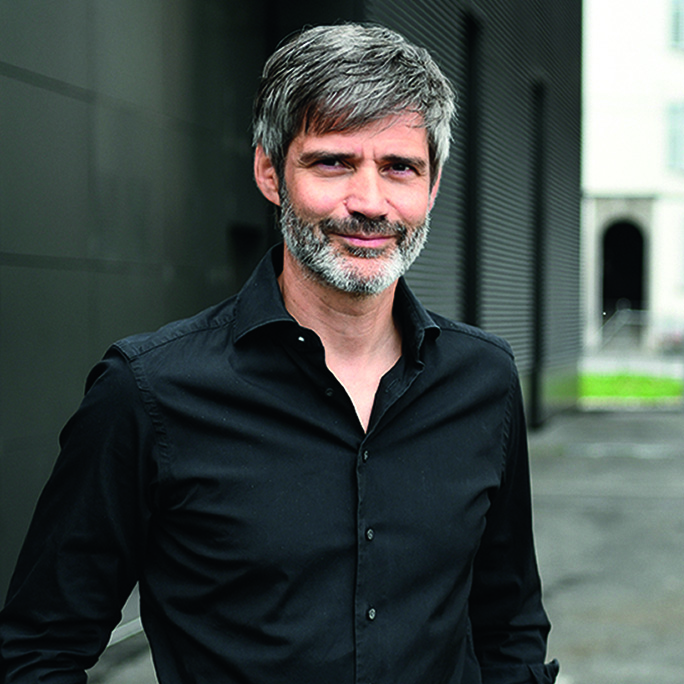
Mark Imhof, CEO Luucy.
Wir verwenden Cookies zur Unterstützung und Verbesserung unserer Dienste. Mit der Nutzung dieser Website erklären Sie sich mit der Verwendung von Cookies einverstanden. Weitere Informationen finden Sie in unserer Datenschutzerklärung.