Tag: Lehre

  • Start of construction for the ZHAW School of Engineering extension

    Start of construction for the ZHAW School of Engineering extension

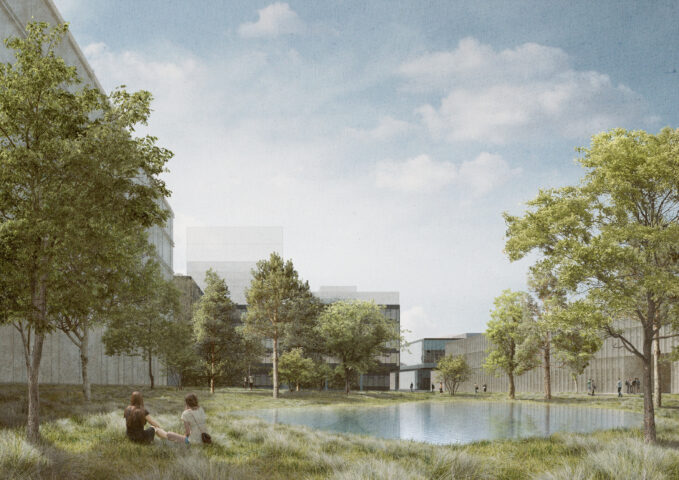
    The first construction phase comprises the construction of two five-storey laboratory buildings, which provide urgently needed space for teaching, research and development. These modern buildings complement the historic buildings of the former technical centre and are flexibly designed to meet the changing requirements of the university in the long term. The buildings will also be connected to Winterthur’s district heating network and equipped with photovoltaic systems, making an important contribution to a sustainable energy supply.

    More than just university buildings – a public space for all
    Parallel to the construction of the laboratory buildings, the Eulach will be integrated into a natural park. This park offers not only students but also the public a green oasis of relaxation in the centre of the city. The river will be ecologically enhanced and two new bridges will connect the old town with “Campus T” and the surrounding neighbourhoods. The park serves as a lively meeting place that harmoniously combines education and nature.

    Timetable and outlook
    The existing TB building will be demolished this year and excavation for the new TT laboratory building will begin. The shell of the first new building should be completed by 2027, while the second building is expected to be ready for occupancy in 2029. This expansion of the ZHAW is an important step for Winterthur as a centre of education and research, which will further enhance its attractiveness and innovative strength.

    With the start of construction work, the modernisation of “Campus T” in Winterthur will become a reality. The new laboratory buildings and the natural park not only strengthen the ZHAW, but also the entire region. For students, teaching staff and the general public, a modern space is being created that combines research, education and recreation.

  • ETH Campus Hönggerberg continues to develop

    ETH Campus Hönggerberg continues to develop

    The core mission of ETH Zurich is teaching and research as well as the transfer of knowledge to the economy and society. A modern infrastructure is a key factor in this. In order to cope with the increasing number of students and researchers and to create the necessary space for new research areas and innovative teaching methods, ETH Zurich is working on the further development of its main locations Zurich Centre and Zurich Hönggerberg. With regard to future space requirements, the Hönggerberg campus plays a central role. As a basis for its further development, ETH Zurich, together with the City and Canton of Zurich, has drawn up the master plan “Campus Hönggerberg 2040”. It describes the long-term spatial development goal. The structural densification and further development of the campus should preserve the current conditions of the site, such as the sensitive embedding in the local recreation area as well as listed buildings and gardens, and only take place in accordance with the emerging demand. In the next few years, a new building for quantum physics, a computer centre and a centre for student and entrepreneurial initiatives will be built, among other things. The central Wolfgang-Pauli-Strasse will also be renovated and upgraded as an important master plan element. Until the campus is fully developed, a conversion, new construction, extension or renovation of around a dozen buildings is planned, including four new high points. Various green areas are to be expanded. With the new master plan, ETH is building on the previous “Science City” master plan from 2005. ETH Zurich wants to develop its campus sustainably on various levels: ecologically, economically and socially. Among other things, it wants to take a big step towards climate neutrality and is focusing on energy supply without fossil fuels. A central element of this is the expansion of the current energy grid. Projects are also planned with regard to sustainable building, local climate, biodiversity as well as retention and drainage. For the further development of the campus, ETH Zurich is in dialogue with internal and external interest groups and involves selected people in a participatory manner on a selective basis.

    Attractive open spaces should ensure a high quality of stay and support biodiversity on the campus.

    In order to protect the surrounding landscape, the campus will be developed inwards and densified within the existing area. A green ring road around the campus symbolises this development and serves as a transition from the campus to the landscape. Attractive open spaces will ensure a high quality of stay and further promote biodiversity on the campus. The campus should be easily accessible by environmentally friendly means of transport such as public transport or bicycle. To relieve the local public transport system, a direct electrically powered bus, the so-called eLink, already runs between the Hönggerberg Campus and the Campus Zentrum for ETH members. Other local services such as bike sharing are available and are being continuously expanded. The current urban district character of the Campus is to be further strengthened. The central Wolfgang-Pauli-Strasse will become a lively and green promenade with versatile ground floor uses for the public. The central “piazza” will also gain in importance in the future and will invite people to meet and exchange ideas.