Tag: Limmattal

  • New agenda to strengthen cooperation in the Limmat Valley

    New agenda to strengthen cooperation in the Limmat Valley

    At its Annual General Meeting on 28 August 2025, Limmatstadt AG acknowledged its role as a driving force in regional development. According to a press release, the conclusion of the reorganisation process has sharpened the future mandate for regional location promotion.

    A clear vision has been defined in collaboration with the region’s stakeholders. It is crystallised in the formulation “Together we are shaping a strong Limmat Valley and creating space for more”. Through close cooperation and a consistent focus on the needs of all stakeholder groups, interests can be bundled and projects can be initiated and supported to sustainably promote the successful development of the Limmat Valley.

    Against this background, Limmatstadt AG is taking on a more active role. The development of a joint regional and digital agenda and the Limmat Valley communication channels project are now being launched. Both are intended to increase the visibility of regional offerings and further promote cooperation in the Limmat Valley.

    As part of this realignment, the revised brand identity “Limmattal. Room for more.” was also presented. It is intended to strengthen the region’s identity as a dynamic living and economic area.

    Jasmina Ritz and Josef Bütler have stepped down from the Board of Directors for professional reasons. Roger Bachmann, the mayor of Dietikon, was newly elected. Limmatstadt AG expects his expertise and regional ties to provide valuable impetus.

  • From shopping centre to property platform

    From shopping centre to property platform

    Shoppi Tivoli Management AG has changed its name to Tivoli Real Estate Management AG. According to the company, the name change reflects a strategic expansion of its field of activity. In addition to managing the shopping centre in Spreitenbach, the company intends to manage other commercial and residential properties in the Limmat Valley.

    The first project under the new company name is the management of the Tivoli Garten residential park. According to the company, 445 rental flats have been created in the “new lively and colourful district in the heart of the Limmat Valley” with more shopping facilities in the adjacent Shoppi Tivoli as well as extended sports and leisure facilities. The advantages also include the connection to the city centre and short distances to the countryside.

    According to its own information, Shoppi T ivoli is the largest shopping centre in Switzerland in terms of floor space. “With Tivoli Real Estate Management AG, we are retaining our identity and origins in the name, while at the same time making it clear that we are broadening our positioning in order to continue to be there for customers and partners in a reliable, competent and future-oriented manner,” reads a press release.

    Tenants and suppliers will continue to have the same contact persons, and contracts and processes will remain the same. The offices will also remain at Shopping Centre 9 in Spreitenbach.

  • Zurich and Aargau plan mobile network

    Zurich and Aargau plan mobile network

    The Limmat Valley is developing rapidly, not least thanks to new transport projects. In order to strategically address this dynamic, the cantons of Zurich and Aargau, together with three regional planning associations, are launching a cross-cantonal planning instrument:. The Limmattal regional overall transport concept.

    The concept follows the guiding principle “The Limmat Valley is fit for the future” and aims to create a sustainable, efficient and environmentally friendly balance between settlement and transport development. The planning horizon extends to the year 2050.

    Multimodal networking as a guideline
    The focus is on improving regional networking, promoting multimodal solutions and integrating logistics concepts. Neighbouring regions such as the Furttal or the city of Zurich are also included.

    The results of the concept will form the basis for future agglomeration programmes and will flow into concrete implementation in the municipalities and cantons from 2027/2028. Objectives, strategies and measures will be developed in several phases by the end of 2026.

    Structured process with regional participation
    The project will be managed by a steering group with representatives from the cantons and regional planning associations. Broad participation by the municipalities and public information events ensure transparency and acceptance.

    Project manager Sarah Hug (Canton of Zurich) and project manager Dominik Kramer (Canton of Aargau) are coordinating the participatory process. Public information events are planned on 5 November 2025 and 13 May 2026, among other dates.

    Mobility strategy with a signalling effect
    The rGVK Limmattal is a model project for intercantonal cooperation in one of Switzerland’s most economically significant development areas. It shows how regional and supra-regional interests can be united in a joint strategy for sustainable mobility.

  • Failure of the merger endeavours between Limmatstadt AG and Regionale 2025

    Failure of the merger endeavours between Limmatstadt AG and Regionale 2025

    The plans to join forces in the Limmat Valley by merging the private-sector Limmatstadt AG and the publicly financed Regionale 2025 association have failed. The two organisations, which had previously worked in parallel on the development of the Limmat Valley as a whole, were unable to agree on a joint structure and financing for a future public-private partnership. This development now raises questions about the continuation of location promotion activities in the region.

    The two organisations have existed side by side for a decade with similar objectives but different approaches and funding models. While the Limmat Valley Regional Project Show Association concentrates on the realisation of an exhibition of regional projects, Limmatstadt AG focuses on regional location promotion.

    Last year, Limmatstadt AG initiated a strategy project to develop a sustainable structure for regional development with stakeholders from various sectors. The strategy paper “Together for the Limmat Valley” aimed to merge the two organisations from 2026 in order to tackle regional challenges more efficiently.

    However, these plans were rejected by the board members of the Limmattal Regional Project Show association, which puts the continuation of the project in question. In response to this development, the Chairman of the Board of Directors of Limmatstadt AG, Balz Halter, has announced his resignation and will withdraw from the organisation.

    Limmatstadt AG has worked intensively over the last ten years to establish the Limmat Valley as a region and to represent its interests. In view of the current situation, it is now being discussed whether and how location promotion in the Limmat Valley should be continued.

    The early public general meeting on 12 March 2024 is intended to provide the framework for a comprehensive discussion on the future of Limmatstadt AG and location promotion in the Limmat Valley.

  • Strategy idea “Limmat Valley City” shows potential

    Strategy idea “Limmat Valley City” shows potential

    Thomas Sevcik entwickelte in den letzten Monaten eine Strategieidee für eine zukünftige Limmattalstadt. Er erkennt im Limmattal eine ausgeprägte Modernität und eine Stadt, die in erster Linie durch die Menschen geformt wird. Ausserdem hat er noch viele Vorschläge für eine der interessantesten und dynamischsten Regionen im Land. Denn: Was im Limmattal heute und morgen passiert, betrifft übermorgen die ganze Schweiz.

    Das Limmattal steht exemplarisch für den Wandel von Agglomerationen in der ganzen Schweiz und für die enormen planerischen Herausforderungen, welcher dieser mit sich bringt. Für eine umsichtige Raumentwicklung braucht es politischen Willen, eine breite Diskussion und vor allem ein gemeinsames regionales Verständnis.

    Den Wandel kreativ gestalten
    An der Generalversammlung der regionalen Standortförderung Limmatstadt vom 15. August 2023 stellte Thomas Sevcik den rund 200 Gästen seine Strategieidee erstmals vor. Der Autor hat viele mutige Ideen für die Region. Zu den Prägendsten gehören eine Hochschule, der Ausbau der Shopping-Raststätte Würenlos zu einem Mobilitäts- und Kommunikationshub sowie die Neuplanung des Rangierbahnhofs. Die Strategie zeigt auf, wie viel möglich ist – aber auch, wie viel noch getan werden muss.

  • Real Estate Meeting at the Schlierefäscht takes place on 7 September

    Real Estate Meeting at the Schlierefäscht takes place on 7 September

    Real Estate Meets Limmattal is the name of the new real estate meeting at the Schlierefäscht. According to a press release, it will take place on Thursday, 7 September, from 2 p.m. to 8 p.m. in the “Event Tent – Space for More in the Heart” of the Schlierefäscht. The target group is stakeholders from the Limmattal real estate sector Zurich-Aargau, including investors and students in the field of spatial planning, the Swiss Homeowners’ Association(HEV) and politicians, the announcement says.

    According to the programme, after a welcome by the Mayor of Schlierem, Markus Bärtschiger, a lecture by political geographer Michael Hermann of the sotomo research institute in Zurich is scheduled. He will speak on the topic: A region between valley and city – the somewhat different SWOT analysis. SWOT stands for Analysis of Strengths, Weaknesses, Opportunities and Threats and is called Strengths, Weaknesses, Opportunities and Threats Analysis in German. Afterwards, Dietikon’s mayor Roger Bachmann, Dieter Beeler, area manager of IG Silbern, and Dietikon’s building contractor Josef Wiederkehr will discuss development areas in Dietikon.

    In the invitation, Fabienne Hoelzel’s presentation is described as a highlight. The professor for design + urban planning at the State Academy of Fine Arts(abk) in Stuttgart will speak about “the crux of development”. Other presentations will also examine the energy transition and electromobility in the context of site development.

    The real estate meeting, which will be moderated by Mario Facchinetti of PropTechMarket, will conclude at 6.15 pm with an aperitif. Until the end of the event at 8 p.m., there will be an opportunity for participants to exchange ideas.

  • Hansueli Loosli is elected to the Avobis Board of Directors

    Hansueli Loosli is elected to the Avobis Board of Directors

    According to the media release , the election of Hansueli Loosli completes the Board of Directors of Avobis Group AG . The former CEO and Chairman of the Board of Directors of the Coop Group brings with him entrepreneurial thinking and technical expertise as well as an extensive network. He will help drive Avobis’ growth and innovation strategy.

    In addition to other areas, Avobis is also investing in the Limmat Valley. According to a report in the “Badener Tagblatt”, this is happening via the two real estate service providers Rimaplan and Centerio, who are building in an attractive location in Wettingen AG and operating the Center Passage. The Avobis Group bought both in 2021. Rimaplan AG had its headquarters in Würenlingen AG until the beginning of 2020 and then in Zug. She is involved as a project developer in the Häfliger area on Wettinger Landstrasse, where, among other things, two five-storey apartment buildings with a total of 35 apartments and a small commercial part are to be built. At the beginning of 2016, Rimaplan took over the management of the Center Passage shopping center in Wettingen. This was taken over by Centerio AG in 2019.

    Hansueli Loosli brings “great strategic experience and diverse skills and is a valuable addition to today’s board,” says Thomas Abegg, Chairman of the Board of Directors of Avobis Group AG. Avobis is an “agile, innovative and bold company that has been successfully revolutionizing the real estate market in Switzerland for 25 years,” says Hansueli Loosli, who is chairing the Customers and Market Committee on the Board of Directors and thus taking on the strategic processing of the market and support responsible for large partnerships.

    Loosli was Swiss Entrepreneur of the Year in 2010 and received the SwissAward in 2003.

  • OMIT Group AG celebrates its 40th anniversary

    OMIT Group AG celebrates its 40th anniversary

    The real estate service provider OMIT , based in Dietikon, is celebrating its 40th anniversary this year. According to a statement on LinkedIn, the anniversary was celebrated with a staff trip to Paris. The family business, run by Oliver Mötteli in the second generation, offers real estate services in the Limmat Valley. This ranges from the management of investment properties and condominiums to the marketing of apartments, single-family houses or real estate. “With our incredibly great team we toasted 40 years of OMIT in Paris at the weekend and celebrated it appropriately,” says Oliver Mötteli, son of the company founder and current Chairman of the Board of Directors, Oskar P. Mötteli.

    Oskar P. Mötteli founded OMIT in Geroldswil ZH in 1982, according to the company’s website on the company’s history. His son Oliver has been part of the company team since 2016, which ensures that the company continues to exist as a family business with the second generation.

    Both have other functions in addition to their functions in the management and on the board of directors. For example, Oskar P. Mötteli is a rental judge at the Dietikon district rental court. Oliver Mötteli acts as an arbitrator for the arbitration authority in rental and lease matters in the Dietikon district on the landlord side. He is also an examination expert at the Swiss Real Estate Examination Commission ( SFPKIW ), delegate of the Chamber of Condominiums and board member of the Dietikon-Urdorf homeowners association.

    OMIT AG is a member of various real estate trade associations and also of the Dietikon Trade Association and the Dietikon Industry and Trade Association ( IHV ).

  • The city in the village

    The city in the village

    Schritt für Schritt wird Urdorf-Nord zu einem dichten, lebendigen und bezahlbaren Raum für innovative, nachhaltige und lokale Lebens- und Arbeitsformen. Momentan ist Urdorf-Nord in einer Phase der baulichen Verdichtung und wird mit der Limmattalbahn verkehrstechnisch noch besser an Zürich und den Kanton Aargau angeschlossen. Die Stadt im Dorf ist bereits heute eines der wichtigsten Arbeitsplatzgebiete im Limmattal und hat mit der Kantonsschule und dem angrenzenden Limmattalspital eine starke Verankerung in der Bildung und Gesundheit.

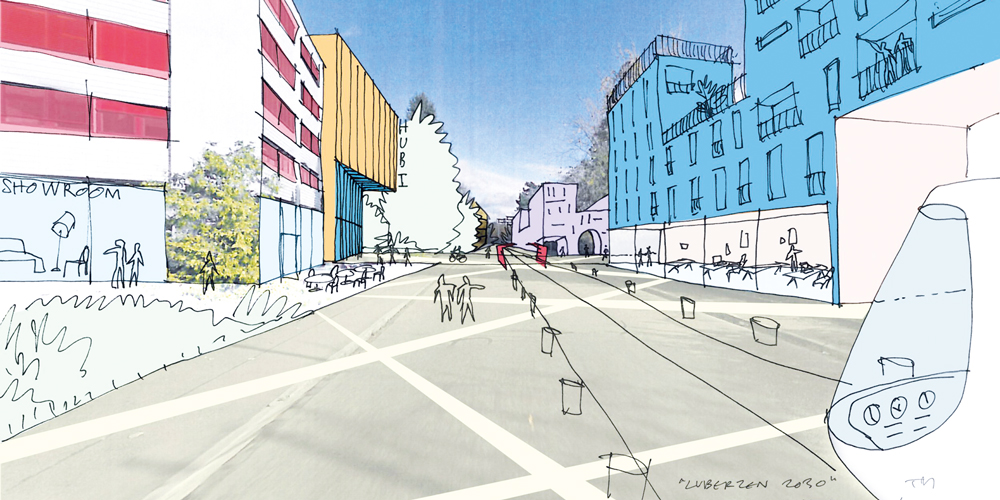
    An die Kantonsschule angrenzend ist eine Zone vorgesehen, die neben innovativem Arbeiten auch urbanes Wohnen möglich macht. Die Strasse «In der Luberzen» soll zur Flaniermeile werden, und an einer der beiden Limmattalbahn-Haltestellen ist ein Platz vorgesehen, der Urdorf-Nord mit den umliegenden Quartieren verbindet. Die Nord-Süd-Verbindung schliesst an den zentralen Platz an, der die Achse weiter zur S-Bahn-Station Glanzenberg leitet.
    Von der Maisonette über das Loft bis zur WG-Wohnung, in Urdorf-Nord soll eine vielschichtige Wohnwelt entstehen, die ein urbanes Flair hat und gleichzeitig den Dorf-Charme nicht verliert. Urdorf-Nord gehört zu den wirtschaftlich interessantesten Gebieten im Limmattal und birgt ein hohes Potenzial bezüglich Arbeits- und Wohnqualität. Die Stadt im Dorf ist topografisch wie auch verkehrstechnisch das Entrée Urdorfs im Limmattal und kann damit eine Leuchtturm-Funktion einnehmen, um innovative und zukunftsorientierte Unternehmen anzusiedeln.

    In Urdorf-Nord (www.urdorfnord.ch) soll aber nicht nur gearbeitet, sondern auch gelebt werden. Die Entwicklungsstrategie sieht vor, eine gute Balance zwischen innovativer Unternehmenskultur und urbanem Wohnen zu ermöglichen. Das Ziel ist klar: In einer umsichtigen Struktur werden sich Wohnen und Arbeiten attraktiv ergänzen, und so ergeben sich befruchtende Synergien. Darüber hinaus wird Urdorf-Nord ein optimiertes Verkehrskonzept erhalten, das den Ausbau des öffentlichen Verkehrs sowie des Langsamverkehrs gleichermassen berücksichtigt.

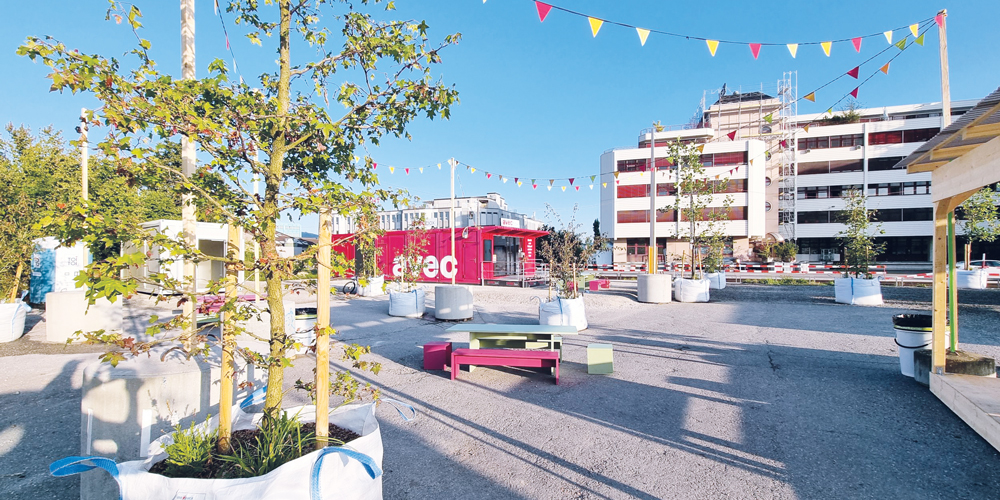
    Bereits heute ist die Stadt im Dorf erlebbar, etwa mit der Zwischennutzung #luberzenareal: Seit Mitte August 2021 bieten unterschiedliche Foodtrucks, die avec box – der modernste Convenience Store der Schweiz – und unkomplizierte Aufenthaltsmöglichkeiten erhöhte Aufenthalts- und Verpflegungsqualität.

    Die Zwischennutzung #luberzenareal lädt bereits heute zu Verpflegung und Aufenthalt ein.
    Willkommen im geplanten Urdorf-Nord.
  • Limmattal communities are committed to "room for more"

    Limmattal communities are committed to "room for more"

    The new motto “Space leads more” of the Limmatstadt AG location promotion will be adopted by several municipalities in the Limmattal and, according to the media release, will be used as a logo in the communication. Limmatstadt AG operates location promotion in the Limmattal across cantons.

    For example, since Thursday the Schlieren website has read: “Schlieren. part of the Limmat city. Room for more.” According to the statement, the large brackets around the statement symbolize the sense of unity in the region and the understanding that the Limmat Valley towns and communities have more power with a common self-image. In this way, the municipalities, together with the Zurich Planning Group Limmattal ( ZPL ), show their commitment to the region. According to the announcement, the appearance was created as a joint effort in workshops with the municipalities and the Baden agency Kommpakt .

    According to the press release, the Limmatstadt municipalities of Bergdietikon, Dietikon, Geroldswil, Schlieren, Turgi, Uitikon, Unterengstringen, Urdorf and Weiningen as well as the ZPL maintain service agreements with the Limmatstadt location promotion. Since it was founded in 2014, Limmatstadt AG has been committed to regional awareness, a common living and economic area, increased networking, sustainable development and joint positioning. At the General Assembly in August 2021 in the JED in Schlieren, the new motto “Room for more.” was approved.

  • Municipalities exchange experiences on indoor air

    Municipalities exchange experiences on indoor air

    The corona pandemic also has consequences for the management of public real estate. The property area of the city of Schlieren has been intensively concerned with the quality of indoor air in recent months. As she reports, she has now formed an indoor air experience group together with other communities. Aarau, Baden, Lindau ZH, Lucerne, Volketswil ZH and Zurich also participate in the group. The Lucerne University of Applied Sciences supports the working group. Schlieren is represented in the group by Philipp Ganz, head of maintenance in the property division.

    The experience group wants to minimize the risk of coronavirus spreading, particularly in schools and kindergartens. Various studies have found that an increase in the CO2 content of the room air also facilitates the transmission of viruses through aerosols.

    The city of Schlieren also wants to use the experience gained together with its partners in its own commercial premises. The city runs the innovation and young entrepreneur center .

  • "Where there are rails, there is a city"

    "Where there are rails, there is a city"

    The November issue of the “ Baden aktuell ” magazine makes the city on the Limmat the topic of the month. In an interview, the managing director of the Limmatstadt AG location promotion company, Jasmina Ritz, explains the vision of the Limmatstadt. This is more than just a synonym for Baden and Zurich, she is quoted as saying.

    According to Ritz, the term Limmatstadt stands for the entire region along the Limmat. Seen in this way, the Limmat Valley is not located on the edge of two cities, but in their center and forms a whole. Ritz: “This change of perspective is central. The Limmatstadt with its around 20 cities and municipalities has what many other regions do not have: space for more. "

    The fact that the Limmat Valley is now becoming the Limmat City is a logical consequence of developments over the past 20 years. One associates the idea of a classic agglomeration with the Limmattal. So industrial location, specialist stores, traffic axis. Jasmina Ritz believes that the reality is different today. With its contrasts and diversity, the region forms a spatial unit, embedded in the Limmatraum and the hills. With the Limmattalbahn, the region is also receiving an urban mode of transport. Ritz: "The Limmattalbahn turns the agglo into an attractive urban region."

    The merging of the region is also interesting for Baden. The managing director of location promotion refers to the practice: “The communities in the region are all in the same boat, so it is worth joining forces. It has little weight when the city of Baden knocks in Bern. But if an entire region presents, the pressure increases, ”she is quoted as saying.

    Regarding the canton border between Zurich and Aargau, which runs in the middle of the city on the Limmat, she says: "Political borders no longer correspond to the realities of life." The fragmentation of the region prevents greater thinking and action. However, an overall view of the competition between the regions is necessary. This becomes clear in challenges such as traffic solutions. The Limmattalbahn will open in 2022. It creates connections between places, people and workplaces beyond the canton's borders. This train is much more than a means of transport. Ritz: "Where there are rails, there is a city."

  • The borders disappear in the Limmatstadt

    The borders disappear in the Limmatstadt

    The customer magazine " blue " of the electricity works of the canton of Zurich ( EKZ ) dedicates its cover story to the development of the Limmatstadt. In conversation in Schlieren and at urban development centers along the Limmattalbahn, the managing director of the Limmatstadt AG location promotion company, Jasmina Ritz, explains the idea behind the project. “A city is emerging” is the title of the latest edition of “blue” with a photo of Jasmina Ritz on the roof of the Bio-Technopark in Schlieren. "Here we are in the epicenter of the urban development of the Limmatstadt," Ritz is quoted as saying. And: "From up here you can no longer see any boundaries."

    With this sentence and in the long conversation with the author Luc Descombes, the person responsible at Limmatstadt AG makes it clear that the advantages and strengths of the individual communities should be brought together in the common vision of the Limmatstadt. "That is why a common self-image is so central," Ritz is quoted as saying. According to the text of “blue”, at least 200,000 people live in the catchment area of the so-called Limmatstadt, depending on the perspective. In the opinion of Jasmina Ritz, this deserves “a strong joint appearance and powerful location marketing”.

    In the main story published under the second title "Vision Limmatstadt", the examples of the communities of Schlieren and Dietikon show the emergence of a "liveable city" across the canton border into Aargauische Spreitenbach. The importance of the Limmattalbahn, which is currently under construction, for regional merging is emphasized. Jasmina Ritz says: “Wherever a tram goes, urban space is created. The Limmattalbahn is crucial for the positive development of the region. "

    The EKZ's commitment in this area is made clear in "blue" with the company projects. The Dietikon EKZ hydropower station supplies 4,500 households, the Oberengstringen substation has been providing an additional 80 megawatts since 2020 and the EKZ has been laying dozens of kilometers of new lines and conduits for the Limmat Valley Railway since 2020 to strengthen the future power grid in the Limmat city. "Blue" appears twice a year with a circulation of 300,000 copies throughout the canton. The magazine goes to every household.

  • Schlieren drives the upgrading of Kesslerplatz

    Schlieren drives the upgrading of Kesslerplatz

    The Migros Pension Fund's investment foundation has presented a design plan for Kesslerplatz. After the transfer of the private design plan from the local council to the local parliament, "the city of Schlieren will soon come a big step closer to its goal," as a media release said.

    As part of the planned upgrading of the square, the high-rise is to be preserved. The design plan also provides for four new structures. One of them is intended for commercial use, the other three are intended to provide living space. A total of 103 new apartments, a double kindergarten and a multi-purpose room are to be created as a result. For the realization of the kindergarten, the city of Schlieren has agreed with the investment foundation of the Migros pension fund both an exchange of land and compensation of CHF 2.11 million.

    Work is scheduled to begin in spring or summer 2022, and move-in is to take place from spring / summer 2024. Since the double kindergarten will not be available until a year later, “the Migros Pension Fund's investment foundation will cover 50 percent of the rental costs for a temporary arrangement, the remaining rental costs are also included in the compensation”, according to the city of Schlieren.

    With the upgrading of Kesslerplatz, a “high-quality and attractive entrance gate” to Schlieren should be created, which will also be optimally connected to the Limmattalbahn.

  • Dietikon relies on location advertising with comedian duo Lapsus

    Dietikon relies on location advertising with comedian duo Lapsus

    The city of Dietikon relies on humor in its location advertising. According to a media release, the well-known Dietiker comedian duo Lapsus has therefore received the order to subject their residential area to a critical examination and to record their impressions. It is said that funny, self-deprecating video productions were created.

    The videos can now be viewed on YouTube, Facebook and Instagram. The first is entitled “Dietikon from its most beautiful side”. Dietikon is presented as a noisy and urban city with idyllic green areas as the train passes by. The second video introduces the open-air gallery “DietikON – experience light art”, which will run until the end of February, with humorous puns. Further topics are planned.

    The core of the campaign, which will last in May, is self-irony, according to the media release. The plan is to publish six to seven videos, which will make the qualities and location advantages of the city visible and promote the city's positioning as a center for business, culture, education, local recreation, sport and leisure.

    It is emphasized that the topics have been discussed with the city. The comedians are free to implement it.

  • Limmatstadt AG is now based in Schlieren

    Limmatstadt AG is now based in Schlieren

    The Limmatstadt AG location promotion organization has moved from Zurich to Schlieren. With the new year she is now based in JED , the former NZZ printing company. From the new premises within the Coworking Space Branch Collab on the ground floor of JED, managing director Jasmina Ritz and her employees will continue to campaign for the Limmattal location and are now even closer to the pulse of the region, as a message shows .

    In JED with anchor tenants such as Zühlke and Halter , innovations are promoted and jobs are created. The Coworking Space Branch Collab also contributes to this with its flexible workspaces and as a platform for collaborative work. The companies and entrepreneurs based in JED as well as Limmatstadt AG benefit from the easy accessibility via the Limmattalbahn (Wagonsfabrik stop).

  • Limmattal Spital is allowed to acquire additional areas

    Limmattal Spital is allowed to acquire additional areas

    After the vote on Sunday, the Limmattal Hospital Association has several years of planning security for future extensions and additions to the Limmattal Hospital . With 87.1 percent, those eligible to vote from the eleven supporting communities of the hospital association voted in favor of the purchase of the Sandbühl property in Schlieren. According to a media release , the property, which consists of three parcels, is directly adjacent to the existing hospital area with an acute hospital, care center and rescue service base in the northeast. This enables future-oriented, forward-looking and sustainable planning of the Limmattal health center, it says. Those eligible to vote followed the unanimous vote of the delegates' meeting on September 23 with their yes to long-term site planning. The purchase price is around CHF 15 million.

    The Limmattal Hospital ensures basic medical care for over 77,000 patients every year. With the new building from October 2018, it has 188 beds, eight operating theaters and eight intensive care places. According to the announcement, 1480 employees from 49 nations are currently working in the hospital.

  • EKZ supplies the Limmat Valley with a further 80 megawatts

    EKZ supplies the Limmat Valley with a further 80 megawatts

    With the facility in Oberengstringen, the electricity works of the canton of Zurich (EKZ) put their third substation in Limmat Valley into operation. The Limmattal is now supplied by the three substations Schlieren, Dietikon and Oberengstringen. The new substation with an output of 80 megawatts will gradually be put into operation by next February.

    "This means that we are very well prepared for the steadily growing energy demand in the region", Hans-Peter Häberli, Head of Construction and Systems at EKZ, is quoted in an interview . The economic upswing in the Limmattal with the settlement of new companies, a large data center and the Limmattalbahn is causing the demand for electricity to rise sharply. Häberli: “We have generally seen strong increases in load in the Limmat Valley over the past few years. In the future, the energy demand will be driven by the Limmattalbahn and the establishment of a data center in the region. The Schlieren substation, which previously supplied the region with energy, must therefore be relieved. Its capacity would soon no longer be sufficient. "

    The electrical energy is converted in the new substation. In the case of Oberengstringen, EKZ takes over the electricity with a voltage of 110 kilovolts from the Axpo high-voltage network. The energy is converted to 16 kilovolts with two 40-megawatt transformers, according to the EKZ website. After that, the electricity would be further stepped down until it is fed into the grid for end users such as housing estates.

    The connection of the new plant is to take place gradually by February. According to Häberli, Oberengstringen will then be fully connected to the Axpo high-voltage network. The communities of Ober- and Unterengstringen, Weiningen and parts of Schlieren are then supplied.

  • An elevated railway for Silbern and the Niderfeld

    An elevated railway for Silbern and the Niderfeld

    The innovative project of the interest group (IG) Hochbahn Silbern, founded in May 2018, is campaigning for a transport solution high above the tracks between the Silbern districts that are relevant for Dietikon and Niderfeld, which is still under development. Because the SBB shunting terminal forms a barrier between the two parts of the city. The elevated railway would secure the direct connection between the S-Bahn station in Silbern and a station of the Limmattalbahn in Niderfeld. This would give the Silbernquartier a connection to the Limmattalbahn, and the approximately 2000 future residents and workers of the Niderfeld-Quartier could easily reach the shopping infrastructure and a possible S-Bahn station in Silbern.
    Behind IG Hochbahn Silbern are representatives of the Silbern and Niderfeld areas as well as Limmatstadt AG and the city of Dietikon. The IG is chaired by Beny Ruhstaller, Association of Landowners Niderfeld Dietikon (VGND). The elevated railway is to be completed in the next 8 to 15 years. The project was classified as relevant for the Limmat Valley. That is why the Silbern elevated railway was included in the Limmattal Regional Project Show as a project worthy of funding. It is already clear what the automated cable-drawn elevated railway might look like. With its possible futuristic design, the elevated railway would not only be an attraction in the Limmat Valley, but would also offer the desired cross-connection. Cable cars have also proven themselves in other places in Switzerland. For example, the Polybahn in Zurich, the Rigiblick cable car or the Lugano light rail.

    The Hochbahn Silbern has meanwhile developed from a vision to a concrete project. The feasibility was checked and classified as feasible – the route and possible stops have already been narrowed down. The route should be between 607 and 637 meters long. With a travel time of around 2 minutes, the elevated train could transport 700 to 750 people per hour. The discussions that have taken place so far with the SBB and the Garaventa cable car company, who regularly take part in the IG Hochbahn Silbern meetings, have so far been very promising. The costs are estimated at around 20 million francs. Operation should be fully automated and not require any on-site personnel.

    According to IG Hochseilbahn Silbern, support from the city authorities is now required to advance the project. In addition, the elevated railway must be integrated into the Niderfeld district plan – with a possible land separation for the stations and the tracks on both sides. In the near future, the project is to be further concretized with a potential analysis and the cost planning and technical feasibility checked. This is followed by the submission to the Federal Office of Transport. ■

  • Letzibach D: Three autonomous building parts from three different clients

    Letzibach D: Three autonomous building parts from three different clients

    The new Letzibach D building will be built in Zurich-Altstetten between 2021 and 2025. The city of Zurich acquired the 10,000 square meter area from SBB in 2014. The area has the open track field on the north side and the busy Hohlstrasse on the south side. 250 non-profit apartments are to be built here under the supervision of the property management company, the Retirement Homes Foundation and the Apartments for Large Families Foundation of the City of Zurich. The three builders are each planning a third of the construction volume. This creates three autonomous parts of the building with their own entrances.

    The area development is designed for a utilization of 318 percent. The required density can only be achieved using high-rise solutions. Gut & Schoep Architekten GmbH and Neuland Landschaft GmbH from Zurich are responsible for the plans. A 60-meter-high building with 24 floors and a memorable urban silhouette as well as an eight-story, elongated building that opens in a U-shape towards the track field is planned. A small town square will also be created at the intersection of Hohlstrasse / Flurstrasse.

    The building protrudes to the west of Hohlstrasse and continues the street space of the adjacent Letzibach C development. In the north it bends again at a right angle and thus forms the end with the high-rise. The low, contiguous eight-story part of the building houses the 53 apartments of the Apartments for Large Families Foundation and the 81 apartments of the City of Zurich properties. The apartments in the flat part of the building offer south-facing kitchens as well as north-facing living rooms – some with inner circular routes or with spacious entrances. Retracted balconies between the eat-in kitchen and living room are intended for the 131 retirement homes. These apartments of the Foundation for the City of Zurich Housing for the Elderly are to be built in the sixty-meter-high tower. The concrete facade of the building should ensure durability and economical maintenance. ■

  • "We are on course on all construction sites"

    "We are on course on all construction sites"

    The first stage of the Limmattalbahn between Zurich Farbhof and Schlieren Geissweid has been in operation for over a year. The tram is well accepted and used extensively. “There is hardly any distinction between 'old' and 'new' routes,” says Oliver Obergfell from the VBZ media office. The Grüntrassee also made a very good impression after one year of operation. On average, around 5000 people use the Schlierem stops during the week – this roughly corresponds to the number of passengers on the former bus route 31. The Limmattalbahn (LTB) AG is also satisfied with the operation. "So far we have hardly had any complaints with regard to the infrastructure," says managing director Daniel Issler.


    The second stage of the Limmattalbahn between Altstetten station and Zurich Farbhof and between Schlieren Geissweid and Killwangen-Spreitenbach has been under construction for a year. Here, too, everything is going according to plan: “The construction work is making very good progress. We are on course or even a little faster on all construction sites, ”says Issler. There are currently no signs of a cost overrun. The overall project manager also sees himself confronted with challenges: "In the second stage, construction work will take place over a length of around 10 kilometers at the same time." Then there are the large structures such as the Färberhüsli tunnel in Schlieren, the underpass at the Dreispitzkreuzung in Dietikon and the ramp structure in Killwangen.

    A bus line could not cope with the increasing number of passengers
    The construction of the Limmattalbahn is associated with restrictions and immissions for residents, entrepreneurs and road users along the route. LTB AG is aware that the construction site of the Limmattalbahn will cause some inconvenience. “We are therefore trying to build as quickly as possible in order to reduce the restrictions to a minimum. If someone contacts us with a concern, we endeavor to find individual solutions, ”says the managing director. Issler once again emphasizes the benefits of the continuous Limmattalbahn from Zurich Altstetten to Killwangen-Spreitenbach: "Public transport is being strengthened – the Limmattalbahn is a supplement to the existing S-Bahn and enables a continuous and reliable travel chain." The much-brought-up argument of the Limmattalbahn opponents – that an expansion of the existing bus networks in the region would have been enough and would have come more cheaply – is invalidated by the head of LTB AG: “The Limmattal is developing rapidly. Many innovations are still to come. A bus route could not cope with this growth. In addition, a bus always runs the risk of getting stuck in a traffic jam. "

    The announcement of the Limmattalbahn has already triggered numerous construction activities along the route. Old buildings are being renewed, new commercial and residential buildings are being built. Issler expects this trend to continue and even intensify. The growth also exacerbates the already existing traffic problem in the Limmat Valley. Can the Limmattalbahn provide a remedy here? “One of the goals of the Limmattalbahn is to absorb most of the additional traffic caused by public transport. Since measures for individual motorized traffic are also being implemented at the same time, we are confident that road traffic will also become liquid as a result, ”says Issler.

    The second stage should be completed in mid-2022. This is followed by test drives. Official operations are scheduled to begin when the timetable changes in December 2022. Then the Limmattalbahn covers a distance of 13.4 kilometers at an average speed of 22 km / h: from Zurich Altstetten via Schlieren, Urdorf, Dietikon, Spreitenbach to Killwangen. The tram stops 27 times and has a capacity for 260 passengers. The cantons of Zurich and Aargau, as well as the federal government, spent a total of 755 million francs on the first two stages.

    The Aargau government is currently working on plans for a third stage: from Killwangen-Spreitenbach to Baden. In late summer 2020, the Grand Council decided to keep the route clear and to raise the continuation of the tram route in the cantonal structure plan from the previous status of “preliminary orientation” to the level of “interim results”. The extension of the Limmattalbahn thus has a good chance – but a few hurdles still have to be overcome before a final decision can be reached. The start of operations for the last stage, if it is actually implemented, is not expected before 2032. ■

  • The Villa Langmatt Museum is to be preserved

    The Villa Langmatt Museum is to be preserved

    The Langmatt Museum in Baden is unique in the Swiss museum landscape. The art nouveau villa of the industrialist couple Sidney and Jenny Brown-Sulzer houses an exquisite art collection by French impressionists. It was put together at the beginning of the 20th century with a lot of personal passion. The unmistakable charm of the villa lies in the presentation of outstanding images from art history in historical living rooms, surrounded by an idyllic park, says Markus Stegmann, director of the Langmatt Museum, describing his “workplace”.

    The Langmatt Foundation announced in a statement that the cantonal protected property must be renovated and that the operation must be put on a financially sound basis. While the foundation is restructuring its operating finances and thus ensuring operation and maintenance, the city makes recurring contributions to the repair of the property with the help of the canton and third parties.

    Clear distribution of responsibility
    With this partnership approach, the important cultural institution could be led into the future. The strategy motto is: "Jewel for everyone." The aim of the strategy is to preserve the Langmatt as a unique institution and a living witness of industrial, social, collection and architectural history. The core of the strategy is a clear distribution of responsibility between the city and the foundation: As the founder and sole heir, the city makes a substantial contribution to the renovation of the property, which is estimated at around 17.2 million francs (+/- 25%). As the operator of the museum, the foundation is restructuring its operating finances on a sustainable basis.

    At its meeting on June 3, 2020, the residents' council of the city of Baden decided to implement the “Langmatt Future” strategy in order to secure the future of the museum. In other words: the foundation takes over the lead for the repair and the costs of the planning up to a construction project. In order to carry out the construction project, the city council and the foundation council plan to found a stock corporation in which the city will hold a substantial share. It should raise the additional financial resources to cover the operating costs.

    Sale of pictures for the necessary return on investment
    For the long-term renovation of the foundation's capital, which was too small from the start, a targeted sale of one to three works is necessary, which, however, does not affect the core of the collection, emphasize the project managers. From the proceeds of around 40 million Swiss francs, the foundation generates the capital income it needs to secure its operations in the long term. “A step that is painful, but without any alternative, that will secure the future of the museum,” emphasizes Lukas Breunig-Hollinger, President of the Langmatt Foundation. "The Langmatt will be preserved as a historical ensemble, as a place of Baden's identity and as a living witness to the history of industry, collections and architecture," says Markus Stegmann, director of the Langmatt Museum. With its regional roots, the Langmatt will strengthen its international presence in the future.

    Two-year construction planning phase
    The main innovations include the year-round museum opening, an improvement in the entrance area with cash register, shop and cloakroom, a lift for barrier-free access and a filigree pavilion for events. The next stage is a two-year construction planning phase with the aim of specifying the cost accuracy of the repair. This is a key requirement for the required referendum, which is expected in 2023. If the template is approved, the next step is to sell the pictures. Repairs to the museum could begin in 2024, and Langmatt could reopen in 2026. ■

  • Mammoth project in Niderfeld

    Mammoth project in Niderfeld

    The Niderfeld is located in the northeast of the Dietikon municipality and partly borders on Spreitenbach. With around 40 hectares, Niderfeld is Dietikon's last large reserve of building land. And good things take time: The planning of what the area used for agriculture up to 1890 will look like in the future has been going on for around ten years. Around 3000 people will one day live here and another 4000 people will work. The association “Landowner Niderfeld Dietikon” (VGND), founded at the end of 2012, is behind the project. This accompanies the development in the Niderfeld, promotes the interests and concerns of the landowners and represents them to the authorities. The three largest owners are Planzer Transport AG, the city of Dietikon and Josef Wiederkehr AG from Dietikon.

    In the course of time, applications have been made twice to convert all or part of the Niderfeld into an industrial zone. Both times the applications were rejected: first by the municipal council and then at the ballot box. In 1995, in the cantonal structure plan, Niderfeld was assigned cantonal importance as a central area. Settlement parts with a high structural density as well as recreation areas are prescribed in a central area. The aim is to create an attractive economic location with good access to public transport. At the beginning of 2002 the city of Dietikon turned to the regional planning of Zurich and the surrounding area (RZU) with the aim of finding a politically viable zoning. This should allow an orderly structural development based on an overall concept. In addition to representatives of the city and municipal council, landowners, business organizations, representatives of the canton of Aargau, ideational organizations and residents of Dietikon also took part in the Niderfeld open planning process. This ensured that all interest groups were represented and could contribute accordingly.

    This resulted in two rough concepts: One provided for an access network that was largely adapted to the existing parcelling. The second sketched the creation of a park along the Teischlibach, which divides the Niderfeld into a work area in the west, a park in the middle and a residential / mixed area in the east. In 2010 the zoning draft finally became legally binding: the core elements of the new zones are the mandatory design plan and the requirement for an eight-hectare city park. The urban planning concept developed in 2013 formed the basis for the subsequent design and district plans. The master plan was finally approved by the city and municipal council in 2015 and submitted to the landowners and the public for consultation. The Dietikon City Council initiated the district plan procedure at the end of August 2017. After that, the landowners had to agree on various parameters and the redistribution of the land. The design and neighborhood plan, the revision of the building and zoning regulations plus the Teischlibach hydraulic engineering project were submitted to the canton for review in mid-2020. The answer is still pending.

    This is what the new quarter should look like
    The large, central park forms the heart of the Niderfeld district. Quiet park islands, play areas, residential gardens and spacious lawns are planned and are intended to attract people from the surrounding area. Around the park there is a mixed area along the route of the Limmattalbahn, a residential area on the northern edge of the park and a work area in the west towards Mutschellenstrasse. For reasons of noise protection, the mixed area towards the Ueberlandstrasse forms a largely closed development. The residential part should consist of smaller building units, the height of which is graded towards the park.

    The entrance to the new city quarter is marked by the Torplatz at Dreispitz, where a stop for the Limmattalbahn is planned. The residents of Niderfeld should find restaurants and various shops at Torplatz. To the east is the neighborhood square, which is intended to serve as a play and meeting point for the residents. Another space will be created at the second tram stop at the intersection of the workplace and mixed area. The Limmattalbahn runs along the boulevard on its own route. In addition, a dense network of paths for bicycle and pedestrian traffic is to be created. The depot for the Limmattalbahn is planned to the west of Mutschellenstrasse. The residential and mixed zones of the Niderfeld will be designed as a 30 km / h zone. The road network is designed in such a way that there is no crawl traffic from the workplace area in the west to the mixed and residential area in the east.

    So far, the city has received financing loans of over CHF 1 million – the planning effort turned out to be greater than expected and due to the high density of regulations there are still many hurdles to be overcome. The desired elevated railway from Niderfeld to Silbern is also still in progress. Construction is scheduled to start in 2028 at the earliest. ■

  • The new “LimmiCura” care center is under construction

    The new “LimmiCura” care center is under construction

    On the site where the high-rise building of the old Limmattal Hospital from 1970 stood until the end of 2019, the new “LimmiCura” care center will be built from 2020 to 2023. In order for the Limmattal Hospital Association to begin implementing the project, the consent of the population was required. This approved the required loan of 65 million francs. The care center, including the day center, three long-term care wards with palliative beds and a rehabilitation floor, is to have 116 rooms: 73 single and 43 double rooms. The new building will have five floors and will be implemented by the architects' office fsp in Spreitenbach. Architecturally, “LimmiCura” is based on the Limmattal Hospital, which was newly opened at the end of 2018. A dementia department with its own garden and a rehabilitation station on the 5th floor with 48 beds are planned. The day center will be located on the ground floor next to the dementia department. The inner courtyards will be accessible. The nursing department is located on floors 2-4. The "LimmiCura" should open in the first quarter of 2023. ■

  • Apartments close to the center on the brewery area

    Apartments close to the center on the brewery area

    The premises of the H. Müller AG brewery and the Burger heirs are directly adjacent to the Baden train station and are within walking distance of Baden's old town. Beer has been brewed on the site since 1897. Today the areas are densely built with commercial uses. The brewery H. Müller AG intends to build the centrally located company
    to develop the area and to make better use of it. The area to be built corresponds to the size of a football field. Five multi-storey buildings with 145 apartments are planned, offering space for around 250 people as well as various commercial spaces and services. Plots A, B, C and E are in the planning phase. The brewery garden and beer production will be retained. Likewise the malt silo, the boiler and brewhouse, which are classified as historical. A beer hall is to be built next to it. The logistics, operation and administration of the brewery are outsourced to Lupfig. Otherwise the area will appear almost completely new.

    Apartments close to the center
    In addition, the Burger Heirs are planning an increase in the building adjoining the brewery garden to the south. The realization of apartments close to the center as well as the preservation of the brewery garden and the new connection through the future Brauereigasse were essential public interests, for which the city was committed. For the implementation of an overall project that was convincing in terms of urban planning, architecture and marketability, the preliminary work was ultimately transferred to the present design plan. The builders – the H. Müller AG brewery and the Burger heirs – expect that the first planning applications can be submitted in the course of autumn 2020. ■

  • Urdorf-Nord: From the workplace to the town in the village

    Urdorf-Nord: From the workplace to the town in the village

    There is a master plan for Urdorf-Nord, which aims to lead the economically and urban-planning important economic area into a modern and attractive future. The district is currently struggling with structural difficulties that have led to considerable vacancies and poor quality urban space. Although the economic area is one of the most important job areas in the Limmattal, the attractiveness of the location still has potential. Urdorf-Nord scores with its location: the economic area is ideally accessible thanks to the motorway connection, the Limmattalbahn, which is currently under construction, and the Glanzenberg S-Bahn station.

    The thrust is clear: to generate a prudent structure of uses that are mutually beneficial. At the same time, Urdorf-Nord benefits from structural densification and the creation of high-quality public spaces. In addition, the development is taken into account with an optimized traffic concept – including an expansion of public and non-motorized traffic. The new economic area Urdorf-Nord – which, topographically and in terms of traffic, forms the entrance to Urdorf from the Limmat Valley – is intended to attract innovative and future-oriented companies. The proximity to the cantonal school and the Limmattalspital as well as the Schlierem biotech cluster should be particularly attractive for companies in the education and health sectors.

    The coordinated master plan should convey a common development idea to the landowners. Due to the necessary adjustments in the building and zoning regulations (BZO), this will later become legally binding. The possibilities provided by the master plan have already been anchored in the cantonal structure plan. The structural densification is intended to create a district – the town within the village – with a novel, attractive character and relieve other areas of the pressure from settlement.

    The plan provides for a representative zone adjacent to the canton school, in which urban living is now possible in addition to work. A slow traffic axis enhances the connection to the center of Urdorf in the south. The street in the Luberzen, which forms the pulsating artery of the new quarter, is to become a promenade. A space is planned at the Limmattalbahn stop in the Luberzen to connect the northern economic area with the surrounding quarters. The newly created north-south connection connects to the central square, which, like a hinge, guides the axis on to the Glanzenberg S-Bahn station. Bike stations will also be placed at the Limmattalbahn stops.

    As part of a BZO revision, this strategy is expected to be presented to voters in 2023. By then, specific developments are already planned, on the one hand the communicative positioning of Urdorf-Nord as “the town in the village”, on the other hand forms of temporary use to upgrade public space and, as a result, above all an improvement in the quality of stay and catering. ■

  • Star architects are building on Lindenplatz

    Star architects are building on Lindenplatz

    The list of her previous buildings includes the Elbphilharmonie in Hamburg and the Tate Modern in London. And now the Basel duo Jacques Herzog and Pierre de Meuron is building on Lindenplatz in Zurich-Altstetten. Between 2022 and 2024, the Badener-
    Strasse and Segnesstrasse the existing houses will be demolished and replaced by new residential and commercial buildings. Altstetten has many old and relatively low buildings. The potential for compression is great here. Especially in view of the fact that the city of Zurich is forecast to grow from 434,000 today to 516,000 in 2040. With good transport links and the need to renovate old buildings, Altstetten offers optimal conditions for projects like this one.

    At Badenerstrasse 682-690 and Segnesstrasse 8-12, a total of six new buildings are to be built over the next four years. The houses should be perceived as a collection of big and small, high and low. On celebrity
    A 30 meter high building on the corner of Badenerstrasse Segnesstrasse will stand out; it should enter into a dialogue with Lindenplatz and, in terms of urban planning, fit into the chain of high-rise buildings along Badenerstrasse. The owner writes in the building specification: "The project builds on the location-specific quality of Zurich townhouses and tries to achieve an urbanity appropriate to the location by means of a dense and at the same time open, small-scale ensemble of houses."

    A total of 72 apartments are planned, 38 of which are rental apartments in the front area and 34 condominiums around the green inner courtyard. Commercial space on the ground floor and a parking garage with 31 parking spaces complement the new buildings. The flat roofs are equipped with photovoltaic systems. The owner is Senn Resources AG from St. Gallen. The building application was submitted at the end of April 2020. ■

  • From the Limmat Valley to the Limmat City: The enviable development of a region

    From the Limmat Valley to the Limmat City: The enviable development of a region

    The Limmat Valley has changed like hardly any other region in Switzerland over the past few decades. Since the 1960s, the predominantly rural villages have been transformed into what is now a coherent urban landscape, embedded in a spacious landscape of forests, hills and recreational areas along the 36-kilometer-long Limmat.

    From the Limmat Valley to the pulsating urban landscape
    The transformation started with the economic boom of the post-war years. In Zurich's Limmat Valley, the population doubled between 1950 and 1960. The enormous boom was also reflected in large infrastructure buildings: the A1 motorway including the “Fressbalken” – the world's largest motorway bridge restaurant at the time – and the first shopping temple in Switzerland, the Shoppi Tivoli in Spreitenbach.

    The intensification of de-industrialization from the 1980s onwards led to major upheavals in the Limmat Valley: On the one hand, jobs were created in the service sector, especially in the cities, which further fueled population growth. At the same time, the region suffered from this transformation. Traditional industrial companies had to restructure or even give up. The resulting industrial wastelands were initially unpleasant contaminated sites. It was not until the 1990s that their potential as mixed urban areas was recognized. In another wave of urbanization, they were developed into new city quarters. Examples of this are the conversion of the Wagi or Färbi area in Schlieren or the Limmatfeld in Dietikon: where the Rapid company used to produce agricultural machinery, a new district has been created on an area of 89,000 m2.

    An important piece of Switzerland
    Today the region has well over 200,000 inhabitants and 80,000 jobs, and the trend is rapidly increasing – also thanks to the preferred location at the gates of Zurich and the proximity to leading educational and research institutions. The present and future are shaped by the pioneering spirit of the industrial culture past, which is reviving in many traditional companies and in the enormously developing start-up scene. In addition, the emerging urban landscape and the rich industrial heritage leave a lot of space for design and development. At the same time, idyllic local recreation areas can be found in the immediate vicinity of pulsating urban spaces in the Limmat Valley. These include the Limmat or the green valley flanks, which can be reached within a very short time from anywhere in the Limmat Valley. All of this contributes significantly to the unique character and attractiveness of the region.

    The future prospects are also extremely promising. On the one hand, the growth forecasts are intact. On the other hand, the region is once again experiencing a major upgrade thanks to the Limmattalbahn. The tram will connect Zurich, Schlieren, Urdorf, Dietikon, Spreitenbach and Killwangen with each other from December 2022. A continuation to Baden is being planned. The light rail network networks the region closely beyond the canton's borders and is the driving force behind numerous urban development projects.

    Far-sighted development as a necessity
    With this in mind, foresight is now more important than ever. Only with a regional understanding and coordinated planning does growth lead to a better quality of life. How can that be achieved? The growth should concentrate on the new urban focal points in the valley floor, where urban life should pulsate with high density and intensity in attractive public urban spaces. As a result, local recreation areas along the Limmat and especially on the valley flanks on the right bank of the Limmat can be protected. Instead of a random collection of settlements and communities, the Limmatstadt is to develop into an attractive urban area with supra-regional charisma embedded in the local recreation area.

    Limmatstadt AG: A powerful location promotion for a strong region
    Limmatstadt AG is consistently committed to networking the entire region and creating regional awareness. In particular, it wants to make their advantages and potentials better known both internally and beyond the region.

    It is of central importance to join forces and strengthen the interaction between politics, business and society. This is the only way to ensure sustainable development and positioning. Until recently, there was no perspective on the region as a whole: Promotion of business locations ceased in the middle of the Limmat Valley, on the canton border. Only the creation of Limmatstadt AG in 2014 closed this gap.

    The location promotion organization was created on a private initiative and is organized as a stock corporation. It is broadly anchored in the entire region with 160 corporate and public shareholders and is supported by 13 commissioned municipalities and the planning association of the Zurich planning group Limmattal. The network is growing and having an impact: It bundles strengths, promotes diversity, increases competitiveness and releases potential.

    Limmatstadt AG is much more than a business network. It also provides a wide range of options for culture and society, always with the aim of creating awareness for the region. In addition, it addresses the urban development of the region and campaigns for sustainable development. ■

  • Regional 2025 – projects for diversity

    Regional 2025 – projects for diversity

    The Limmattal – a diverse, coherent mosaic
    Despite urban thrusts, the development and the initial situation are not the same everywhere. For example, Spreitenbach and Neuenhof are changing from the formative 1970s modernism to more urban locations, but the dynamic cannot be compared to Schlieren, for example, until now. Wettingen is also discussing densification, and the concept of the garden city, which has been so formative up to now, is being questioned.

    It looks completely different on the right bank of the Limmat. The communities with their large single-family house areas look in amazement at the other side of the valley and watch the development from a distance. They are still villages and want to stay that way. This heterogeneity of the Limmat Valley, which can be interpreted as a difficulty, is above all its strength. In addition, with the formative landscape there is a kit that holds these pieces of the puzzle together. Above all the Limmat as namesake and identity bearer, as a unifying force of nature that meanders through the valley. But “spaces in between”, such as the Sulperg-Rüsler or Hüttikerberg-Sandbühl landscape corridors, are becoming increasingly important and are developing into a park landscape.

    "City" is only of limited use as a guiding term for this diverse fabric and does not do justice to the differences in places and the role of the landscape as a framework for the whole. Experts therefore speak more of “urban landscapes” in order to do justice to this phenomenon. That is why the edge of the block, the square and the boulevard, as tried and tested city elements, are not always the cure-all. In doing so, it is often not considered that this does not correspond to the complex social, economic and spatial structures of the Limmat Valley. The implementation of this idea can be seen, for example, in the Limmatfeld, where the new structures have so far represented an island in the context of the surroundings and have not yet been able to form the desired lively center beyond the railway.

    These new city modules are definitely a good contribution to the discussion about the future of the Limmat Valley, but they ignore many of the realities of the existing Limmat Valley and the sensitivities of the population. The starting point in the Limmat Valley is too complex to take just one approach. Industrial wastelands such as the Rietbach area in Schlieren or the Limmatfeld for consistent new urban building blocks are practically no longer available. Everything that is now added in the course of the consolidation must deal with the existing. The further construction of the Shoppi Tivoli in Spreitenbach requires different strategies than the densification of Wettingen or Neuenhof. And the strategies for the further development of the villages to the right of the Limmat require completely different recipes.

    Overcoming boundaries – spatially and thematically
    The whole thing becomes interesting in the combination of different strategies for the long-term further development of the Limmat Valley. In the longitudinal direction, the Limmattalbahn establishes the linear connection with high-density nodes along the stops. It is also exciting when the cross-connections are considered. So far, hardly trained, they have the potential to form completely new gravity lines: both in built-up space and in the landscape. The axes such as Schlieren-Unterengstringen or Dietikon-Fahrweid-Geroldswil, like the landscape corridors, offer an opportunity to connect the differences spatially and socially and to enable a new interaction across the longitudinal barriers.

    This is also of great importance within the towns and cities themselves. Examples of this are various plans and concepts that must be pursued further: Schlieren would like to link the rapidly emerging new districts on both sides of the railway with the existing districts and the village center. In Dietikon there is the idea of a connection between Silbern and Niederfeld. Spreitenbach would like to extend the central axis as far as the Limmat, and Neuenhof is developing transversely to the main axis into “Neuenhof am See”. This requires new connections and bridges over the railway, the Limmat or over roads. These are not only spatial connections, but also bring long-term residents and newcomers closer to one another.

    Growth and change therefore not only affect the areas of construction and mobility, but all areas of life of the population: The everyday life lived across borders is already reflected today in work, living and leisure behavior as well as in mobility and consumer behavior. What began with a visit to the Shoppi Tivoli in Spreitenbach in the 1970s will intensify with the construction of the Limmattalbahn and result in further investments. The cantons of Zurich and Aargau have therefore decided, together with 16 cities and municipalities in the Limmat Valley, to actively shape the development across borders using a new format. To this end, they founded an association in 2015, the “Regional Project Show Limmattal”.

    To cope with the challenges and also to alleviate the “growing pains” in the Limmattal, the Regionale 2025 is pursuing a thematically broad approach which, in addition to the classic spatial planning issues, also includes the areas of culture and society. ■

  • The “Pfaffechappe” school house will be transformed into a primary school

    The “Pfaffechappe” school house will be transformed into a primary school

    A look back at the past: The “Pfaffechappe” school complex was built in 1973/74 as one of the largest school buildings in the Baden elementary school. The “Pfaffechappe” school house is to be extensively renovated in the summer of 2021 after the secondary school has moved to the new secondary school center in Burghalde and converted into a purely primary school building.

    The architects describe the renovation of the outer shell of the “Pfaffechappe” school complex as follows: “The closure of the two currently covered entrance / break areas and
    The relocation of the entrances to the place of the three stair towers clarifies the relationship between the school and its surroundings and creates an inviting, attractive and clear entrance area. In addition, the new entrance situation is integrated into the spatial sequence from the school building above.
    area up to the river basin integrated. "

    The work will be completed by summer 2023. At the meeting on December 11, 2018, the city of Baden wrote in a press release that the project loan for the renovation and renovation of the “Pfaffechappe” schoolhouse was approved. The residents' council will rule on the construction loan in December 2020, and in March 2021 the people will vote on the "Pfaffechappe" construction loan. ■