Tag: Logistik

  • New competence centre strengthens logistics and flooring solutions in Oberhasli

    New competence centre strengthens logistics and flooring solutions in Oberhasli

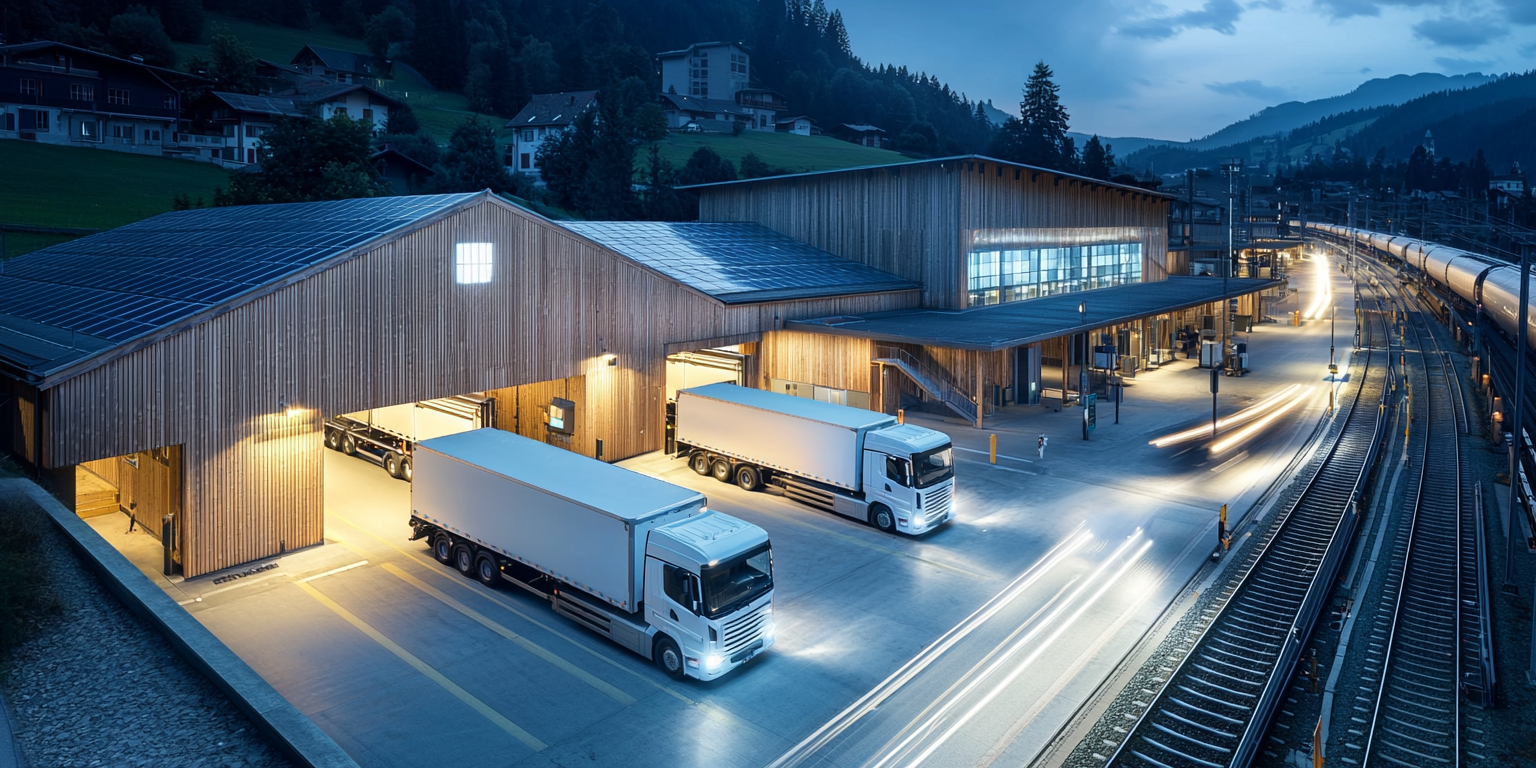
    SHARKGROUP AG, a specialist in flooring solutions from Oberhasli, is moving into its new centre of excellence in Oberhasli together with Dietiker Planzer Transport AG. As Planzer reports in a LinkedIn post, the two companies will now be pooling their expertise under one roof. While Planzer will take over SHARKGROUP’s logistics on the 4000 square metres of warehouse space, SHARKGROUP will be able to use the new location to drive its growth and further expand its range of services.

    The competence centre covers an area of 10,000 square metres and has a 3,000 square metre solar installation on its roof. It also enables companies to travel short distances and reduce CO2 emissions during transport, which is a step towards sustainable logistics.

    As SHARKGROUP explains in a press release, the new site will enable the company to further strengthen its presence in the Zurich region and improve the availability of its product range. In addition, the expanded capacity and exhibition space will create more room for personalised support and services. “We are proud of the growth of our group and of being able to offer our customers even greater proximity and service in future,” says Managing Director Moritz Mühlebach, CEO of SHARKGROUP. “This project is an expression of our entrepreneurial vision and our ambition to play an active role in shaping the industry.”

  • The Landolt site in transition

    The Landolt site in transition

    What significance does the development of the Landolt site have for Glarus as a business location? What specific impetus do you expect for the local economy and the creation of new jobs?
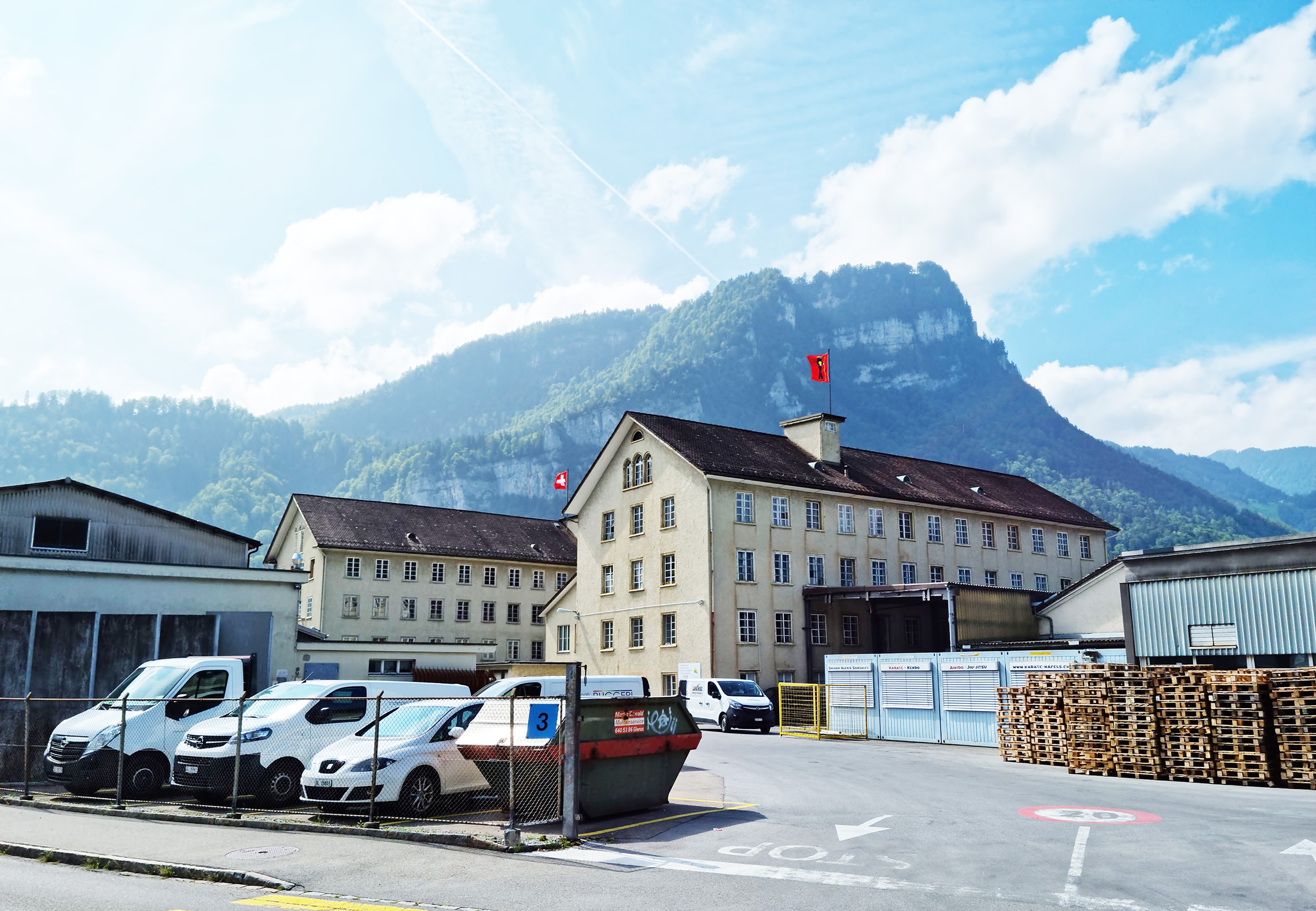
    The site is already well utilised with many different SMEs. When the Landolt company moves out in the medium term, the old stock will be freed up. The Shedhalle, which we have already renovated and equipped the roof with a large PV system, is particularly interesting. We are in the process of attracting new tenants and offer a very attractive location with optimal logistics connections. Attractive new jobs are being created here.

    Temporary uses such as the planned mobility hub are a central element of the concept. What opportunities do you see in these temporary uses to revitalise the site during the development phase?
    This is one of the most important parts of the transformation. We would like to keep all of the existing tenants if possible. We maintain direct contact with them so that they can continue to develop within the site. The buildings with interim uses are let cheaply but not for long, whether as storage, car parks or hubs, but without major investment on our part. There is also room for creativity here.

    How are the canton of Glarus and the location promotion organisation involved in the project? Is there strategic coordination with cantonal development goals?
    We are in regular dialogue with the location promotion agency and are confident that the good location and the size of the space on offer will also attract larger SMEs to the canton of Glarus. Several companies are already interested in setting up here.

    Participatory planning is emphasised. How were local residents and businesses able to get involved and what findings from this process will be incorporated into the next steps?
    With well-supported representation from the authorities and a specialist committee from the worlds of business and urban planning, as well as an international team of planners, the urban design, the relationships with the neighbours and the use and building distribution of the site were reworked. Many of the old spinning mill buildings are to be preserved and given a new lease of life.

    The current purely commercial area will be supplemented with various commercial offerings, and a small proportion of housing will also be possible. The very attractive location between the Chli Linthli and Mühlibach streams also invites walkers and residents to experience this beautiful and idyllic place.

    The planners are currently working with the design commission and the heritage conservation organisation to draw up the basic project. By the summer of 2025, it will be possible to show the future shape of the site, the expanded commercial offer and the variety of flats. We are very pleased with the excellent cooperation and are convinced that the careful handling of the existing buildings and the new buildings will create great added value for the users of the site, as well as for local residents.

    The development will take place in four stages. How will you ensure that the site remains lively, usable and attractive in the intermediate phases and does not become a long-term construction site?
    As already mentioned, part of the existing industrial buildings will be used for new purposes. The very old existing buildings, which will be vacant in the medium term after the Landolt company moves out, are to be rented out again quickly after conversion or modernisation. The various talent zones were defined for this purpose, and these form the stages. The development will be successively finalised with the completion of the respective zones.

    The innovation campus at Chli Linthli is intended to develop independently and in line with demand. Which target groups would you like to address here and which sectors could settle here?
    This site is already fully occupied with a wide range of businesses. The needs of the future will be accommodated here. The idea is to create a diverse range of businesses that require good networking within this area and function like a campus. However, we are also open to other ideas. Only time will tell what these are.

    How do you create long-term identity and loyalty on the site? What role do social, cultural or ecological offerings play for future users?
    The site already has a rich history. You can see this everywhere here. With a new use and the right approach, the culture will be preserved but also redefined. With our goal of sustainability, this process will also conserve resources. The use of natural building materials and simple architecture will create affordable working and living space that is healthy and worth living in. With its watercourses, green spaces, newly created neighbourhood squares, etc., the site offers a lot of spatial quality, but also a very attractive place to work, live and stay.

  • New distribution centre with train connection

    New distribution centre with train connection

    The wholesaler Pistor AG has opened a distribution centre in Sennwald for customers in Eastern Switzerland. According to a press release, Pistor has been supplying bakeries, catering companies and hospitals with food and goods from there since Monday, 12 May. After a construction period of around one year, the wholesaler’s customers in Eastern Switzerland are supplied directly from Sennwald. “The start went smoothly,” says Pistor’s Head of Logistics Richard Betschart.

    “We are expecting daily deliveries of up to 85 tonnes from Sennwald,” continues Betschart. 21 employees work on site, most of whom are lorry drivers. Three of the 14 lorries are electrically powered. This number is set to rise to eight over the next few years.

    According to the press release, the company has focussed on sustainability in the project. The distribution centre in Eastern Switzerland enables shorter distances and sustainable deliveries. Pistor transports the goods overnight by train from its headquarters in Rothenburg to Sennwald before they are distributed further by lorry. This saves over 400,000 kilometres on the road every year, the company adds. The building is also made of wood, which has prevented 670 tonnes of CO2. There is a solar system, an underground storage tank and a rainwater washing system for the lorries and rail wagons.

    Pistor is a trading and service company for the bakery and confectionery sector, the catering industry and the healthcare market. Founded in 1916, the company now employs more than 700 people. According to the company, the Pistor range comprises over 20,000 products, services and a large network of specialists. In 2024, Pistor generated a turnover of 827 million Swiss francs.

  • Pistor’s growth requires larger buildings

    Pistor’s growth requires larger buildings

    Pistor has expanded the WUZ West goods handling centre in Rothenburg. According to a press release, the investment for the fully automated replenishment warehouse amounts to CHF 34 million. The building now has space for 22,000 pallets, 7,000 more than before.

    According to Pistor, a solar system on the roof will supply enough electricity to power 66 households each year. “We have also installed a large underground storage system that allows us to heat the site with our own summer waste heat in winter and minimise CO2 emissions,” says business performance member and logistics manager Richard Betschart. Pistor is also reportedly expanding the number of electric lorries.

    With the expansion measures, the catering wholesaler and service provider is reportedly responding to the continuously increasing demand. In addition to its core business of supplying bakeries and patisseries, the company also supplies catering and healthcare businesses such as hospitals and retirement homes.

    However, Pistor says that the big leap is still to come: the company is planning new office, warehouse, goods handling and distribution space at its headquarters in Rothenburg, covering an area the size of four football pitches, by 2030. In addition, the ground-breaking ceremony for a distribution centre in Sennwald SG will take place this year. The aim is to supply eastern Switzerland even better from this centre.

  • Rhenus Switzerland puts solar roof into operation in Schaffhausen

    Rhenus Switzerland puts solar roof into operation in Schaffhausen

    Rhenus Switzerland is putting a total of 2511 photovoltaic modules into operation on the roof of the logistics building in Schaffhausen, which has been fitted with a special film. This system is expected to generate around 1,100,000 kilowatt hours of electricity. According to a press release, this is roughly equivalent to the consumption of 220 households.

    The building was renovated in just under four months. The solar power generated on 6700 square metres will be fed directly into the Rhenus grid. Rhenus intends to use this to operate three buildings with office, warehouse and rental space. This will ensure that the logistics areas with a total of 23 loading bays and over 15,000 pallet spaces as well as block storage and picking areas are supplied with energy.

    “When it comes to sustainable logistics, we at the Rhenus Group prefer to be two steps ahead,” said Andreas Stöckli, CEO of Rhenus Alpina. “We are laying the foundations for more efficient and climate-friendly goods handling with the latest addition to our photovoltaic system in Schaffhausen and also at logistics centres in Basel and Spreitenbach. We need innovative solutions that not only benefit the environment and society, but also our customers.”

    The German Rhenus Group is one of the world’s leading logistics service providers with 39,000 employees at 1120 sites and an annual turnover of EUR 8.6 billion. The company has 15 sites in Switzerland.

  • Zurich Airport puts new baggage system into operation

    Zurich Airport puts new baggage system into operation

    Zurich Airport is starting to switch to a new baggage sorting system, as detailed in a press release. This is largely located underground and covers a conveyor route of around 25 kilometres. It is powered by 5500 motors and is said to be more energy-efficient than the current system. It is also monitored by 5,600 sensors and complies with the new EU regulations on safety checks.

    According to the press release, the system is currently the largest construction project at Zurich Airport. It will cost around 400 million Swiss francs. Zurich Airport assumes that it will be in operation for 20 to 25 years.

    The changeover to the new system will take place in stages from 6 November. By the end of January 2024, the baggage sorting system should be converted to such an extent that all checked baggage can be checked in accordance with the new EU regulations. The complete replacement of the old system is expected to take until 2026.

  • Limmattal should actively shape its urbanisation

    Limmattal should actively shape its urbanisation

    Urbanist Thomas Sevcik assumes that the region between Schlieren and Turgi will increasingly become a city. In his publication “Limmattalstadt – Impulse für die Region entlang der Limmat” (Limmat Valley City – Impulses for the Region along the Limmat), he proposes to shape this urbanisation “actively and strategically”. “The Limmattal city will come anyway. But we should make it as good as we can,” he writes.

    Among other things, Sevcik proposes so-called neo-areas. These should close gaps between settlement areas. For example, a campus on part of the marshalling yard could offer space for a Hochschule Limmat, a computer centre, but also a congress and entertainment centre. A new residential quarter could be built between Neuenhof and Killwangen, and a future-oriented quarter for new forms of living and working in the Tägerhard to the east of Wettingen. In the Hard in Siggenthal, too, a new district could combine work, living and leisure.

    Sevcik points out that the Limmat has so far had little presence in the region. He suggests upgrading the river landscape in Dietikon to a riviera.

    Economically, the future Limmat Valley city should rely on its strengths in applied technology and design, logistics and trade, as well as medtech and biotech. Mobility in the region should be facilitated by the extension of the Limmattalbahn, the use of the railway line between Dättwil and Wettingen, cable cars and the bicycle network. Sevcik also proposes a take-off site for vertical take-off electric helicopters at the Würenlos motorway service station.

    Sevcik developed the strategy ideas on the initiative of the Limmatstadt Location Promotion Agency and presented them at the general meeting of Limmatstadt AG on 15 August. 20 companies, mainly from the region, supported the project. The publication can be ordered digitally.

  • Basel harbour area wants to save energy

    Basel harbour area wants to save energy

    The players on the Basel port site could reduce their energy costs by 20 to 25 per cent, Industrielle Werke Basel(IWB) explains in a statement. The energy supplier is basing this on an analysis carried out by IWB together with the companies based on the port site, Schweizerische Rheinhäfen, Rhenus Alpina AG and Ultra-Brag AG, as well as the young company Sympheny from Technopark Winterthur. As a result, the analysis shows a far-reaching energy concept that relies on an interconnection for self-consumption.

    “The planning for the harbour area was complex, as the numerous electrical consumers, such as cranes and buildings, had to be taken into account,” Bernd Weinmann, senior strategy developer at IWB, is quoted in the statement. This is where the solutions of Empa spin-off Sympheny came into play, with which resilient models were created and viable scenarios developed. “This enables the consortium to make objectified strategic decisions for the future development of the port area,” Weinmann says.

    Two photovoltaic systems already in use are to be supplemented by a third on the roof of Terminal 4, explains Rhenus Alpina CEO Andreas Stöckli. Ultimately, the partners want to produce more electricity in the port than they need themselves. “It was clear to us that we therefore needed an overall concept for the port area,” says Stöckli. “IWB and Sympheny provided us with very good support in this complex process

  • Pistor expands its headquarters

    Pistor expands its headquarters

    Pistor AG has been headquartered in Hasenmoosstrasse – near Rothenburg Station – for over 40 years. The company offers over 25,000 products as well as innovative services: “As a wholesaler and service provider, we have been supplying not only bakeries and confectioners for some time, but also catering and healthcare businesses such as hospitals and retirement homes. We want to supply the latter increasingly with medical consumables,” explains Pistor CEO Patrick Lobsiger. He emphasises that the company is basically on a growth course, which is why more space is needed.

    The planned 32,000 square metres of space will mainly be used for warehousing, goods handling and distribution. In addition, there will be parking spaces for cars, lorries and bicycles, as well as new office space. These are to be realised on the meadow between the headquarters and the ACE Café. Since the site is located in the agricultural zone, rezoning is a prerequisite. This fulfils the requirements of the Lucerne Plus partial guideline plan for settlement management 2030. The Rothenburg electorate approved this project on 12 March 2023. The cantonal government of Lucerne still has to formally confirm the voters’ decision in an approval procedure. Lobsiger is pleased about the trust of the people of Rothenburg: “With the expanded infrastructure and our highly automated logistics solutions, we want to offer our cooperative members and customers the most efficient and reliable supply chain on the market,” says Lobsiger.

    The new building is to be constructed in three stages starting in 2026 using a CO2-reducing construction method. Around two years are planned for each stage. None of the buildings will exceed 30 metres in height. An ecological upgrading of the new buildings by greening the surroundings is planned. The flat roofs will also be greened and equipped with seepage-capable surfacing and photovoltaic systems. The double-digit million euro amount budgeted for the expansion of the headquarters is also to include the acquisition of additional E-LKWS. By the end of 2023 alone, Pistor AG wants to expand its fleet from the current three to a new eleven e-trucks.

    The company, which currently employs around 616 people, is considered an important employer in Rothenburg. The expansion could create more jobs for central Switzerland.

  • Freight metro begins work in the field

    Freight metro begins work in the field

    The first section of the freight metro from Härkingen to Zurich is scheduled to go into operation in 2031. At the end of January, initial work will begin on the site, Cargo sous Terrain AG(CST) informs in a statement. Specifically, test drillings and geophysical measurements are planned to provide information about the nature of the subsurface. The findings are to be used to concretize the planning of the first section and to advance the corresponding approval procedure.

    For approval by the various federal and cantonal authorities, CST must provide a number of supporting documents. In the communication, the company lists in-depth clarifications for geology, traffic, recycling of excavated material, environmental compatibility and the impact of the planned tunnel on groundwater. However, a detailed routing cannot be read from the initial work, CST explains.

    The planned test wells are to reach depths of 100 meters and more. For the implementation, CST has hired specialized companies that work “with modern, environmentally friendly methods,” according to the statement. Incentivists would only have to expect low noise emissions and short-term traffic closures at some measurement points.

  • Post opens new parcel center in Buchs

    Post opens new parcel center in Buchs

    Swiss Post has opened a new regional parcel center in Buchs. According to a press release , the company has invested around 15 million francs in the necessary conversion of a warehouse.

    After 15 months of planning and construction, the logistics center has been in operation since mid-July. Vertical, spiral conveyor belts are used here for the first time at Swiss Post. They save space and "heave the parcels to the sorting machine at a height of almost three meters in just a few seconds".

    In this way, up to 5,000 parcels per hour are sorted, which are posted and delivered in the greater Aarau, Lenzburg, Seetal, Suhrental and Wynental areas. You no longer have to go via the large parcel centers such as Härkingen SO, Frauenfeld and Daillens VD. This shortens transport routes and makes parcel processing faster and more sustainable.

    A total of 175 people are employed in Buchs, of which 60 positions were newly created. Another 100 are to move there from the Aarau letter delivery point in the coming year.

    “Post is an attractive employer in Aargau, employing almost 2,500 people. With the new logistics center, she is committed to our business location, which makes me very happy," Dieter Egli, government councilor and economics director of the canton of Aargau, is quoted as saying in the media release.

    According to Rümlang, Buchs is the second regional parcel center that Post has put into operation this year. The group has opened further regional parcel centers in Vétroz VS, Cadenazzo TI, Untervaz GR and Ostermundigen BE. In recent years, Swiss Post has invested a total of around 250 million francs in expanding its sorting and delivery infrastructure.

  • Gütermetro is being implemented

    Gütermetro is being implemented

    At the end of 2021, Cargo sous terrain AG ( CST ) received the go-ahead from Parliament for plans to move part of Switzerland's freight transport underground. As a result, CST can now draw on the investors' funds for the building permit phase, the company said in a press release . The next step is to prepare the approval procedures in the cantons along the first section of the tunnel. Structure planning procedures are scheduled for the end of this year in the cantons of Aargau, Solothurn and Zurich.

    The first leg is to run from Härkingen SO to Zurich Airport. CST is currently examining suitable hub locations, according to the press release. An agreement was reached with Flughafen Zürich AG , which has a stake in the company, to connect the airport with the first leg. CST is contributing to the junction from the main tunnel and a vertical conveyor. The airport operator is responsible for the construction of the logistics terminal building.

    At the same time, work is being done on expanding the network across Switzerland. Important milestones have been reached here in recent months, writes CST. The communication mentions the connection to Eastern Switzerland. Here, CST carried out a potential analysis with the cantons of St.Gallen and Thurgau. It has shown "that the extension of the network to St.Gallen is technically and economically promising". A feasibility study in cooperation with the cantons of Vaud and Geneva has shown a corresponding potential for French-speaking Switzerland.

  • Four companies have been nominated for the Swiss Logistics Award

    Four companies have been nominated for the Swiss Logistics Award

    The Bern association GS1 Switzerland has nominated four companies for this year’s Swiss Logistics Award. According to a press release , the award recognizes “special market and customer-oriented process solutions” that are considered to be particularly promising.

    The Feldschlösschen Brewery based in Rheinfelden AG is one of the nominees. She was able to convince the jury with a project for the environmentally friendly delivery of drinks. By 2030, Feldschlösschen wants to operate all of its logistics in a CO2-neutral manner. It has already procured 20 new 26-ton electric trucks for this purpose.

    Secondly, Gilgen Logistics from Köniz BE is one of the nominees. The company is digitizing its intralogistics systems. It relies on augmented reality and the cloud, for example. Each element of the system receives a digital twin. In this way, the system can be presented digitally to customers or to service. The retailer Denner has already put a digitized system from Gilgen into operation.

    Thirdly, Kemaro from Eschlikon TG was chosen among the nominees. The company was able to convince with a dry cleaning robot. This can clean autonomously in logistics and without the use of chemicals or water. According to the information, it can reduce cleaning costs by 50 percent.

    The fourth nominated company is SBB Cargo based in Olten. The goods division of SBB was able to convince with the Urban Mining Logistics Zurich project. SBB Cargo is building a plant for recycled concrete together with Zürcher Spross Transport & Recycling AG. This recycles demolition material supplied by the city of Zurich. Primary and secondary raw materials are transported exclusively by rail. According to the announcement, the concept was created through the combination of urban mining, urban logistics and rail logistics.

    The Swiss Logistics Award will be presented on June 8th in the Kursaal Bern.

  • New parcel logistics should relieve cities

    New parcel logistics should relieve cities

    A new pilot project by the Swiss innovation agency Innosuisse is testing an alternative distribution system for parcel shipments in Zurich. It is intended to reduce delivery traffic in cities. A media release from the Zurich University of Applied Sciences ( ZHAW ) quoted the Federal Office for Spatial Development, according to which the volume of parcels will increase by 75 percent by 2040 due to the growing online trade and the freight traffic will increase by 37 percent as a result.

    The ZHAW Institute for Sustainable Development in Winterthur is leading this project. Companies such as H&M , Zalando and Ikea are involved. In addition to the city of Zurich, the project partners are also Swiss Post , DPD and Cargo Sous Terrain . The desired solution provides for the interaction of three distribution centers, so-called hubs. The project also aims to provide cities with assessment criteria that they can use to find suitable locations.

    “Today every truck drives through town once and distributes the goods. With a hub in the city center, from which the fine distribution takes place, you can bundle much better, ”Maike Scherrer from the ZHAW is quoted as saying. A digital backbone based on artificial intelligence is to organize the shipment allocation to different means of transport in such a way that as few transport kilometers as possible are driven. Free transport capacities can be auctioned online. It is important that the distance to the home address is short so that the parcel recipients can walk to the Microhub as much as possible.

  • Logistikcenter Luzern nimmt Form an

    Logistikcenter Luzern nimmt Form an

    Imbach Logistik errichtet im Littauerboden sein neues Logistikcenter Luzern. Im August 2020 war der Spatenstich für den Neubau  mit einer Gesamtfläche von rund 30’000 Quadratmeter erfolgt. Nun ist die Gebäudehülle fast fertiggestellt, informiert das zur Galliker Transport AG gehörende Unternehmen mit Sitz in Schachen.

    Das Ende der Bauarbeiten ist für Herbst 2024 vorgesehen. Einmal fertiggestellt sollen im neuen Logistikzentrum rund 60 Mitarbeiter beschäftigt sein. Das Lager werde ein vollautomatisiertes Hochregallager mit Stellplätzen für 6500 Paletten und ein ebenfalls vollautomatisiertes Kleinteilelager beinhalten, erläutert Imbach Logistik. Im Zuge der Arbeiten werden zudem von Imbach am Standort bereits betriebene alte Hallen abgerissen.

    Die Energie für das neue Logistizentrum will Imbach Logistik aus erneuerbaren Quellen gewinnen. Heizung und Kühlung des gesamten Gebäudes sollen mit Grundwasser erfolgen, eine auf dem Dach geplante Photovoltaikanlage ist auf eine jährliche Produktion von 950’000 Kilowattstunden Strom ausgelegt. Insgesamt investiert Imbach Logistik rund 60 Millionen Franken in das Projekt.

    Aktuell werden Haus- und Gebäudetechnik installiert und die Fördertechnik für Paletten und Behälter eingerichtet. Im Kleinteilelager sind bereits erste Arbeiten für die Inbetriebnahme angelaufen.

  • Parcel system should reduce delivery traffic

    Parcel system should reduce delivery traffic

    In the pandemic, the already growing online trade continued to grow, write the construction and transport department of the canton of Basel-Stadt , the association Pro Innenstadt Basel and the logistics cluster Region Basel in a joint message . The provider-neutral parcel systems they have developed are intended to remedy this. As part of a pilot project, the first of the so-called Smart Boxes has already been set up on Claraplatz.

    Another smart box is to be set up at St. They want to test the acceptance and effectiveness of the parcel systems by February 2023. "The current pilot project is intended to show how much the offer is being used and how much the daily traffic volume can be reduced with it," said Deborah Strub, chairwoman of the Basel region logistics cluster, quoted in the press release.

    The project is financed by the Office for Mobility of the Canton of Basel-Stadt and the Pro Innenstadt Basel association. “Residents of Basel can conveniently have the parcels they have ordered delivered to the Smart Box Basel, where they can pick them up around the clock,” explains the managing director of the association Mathias F. Böhm. The package systems are manufactured and operated by Huber AG . She has also developed a digital application for using the Smart Boxes.

  • s: stebler cooperates with innovative partners

    s: stebler cooperates with innovative partners

    The s: stebler company has already concluded three partnerships this year. This emerges from media releases from the manufacturer of letterbox systems, depot boxes and roof windows from Oensingen.

    Firstly, s: stebler is working with the start-up LivingPackets . The company, founded in 2016 in Nantes, France, has developed an intelligent delivery box that can be digitally locked. Among other things, the box is equipped with a GPS and Internet connection, which means that the delivery can be monitored at any time. In addition, the box is reusable, which reduces the waste generated in online retail. Thanks to the partnership, parcels in the intelligent boxes are delivered directly to multifunctional parcel stations called s: yourbox from s: stebler. The customer will be notified as soon as the delivery arrives.

    Second, s: stebler works with the Zurich start-up Allthings . Allthings has developed a tenant platform, thanks to which all interactions between tenants, property owners and other service providers can be recorded. Together with the letterbox and parcel compartment systems from s: stebler, “total solutions” are now to be created which “significantly increase tenant loyalty and efficiency,” it says.

    Thirdly, s: stebler cooperates with Bird Home Automation , a leading manufacturer of IP door stations. The aim is to integrate IP video door intercom systems from the Berlin company into letterboxes and letterbox systems from s: stebler. Building operators can manage the intelligent door intercom system remotely and integrate it into existing home automation systems.

  • Emmi tests hydrogen trucks

    Emmi tests hydrogen trucks

    Emmi has put two hydrogen trucks from Hyundai Hydrogen Mobility into operation, according to a press release . The company will now test this in logistics. It works together with the Association for the Promotion of Hydrogen Mobility Switzerland .

    Emmi transports around 8,000 pallets from A to B every day to supply its customers in Switzerland with fresh dairy products. The company currently has 140 vehicles in use for this, which cover 9.3 million kilometers annually. Emmi has shifted some of its transports to rail. However, this environmentally friendly means of transport is limited in various ways. On the other hand, Emmi sees great potential in the switch to hydrogen trucks.

    Compared to conventional diesel trucks, the hydrogen trucks can save around 70 to 80 tons of CO2 per year, the company states in the press release. Instead of CO2, these vehicles emit water vapor.

    Emmi will refuel the two hydrogen trucks at the H2 filling station network of the Hydrospider company from Opfikon, which is currently being expanded in Switzerland. This provides 100 percent emission-free hydrogen. According to the information, one tank of fuel is sufficient for a range of up to 400 kilometers. The environmentally friendly fuel also enables auxiliary units such as the cold room to be operated.

  • Quickpac now distributes packages from Dietikon

    Quickpac now distributes packages from Dietikon

    With the newly opened depot in Dietikon, the parcel delivery company Quickpac intends to serve large parts of the cantons of Aargau, Zug and Zurich in the future. With Dietikon, Quickpac expands the number of its distribution centers to three. Up to 25,000 parcels can be transported daily from the three depots. The subsidiary of Quickmail AG is planning to open further depots in St.Gallen in 2021 and, according to a media release , is currently looking for locations in the regions of Bern, St.Gallen, Upper Lake Zurich, Lucerne and Basel.

    55 new parcel deliverers have been hired in Dietikon. The number should double in 2021, it is said. 75 new electric vehicles were purchased for delivery. With 176 Renault Kangoo ZE, Quickpac has the largest electric car fleet in Switzerland. According to the announcement, the head of the Dietikon depot is Matthias Merz (47), previously Head of Operations at Cargo Solution GmbH.

    The new parcel center would allow even more recipients in Switzerland to benefit from “the fact that their parcels are delivered quietly and with low emissions,” says Thomas Ulmann, COO of Quickpac, quoted as saying. In addition, there is the rapid delivery. A quarter of the parcels are delivered on the day of delivery. Even between 5 and 9 p.m. when working people are at home. Ulmann: "That saves unnecessary and unecological trips to collection points."