A house shift is undoubtedly a rare and impressive event. This is what happened on 17 August last year at Lugano railway station. The actual shifting of the house, which used to house the post office and later the customs authorities, lasted from 8.30 am to 12.00 pm. The house, built at the beginning of the last century, has long been protected because of its architectural significance. Its location would have caused major problems, especially during the excavation work for the new subway, and therefore posed great challenges for all involved. It was decided to move it about 40 metres towards the north, and after about a year it was more or less moved to its original position.
The technology used to move a 600-tonne, 25-metre wide, 10-metre long and 9-metre high building cannot be used just like that. Months of preparations were necessary before the building could be moved. First, the building was completely hollowed out and a reinforcement made of wood and steel was built to prevent the outer walls from being damaged during the shift. Then, the ground was removed both around the building and inside it to expose the original foundation, which was completely milled away and gradually replaced with steel beams. At the same time, the advance tracks were prepared to the north of the building, on which the house was moved about 40 metres.
At the end of this year, as soon as the work on the subway is completed, the house will return to its original place, where it will stand on a fresh foundation for many years to come.
The magazine “ Bilanz ” has published this year’s ranking of the quality of life in Swiss cities. Zurich took first place again and, according to the report , has been the undisputed leader for eleven years. The cities of Zug and Bern took second and third place, followed by Winterthur, Basel and Geneva.
The city ranking was created by the real estate experts from Wüest Partner for the business magazine “Bilanz” based on several indicators for the quality of life in cities, for example in the areas of the job market, education, leisure and shopping. A total of 162 cities were rated in this way.
According to the article by “Bilanz”, it hardly seems possible for other cities to break into the absolute top group. In the top 10, only the canton’s capital, Aarau, lost two places and fell from 6th to 8th place. When asked whether other cities even had a chance of making it into the top group, Patrick Schnorf from Wüest Partner was quoted as saying: “It’s impossible It doesn’t.” For example, St.Gallen, which currently ranks 11th, has a chance if the city could increase its educational and cultural offerings as well as its population growth.
According to Schnorf, Bassersdorf ZH is a counter-example, which has slipped back eleven places. “Compared to other cities, Bassersdorf has not developed as quickly, for example in terms of education and culture,” Schnorf is quoted as saying. According to the ranking, the two economic regions of Zurich and Lake Geneva are the most liveable.
Since there are only four cities in the top 30 from western Switzerland and Lugano, one in Ticino, it must be said that the overall quality of life in German-speaking Switzerland is higher.
The dynamic startup HEGIAS offers the world’s first automated and browser-based solution for visualization and communication with Virtual Reality (VR) for the planning, construction and real estate industries. The rapidly growing company was founded in 2017 and currently employs around 20 people at the two locations in Zurich and Lugano. “With Steiner AG, we have a strong partner at our side who supports us in realizing our growth ambitions,” says Patrik Marty, CEO of HEGIAS. Giuseppe Giglio, Chief Digital Officer at Steiner AG, adds: “The new virtual collaboration environment will enable everyone involved in the project to work on the same model at the same time and from any location.” This simplifies and accelerates previous processes and contributes to a significant reduction in errors.
Ajay Sirohi, CEO of the Steiner Group, is convinced that the cooperation will contribute to the long-term success of both companies: “The combination of HEGIAS’ digital expertise and our proven experience in the BIM and construction sectors enables us to jointly create tailor-made innovations for the market develop. With the first strategic partnership in the digital sector, we can expand our expertise in this area and actively help shape the future of the real estate industry. In the future, we are planning further collaborations with innovative start-ups in order to continue the digital transformation of our company and to grow sustainably in the field of future technologies.»
Best location directly on the European north-south axis The most direct connection between Europe’s south and north has always been through Uri, but no later than the construction of the legendary Devil’s Bridge in 1230. Since the opening of the Gotthard railway tunnel in 1882, fast transport of people and goods has also been guaranteed by rail. And in 2016, a new work of the century went into operation with the Gotthard base tunnel: since then, Uri has been connected to the south by the longest railway tunnel in the world (57 km).
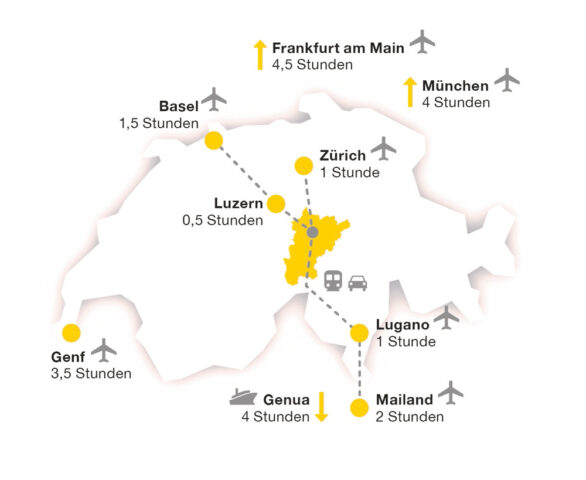
With the commissioning of the cantonal train station in Altdorf in 2021, the south and north moved even closer to Uri: Lugano can now be easily reached in 50 minutes, Milan in two hours and Zurich in one hour with direct connections.
The central location of the Uri site with advantageous connections at a glance.
Optimal cost environment Uri not only impresses with its advantageous location, but also with an attractive cost environment. On the one hand, the Gotthard canton combines several financial advantages for the benefit of the resident population: the tax burden, health insurance premiums and housing costs are relatively low. The proportion of properties with at least four rooms that can be afforded with a household income of CHF 134,000 is 31 percent on average in Switzerland in 2021. In Uri, this value is 40 to 50 percent. This underlines the attractive real estate prices in Uri. At the same time, the tax deduction options for families are well above the Swiss average. In this way, the people of Uri can freely dispose of around 50 percent of every franc they earn in Uri. In terms of disposable income and the financial attractiveness of living, the canton of Uri is among the clear leaders in Switzerland.
In the same way, companies also benefit from relatively inexpensive land and real estate prices. But Uri also outperforms many cantons in corporate tax competition. Because the Gotthard canton has had a flat rate tax for years – for both natural and legal persons. The low corporate taxes are particularly beneficial for small and medium-sized companies. The profit tax is around 12.6 percent and the capital tax is 0.001 percent (cantonal and municipal taxes in the municipality of Altdorf). Both in the Swiss and in the international comparison, Uri thus occupies an absolute top position!
Fast and reliable realization of business ideas Decision-makers and reliable partners in authorities, business and society can be reached quickly in Uri. After all, a small canton also means short distances. The small size also means tailor-made solutions, so that business ideas can be implemented pragmatically. In addition, Uri can boast of committed and effective employees who are characterized by loyalty and a high degree of identification with the employer.
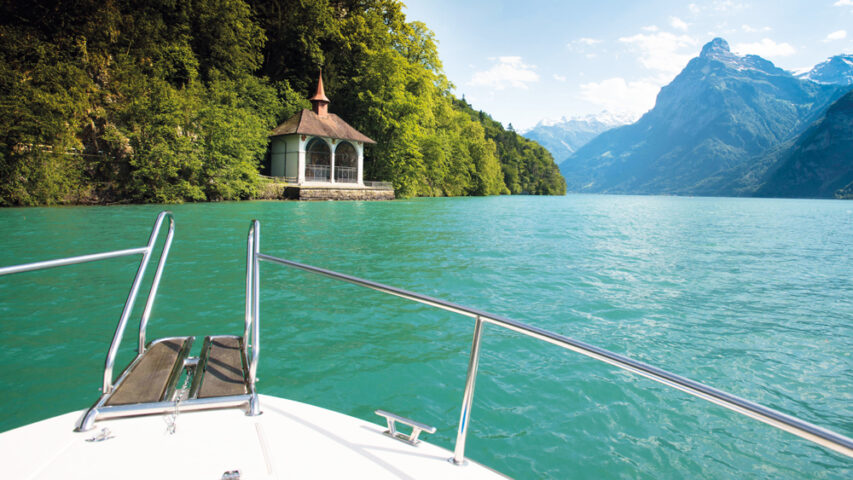
Uniquely simple combination of work and leisure Kayaking before starting work? Cross-country skiing during the lunch break? Short hike in the evening with the family? Embedded in an attractive mountain and lake landscape, the canton of Uri with its local recreation areas makes this unique combination of work and leisure possible. In Uri there is energy and quality of life – discover this added value at work, after work and on days off.
Good things are so close: a unique combination of free time and work in the canton of Uri. (Image: Angel Sanchez)
Numerous investments in a small space A lot is currently being built in the canton of Uri. Hardly any other place invests so much in such a small space. This results in significant impulses that contribute to the noticeable spirit of optimism in the canton of Uri. The development of the Uri housing market is exemplary for this. In the last 10 years it has grown by almost 3,000 new apartments – that means a remarkable increase of 16 percent.
The resident population of Uri, which has stagnated in recent decades, has also been growing significantly again for several years. All of this underscores the attractive framework conditions, but is also thanks to the well-known investments in the Uri location.
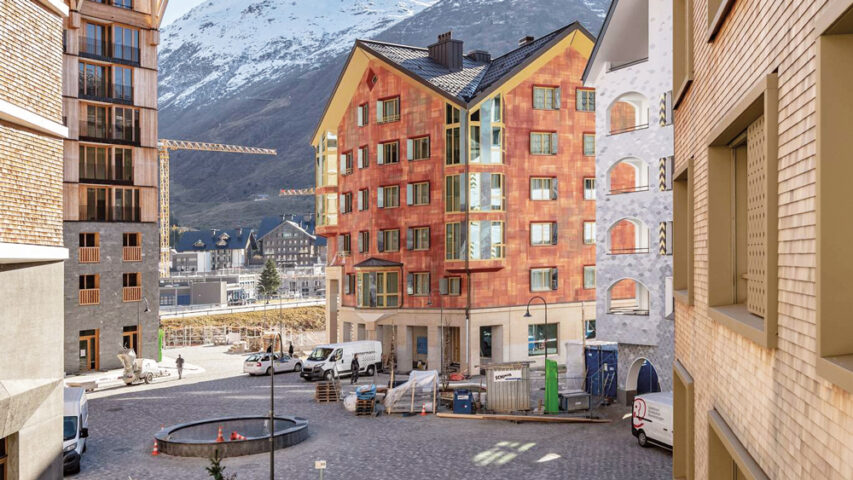
Promotion to the tourist champions league Tourism development in Andermatt in particular has contributed to this growth. Due to the partial withdrawal of the military, the mountain community was faced with major challenges. Egyptian investor Samih Sawiris brought the turning point. Since 2009 he has invested more than CHF 1.3 billion together with fellow investors, thereby catapulting Andermatt into the tourism champions league. CHF 130 million went into the modernization and expansion of the winter and summer sports facilities. Further investments were made in an ecologically operated 18-hole golf course and in a multifunctional concert hall for brilliant music experiences as well as conferences and exhibitions. With Andermatt Reuss, a completely new part of the village was created with hotels, apartment buildings, restaurants and businesses and its own village square, the Piazza Gottardo.
With more than 1000 employees, Andermatt Swiss Alps AG, which operates the tourist resort, is now the largest employer in Uri. Andermatt is an up-and-coming and attractive tourist destination. Further investments are already planned: on the one hand, the new village part of Andermatt Reuss will be expanded in stages by another 18,000 m2. On the other hand, Vail Ski Resorts will take over the majority of the mountain railway infrastructure in Andermatt and plans further investments of over CHF 100 million.
Newly created part of the Andermatt Reuss village with a view of the «Piazza Gottardo». (Image: Andermatt Swiss Alps)
More mobility and attractiveness in the Uri valley floor Despite the impressive development in the mountain village of Andermatt and its importance for Uri as a business location: around 80 percent of the population of Uri live in the valley floor, where most of the service, industrial and commercial companies are concentrated. This area has undergone substantial changes in recent years. With the development focus of the Urner valley floor around the cantonal train station in Altdorf, Uri is tackling a project for generations: Here, sustainable uses are created in the overall regional interest and the corresponding economic, settlement and transport infrastructures are carefully coordinated.
An important milestone was reached in December 2021 with the commissioning of the new cantonal railway station in Altdorf. Intercity trains now stop in Altdorf, which connects the station to the Gotthard base line. The regional and national bus concept is also geared towards the new hub. Impetus for economic and settlement projects should arise from better accessibility. The first effects are already visible: in the immediate vicinity of the train station, modern residential developments have already been realized with “Vena” and “Cubo”. Others, such as the “Strickermatt” development in the immediate vicinity of the cantonal railway station, are in the works. The Cantonal Bank of Uri is also actively involved in the development of the new Uri transport hub. With its newly erected service building at Bahnhofplatz 1, it is committed to the overall economic development of the canton and the bank itself. State-of-the-art office space has been created there in a prime location. The UKB itself claims a third as its new headquarters, and a further 3100 m2 are rented out. Exciting new companies from Germany and abroad have already settled here.
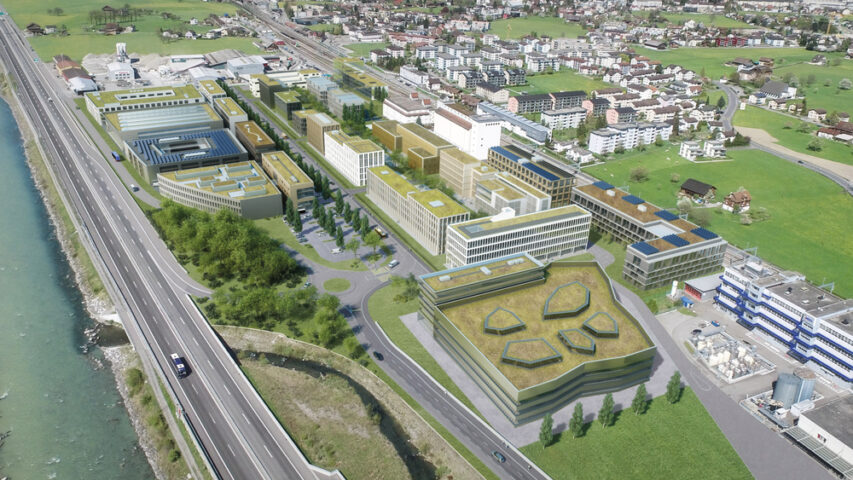
Werkmatt Uri – space for business ideas The Werkmatt Uri in Altdorf is the central piece of the puzzle for the focus of development. It is the largest contiguous land reserve in Uri. The canton of Uri, as the owner, invested millions in the area between the new canton train station and the future half-junction to the motorway. On around 120,000 m2, the area offers business opportunities for future-oriented industrial, commercial and service companies. More than 1,000 jobs are to be created on the site in the future. The aim is to develop the area in a coordinated manner so that sustainable economic uses can arise. The public sector as the provider is striving for a win-win situation with investors and the future owners and users of the area.
What the Werkmatt could look like in the future, including the Autobahn half connection.
Further promising developments are pending The canton of Uri has already implemented various generation projects, as described above. Other important development projects are pending. A new traffic hub in Göschenen is being planned. In addition to the station for trains and buses and a multi-storey car park, a cable car connection from Göschenen station to the Andermatt ski area is being planned.
In addition, there is the west-east bypass in the Urner valley floor, which will relieve the settlement areas of road traffic and thus upgrade them. In Altdorf, a new half-junction to the motorway is being built, which will open up the Urner valley floor even better. The federal government is already working on the construction of the second Gotthard road tunnel. Finally, new bike paths are being created, which should make Uri even more attractive for non-motorised traffic. In addition, investments in education and research are becoming even more important. The first approaches are already there: on the one hand with the Institute for Alpine Cultures, which is dedicated to the special features of the Alpine region – from prehistoric evidence to specific traditions to the challenges of the present. On the other hand with the Logistikum Schweiz in Altdorf, a research and innovation center for logistics and supply chain management.
Promotion of the Uri location – your effective partner Many exciting developments are underway in the canton of Uri. Location promotion is working on using this momentum in an economically sustainable manner and converting it into jobs and added value for the entire canton. How does the Uri location promotion work?
On the one hand, we make the advantages of the Gotthard canton and the exciting developments visible. Location communication and marketing takes place via the web, print, trade fair appearances and via the personal network. In particular, membership in the Greater Zurich Area is intended to ensure that the Uri location and its advantages are even better perceived. Those interested in settling, as well as existing companies and start-ups, are supported by the location promotion in consultations or during site visits or the search for building land. It is also the information and contact point of the administration for the economy of Uri. In addition, she establishes contact with the key people in business, education, innovation promotion and authorities.
Wide range of tools The Uri location promotion can fall back on a wide range of instruments to support companies. They are custom-defined for each individual case. Innovative start-ups, for example, benefit from this in the form of start-up aid. Another option is to support cross-company initiatives with the New Regional Policy (NRP), a funding instrument for rural and mountain areas. As a start-up aid or pioneer, she can help entrepreneurial initiatives to achieve a breakthrough.
With the Uri location promotion, you can count on quick, competent and binding reactions to your concerns.
Welcome to the living and business location Uri. Grab the bull by the horns with us!
The monthly rental index collected by the digital real estate marketplace Homegate in cooperation with the Zürcher Kantonalbank ( ZKB ) was stable in April. According to the media release , asking rents in Switzerland rose minimally by 0.2 percent. The index now stands at 117.4 points. Asking rents rose the most in the last month, at around 1.7 percent, in the canton of Nidwalden. They have fallen significantly in the canton of Zug by around 2 percent. In the other cantons, asking rents also remained stable in April, with fluctuations of less than 1 percent.
In the cities surveyed, too, the development of asking rents was similarly stable as at the cantonal level. According to the announcement, the biggest change was in Zurich, where asking rents rose by 1 percent. This continues a development of the last five months, in which asking rents there increased by 4.3 percent. Lugano reports the lowest value among the cities at 0.5 percent. Despite the decline in April, Lugano still recorded an increase of 2.1 percent compared to the previous year. However, Homegate reports that it is a long way from the peak in July 2016.
When recording the rental price changes for the rental index, the rental prices are corrected for different quality, location and size of the apartments, the communication explains. This makes it possible to record the actual rental price development.
The latest edition of the Online Home Market Analysis from the real estate portal Homegate and the Swiss Real Estate Institute (SwissREI) examines the advertisement data for condominiums for 2020 and 2021. The evaluated advertisements come from the four largest Swiss Internet portals and thus comprise around 85 percent of all online advertisements during the period under review. Detailed reports on the study for all regions can be foundhere in the online media release .
For Martin Waeber, Managing Director Real Estate, SMG Swiss Marketplace Group, the latest online home market analysis shows how heterogeneous the Swiss condominium market is: “Overall, the demand for condominiums throughout Switzerland developed somewhat less dynamically last year due to the corona. However, certain market segments have seen lively demand over the past year, particularly in cities.” On average, the duration of advertisements in the low price segment has increased significantly in the cities examined, while it has remained practically unchanged in the higher price segment, although the number of advertisements has increased. “Similar to the rental apartment market, preferences in the condominium market have shifted away from smaller and cheaper to larger and more expensive properties during the Covid19 pandemic,” said Waeber, summarizing the study results.
Longer advertisement duration despite smaller offer The significant increase in the average tendering period for condominiums from 61 to 84 days in 2020 compared to 2019 due to the Covid19 pandemic was confirmed at a high level in 2021 with 85 days. In comparison, the length of listings for single-family homes has fallen from just over 61 days in 2019 to pre-pandemic levels.
On the other hand, around 20 percent fewer condominiums were offered online across Switzerland in 2021 than in the previous year. With such a severe shortage of offers, one would expect that the average duration of advertisements would also be correspondingly shorter. However, the fact that this has not shortened, but actually lengthened slightly, is evidence of a declining demand for condominiums across Switzerland for 2021.
Prof. Dr. Peter Ilg, head of the SwissREI institute, sees several reasons for the weaker demand for condominiums: “Condominium prices in Switzerland rose by more than 8 percent on average in 2021. This is the strongest price increase in ten years. Such a significant increase in prices is likely to have had a dampening effect on demand in general. Increasing demand can only be seen in selected regions and in individual upper price segments, in which the buyers were probably able to increasingly resort to advance inheritances». This can be deduced, for example, from the distribution of taxable assets and homebuyers by age group. In the canton of Zurich, for example, the over-54s have more than half of the taxable assets, while across Switzerland the majority of home buyers are under the age of 55, Ilg continues.
Regional differences in the duration of advertisements are increasing From a regional perspective, the differences in the duration of advertisements in the eight major regions examined in 2021 have become more pronounced. In the Zurich region, where sellers have to advertise a condominium for the shortest time in Switzerland, the duration of the advertisement was reduced significantly by around a quarter to just 43 days (minus 14 days). In the two regions with the longest average duration of advertisements for a condominium, on the other hand, they continued to rise significantly, each at around 22 percent; the Vaud/Valais region recorded an increase of 18 to 98 days, Ticino by 25 to 139 days.
In absolute terms, the greatest reduction in the length of advertisements was seen in the Central Switzerland region. After a decline of 19 days (minus 27 percent) for 2021 with 51 days, this region now has the second shortest advertisement duration of all eight regions surveyed, right after the Zurich region. The Geneva region, on the other hand, which still had the shortest advertisement duration in Switzerland at 52 days in 2020, fell back to third place in 2021 after an increase of 12 percent (plus 6 days).
Increasing demand only in three out of eight regions examined The combination of the change in the duration of advertisements and the change in the number of advertisements allows conclusions to be drawn about the change in demand in the regions examined. In the three regions of Ticino, Vaud/Valais and Geneva, for the year 2021, despite a shortage of supply (i.e. a declining number of advertisements), there has been a significant increase in the duration of advertisements in some cases and thus a shrinking demand for condominiums. For the three regions of Central Switzerland, Northwestern Switzerland and Zurich, on the other hand, increasing demand (larger percentage decline in the length of advertisements than in the number of advertisements) can be observed. The other two regions (Eastern Switzerland and Espace Mittelland) show constant demand for 2021.
Growth in demand for city apartments, especially in the upper price segment In addition to the eight regions, the Online Home Market Analysis also examines eight Swiss cities. When analyzing the demand for condominiums, a closer look at the price segment shows that demand in Basel, Lausanne, Geneva and Lugano in particular has increased. Both in the high price segment (CHF 1.5 million – CHF 3.0 million) and in the low price segment (CHF 0.3 million – CHF 0.5 million). In the high price segment, demand increased overall in six of the eight cities surveyed – in addition to Basel, Lausanne, Geneva, also in St. Gallen and Lucerne – while in the low price segment, the remaining four cities recorded constant or falling demand. This increased demand in the high price segment is now taking very different forms; While in Basel the declining length of advertisements in particular led to higher demand, in Geneva a much higher increase in the number of properties on offer compared to the length of advertisements indicated this conclusion.
In spring 2021, the restoration works of the former Masseria di Cornaredo started, which stands on land owned by the city of Lugano, which in 2019 granted a surface right to the Francesco Foundation for social aid in order to renovate and offer valuable contents to an area that, in the last thirty years, has undergone a major deterioration since it has been left in a state of neglect. To revive the rural complex – of which there are historical evidences dating back to 1351, which once belonged to the Castle of Trevano (begun in 1871 at the behest of the Russian baron Paul von Derwies, who had one of the most splendid residences in Switzerland built with huge investments) – the Francesco Foundation was able to count on the support of the city of Lugano, the Municipality of Porza and the Rotary Club Lugano-Lago, which decided to support the creation of this social citadel which provides for the architectural and structural recovery of the existing complex .
New project in a modern sector The redesign and renovation of the former Masseria di Cornaredo are part of the reorganization of the new Cornaredo district, which since 2012 – the year the Vedeggio-Cassarate gallery was opened – is undergoing substantial changes. The Cornaredo sector, which extends over approximately 1 million square meters, will become the new gateway to the urban center, with other road connections, intermodal structures, parking lots and large construction sites with mixed content (residential-commercial and administrative), as well. as defined by the new Master Plan which involved the Municipalities of Lugano, Canobbio and Porza. One of the pieces of this construction site is precisely the former Masseria, which will be enhanced to become a strategic point for the city and the area that revolves around it. The precarious state of the buildings requires static-structural consolidation interventions, respecting the existing architectural system.
The conservative restoration project contemplates the maintenance of the ancient charm of the buildings, in particular of the facades, which will be meticulously restored and completed with timely interventions in order to meet the new needs of the interior spaces.
The social canteen promoted by the Bethlehem Center with related services, the administrative offices of the Francesco Foundation, a multipurpose room will be located in the building. On the ground floor, in addition to the restoration of an ancient press, an inn with accommodation will be created, the proceeds of which will help finance and feed the Foundation’s charitable activity, also compensating for the important costs of the restructuring.
Visionapartments will open three new buildings this year and next, according to a media release . The opening for the project in Basel is planned for July 2021. In a central location behind the Basel SBB train station, 125 studios in five different furnishing styles will then be available. A gym, restaurant, communal office and swimming pool will also be set up in the building.
The projects in Glattbrugg and Lugano will follow in the coming year. 316 new apartments are being built in Glattbrugg alone. These are located in the immediate vicinity of Zurich Airport. In addition to the new apartments, a restaurant, a communal kitchen and a fitness and wellness area will also be built there. The property in Lugano will also open next year, on the shores of Lake Lugano. 55 new apartments are being built there. "Despite the current global crisis, we are following our mission to expand further," said Anja Graf, CEO and chairwoman of Visionapartments, in the press release. "We are proud of our growth and look forward to the completion of these real estate projects," she says of the projects in Glattbrugg and Lugano.
Visionapartments was founded in Switzerland in 1999 and specializes in the rental of furnished temporary apartments. The company offers corresponding properties at 850 international locations.
The New Railway-Alpen-Transversale ( NEAT ) is largely completed. The Federal Office of Transport ( FOT ) has issued the permit for the scheduled operation of the Ceneri base tunnel, it writes in a message . This means that the tunnel will be available for scheduled passenger and freight trains from the timetable change on December 13th.
The Ceneri Base Tunnel was inaugurated on September 4th. Since then, around 5,800 commercial passenger and freight trains have been run through the tunnel in a trial run.
The 15 kilometer long tunnel is the third of the three large base tunnels that were built as part of the NEAT. It also enables direct connections between Lugano and Locarno. These form a central element of the Ticino S-Bahn.
The Lötschberg Base Tunnel with a length of 35 kilometers was the first of the three large tunnels to go into operation in 2007, the Gotthard Base Tunnel with a length of 57 kilometers followed in 2016. The almost 20 kilometers long Simplon Tunnel has been in operation since 1906. Switzerland now has two flat rail routes through the Alps.
Wir verwenden Cookies zur Unterstützung und Verbesserung unserer Dienste. Mit der Nutzung dieser Website erklären Sie sich mit der Verwendung von Cookies einverstanden. Weitere Informationen finden Sie in unserer Datenschutzerklärung.