Tag: Mehrfamilienhäuser

  • Erlenpark Näfels creates new living space

    Erlenpark Näfels creates new living space

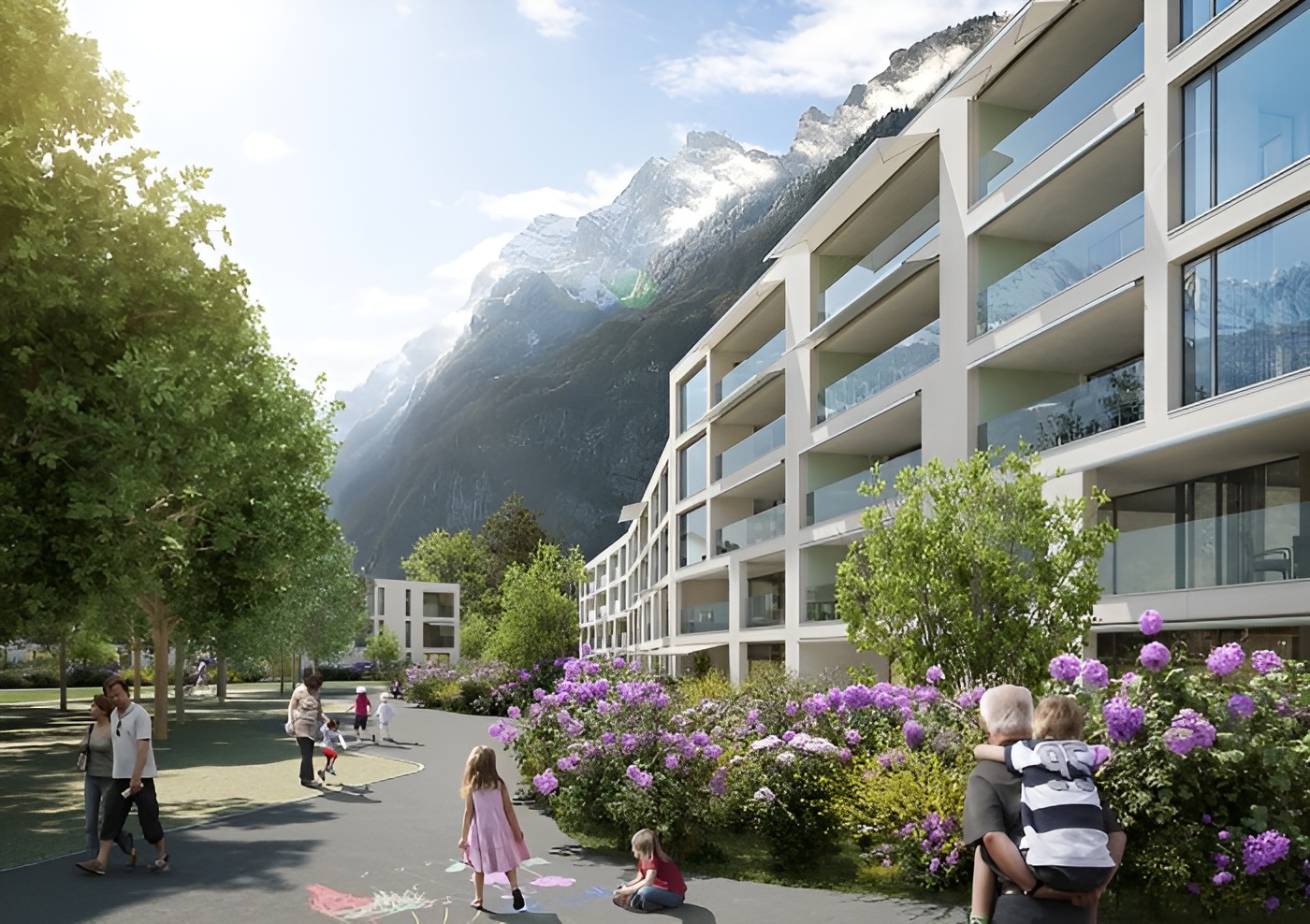
    On the 16,000 m² “Feld” site in Näfels, the municipality of Glarus Nord is realising a pioneering residential development together with FT3 Architekten AG. A total of ten apartment blocks with around 98 flats are being built in three rows of buildings. The flats are between 1½ and 5½ rooms in size and are aimed at people at all stages of life – from singles and families to senior citizens. The diverse range of apartments is intended to promote a social mix and revitalise the neighbourhood.

    Quiet inner courtyard as the centrepiece of the development
    The special geometry of the plot results in a diamond-shaped arrangement of the buildings, which enclose a green inner courtyard measuring around 6,800 m². It acts as the centre of the car-free development and offers space for people to meet and relax – protected from the noise of the surrounding traffic routes. The staggered residential buildings also provide a rhythmic structure and create architectural quality as well as optimal sunlight for the flats.

    Car-free and central access
    A central feature of the project is its consistently traffic-free design. Access and all parking facilities are bundled at a central point, keeping the entire residential area free of motorised traffic. This increases safety, creates attractive, liveable open spaces and meets the current requirements for residential and urban development.

    Signal for site development and building culture
    Municipal president Fritz Staub sees Erlenpark as a strong signal for municipal development. Shortly after the overall revision of the NUP II land use planning came into force, the project is an example of how high-quality, space-efficient residential construction projects can be realised in the canton of Glarus. The ground-breaking ceremony took place in April 2025 and the first construction phase will be completed by summer 2027, followed by the second and third phases by autumn 2028.

    Modern construction with high standards
    The planning and realisation by FT3 Architekten AG follows a clear architectural approach. Towards the street, the buildings appear closed and compact, while they open up towards the inner courtyard with generous balconies. The staggering of the storeys supports the natural lighting and gives the buildings a clear structure. Erlenpark is thus a successful example of modern, high-quality construction in the Glarus region. A project with a signal effect for site development in rural centres.

  • Property market remains attractive

    Property market remains attractive

    The Swiss property market remains attractive for 93 per cent of property investors, EY Switzerland reports in a press release. The auditing and consulting firm based its findings on the latest edition of its annual “Real Estate Investment Market Trend Barometer”. EY Switzerland surveyed a representative cross-section of 106 property market players.

    Six out of ten respondents anticipate growth in investment volumes this year. 85 per cent expect property to become more attractive than alternative investment opportunities. “This result demonstrates a remarkable consensus regarding the assessment of future developments on the property investment market and reveals the collective confidence that investors have in the real estate asset class,” Daniel Zaugg, Sector Leader Real Estate, Construction & Building Material at EY in Switzerland, is quoted as saying in the press release.

    Within the property market, residential property continued to gain in attractiveness. A total of 74 per cent of respondents now want to focus more on residential property, compared to 67 per cent in the previous year. Investments in apartment buildings are seen as a safe investment strategy by 96 per cent. The willingness to invest in logistics and office properties increased by 9 to 10 percentage points year-on-year to 52 and 48 per cent respectively. The overwhelming view is that demographic change and interest rate trends will have the greatest impact on the property market in the coming years.

  • New charging stations for property funds

    New charging stations for property funds

    The Akara Swiss Diversity Property PK(ADPK) property fund managed by Swiss Prime Site Solutions from Zug invests in existing properties and development and construction projects throughout Switzerland. According to a press release, the fund’s apartment buildings are to be equipped with a new charging concept for electromobility. AEW Energie AG, based in Aarau, has assumed responsibility for the planning and operation of the new charging infrastructure under the contracting model. The on-site installations will be carried out by regional specialist partners, according to the press release. The charging stations will be customised to the various properties and local requirements. The first projects have already been launched.

    “We are proud to have a strong partner at our side in the ADPK fund management, which, like us, recognises and promotes the importance of sustainable mobility solutions,” said Arian Rohs, Head of Mobility Solutions at AEW Energie AG, in the press release. “This cooperation enables us to further expand our commitment to electromobility and make an important contribution to reducing CO2 emissions.”

  • “Fischermätteli” first site with Minergie certificate

    “Fischermätteli” first site with Minergie certificate

    The innovative and long-term residential construction project Fischermätteli was successfully completed by Strüby Unternehmungen in autumn 2023 after a staggered construction period of around three and a half years. The ten apartment blocks with a total of 168 condominiums were built on a former commercial site in Burgdorf BE. Over 6600 m3 of Swiss wood was used in the construction, which serves as a natural CO2 reservoir and has an excellent ecological footprint thanks to the short transport routes.

    One hundred per cent of the energy requirements for the entire site are covered by renewable sources. The electricity comes from the PV systems on the roofs of the buildings, while the heat for heating and hot water comes from a heating centre that runs on Swiss pellets. The well thought-out mobility concept is based on electric mobility, car sharing, bicycles and public transport. A co-working space supports working from home and thus indirectly relieves traffic congestion. In addition, the environmental design based on the sponge city principle ensures natural and efficient cooling in summer and turns the project into a true biodiversity hotspot thanks to the wide variety of native plants.

    Label with high requirements
    In April 2024, the largest real estate project to date was awarded the coveted certificate by the Minergie association: the Minergie-Areal label, having already been awarded the Minergie-A-ECO label. The new standard, which has been in place since September 2023, is supported by various organisations such as the Minergie Association, the cantons, the business community and the Swiss Federal Office of Energy. The Minergie site is characterised by minimal energy consumption, minimised greenhouse gas emissions during construction and operation and maximum self-sufficiency with renewable energies. The buildings have particularly efficient heat insulation and controlled air exchange. In addition, the outdoor space of the Minergie site is designed in such a way that climate resilience and quality of stay are increased, for example through green planting and shading options. Another advantage of the Minergie site is the promotion of climate-friendly mobility.

    The development in Burgdorf BE sets new standards in timber construction for flats. With 168 owner-occupied flats in ten apartment blocks, it is the largest construction project of its kind to combine Swiss timber and the Minergie-A-ECO standard. Sustainability aspects were at the centre of the project right from the start, which earned it the first Minergie-Areal certificate for a completed project.

    Thanks to the elegant timber façades, the ensemble blends in perfectly with its natural surroundings. The clearly defined meeting and play zones with village charm promote relationships between the residents. At the same time, the architecture ensures privacy and creates living spaces with ideal air, light and sound characteristics. Community-enhancing elements such as a spacious communal pavilion and the professional home office zone “fm produktiv” round off the offer.

    The flats offer 2.5 to 5.5 rooms and are designed for singles, couples and families of all ages. The floor plans are flexibly designed so that they can be adapted to future needs. From the ground floor upwards, the building was constructed using timber elements.

    The energy supply is consistently based on renewable sources. The electricity for the approximately 400 residents comes from the PV systems on the roofs of the apartment blocks (700 MWh/year). Heat is generated in a heating centre using Swiss wood pellets.

    The mobility concept focuses on cycling, public transport, electric vehicles and car sharing. Bicycle stands, charging stations, repair and cleaning areas are available. Residents can also use one of the two electric cars from the neighbourhood’s own car-sharing scheme via an app or conveniently use the bus, which runs every half hour from the neighbourhood to Burgdorf. Demand for the condominiums and rental flats was very high right from the start. All 168 flats were sold or rented months before completion. The fair sales and rental prices certainly contributed to the great success, e.g. a flat with 4.5 rooms was already available from CHF 610,000 (minus Minergie subsidies from the Canton of Berne).

  • Strabag focuses on sustainability for apartment buildings

    Strabag focuses on sustainability for apartment buildings

    Strabag has begun work on the construction of six apartment buildings that will house a total of 29 condominiums, according to a media release. Strabag has set itself the target of handing over the turnkey building pit within twelve months. Part of this work includes 18 geothermal boreholes, as the heat supply for the houses will be realised by geothermal energy. The houses will also be connected via an underground parking garage, which will have different levels.

    “In total, we have around 4-5 months to complete the main excavation,” Roger Reich, technical group leader for civil engineering at Strabag AG, is quoted as saying. “That is relatively sporty. The construction site is also in the middle of a residential neighbourhood, which means we have to work particularly closely to schedule.”

    For the bored piles, the Schlieren-based company relies on sustainable basalt fibres. The conventional steel reinforcement of the piles can thus be largely replaced. On the one hand, this reduces the construction time and, by reducing the steel resources required, CO2 emissions are also kept lower.

  • Canton Zurich identifies untapped potential for solar power

    Canton Zurich identifies untapped potential for solar power

    Falling prices for solar installations have fuelled the construction of new photovoltaic systems in the canton of Zurich, as an analysis by the cantonal statistics office shows. According to this, there were at least 12,600 active photovoltaic systems in the canton at the end of 2021. Almost all of them were installed after 2010, according to the data. They produced about 0.3 terawatt hours of solar electricity per year, which is roughly equivalent to the annual electricity consumption of the canton of Appenzell Ausserrhoden.

    Despite the increase in installations, the analysis finds that there is still a great deal of untapped potential for solar power. About half of all Zurich systems are installed on single-family homes. There is still a need to catch up with multi-family houses and buildings that are not used for residential purposes. The latter also offer space for larger systems with a higher installed capacity.

    The analysis identifies further potential in new buildings. When the new cantonal energy law comes into force in September 2022, all new buildings will have to contribute to covering their electricity demand. It can therefore be assumed that new systems will be installed in the coming years.

    The Canton of Zurich wants to achieve zero greenhouse gas emissions by 2040 – or by 2050 at the latest. Accordingly, according to its own information, it attaches great importance to the use of the existing potential for renewable electricity production. ce/ssp

  • The forgotten solar hot water systems

    The forgotten solar hot water systems

    In Switzerland, about 6% of all apartment buildings have a solar hot water system (solar thermal) in operation. These are used to heat hot water in order to reduce the consumption of oil and gas. Most of these systems were installed about 10 years ago, when photovoltaics were much more expensive. However, in recent years they have been forgotten. Many owners and administrators discover the installations only by chance through a view of the property on Google Maps, when they analyse the roof for photovoltaic suitability.

    On average, solar hot water systems have 20 years of operation ahead of them, during which they can generate CO2-free heat and also significantly reduce utility costs thanks to fossil energy savings. Because nobody knows about the existence of many installations, one in five is defective. This means valuable solar heat is being wasted and fossil fuel heating systems are having to step in instead.

    Several cantons have already recognised the problem and launched awareness campaigns to make owners, caretakers and administrators aware of the issue. The free solartest.ch platform has been created for this purpose in collaboration with Energie Schweiz and Swissolar. This allows users to check whether their system is running correctly by simply entering the temperature values they have read.

    To avoid having to read the temperature values every week, Energie Zukunft Schweiz has developed the LORALARM monitoring system, which can be retrofitted.

    As part of a project with a large Swiss insurance group, 65 existing solar hot water systems were monitored, of which a total of 15 systems were found to be out of order. Minor repairs enabled systems worth CHF 1.5 million to be put back into operation within a very short time.
    The good time to find out if your solar thermal system is running is on a sunny winter’s day. This ensures that the defect will be producing sun-warmed water again by the time of the productive spring days from the beginning of March, after any repairs have been carried out.

  • The foundation stone for the Gupfengarten housing estate is laid

    The foundation stone for the Gupfengarten housing estate is laid

    According to a press release , real estate service provider Steiner celebrated the laying of the foundation stone for the Gupfengarten residential area. With the official starting signal, the construction project for a “family-friendly development in the Zurich Unterland” will be initiated. Steiner took over development, consulting and sales. The general contractor Eiffage Suisse AG , headquartered in Glattbrugg ZH, the architects Graf Biscioni based in Winterthur and the client Evostate Immobilien AG from Zurich are involved in the implementation.

    By the end of 2023, 36 terraced single-family houses and three multi-family houses with 21 condominiums are to be built on the Gupfengarten site south of the center of Niederweningen. The housing estate meets a contemporary living and development standard and covers the strong demand for high-quality living space.

    The planning meets the criteria for sustainable construction. The heat is generated almost entirely by means of a heat pump, geothermal probes and photovoltaic system. An energy management system enables “efficient and intelligent” use of energy. According to the announcement, the wooden building envelope has optimal thermal insulation.

  • Steiner AG sells housing project in Suhr to Corpora

    Steiner AG sells housing project in Suhr to Corpora

    13 apartment buildings with a total of 146 apartments are to be built on Neumattweg Ost in Suhr. The superstructure is designed for use by different age groups and family sizes, Steiner AG informed in a press release . The real estate developer from Zurich has decided to sell the project to Corpora Immobilien AG from Aarau before it is actually implemented.

    "With Corpora Immobilien AG, Aarau, we were able to sell this extensive project to an investor with development expertise and local roots, who will ensure the successful further development and realization of this attractive residential development," project manager Daniel F. Hauri is quoted as saying in the press release. No information is given there on the purchase price for the approximately 1.6 hectare area. Steiner cites an adjustment to the portfolio that was initiated last year as the reason for the sale.

  • Baden promotes charging stations for electromobility

    Baden promotes charging stations for electromobility

    The city of Baden financially supports the construction of new charging stations as part of its energy promotion program. According to a press release , half of all new registrations are already electric or hybrid vehicles. The city of Baden wants to make the switch easier. That is why new charging stations for electric vehicles will be funded with 25 percent of the investment costs from now on.

    According to the city, the offer applies to existing apartment buildings and condominiums with three or more residential units. Shared garages of individual units are also taken into account. The expansion of the electrical infrastructure will also be promoted, according to the press release. Not only could the applicant install a charging station in the underground car park, but others could also be added. That can be done at the same time or later. The aim of this funding is that tenants can also become electromobile.

    The funding program is broken down on the city's special website for electromobility. For electric charging stations, there is a subsidy of 25 percent of the investment costs, but no more than 1,000 francs per charging point. To develop the charging infrastructure, there are also 25 percent of the investment costs in communal underground car parks, but no more than CHF 500 per parking space. The development costs include the creation of power and communication lines to the parking lots.

    The application for funding can be downloaded by clicking on this page and on the city's environmental blog.

  • Menziken gives the green light for the Unity housing estate

    Menziken gives the green light for the Unity housing estate

    The building permit for the new housing estate called Unity in the municipality of Menziken has become legally binding. Steiner AG can then start construction work.

    As the Zurich developer as well as a total or general contractor notifies , six apartment buildings with 47 condominiums and 51 parking spaces will be created close to the station as a whole. The canton-protected Villa Zur Eintracht, which was built in 1811/12, will blend in harmoniously with the overall situation.

    Steiner is thus making a contribution to the promotion of affordable housing. A functional design can be built in a cost-optimized manner. Among other things, uniform windows in all buildings, minimized living space and standardized wet rooms in all apartments contribute to this.

  • NeoVac uses the app from eCarUp for charging stations

    NeoVac uses the app from eCarUp for charging stations

    NeoVac now uses the NeoVac my Charge app to bill the consumption-based costs for e-charging stations in apartment buildings and areas. According to a media release , the specialist for building and environmental technology based in Oberriet is reacting to the increasing demand for e-charging stations in buildings.

    The app was developed by eCarUp AG from Zug. The young company offers a comprehensive software solution for setting up charging infrastructure. Its backend enables billing, monitoring, load management and maintenance of e-charging stations.

    With its Switzerland-wide service network, NeoVac prepares the consumption-based energy and water bills for over 400,000 apartments every year. The Rheintaler company has set itself the goal of offering a solution for every billing-relevant measuring point in a building. "The number of new registrations of electric vehicles is increasing significantly and tenants are asking for more and more charging options," says Pascal Welti, Head of Energy Consulting at NeoVac. That's why his company has now launched an app for it.

    It enables drivers of electric cars to activate charging stations and pay for the electricity they use. In addition, the charging data is transferred directly to the NeoVac myEnergy app. There, users receive an overview of their personal consumption and a directly accessible energy cost bill.

    NeoVac also offers complete solutions for e-mobility infrastructure projects with a nationwide sales and service network. In addition, charging stations could "also be controlled depending on the PV system, battery storage or heat pump". This increases self-consumption and the profitability of photovoltaic systems.