Tag: Messung

  • 1.47 billion in venture capital invested in Swiss start-ups in the first half of the year

    1.47 billion in venture capital invested in Swiss start-ups in the first half of the year

    In the first half of 2025, CHF 1.47 billion flowed into Swiss start-ups, an increase of 36 per cent compared to the previous year. This is the third-best result since measurements began. However, growth was driven by a small number of startups that raised large sums from international investors. The number of financing rounds fell for the third time in a row to 124, which corresponds to a decline of ten per cent.

    Biotech as a growth driver
    The biotech sector in particular produced a strong result. It set a new record with an inflow of CHF 705 million in capital. The previous record of CHF 436 million from 2021 was clearly surpassed. The reasons for this success lie in highly qualified start-up teams and technological developments based on excellent research.

    Recovery in ICT and fintech
    The recently weakening ICT and fintech sectors were also able to recover. General ICT start-ups recorded investment growth of 86 per cent to CHF 247 million. Fintech companies received CHF 153 million, which corresponds to an increase of 93 per cent. The number of transactions remains low, which indicates continued investor selectivity.

    Swiss startup ecosystem remains resilient
    Despite the uncertain market environment, the Swiss startup ecosystem is able to produce internationally competitive companies. One example of this is Sygnum Bank, which became Unicorn in the first half of 2025. The bank, which specialises in digital assets, was valued at over 1 billion dollars, a signal of the potential of innovation outside of the healthcare sector.

    Gloomy outlook among investors
    A broad-based survey shows that expectations for the coming twelve months are subdued. Fundraising and more difficult exit opportunities are of particular concern. International trade barriers, on the other hand, only play a subordinate role. Access to capital is likely to remain challenging for many start-ups, despite individual success stories.
  • New measurement technology detects corrosion in reinforced concrete without intervention

    New measurement technology detects corrosion in reinforced concrete without intervention

    Retaining walls, tunnels and bridges made of reinforced concrete characterise the Swiss cityscape and infrastructure. However, many of these structures are already several decades old – and chemical changes in the concrete affect the steel used. If the reinforcing steel begins to rust, the structure loses stability. The damage is particularly problematic in inaccessible places where conventional testing methods fail.

    Electrochemical measurements as a new solution
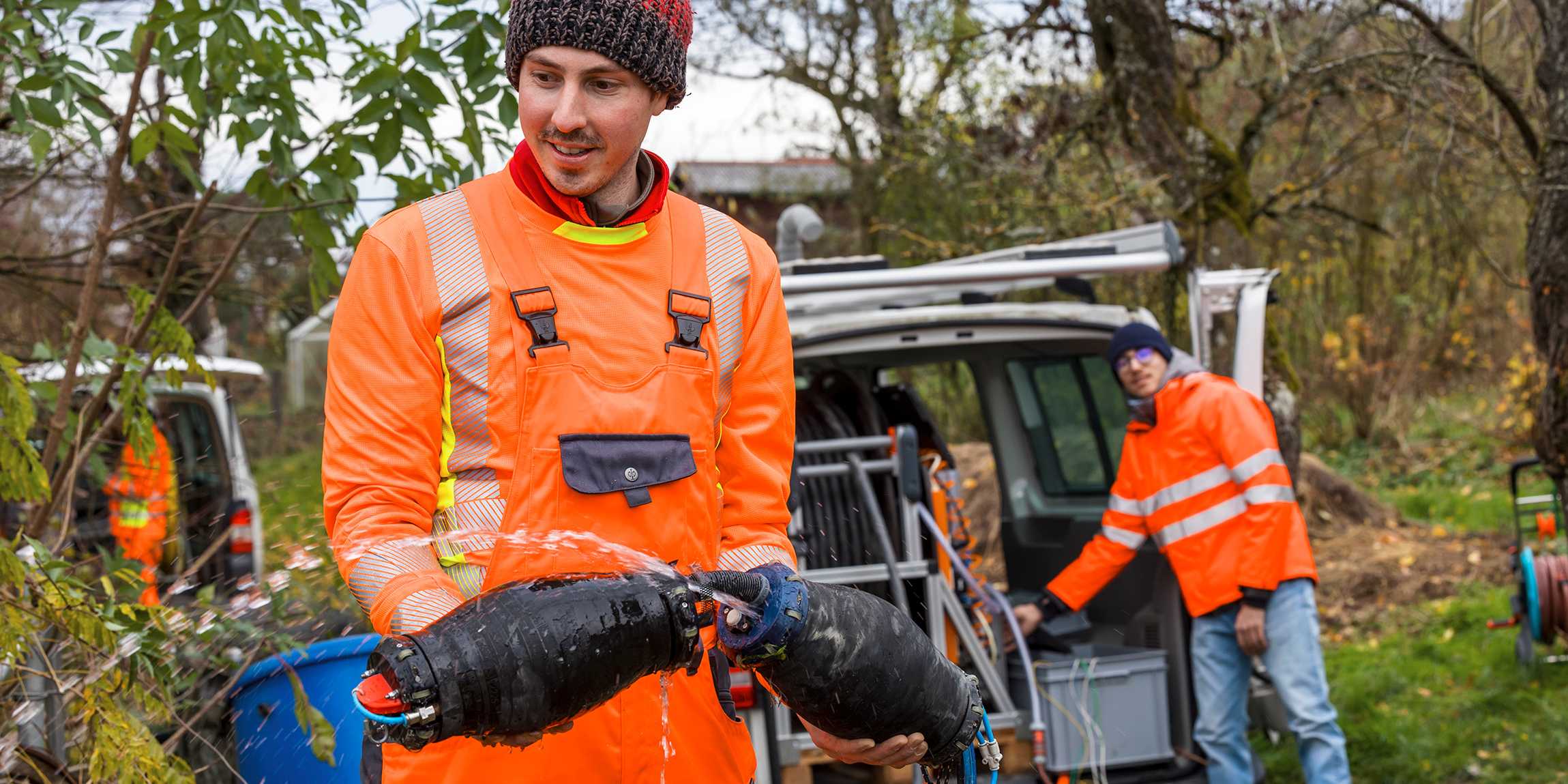
    Until now, engineers have had to break open parts of the concrete to check for corrosion damage. A time-consuming and often inadequate procedure. Talpa has developed a new method that works via drainage pipes. A special probe is inserted into the pipe and uses electrochemical signals to measure the likelihood of corrosion in the surrounding reinforced concrete.

    “This has never been done before,” explains Lukas Bircher, one of the developers. “Previously, you had to remove entire concrete surfaces to find damage and could still easily miss a critical area.” With the new technology, entire sections of wall can now be systematically tested without destruction or costly construction work.

    Measurements during operation – without a construction site
    The method has already been successfully tested, including on a 200 metre-long retaining wall in Zurich-Höngg. The principle is a probe that is inserted into the drainage pipe and fixed in place with inflatable seals. The system then directs water into the measuring area, creating a conductive connection between the electrodes of the probe and the steel in the concrete. Based on the recorded electrical signals, the team can recognise whether and to what extent corrosion is present.

    A new measurement is taken every 25 centimetres to record the condition of the entire section of wall. “This allows us to specifically identify those areas that actually pose a risk,” says Bircher. “This not only saves time, but also high costs for unnecessary interventions.”

    50 years after the construction boom – the need for renovation is growing
    Many of the reinforced concrete structures affected today date from the boom period between 1960 and 1980. Retaining walls from the 1970s in particular often contain cavities that favour corrosion. Previously, damage had to be identified by means of time-consuming spot checks, with a high risk of overlooking critical areas. The new method offers a comprehensive and reliable analysis for the first time.

    From research to start-up Talpa-Inspection
    The technology has such great potential that Bircher founds the start-up Talpa-Inspection together with two colleagues. The name “Talpa”, Latin for “mole”, symbolises the innovative way of making deeply hidden damage visible. Supported by an ETH Pioneer Fellowship, the team is further developing the technology and preparing to enter the market.

    Future prospects, automation and scaling
    The measurement is currently still partly manual, but the team is already working on an automated version. The aim is to make the probe more robust and further accelerate the measurement process. Demand is high. In Switzerland alone, there are over 1,000 kilometres of potentially affected reinforced concrete structures.

    “Our method offers a real opportunity to extend the service life of existing structures,” says Bircher. “We hope that it will soon establish itself as a standard procedure for structural diagnostics.”

  • BKW wins technology partner for digital electricity metering

    BKW wins technology partner for digital electricity metering

    BKW Energie AG is getting support for the conversion of its meter technology from the metering technology supplier Kamstrup, with its Swiss headquarters in Glattbrugg, and from the Cham-based companies Ensor and Semax. Together with the project partners now presented, the energy supplier wants to introduce more than 400,000 electronic meters in the grid area by 2028, according to a media release.

    Legislation requires the installation of the new meters as part of the Energy Strategy 2050. For this forward-looking infrastructure project, BKW is counting on the expertise of the technology partners selected by tender. In future, data encryption and data collection will be based on secure cloud technology from Kamstrup. BKW is purchasing high-quality smart meters from Ensor and Semax, which are designed to meet the requirements of industry.

    According to BKW, the digital meter technology allows consumption to be measured every quarter of an hour and data to be transmitted directly to the energy supplier. Customers get a more detailed insight into their electricity consumption, it says. The communication company Sunrise will take over the transmission of the data. According to the press release, Hansen is responsible for data management.