Veriset AG has invested in its kitchen exhibition at its headquarters in Root. After six months of construction, the showroom has been completely refurbished. The infrastructure had reached its limits since the last major renovation in 2010, according to a press release. In addition to modernisation, the aim was also to present the exhibition kitchens in a fresher way. Now the exhibition appears airier and larger.
At the same time, many new functions will be introduced. For Veriset, these include a new type of appliance wall, where new built-in appliances can be quickly and easily exchanged, or a kitchenette with a utility room that is “cleverly hidden behind a cupboard door, as is customary today”.
The two partners Cozza Plättli and Textilwerke are also represented with their products. For the employees, Veriset has reportedly created attractive workplaces with new, modern offices.
The three kitchen professionals have two consulting stations with numerous material samples and a large computer screen for visualisation and planning. According to Veriset, both the simple rental flat kitchen and the luxurious black island kitchen have been considered for the exhibition kitchens. A virtual tour and pictures are intended to provide a first impression.
With Lokstadt, Implenia is developing a new, urban and versatile quarter with 750 flats for around 1500 people. Lokstadt is located to the south-east of Winterthur railway station. The area used to be home to the workshops of the Swiss Locomotive and Machine Factory (SLM) – the most important locomotive forge in Switzerland. The neighbouring Sulzer factory took over SLM in the 1960s.
Some of the locomotives produced by SLM serve as namesakes for the various construction fields. For example, the “Tender”: condominiums were built here, which are ready for occupancy since the beginning of 2023, as well as commercial space. The flats of the 17 “townhouses” were also for sale: these are four- to five-storey maisonettes that have already been completed. In a second construction phase, six four-storey “townhouses” were built: these comprise a total of 24 flats and will be ready for occupancy in spring 2023. The “Elefant” office building, which is located directly on Zürcherstrasse, will also be ready for occupancy soon.
The central dialogue square will be framed by three buildings in the future. The first is the “Krokodil”, a wooden building. Here, 254 flats have been created to meet the diverse living needs of three cooperatives as well as individual homeowners. Vertical window bands are reminiscent of the former industrial halls and give the building a clear structure. BIGBOY” is located at the front of Dialogplatz:
BIGBOY offers 125 flats and a roof terrace for the residents…
The building, which is over 50 metres high and 16 storeys high, is home to 125 rental flats as well as five office and commercial spaces between 55 and 370 square metres. The roof terrace offers a unique view over Lokstadt and the whole of Winterthur. The industrial past of the site is reflected in the brick façade. Bigboy will be ready for occupancy in summer 2023. The third building is still under development and is currently the tallest planned wooden high-rise in the world: “Rocket”, developed and realised on behalf of Ina Invest, will be 100 metres high and with 32 storeys will be the landmark of the new district and the Winterthur skyline. The plan is for 255 flats. In addition, non-profit flats are planned in the “Tigerli” base building. A hotel is also planned. The occupancy date is planned for 2027.
Lokstadt offers a unique residential atmosphere.
Lokstadt stands for the sustainable use of resources, a prudently planned variety of uses and the innovative revitalisation of listed buildings. These include the former factory buildings. Under Implenia’s leadership, these are being transformed into spaces for experience that reflect local history and modern city life. The quarter is being developed step by step in accordance with the requirements of the 2000-watt society. Despite the dense construction, importance is attached to sufficient open spaces and a high quality of stay. The area will be made accessible to motorised traffic by means of an underground car park spanning all the buildings. Above ground, pedestrians and cyclists have priority thanks to a generously designed pedestrian zone.
Despite the dense construction, Lokstadt attaches importance to sufficient open spaces and a high quality of stay.
With Lokstadt, Winterthur links the 19th century with the 21st century: Here, the city’s industrial history is brought together with Winterthur’s future as a residential, educational and service city. The quarter is being built for people who love city life and who care about sustainability. A Lokstadt app will serve as a communication and interaction channel for all tenants, owners and employees in the future.
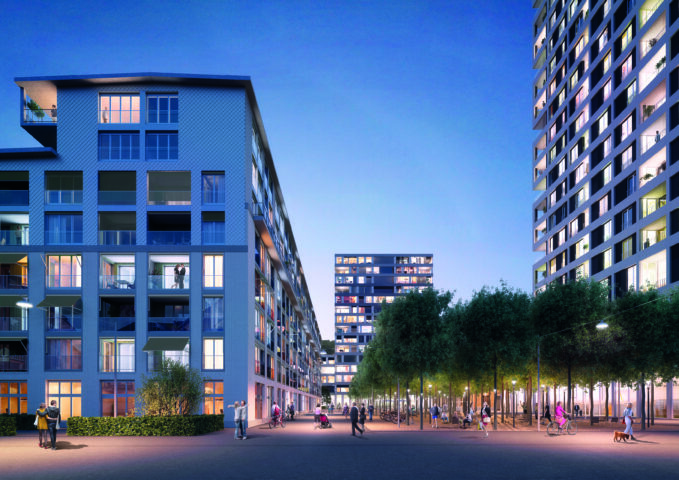
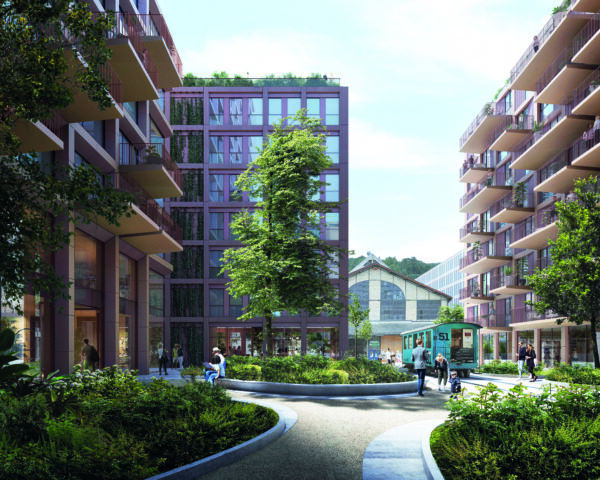
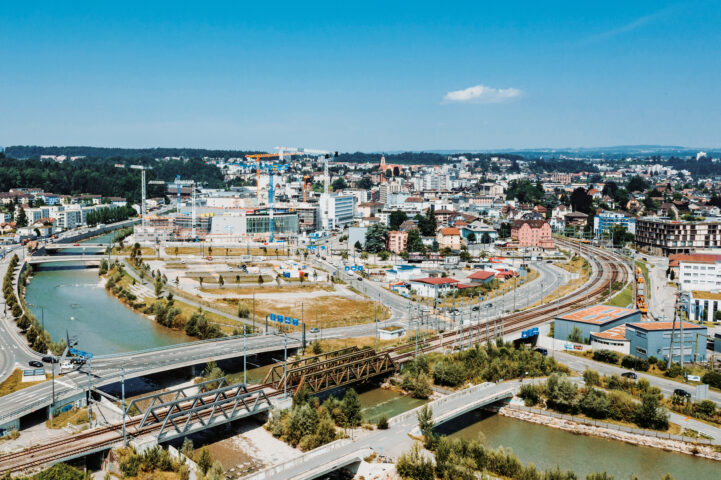
Lucerne North is a development focus of the Canton of Lucerne. In the coming years, 1,500 new flats, 4,000 additional jobs, 850 study places, two recreation zones and various cultural facilities are to be built here step by step.
In order to become a modern, ecological and lively centre on the river, Lucerne North is to develop as a Smart City. A Smart City uses technologies, innovations and data to improve people’s quality of life, make the location more attractive for businesses, use the infrastructure more efficiently and conserve resources.
So far, Central Switzerland has lacked concrete examples of the smart city approach in an area development. Lucerne North is to become a first practical example with a pioneering character – with the simultaneous developments of the city of Lucerne towards a Smart City as well as possible cooperations on the way to a Smart Region Lucerne. The municipality of Emmen, the city of Lucerne, the canton, the transport association, the business development agency, companies, site developers and the population are involved in this networked approach.
The partners involved are convinced that the Lucerne North area is particularly suitable as a smart city, as there are an above-average number of innovative companies, investors and organisations on site and cooperation already works well.
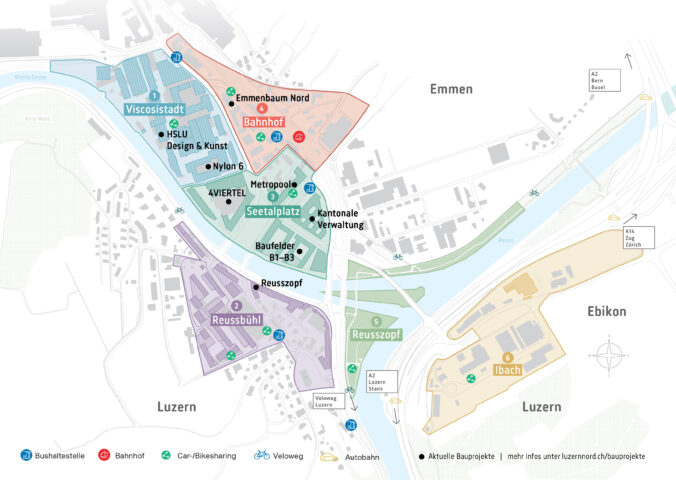
Lucerne North is divided into six sub-areas. The adjacent areas of Seetalstrasse and Littauerboden are also part of the development focus.
Smartness has many dimensions The Smart City approach is characterised by six dimensions: “Mobility”, “Living”, “Economy”, “Environment”, “Governance” and “People”. In the Smart City dimensions “Living” and “People”, the participatory pilot project “Quartiereffekt” was a milestone in Lucerne North. It enables the population to finance and implement their own ideas for neighbourhood design. But exciting projects were also developed on a smaller scale, such as a smart box from which the population can spontaneously borrow balls, badminton rackets and other games free of charge via an app.
The “Offcut” materials market in the Reussbühl area pursues the goal of a circular economy by recycling residual and used materials, in line with the “Environment” dimension. The “4VIERTEL” development on Seetalplatz provides new approaches in the “Mobility” dimension and provides its residents with a mobility station with sharing vehicles such as e-cars, e-scooters, e-cargobikes and e-bikes. In addition, all car-free households receive annual vouchers for public transport, a bicycle service or the in-house sharing service.
In the “Economy” dimension, a new research cooperation for sustainable textiles was established in 2022 with the Viscosistadt Lab. It aims to realign the textile competences at the location in Lucerne North.
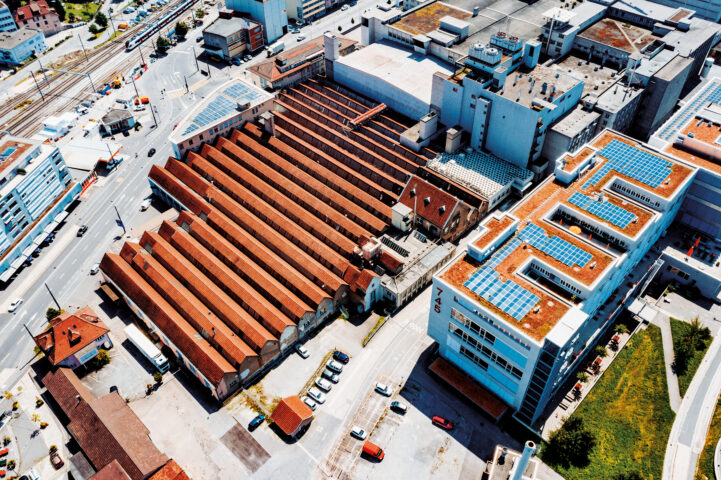
Viscosistadt is gradually developing into the creative part of Lucerne North.
Transformation in full swing The transformation of Lucerne North is in full swing. While some projects are under construction, important planning decisions have been made for others.
In Viscosistadt, a historic industrial building of the former Nylon-6 factory is currently being converted. This will create about 20,000 square metres of new space for office and commercial use. Right next door, the construction site for the “4VIERTEL” development is in the final phase. The first residents of Lucerne North will move in here from summer 2023.
Near Emmenbrücke station, 42 new flats will be built in “Gerliswil Central” by 2024. The Emmenbaum Nord building and the newly designed Schützenmatt district will give the area directly around Emmenbrücke station a fresh face.
An urban location with high density is being created around the new Seetalplatz.
The Rüüssegg housing cooperative’s development on Seetalplatz is about to receive the building permit for around 380 flats. Directly opposite the Kleine Emme in Reussbühl, 80 cooperative flats will also be built from 2024. The “Metropool” project of the Luzerner Kantonalbank and the cantonal administration on Seetalplatz are about to start construction.
The Reussbühl West area has a somewhat longer time horizon. The CKW site, which is used for commercial and industrial purposes, is to become an attractive and lively urban district in the coming years.
Even if no new flats have been occupied yet, Lucerne North is already alive today. Various temporary uses such as the cultural meeting place “NF49” (until November 2022) or the “Garage Emma” with studios for creative people, numerous events such as “Design Schenken” or the Swiss championship of bicycle couriers, cinemas and leisure facilities such as the “Adventure Room” brought around 105,000 visitors to Lucerne North last year. In addition, there are thousands of guests at the summer bar “Nordpol” on the Reuss.
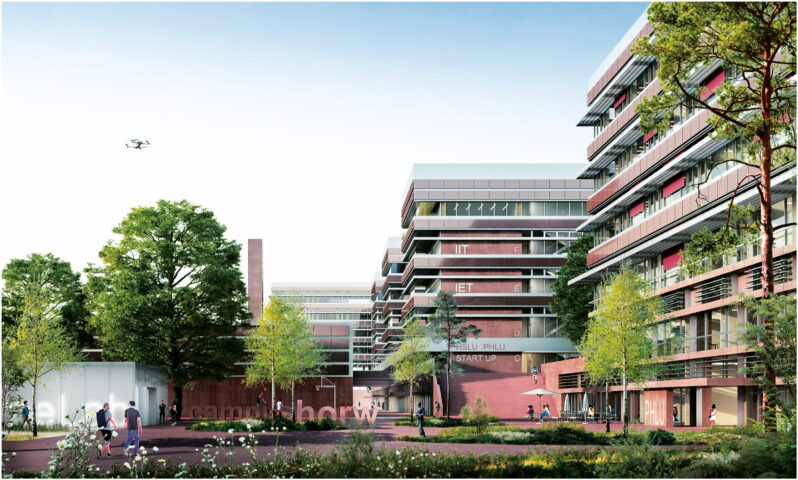
Der Kanton Luzern zählt immer mehr Studierende – die bestehende Infrastruktur auf dem jetzigen Campus Horw hat ihre Kapazitätsgrenzen aber bereits erreicht und einige Gebäudeteile sind zudem veraltet. Dank den Erneuerungen und Erweiterungen des Hochschulcampus in Horw sollen nach Fertigstellung ab dem Jahr 2029 rund 4000 Studierende und 1000 Mitarbeitende des HSLU-Departements Technik und Architektur sowie der Pädagogischen Hochschule Luzern Platz finden.
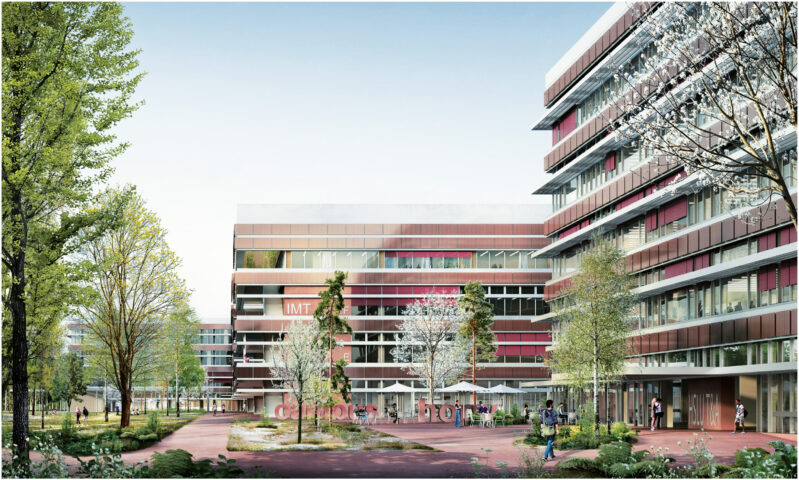
Die beiden Institutionen bleiben dabei eigenständige Organisationen mit einer je eigenen Identität und mit unterschiedlichen Kulturen. Der Campus lässt diese Diversität zu und ermöglicht eigenständige Auftritte. Trotzdem prägt ihn Gemeinsamkeit nach innen und aussen. Die gemeinsame Nutzung von Räumen und Einrichtungen, überschneidende und komplementäre Lehr-, Forschungs- und Dienstleistungsangebote sowie die zentrale Bewirtschaftung der Campusanlage basieren auf gemeinsamen Abmachungen und bewirken Synergien. Dadurch entsteht für die Pädagogische Hochschule wie auch Technik & Architektur ein qualitativer und ökonomischer Mehrwert.Geplant sind zwei neue Baukörper: Im Norden ein sechsgeschossiges Hauptgebäude der PH Luzern und im Süden ein siebengeschossiger Bau des Departements Technik & Architektur der Hochschule Luzern. Die bestehenden Trakte II, III und IV werden saniert und um ein Geschoss erweitert. Die leicht versetzte Anordnung der neuen Bauvolumen sorgt für eine spannungsvolle Gesamtkomposition auf dem Areal. Den Zuschlag für das Projekt erhielt das Architekturbüro Penzel Valier AG aus Zürich.
Die neuen Bauvolumen werden leicht versetzt angeordnet.
Die Architekten haben sich für eine Hybridbauweise aus Beton und Holz entschieden. Für die Erweiterung der Bestandesbauten sowie für die aussenliegenden Raumschichten der Neubauten soll unter anderem heimisches Holz zur Verarbeitung kommen. Dieses verleiht den Unterrichtsräumen eine angenehme und warme Atmosphäre. Die innenliegenden grossen Raumbereiche werden aus Recyclingbeton konstruiert.
Die Unterrichts- und Büroräume der beiden Neubauten entstehen rund um zentrale Atriumfiguren. Die Räumlichkeiten werden flexibel und an sich verändernde Bedürfnisse anpassbar gebaut. Die Atrien vernetzen die Institute der jeweiligen Schulen untereinander sowie mit den übergeordnet genutzten Sockelgeschossen. Diese sehen gemeinsame Nutzungen für den Gesamtcampus wie Bibliothek, Mensa, Audimax oder Campusaula vor.
Die rötliche Farbgebung der verschiedenen Fassaden-Elemente setzt die bestehende Tradition und Identität des Campus Horw fort.
Für die Realisierung des rund 365 Millionen kostenden Projekts sowie für den späteren Betrieb des Campus ist eine eigens dafür gegründete Aktiengesellschaft, die Immobilien Campus Luzern-Horw AG, verantwortlich. Die Realisierung ist ab 2026 vorgesehen. Die etappierte Inbetriebnahme ab 2029.
Der neue Campus Horw entsteht in Hybridbauweise aus Beton und Holz.
On November 24th, the foundation stone "for a casino the likes of which Switzerland has never seen" was laid in the listed Rapide Hall in Winterthur 's Lokstadt , writes Swiss Casinos in a press release . According to her, the company based in Zurich is planning a building integrated into the hall. In the industrial atmosphere of this “Loki”, casino operations are to begin in 2025.
A corresponding lease has already been signed, informs Ina Invest , the owner of the Lockstadt halls. This means that the Lokstadt halls with a total floor space of 8,200 square meters have been fully occupied, explains the real estate company from Opfikon in a separate communication . "Where locomotive history was once written, there will soon be overnight stays, entertainment, celebrations and games in a unique industrial setting", Ina Invest CEO Marc Baumann is quoted in the press release.
Swiss Casino plans to close its casino in Schaffhausen, just under 30 kilometers from Winterthur, at the same time as the opening of the new casino in Winterthur. The Swiss Casino in Schaffhausen has posted a total of 18 million francs in loss over the past 18 years, according to the operating company's announcement. The around 70 employees in Schaffhausen are to be offered a position in Winterthur or within the Swiss Casinos Group.
Wir verwenden Cookies zur Unterstützung und Verbesserung unserer Dienste. Mit der Nutzung dieser Website erklären Sie sich mit der Verwendung von Cookies einverstanden. Weitere Informationen finden Sie in unserer Datenschutzerklärung.