Tag: nachhaltige Entwicklung

  • The fifth generation of the Basel agglomeration program

    The fifth generation of the Basel agglomeration program

    New impetus for space and transport
    The program marks a decisive step in the joint planning of landscape, settlement and transport across national borders. Germany, France and Switzerland are pulling together to make mobility in the tri-national area more efficient, safer and more climate-friendly. In the coming years, eleven new transport hubs will be built along the tri-national S-Bahn and Basel-Stadt is investing in a fully electrified bus fleet. Around 200 million francs have been earmarked for the upgrading of municipal streets and the promotion of pedestrian and bicycle traffic.

    Mobility with a future
    In essence, it is about more than just infrastructure. The agglomeration program is a coordinated response to the complex mobility needs of a region that uses busy international transport routes on a daily basis. The integrated planning of public transport, private transport, footpaths and cycle paths is intended to reduce traffic congestion and CO² emissions. The priority is to develop a sustainable transport system that increases the quality of life and attractiveness of the location.

    Broad political support
    Esther Keller, member of the cantonal government and President of Agglo Basel, emphasizes the success of the cross-border cooperation, which has been in existence for over 15 years. Isaac Reber, Director of Construction in Basel, sees the large number of small and medium-sized projects as the backbone of progress. Jean-Marc Deichtmann from Saint-Louis and Marion Dammann from Lörrach also emphasized the strategic horizon. This ranges from multimodal platforms to citizen participation that strengthens climate protection and spatial quality.

    Looking ahead to the sixth generation
    Work has already begun on the 6th generation agglomeration program. Submission to the federal government is planned for 2029, with the construction phase starting in 2032. The Agglo Basel association is continuing the coordination and ensuring that space, transport and landscape in the border triangle are not considered separately, but as a coherent project for the future.
  • Master plan for the Jenny site

    Master plan for the Jenny site

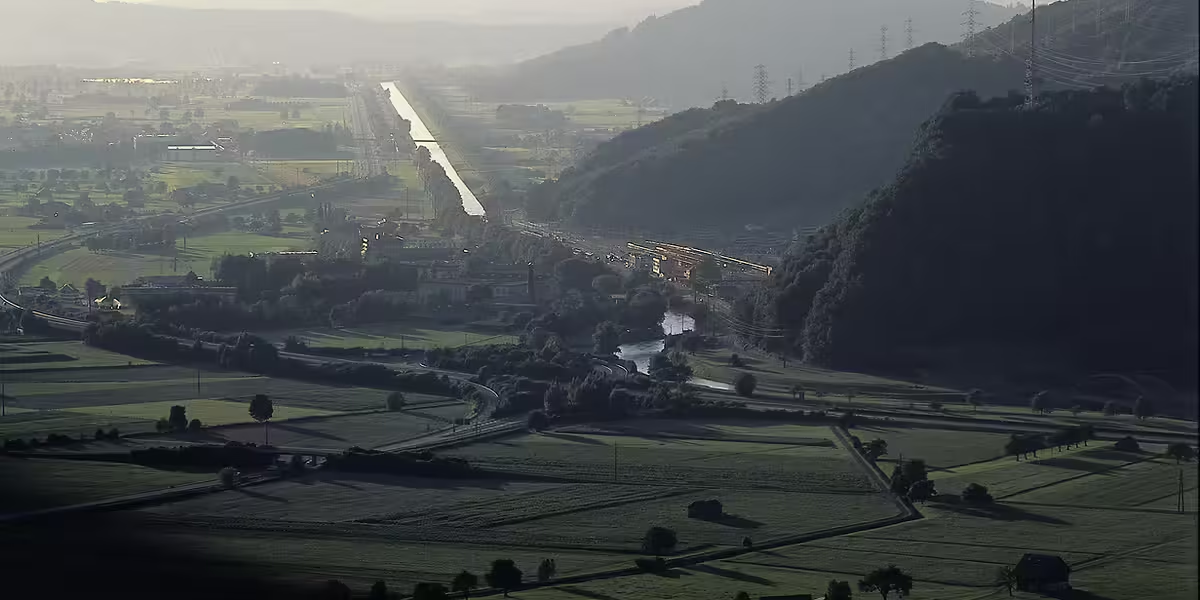
    The approximately 30-hectare Jenny site of Fritz Caspar Jenny AG is deeply rooted in the industrial history of the Glarus region. Where textile production has taken place since 1834, a multi-layered site with new prospects is being created today. The proximity to Ziegelbrücke railroad station, the size of the site and the existing infrastructure make the area a key location for economic and urban development in the canton.

    Planning with vision and participation
    A strategic master plan was developed as part of a multi-stage process, based on comprehensive test planning with four interdisciplinary teams. The resulting findings form the basis for a long-term development that is aligned with regional spatial planning, economic potential and social diversity. The winning design by Blättler Dafflon Architekten with Tony Fretton Architects and Studio Vulkan impressed with its strong combination of nature, building culture and open spaces.

    Diverse use as a location strategy
    The site already combines a variety of uses. From the Carlsberg Supply Company to creative work and residential forms such as Loft Z25 and the Glarus cantonal vocational school. The master plan builds on this diversity and expands it to include new educational, service and residential facilities. A hotel project is also being examined. The aim is to permanently establish and sustainably revitalize the Jenny site as a business, residential and educational location.

    Building culture as an identity-forming element
    Respectful treatment of the architectural heritage is central to the development. The site is part of the inventory of sites worthy of protection in Switzerland. Existing buildings of architectural and historical significance are to be preserved and integrated in a targeted manner. The listed riding stable, for example, is intended to enrich the new site concept as a defining element and contribute to the identity of the location.

    Focus on the legal framework
    The implementation of the master plan requires adapted land use planning. The project is currently awaiting the legal validity of land use planning II of the municipality of Glarus Nord. The first steps towards rezoning have been taken, but key legal requirements are still outstanding. Once this process has been completed, the development potential of the Jenny site can be fully exploited. A decisive step for the future of the site.

  • Canton Aargau approves Vinea project in Spreitenbach

    Canton Aargau approves Vinea project in Spreitenbach

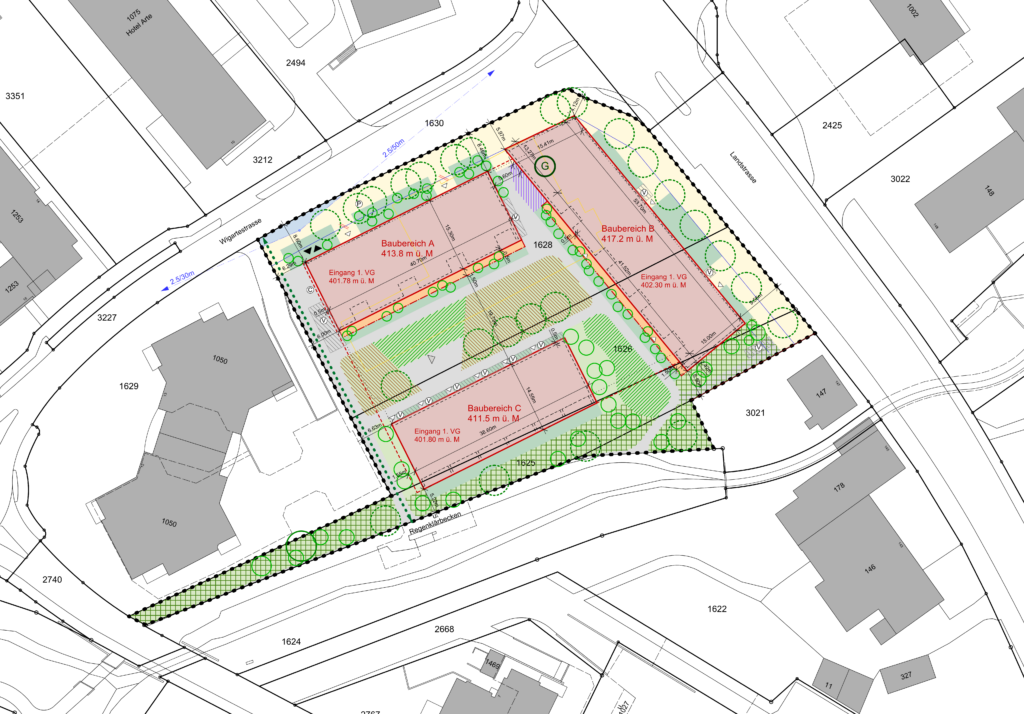
    The municipality of Spreitenbach can realise the Vinea design plan for the construction of flats at the entrance to the village. The Department of Construction, Transport and Environment(BVU) of the Canton of Aargau has approved the design plan, according to a press release. It forms the planning basis for the realisation of a development with around 37 flats on the previously commercially used site south of the Landstrasse and Wigartestrasse junction.

    According to the municipality, the planned development comprises three buildings. A four-storey building is to be constructed along Landstrasse, a three-storey building on Wigartestrasse and a two-storey building directly facing the village stream.

    A traffic-free inner courtyard is to be created between the buildings, which will be available to residents. The underground car park is intended to increase the quality of living and contribute to sustainable development.

    Vinea is based on the indicative project by Hunziker Architekten AG in Baden-Dättwil and SKK Landschaftsarchitekten AG in Wettingen AG. Metron AG in Brugg AG drew up the design plan together with the client and the municipality of Spreitenbach. The Vinea site is currently built on with a commercial development. A development study was prepared by Hunziker Architekten back in 2018. After weighing up various options, the municipality decided in favour of a longitudinally oriented development along the road in order to “create optimal urban planning conditions”.

  • Public consultation on the Lucerne agglomeration programme

    Public consultation on the Lucerne agglomeration programme

    The fifth generation of the Lucerne agglomeration programme (AP LU 5G) includes the towns of Sursee and Sempach for the first time, as well as several new municipalities such as Meierskappel and Neuenkirch. This expansion of the perimeter emphasises the increasing importance of regional cooperation in the sustainable development of settlement and transport structures. The focus of AP LU 5G is on coordinating transport development with settlement planning in order to optimally meet the challenges of growth and mobility in the region.

    Key projects through station and bypass
    The key projects of the LU 5G AP are the Lucerne through station and the A2 Lucerne motorway bypass. These major projects financed by the federal government form the backbone of long-term transport planning in the Lucerne region. In addition, accompanying measures and projects are planned by the canton and municipalities, such as the expansion of parking facilities and the creation of continuous bus lanes, in order to further improve the efficiency and flexibility of the transport system.

    Investments in overall transport and walking and cycling
    The LU 5G AP plans extensive investments in transport and settlement development. Overall transport, including important transport hubs such as the expansion of Ebikon railway station, will receive CHF 216 million in funding up to 2031. Pedestrian and bicycle traffic, with measures to optimise the cantonal bicycle network and improve local recreation, will also be given high priority. Projects in this area will be supported with a total of CHF 129 million.

    Public participation and future steps
    Public participation offers municipalities, experts and interested members of the public the opportunity to play an active role in shaping the AP LU 5G. The comments and suggestions, which can be submitted until 1 October 2024, will be incorporated into the revision and finalisation of the programme. An information event will be held in Rothenburg on 2 September 2024 to explain the draft and the planned measures in detail. Registrations are possible until 28 August 2024.

    The programme will be reviewed and adjusted once the public consultation has been completed. Adoption by the government is planned for 2025, before the AP LU 5G is submitted to the federal government for review.

  • Commercial use and solar energy: development of the Papieri site is progressing

    Commercial use and solar energy: development of the Papieri site is progressing

    Property developer HIAG is expanding the transitional use of the Papieri site in Biberist. By the end of the year, around 6,000 square metres of space in the western section will be prepared for commercial use, as HIAG project developer Dominik Ulrich explained at an event organised by the Standort Schweiz network. Padelta AG is one of the users of the additional space. The company plans to operate eight modern courts there for the sport of padel, the Mexican version of tennis. The leisure facilities will be complemented by the Jump Factory trampoline park. Speed-E GmbH moved into the site in February with its workshop and showroom for electric bikes.

    In the industrial eastern part of the site, HIAG Solar AG, a joint venture between HIAG and aventron, installed a solar power system with a capacity of 620 kilowatt peak on the roof of a new building due for completion at the end of 2023 in mid-April. The electricity generated there will be used on site by the start-up Librec, which intends to recycle lithium-ion batteries here on an industrial scale. The second photovoltaic system on the site is already being planned.

    The approximately 270,000 square metre site on the River Aare was used as a paper mill from 1862 to 2011. HIAG took over the site in 2012 and the 2015 master plan envisages mixed use with a residential component in the western part of the site and commercial/industrial use in the eastern part. The property developer is currently working on the partial zoning plan, which covers the entire perimeter of the site. Temporary uses already occupy around 30 per cent of the site. The major users include Sieber Transport and Vigier.

  • Site development – strategies for a vibrant city

    Site development – strategies for a vibrant city

    The city of Zurich is undergoing constant change, characterised by rising population growth and increasing demand for residential and commercial space. Balanced urban development that takes into account the needs of residents and incorporates ecological and social aspects is crucial. The Office for Urban Development plays an important role in the planning and realisation of this development. By coordinating public and private interests and developing urban development projects, the Office helps to ensure that Zurich remains a vibrant and attractive city. In doing so, the architectural heritage is preserved and space is created for forward-looking construction projects. The municipal structure plan is a key instrument for the long-term development of the city. This defines strategic goals and measures for sustainable area development and serves as a guideline for the coordination of various interests and stakeholders. In view of the projected population growth up to 2040, targeted planning and densification of existing areas is essential. The municipal structure plan defines areas that are suitable for building densification, as well as areas for public open spaces, municipal buildings and facilities. The focus here is on creating a liveable environment that meets the needs of residents and enables sustainable urban development. Overall, site development and spatial planning in Zurich is a complex challenge that requires close co-operation between various stakeholders. The Office for Urban Development is committed to a balanced and future-orientated development of the city that preserves its identity and meets the need for living, working and recreational space.

  • Dormakaba scores with sustainability

    Dormakaba scores with sustainability

    EcoVadis has recognised dormakaba ‘s progress in sustainable development. Dormakaba has improved its overall score in all four categories – environment, labour and human rights, ethics and sustainable procurement – in a year-on-year comparison, the internationally active locking technology company from Rümlang announced in a press release. Having been awarded the gold medal for the third time, dormakaba is among the top 5 percent of the more than 130,000 organisations assessed worldwide.

    In addition, dormakaba was nominated by EcoVadis in the two categories Outstanding Programme Management and Best Mature Programme of the Sustain 2024 Achievement Awards of the sustainability ranking provider. “The fact that we were able to maintain our top 5 per cent position in the area of sustainability despite increasingly demanding criteria clearly shows our commitment,” said Stephanie Ossenbach, Group Sustainability Officer at dormakaba, in the press release. “Our nomination and leading position in industry ratings are further proof that our efforts in the area of sustainability have been recognised.”

    The gold medal from EcoVadis is one of several awards that dormakaba has received this year for its commitment to sustainability. Back in January, Institutional Shareholder Services awarded the company Prime Status in its ESG ratings. In March, dormakaba was awarded an AA rating by Morgan Stanley Capital International. This indicates “that dormakaba is one of the industry leaders in dealing with financially relevant ESG risks and opportunities”, according to the press release.

  • City of Baden reviews development for the Galgenbuck area

    City of Baden reviews development for the Galgenbuck area

    In consultation with the canton of Aargau, the city of Baden is launching a cooperative workshop process to review the development guideline plan (ERP) for the Galgenbuck area in Baden-Dättwil, according to a press release. The ERP, which was drawn up in 2008, defines planning parameters and strategic objectives for the development of the plot and was revised in 2019. To date, it has not been possible to reach agreement on the development of Galgenbuck in the subsequent procedures. As a result, the zoning procedure has been blocked. At 15 hectares, the Galgenbuck site in Dättwil is the last large and contiguous settlement reserve in the city of Baden.

    “The workshop process allows for an open discussion. We are conducting it with the aim of jointly setting the right course for one of the last settlement reserves,” says Karin Bächli, Co-Head of Urban Development and Environment. The city of Baden, Baden Regio, the canton and experts are now to test the future viability of the Galgenbuck development plan on an interdisciplinary basis and reach a consensus on how to proceed.

    “This modern review of the ERP will provide the necessary certainty for future investors and users,” says Markus Schneider, Mayor of the city. The process, which has now been presented to those directly affected, should provide clarity on the next steps by 2024.

    According to the press release, the review of the ERP is running in parallel with the overall revision of Baden’s building and utilisation regulations. The master plan for the cantonal development centre in Dättwil is also being drawn up.

    The cantonal Department of Construction, Transport and Environment (BVU) has suspended the project for Mellingerstrasse, which was developed jointly with the city, until the results of the urban planning processes are available.

  • Innovation Park Zurich gets its first new buildings

    Innovation Park Zurich gets its first new buildings

    The first development phase of the Zurich Innovation Park on the airfield site in Dübendorf is taking shape, the operator announced in a press release. Construction work on a total of seven new buildings on the apron of the site is set to begin this year. The projects were selected from a total of 28 proposals submitted last year in a global architectural competition.

    The projects now selected were developed by the architectural firms E2A, Roger Boltshauser, Mulder Zonderland and TEN from Zurich as well as Muoto from Paris and 3XN from Copenhagen. According to the current planning status, around 24 per cent of the total floor space is to be divided into office space, 8 per cent into laboratory space and 12 per cent into production space, for example for the manufacture of prototypes. A further 36 per cent is planned as flexible space for various uses. In addition, areas for utilities, services and research-related living are to be created. Catering, leisure and shopping facilities are also planned.

    With its own development, the Innovation Park Zurich aims to set an example for innovative urban development and sustainability. “Accordingly, special building typologies are being developed that can be used sustainably over long periods of time thanks to their flexibility and modularity and have a significantly reduced ecological footprint through the use of new technologies,” the press release states. Plans include the installation of an anergy grid and large solar panels on roofs and façades.

  • ZKB offers mortgages for non-profit housing developers

    ZKB offers mortgages for non-profit housing developers

    The Zürcher Kantonalbank is offering a new mortgage for housing cooperatives at favorable financing conditions. According to a press release , non-profit property developers benefit from a reduced interest rate of up to 0.5 percent. This applies both to the extension of existing loans and to a new mortgage.

    The basic requirement for the granting of the ZKB WohnPlus mortgage is that the apartment rents from the housing developer are at least 15 percent below the market rents. “We want to use this to maintain and promote non-profit and affordable housing,” Patrick Bühlmann, corporate customer advisor at Zürcher Kantonalbank, is quoted as saying in the press release. Because in the cities, above all Geneva and Zurich, rising rents are leading to a lack of affordable living space.

    In addition, applicants must meet 29 criteria, seven of which are basic criteria. If the applicant meets a further 14 criteria in stage 1, he will receive a maximum interest rate reduction of 0.3 percent. In order to receive the full 0.5 percent, he must meet a total of 21 requirements based on the United Nations Sustainable Development Goals ( SDG ), the Swiss Sustainable Building Standard ( SNBS ) and the ten guiding principles for non-profit housing in Switzerland.

    If level 1 is initially reached in a construction project, the property developer can prove further criteria later on. In this way, the bank wants to create an incentive “to make further improvements in terms of social performance even during the term”.