Tag: Netto-Null

  • Switzerland on course for net zero

    Switzerland on course for net zero

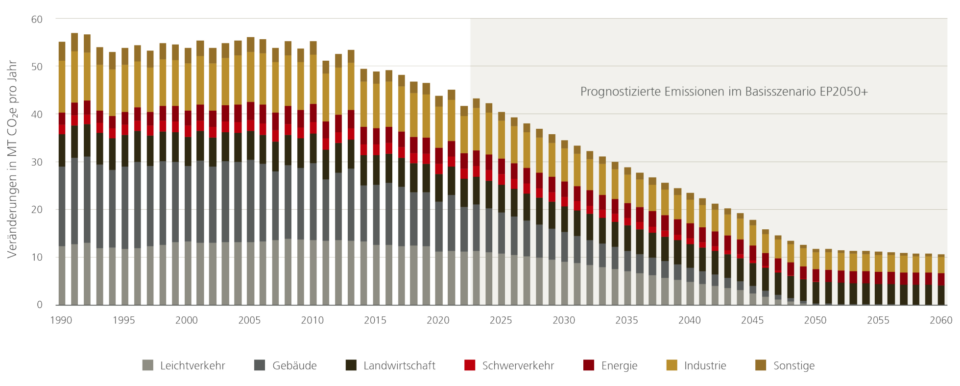
    Switzerland compares favourably with other countries. Its carbon intensity is the lowest of all OECD countries and electricity generation is already largely CO₂-free. Emissions were reduced by 24% between 1990 and 2022. This is a remarkable achievement while at the same time doubling its economic strength. This strong starting position offers Switzerland the opportunity to take a leading role in green technologies such as carbon capture or low-carbon cement.
    Renewable energies and energy storage are key
    In order to continue decarbonisation, electricity generation capacity must be increased from the current 27 gigawatts to over 60 GW by 2050. This is particularly challenging as the four remaining nuclear reactors will be shut down by 2034. A massive expansion of renewable energies and innovative solutions for the seasonality of supply and demand are required. Increasing energy storage capacities and efficient demand management will also play a key role.

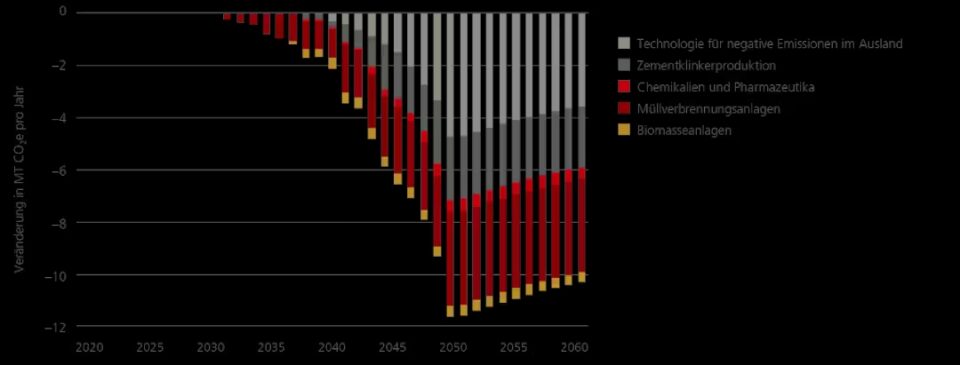
    Michael Baldinger, Chief Sustainability Officer at UBS, explains: “For sectors that cannot completely eliminate their emissions, carbon capture technologies are crucial. This presents Switzerland with technological, logistical and financial challenges, but at the same time opens up opportunities in green markets.”

    Regulatory changes set the course
    The legal basis for the transition will be defined by significant regulatory changes in 2025. These include the Electricity Act, the CO₂ Act and the Climate and Innovation Act. Adapting to EU requirements will also increase the number of Swiss companies subject to reporting requirements from 300 to 3,500. These changes require targeted investments and close cooperation between the business, political and financial sectors.

    Financial sector as a key player
    According to estimates by the Swiss Bankers Association (SBA), CHF 13 billion is required annually to achieve net zero. The Swiss financial sector plays a decisive role here. It offers financing options such as bank loans, bonds and blended finance solutions that support the market entry of new technologies. It can also advise companies on the transformation and act as a link between investors and companies.
  • Energy City strengthens climate policy with new certification standards

    Energy City strengthens climate policy with new certification standards

    The Energiestadt association wants to support its 644 member municipalities and cities on the path to climate neutrality in future. In 30 years of commitment, much of what was initially considered progressive has become the standard, writes Energiestadt in a corresponding press release. In order to continue to act as a pacesetter, certification and support for members should be consistently focussed on the net-zero target.

    The Energiestadt label recognises cities and municipalities for their sustainable energy and climate policy. In future, the certification process will place particular emphasis on net-zero relevant strategies and measures. The press release cites the phasing out of natural gas for heating and the promotion of electromobility as examples. To receive the highest accolade of Gold City, in future it will be necessary to prove that strategies and measures are being consistently pursued and are compatible with the net-zero target. At the same time, Energiestadt wants to simplify the certification process for smaller municipalities.

    “With the new instruments, Energiestadt is strengthening its role as a leading competence centre for local energy and climate policy in Switzerland,” said Maren Kornmann, Co-Managing Director of Energiestadt, in the press release. “Energiestadt is the only organisation to offer a comprehensive package for the planning, implementation and monitoring of net-zero measures at local level.”

  • Bank aims for net zero by 2030 in its own operations

    Bank aims for net zero by 2030 in its own operations

    ZKB wants to reduce its operational emissions to net zero by 2030. Since 2010, the Cantonal Bank has already reduced its greenhouse gas emissions by around 70 per cent, explains Marit Kruthoff from ZKB’s Performance Mandate department in an interview on the Cantonal Bank’s blog. The overall goal is to continuously reduceCO2-equivalentemissions(CO2e) and increase operational ecological performance. ZKB aims to limit its operational emissions to a maximum of 1,800 tonnes ofCO2eper year by 2030.

    ZKB aims to eliminate these unavoidable residual emissions through its removal portfolio. This involves removing CO2 from the atmosphere and storing it permanently in plants, soil, oceans or cement, for example. ZKB is relying “on the combination of the three providers neustark, climeworks and Bioenergie Frauenfeld”, explains Kruthoff.

    Climeworks, a Zurich-based spin-off of the Swiss Federal Institute of Technology in Zurich, operates plants that remove CO2 directly from the atmosphere and permanently store the CO2 captured from the air. Bioenergie Frauenfeld, based in the capital of Thurgau, uses pyrolysis to produce biochar and gas from wood. The resulting waste heat is utilised as district heating. Neustark from Bern has developed a technology for storing CO2 in demolition concrete. All three companies achieve negative emissions with their technologies. The resulting waste heat is utilised as district heating. Neustark from Bern has developed a technology for storing CO2 in demolition concrete. All three companies achieve negative emissions with their technologies.

  • Increased efficiency in construction through negative emission technologies

    Increased efficiency in construction through negative emission technologies

    In order to ensure a clear distinction between the greenhouse gas emissions of the building and the negative emissions, these should be reported separately. Offsetting at the building material and component level is not recommended. Although buildings with net-zero greenhouse gas emissions are not yet achievable, they could be within reach in the future if greenhouse gas emissions from the production of building materials such as cement, steel, brick or glass are massively reduced.

    In order to significantly reduce urban emissions by 2035/2040, the implementation and accounting of negative emissions technologies (NET) in the building sector is essential. A recently completed study has developed methods for integrating NETs into urban carbon reporting and formulated clear recommendations for the building sector in Switzerland.

    A key finding of the study is that biogenic CO² and CO² extracted directly from the atmosphere must be stored for thousands of years in order to have a lasting impact on global temperatures. Temporary storage is not enough, as it cancels out the positive effects of subsequent re-emissions. A binding guarantee of permanence is therefore essential to ensure recognised NET accounting.

    The study recommends accounting for NET in accordance with the SIA 2032 and 2040 standards. To ensure transparent accounting, it is essential to distinguish between negative emissions and greenhouse gas emissions from the building. Offsetting at material and component level should be avoided. The SN EN 15804 standard has shortcomings, as it shows an even balance of biogenic CO² even with permanent sequestration. It is important to use clear and precise language to emphasise the credibility of the statements.

    Timber construction offers the greatest potential for negative emissions. Other renewable raw materials such as straw or hemp lime are promising but not yet widely used. Research should focus on ensuring durability and increasing the contribution of forced carbonation in mineral building materials. Although a net-zero greenhouse gas balance for buildings is not currently achievable, an important step in this direction can be made by drastically reducing emissions in the production of building materials.

    The study emphasises the need for increased efforts to reduce greenhouse gas emissions, particularly in the production of building materials. It is recommended that local authorities provide financial support for the development of NET in order to achieve the desired climate targets.

  • The Circle: Switzerland's largest Minergie building certified

    The Circle: Switzerland's largest Minergie building certified

    Minergie and LEED certification has been an integral part of planning and construction at the Circle for 12 years. In the presence of Christian Appert, CEO Amstein + Walthert AG, Martin Kull, CEO and owner HRS Real Estate AG, Daniel Scheifele, Chief Real Estate Officer, Flughafen Zürich AG, Giorgio Engeli, Head Real Estate Portfolio Management Switzerland, Swiss Life Asset Managers, and Stefan Feldmann, Head The Circle, Flughafen Zürich AG, the team around The Circle celebrated on Monday, June 27, 2022, the goal they have now achieved.

    Beautiful, functional, climate-optimized
    With a good 200,000 m 2 energy reference area, the circle accounted for 6% of the certified Minergie area in the year of provisional certification, but was only one of around 1,900 buildings. This shows the size and importance of this extraordinary building in the Swiss context. The Circle is the largest Minergie-certified building in Switzerland. According to government councilor Marc Mächler, the Minergie certificate means that – in addition to all other requirements and uses – the building is also climate-optimized. Climate-optimized means «that this building does not accelerate climate change and that it uses resources carefully. It is efficient and works almost entirely with renewable energy instead of fossil energy.”

    Thanks to intensive cooperation between the Minergie certification body and those responsible for the circle, the high requirements of the Minergie quality label for the building envelope and ventilation could also be met. Andreas Meyer Primavesi, Managing Director of Minergie, is pleased that the result ultimately benefits everyone: “Especially with today’s energy prices, every kilowatt hour of energy saved is worth it – not only for the climate, but also financially”.

    Into the net-zero energy future
    With the leading Swiss building label Minergie, more than 12 million tons of CO 2 and 67 million megawatt hours of energy have been saved since 1998 thanks to over 53,000 Minergie buildings compared to the minimum legal requirements. Minergie certifies around 3 million m 2 of energy reference area per year. In close coordination with the cantons, Minergie always leads the way and is therefore a pioneer in cantonal energy laws. This interaction has worked since the beginning and continues successfully. Minergie is currently looking very closely at the energy used and the greenhouse gas emissions in the construction of a building. And secondly, Minergie is striving to improve the operating phase: Extensive, digitized building data is used to measure the energy flows during operation in order to then carry out operational optimization where necessary on the basis of the monitoring. For years, fossil-free operation – even with modernization – Minergie is moving more and more towards net zero. The Minergie-A-ECO standard comes closest to the Swiss net-zero building.