Tag: Neubauprojekt

  • Foundation stone laid for mixed-use building in Frenkendorf

    Foundation stone laid for mixed-use building in Frenkendorf

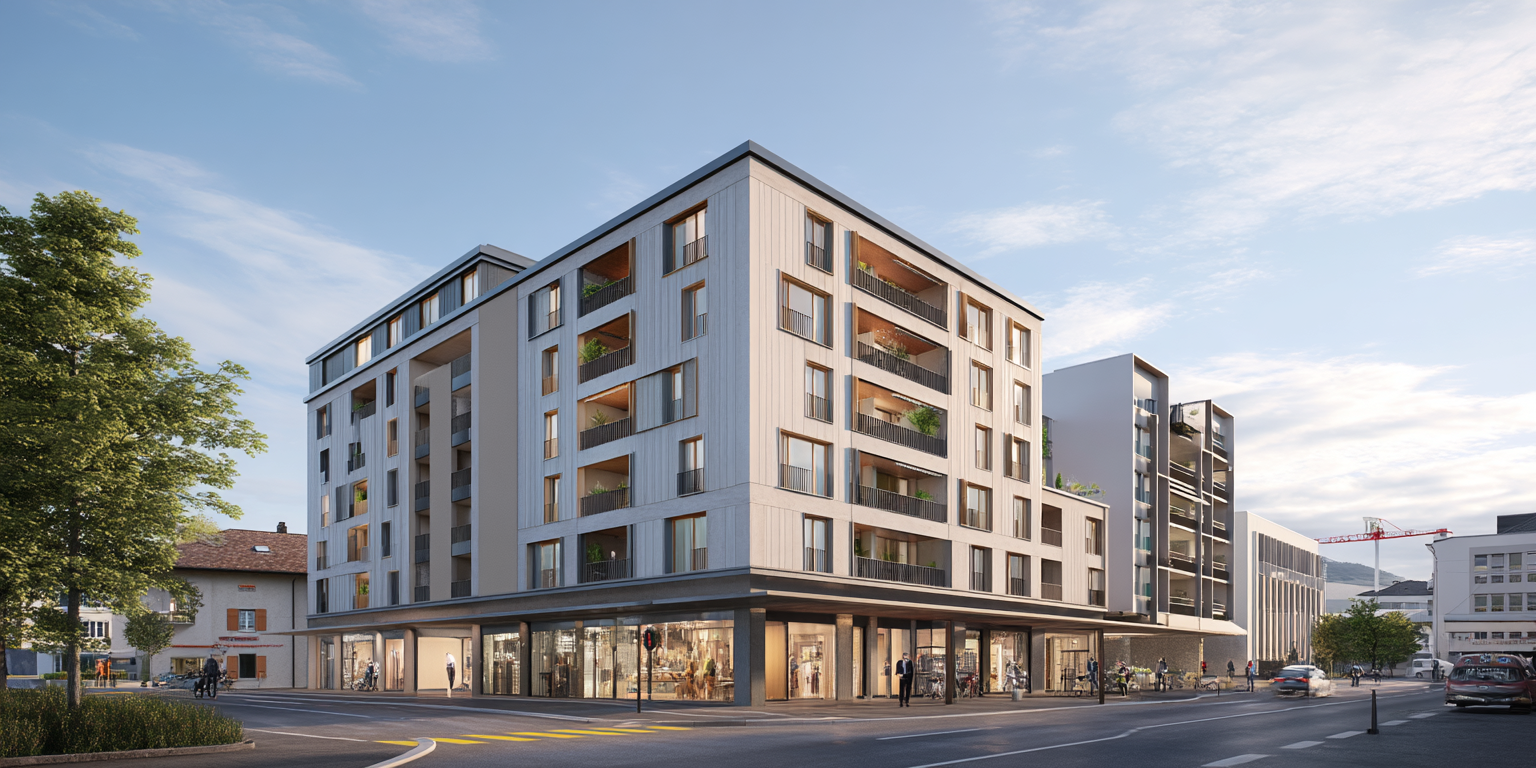
    According to a statement, Halter AG has laid the foundation stone for the Park3project. Also involved were the client Zurimo “B” Immobilien AG, represented by UBS Fund Management (Switzerland) AG, representatives of Reuter Architekten, the municipality of Frenkendorf and the planning, marketing and implementation teams involved.

    The mixed-use residential and commercial building will be a five-storey structure with an attic, combining living, working and commercial space under one roof. The plot size is 2,607 square metres and the construction costs amount to 14 million Swiss francs. Flexible commercial space will be created on the ground floor, with modern office units on the first floor. The upper floors will feature 22 apartments with 2.5 and 3.5-room floor plans. The project is being developed in an area with good infrastructure connections, which is increasingly gaining urban quality as part of urban development. The site is currently used primarily for commercial purposes.

    The building plans for the project, a UBS annual report and the current issue of the Halter Group’s KOMPLEX magazine were placed in the foundation stone as contemporary documents and permanently anchored in the foundations.

    The focus is now on the construction of the shell, which is scheduled for completion by the summer. The project is scheduled for completion in spring 2027.

    Halter AG is a real estate and construction company operating throughout Switzerland. The company handles a construction volume of around CHF 800 million per year at seven locations and currently has around 320 projects in development and execution.

  • Construction site for retirement home in Schlieren to be set up in March

    Construction site for retirement home in Schlieren to be set up in March

    From the beginning of March 2026, the construction site for the new Schlieren retirement home “Wohnen am Stadtpark”will be visible to the public. Preparatory work will then begin there. Two appeals had led to a one-year delay, but these were withdrawn in December 2025. The legal proceedings have now been concluded. According to a statement from the city of Schlieren, the construction site can now be set up and the initial construction and preparatory work can begin. The official ground-breaking ceremony is scheduled for April 2026. Construction work is expected to be completed by the end of 2028.

    As construction begins, the playground on the western edge of the city park will also be dismantled starting in early March. According to the city, a new municipal playground is already being built at Stürmeierhuus. It is scheduled to be completed in April.

    In the referendum on 12 March 2023, a loan of CHF 44.32 million for the construction of the new retirement home was clearly approved with 76.6 per cent voting in favour. As the city emphasises, it makes “an important contribution to ensuring modern, needs-based care and nursing for the elderly close to their homes”.

  • Education cluster Polyfeld Muttenz

    Education cluster Polyfeld Muttenz

    The canton of Basel-Landschaft is combining the BBZ BL, the Muttenz grammar school and the Zentrum für Brückenangebote into a joint secondary II campus at Polyfeld. Stage 1 focuses on the dismantling and conversion of the existing tower, which has been gutted from top to bottom, decontaminated and completely dismantled in the core area. The core walls, staircases, floor slab and foundations were removed in a controlled manner over an area of around 20 by 20 meters.

    To ensure that the slender tower remained stable during the conversion and new construction, temporary bracing with heavy steel frames was installed on each floor. At the same time, the new construction of the building core and the construction of the new main staircase, which is to become a design center of the BBZ as a freely suspended prefabricated construction in exposed concrete, began.

    Exposed concrete, workshop building and triple sports hall
    All new buildings in stage 1 will be constructed in high-quality exposed concrete, with a project-specific formwork and concreting concept for uniform surfaces. The workshop building, which is around 55 meters long and 26 meters wide, is being built in three stages so that walls, columns, earthquake walls and ceilings can be constructed in parallel on each floor.

    The new triple sports hall will have a complex supporting structure made of pre-stressed prestressed concrete beams, which will be assembled in stages, provisionally supported and pre-stressed after the ceiling has been concreted. This allows the hall to be flexibly divided into three smaller units at a later date. An external spiral staircase with specially developed formwork provides an architectural accent. The adjoining assembly hall and canteen is a prefabricated construction, combining exposed concrete with a composite timber ceiling and functionally linking the different parts of the building.

    Life science training building in the Polyfeld
    Parallel to the cantonal campus project, the Polyfeld is being given an additional focus with a new life science training center. The Basel district council has approved a contribution of around two million francs for this. Around CHF 1.7 million for the construction of the new training location at Birsfelderstrasse 46 and around CHF 390,000 for special laboratory equipment. The new building will have a net floor area of around 19,500 square meters. Cantonal funding will be provided for an eligible floor space of around 1,400 square meters.

    The project is sponsored by the Aprentas training association, which intends to combine its existing locations on Lachmattstrasse and in Schweizerhalle in the new building. Aprentas, which originally emerged from the Novartis environment, offers inter-company courses for EFZ training in chemistry, biology and chemical and pharmaceutical technology. The cantonal funding strengthens Muttenz as a life science training location and complements the Polyfeld secondary school campus with a clearly profiled, practice-oriented training infrastructure for regional industry.

  • New ground-breaking ceremony in Bergdietikon

    New ground-breaking ceremony in Bergdietikon

    The ground-breaking ceremony for the Hintermatt retirement and care centre, the Oase, took place on 5 November, as reported by the municipality of Bergdietikon in a press release. On completion in summer 2028, the retirement centre in Bergdietikon will be able to provide 66 flats for senior citizens and 44 care places.

    The project was approved by the municipal assembly back in 2012 and the sale of the land was also authorised. However, this was followed by 13 years of planning and legal disputes. The ground-breaking ceremony is a “decisive moment” in the realisation of the project, which is now “finally being implemented after a long phase of objections and legal disputes”, according to the municipality of Bergdietikon.

    The project is particularly important for the municipality in that it not only meets the needs of the elderly population. The local infrastructure is also to be enriched by publicly accessible facilities.

  • Winning project for the first new building on the Werkstadt site in Zurich

    Winning project for the first new building on the Werkstadt site in Zurich

    Used rails as supporting structure
    The winning project “GLEIS X”, which was developed by Leuthard AG Baumanagement and Gigon/Guyer Architekten AG, impresses with its consistent reuse strategy. The concept uses 12 kilometres of used rails from the SBB ReSale as supports and ceiling beams for the main floors. The building envelope also consists of reused windows and corrugated fibre cement panels. This innovative use of used components was particularly recognised by the jury, as it picks up on the history of the site and continues it architecturally. For SBB, which attaches great importance to the preservation and further development of its architectural and railway heritage, this approach was decisive.

    Six commercial floors and one city floor
    The planned new building comprises seven floors, six of which are to be used as commercial space. These areas are intended for small to medium-sized businesses and offer a mix of traditional and innovative commercial space. The first floor, the so-called “city floor”, will house services or cultural offerings and thus promote interaction with the neighbourhood. The ground floor will initially be used for car parking and goods handling, but will also be converted into a commercial floor at a later stage.

    Public project exhibition
    Interested parties can view the competition entries on the mezzanine floor of Building U, Hohlstrasse 400, 8084 Zurich. The exhibition is open until 19 June 2024 from Monday to Friday from 5pm to 7pm and at weekends from 12pm to 4pm.

    Werkstadt Zürich – a place for urban production
    An innovative centre for urban production and commerce is being built on the approximately 43,000 square metre “Werkstadt Zürich” site. SBB is refurbishing the existing buildings and creating jobs close to the neighbourhood for trades, services and highly specialised professionals. The transformation of the site is being carried out in close cooperation with the City of Zurich and the cantonal monument preservation authorities. Around 35 companies currently provide jobs on the site and contribute to the lively development of the neighbourhood.

  • Thierryturm-Gelände: Uni Freiburgs neues Fakultätsgebäude

    Thierryturm-Gelände: Uni Freiburgs neues Fakultätsgebäude

    Nach einer längeren Verzögerung aufgrund von Grundstücksverhandlungen nimmt das Projekt für den Neubau der Rechtswissenschaftlichen Fakultät der Universität Freiburg auf dem Gelände des Thierryturms wieder Fahrt auf. Der Staatsrat hat beim Großen Rat einen Antrag auf einen zusätzlichen Projektierungskredit in Höhe von 12 Millionen Franken für Studienarbeiten gestellt. Zusätzlich wurde ein Verpflichtungskredit von 3,4 Millionen Franken für den Abbruch bestehender Gebäude auf dem Gelände beantragt.

    Das Projekt, das ursprünglich 2013 gestartet wurde, soll die angespannten Platzverhältnisse der Fakultät lösen und den Standort Miséricorde aufwerten. Der geplante Neubau wird nach den Kriterien des Standards Nachhaltiges Bauen Schweiz (SNBS) konzipiert, inklusive einer Photovoltaik-Anlage auf dem Dach. Die Integration eines Abschnitts der TransAgglo, einem wichtigen Bestandteil des regionalen Fahrradnetzwerks, ist ebenfalls vorgesehen.

    Die nötigen Projektierungsarbeiten werden gemäß der Verordnung über bedeutende Immobilienvorhaben des Staates vorangetrieben. Der geplante Abbruch der bestehenden Gebäude der Stiftung Le Tremplin, die dem Neubau weichen müssen, soll auch bodenkundliche Untersuchungen für eine eventuell notwendige Sanierung ermöglichen.

    Mit einem geplanten Baustart im Frühjahr 2027 und der voraussichtlichen Inbetriebnahme im Herbst 2030 belaufen sich die geschätzten Anlagekosten auf etwa 152 Millionen Franken. Für das Projekt könnte ein Bundesbeitrag für den Bau von Hochschulinfrastrukturen beantragt werden, der im Rahmen des zukünftigen Verpflichtungskreditantrags für die Durchführung des Projekts berücksichtigt wird. Dieses Vorhaben stellt einen bedeutenden Schritt für die Entwicklung der Universitätsinfrastruktur und die Stärkung des Bildungsstandortes Freiburg dar.

  • AIHK submits building application for its new construction project

    AIHK submits building application for its new construction project

    With the building application to the city of Aarau at the end of September, the new building project of the Aargau Chamber of Commerce and Industry(AIHK) has reached an important milestone, according to an article in the magazine “Impulse” published by the AIHK. Depending on the building permit, construction work is expected to start at the beginning of 2025, the article continues. The building permit for the new Haus der Wirtschaft was handed over by AIHK President Beat Bechtold to City President Hanspeter Hilfiker and City Clerk Fabian Humbel in front of Aarau City Hall, the report says.

    The AIHK project team had already been in contact with various city officials beforehand, the report continues. For example, the city architect and the city image commission were consulted when it came to realising a building project that was as broadly supported as possible.

    The approval process starts with the building application. Demolition is planned for the end of 2024. The new building is expected to be ready for occupation in the third quarter of 2026.

    On the one hand, the new facilities in the new Haus der Wirtschaft will enable more professional courses and events to be held, the report in “Impulse” continues. On the other hand, the new building stands for the progressive digitalisation and modernisation that has been taking place at the association for several years.

  • Council of States approves Real Estate Message 2023

    Council of States approves Real Estate Message 2023

    the Federal Council wants to invest 29.5 million francs in the expansion and renovation of the Agroscope research centre in Zurich-Reckenholz. The underground connecting level of the federal administration and laboratory buildings in Liebefeld (municipality of Köniz BE) is to be expanded at a cost of CHF 21.1 million.

    For 27.5 million Swiss francs, the Federal Council wants to have a new building and a new office built for the Swiss representation in Cameroon’s capital. The two buildings are to be constructed on the grounds of the Swiss Embassy and replace rented buildings.

    The Real Estate Dispatch also includes expenditure of CHF 140 million for projects not individually specified below an amount of ten million francs. The Council of States unanimously adopted the federal resolution on the real estate message on Monday. It still goes to the National Council.

  • The LIMMIviva construction project ends with savings

    The LIMMIviva construction project ends with savings

    The Limmattal Hospital Association completes the LIMMIviva new construction project for the acute hospital. The construction was realized between 2014 and September 2018. This was followed by relocation and commissioning. The project can now be considered completed. According to the media release, less was spent on the costs than estimated. The approved commitment credit of 275.7 million francs, including two supplementary credits, was undershot by around 0.8 million francs.

    In a construction project lasting several years, adjustments to the original project are quite common, according to the hospital association. This also applied to the new building project for the Limmattal hospital. The high dynamics of the healthcare system meant that the project was continuously adapted to changing requirements in over 100 supplements. Such supplements usually lead to significant additional costs. During the construction of the Limmattal hospital, together with the Bern-based construction company Losinger Marazzi AG , which was commissioned as general contractor, additional costs that caused additional costs were compensated for by optimizations in other areas.

    With the hospital financing introduced in 2012 and an amendment to the municipal law, the Limmattal Hospital Association was able to finance the investments of around 270 million francs itself, without the help of the municipalities and thus without burdening the taxpayer. 220 million francs of outside capital was raised through the issue of two bonds.

  • Steinfels Swiss lays the foundation stone for a new factory

    Steinfels Swiss lays the foundation stone for a new factory

    Steinfels Swiss laid the foundation stone for its new building in Winterthur on March 30, the Coop subsidiary, which specializes in the production of sustainable cosmetic and hygiene products for the retail trade, hospitals and gastronomy, informed in a statement. “With the new building, we are investing in the Winterthur production site and expanding our range of cosmetic products,” Christian Koch, CEO of Steinfels Swiss, is quoted as saying. “In this way we can meet the increasing demand for cosmetic products, especially for sustainable alternatives.”

    In the new production building, the company wants to renew its cosmetics production and realign the production of detergents, the press release explains further. The internal flow of goods should be automated. The end of the construction work is scheduled for the end of 2023. The new production premises offer space for 150 employees.

    Steinfels Swiss had the old production building demolished for the new building project worth CHF 35 million. The new building is intended to set “standards in terms of sustainability”, the company explains in the press release. On the one hand, it is built according to the Minergie standard. On the other hand, a large part of the required electrical energy is to be produced with the company’s own photovoltaic systems. Steinfels Swiss will obtain the thermal energy required for production from Stadtwerke Winterthur in the form of waste heat.

  • Allreal starts construction work for the new Rieter campus

    Allreal starts construction work for the new Rieter campus

    According to a press release , Allreal has started construction work on Rieter ‘s new campus in Winterthur. The real estate company from Opfikon is responsible for the project as general contractor. She works with the BDE Architects from Winterthur, among others.

    Rieter is investing around 80 million francs in its new campus. This is to include a customer and technology center and an administration building on an area of 30,000 square meters. The textile machine manufacturer will be able to employ around 700 people there from 2024.

    Rieter relies on renewable energies for the new campus. The heat is to be generated with geothermal probes, for example. In addition, a 1300 square meter photovoltaic system will be installed. According to Allreal, the project is “very complex, especially with regard to the building services”. In product and technology development, different climate zones are required that can be set differently.