Tag: Neuenhof

  • Refurbishment of the large Webermühle development

    Refurbishment of the large Webermühle development

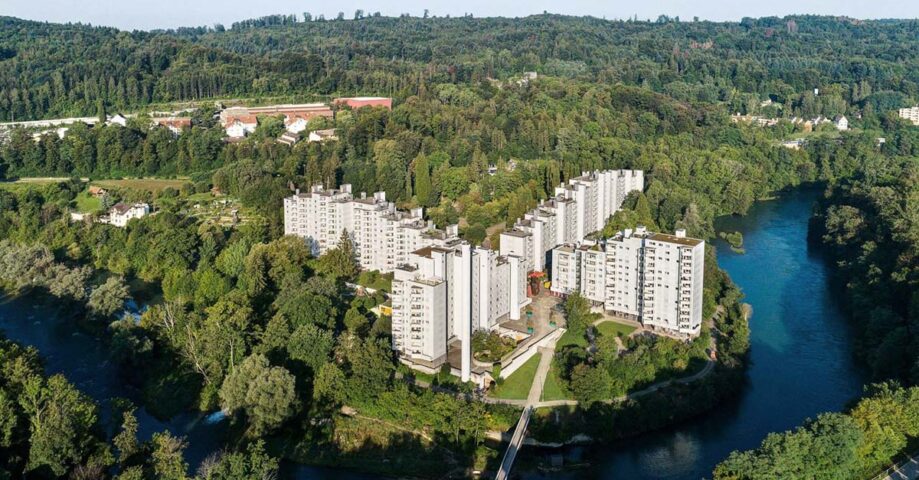
    The Webermühle development in Neuenhof houses 368 rental apartments. The settlement on a peninsula in a loop of the Limmat was built on the industrial site of a former weaving mill and was ready to move into in 1984 after ten years of construction. Planned by the architectural office Steiger Partner AG and built by Ernst Göhner AG, the Webermühle with its different volumes offers living space for up to 1,500 residents. Despite the very high density, the apartments with the four rows of high-rise buildings arranged in a cross shape are characterized by a surprising foresight. Since 2008, the buildings realized in the “Göhner 3” modular construction system have been owned by a real estate fund from Credit Suisse Asset Management.

    Ecologically and economically sustainable renovation
    A good 40 years after moving in, the apartments no longer met today’s standards – neither in terms of appearance nor in terms of comfort. With an analysis of the building structure, the client started planning an extensive partial renovation in 2009, which was implemented in stages between 2012 and 2014. The portfolio strategy of Credit Suisse Asset Management attaches great importance to ecologically and economically sustainable solutions. With the modernization of the Webermühle, one wanted to make the living and green space more attractive for the tenants and to maintain the value of the property. On the other hand, the building technology should be brought up to date and thus the energy consumption should be significantly reduced. Better connections to public transport were also an important goal: Since the construction of a new inclined lift in 2015, Wettingen train station can be reached within a few minutes on foot.
    Heat supply: switch to flow heat
    The core of the energetic renovation is the reorientation of the heat supply. To this end, the client defined a clear goal right from the start: in future, the heat supply in the Webermühle should be at least 70 % CO 2 -free. Due to the size of the facility, Credit Suisse Asset Management wanted to have the heating system replaced by a contractor instead of producing heat itself. The sustainability of the solution proposed by ewz with a river water heat pump convinced the client even after a detailed examination by specialists.

    More about the project

    White paper on the topic of energy-efficient refurbishment
    In addition to the practical example “Webermühle”, the white paper “Energy-related renovations as an opportunity for the real estate industry”, which was created in close cooperation between ewz and the research and consulting company intep, offers insights into the relevance of energy-related renovations.

    Knowing that the building sector is responsible for about a quarter of emissions, there is an urgent need to renovate the building stock. Because the few climate-friendly and energy-efficient new buildings will not have a major effect on the entire sector. At the moment we are in a renovation backlog. The current renovation rate of one percent must be doubled in order to achieve the climate targets.

    Practical experience shows that during renewal processes, too little attention is paid to energy-related refurbishment compared to replacement new buildings. The landowners often lack basic information that shows them the economic, ecological and social potential of energy-related renovations. The whitepaper is intended to make a contribution to precisely this. There is a basic overview of the urgency, legal framework, benefits, opportunities and possible strategies of energy-related renovations.

    The results of an ecological balance sheet (life cycle analysis, LCA) and an analysis of the life cycle costs (LCC), for example, form an excellent basis for decision-making. These quantitative assessment methods take into account the entire building life cycle.
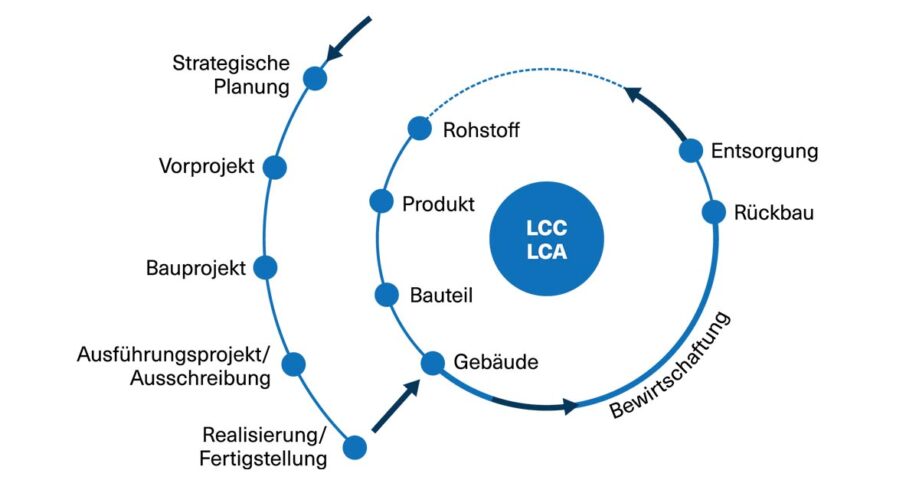
    The life cycle analysis (LCA) to determine the environmental impact and the analysis of the life cycle costs (LCC) offer quantitative decision bases for energy renovation. (Source: Kellenberger (intep), 2021)

    To the white paper

  • Hächler refurbishes historic Posthorn inn

    Hächler refurbishes historic Posthorn inn

    The Hächler construction company reports progress on the renovation project with a new building for the historic Posthorn inn in Neuenhof. According to the press release , the old building will be extensively renovated. Seven rental apartments are being built in the former hotel. There is also a new building with a further 16 rental apartments.

    Since the building permit for the Posthorn superstructure was granted in 2019, the structural and civil engineering department of Hächler AG has been in charge of the construction work since spring 2021. According to Hächler, the project is not easy. The historic post horn was not allowed to be torn off. The building dates from 1834 and is a protected site. Gable and facade must be preserved.

    According to Hächler, to ensure the statics and to support the facade that remains in place, a complex steel brace was installed. The rest of the post horn could only be broken off after the installation of this steel spline. When the historic building was gutted, the effective master builder work began. In the meantime, the erection work on the roof trusses of the Posthorn and the new building are scheduled for March and April.

    According to the construction management, the work on the superstructure will be completed around May 2022. Then the interior work takes place. The move-in date for the new apartments in the Posthorn is planned for February 2023 and in the new building for April 2023.

  • Whitepaper: Energetic renovations as an opportunity

    Whitepaper: Energetic renovations as an opportunity

    Knowing that the building sector is responsible for around a quarter of emissions, there is an urgent need to renovate the building stock. Because the few climate-friendly and energy-efficient new buildings will not have a major effect on the entire sector. At the moment we are in a renovation backlog. The current renovation rate of one percent must be doubled in order to achieve the climate targets.

    Practical experience shows that during renewal processes, too little attention is paid to energy-related refurbishment compared to replacement new buildings. The landowners often lack basic information that shows them the economic, ecological and social potential of energy-related renovations. The whitepaper is intended to make a contribution to precisely this. There is a basic overview of the urgency, legal framework, benefits, opportunities and possible strategies of energy-related renovations.

    The results of an ecological balance sheet (life cycle analysis, LCA) and an analysis of the life cycle costs (LCC), for example, form an excellent basis for decision-making. These quantitative assessment methods take into account the entire building life cycle.

    To the white paper

    Comprehensive redevelopment of the Webermühle housing estate
    One example of a successful renovation is the large Webermühle development in Neuenhof. The former Göhner settlement, which was occupied in 1984 and has been owned by a real estate fund from Credit Suisse Asset Management since 2008, houses 368 rental apartments with around 1,500 residents.

    The core of the energetic renovation of the Webermühle is the reorientation of the heat supply. To this end, the client defined a clear goal right from the start: in the future, the heat supply should be at least 70% CO₂-free. Due to the size of the facility, Credit Suisse Asset Management wanted to have the heating system replaced by a contractor instead of producing heat itself. The sustainability of the solution proposed by ewz with a river water heat pump convinced the client.

    Find out more

  • Refurbishment of the large Webermühle development

    Refurbishment of the large Webermühle development

    The Webermühle development in Neuenhof houses 368 rental apartments. The settlement on a peninsula in a loop of the Limmat was built on the industrial site of a former weaving mill and was ready to move into in 1984 after ten years of construction. Planned by the architectural office Steiger Partner AG and built by Ernst Göhner AG, the Webermühle with its different volumes offers living space for up to 1,500 residents. Despite the very high density, the apartments with the four rows of high-rise buildings arranged in a cross shape are characterized by a surprising foresight. Since 2008, the buildings realized in the “Göhner 3” modular construction system have been owned by a real estate fund from Credit Suisse Asset Management.

    Ecologically and economically sustainable renovation
    A good 40 years after moving in, the apartments no longer met today’s standards – neither in terms of appearance nor in terms of comfort. With an analysis of the building structure, the client started planning an extensive partial renovation in 2009, which was implemented in stages between 2012 and 2014. Credit Suisse Asset Management’s portfolio strategy attaches great importance to ecologically and economically sustainable solutions. With the modernization of the Webermühle, one wanted to make the living and green space more attractive for the tenants and to maintain the value of the property. On the other hand, the building technology should be brought up to date and thus the energy consumption should be significantly reduced. Better connections to public transport were also an important goal: Since the construction of a new inclined lift in 2015, Wettingen train station can be reached within a few minutes on foot.

    Heat supply: switch to flow heat
    The core of the energetic renovation is the reorientation of the heat supply. To this end, the client defined a clear goal right from the start: in the future, the heat supply in the Webermühle should be at least 70% CO 2 -free. Due to the size of the facility, Credit Suisse Asset Management wanted to have the heating system replaced by a contractor instead of producing heat itself. The sustainability of the solution proposed by ewz with a river water heat pump convinced the client even after a detailed examination by specialists.

    More about the project