Tag: Ökologie

  • Life cycle assessment calculator supports sustainable building

    Life cycle assessment calculator supports sustainable building

    The environmental product declarations (EPD) in accordance with SN EN 15804 make it possible to transparently present the ecological impact of a building material over its entire life cycle. This provides building owners with a sound basis for making decisions on sustainable construction that goes beyond individual environmental parameters and allows a comprehensive assessment.

    Baustoff Kreislauf Schweiz provides its members with independently verified average EPDs for various types of concrete and aggregates. This data forms a reliable basis for sustainable construction projects.

    Life cycle assessment calculator as a digital tool
    An industry-specific life cycle assessment calculator has been developed to calculate CO₂ emissions, energy consumption and other environmental indicators. This verified calculation tool offers the construction industry a practical way to determine and optimise environmental product declarations.

    The online tool at oekobilanz-rechner.ch enables an orientating analysis, but does not replace a complete EPD preparation. On request, the data entered can be further processed to create an officially verified environmental product declaration.

    Transparency and optimisation for the construction industry
    The life cycle assessment calculator provides the construction industry with a valuable tool for making sustainable material decisions based on data. By optimising the recording and evaluation of environmental impacts, the tool contributes to reducing the ecological footprint in the construction industry and supports a resource-conserving circular economy.

  • ESG targets with REMMS integration

    ESG targets with REMMS integration

    With the integration of REMMS, the company is taking sustainability analysis in the property sector to a new level. REMMS (Real Estate Meta-rating and Monitoring on Sustainability) enables a comprehensive assessment of properties with regard to economic, ecological and social criteria. Users of the solutions can easily analyse properties and create benchmark comparisons, taking into account relevant standards such as AMAS, ASIP, CRREM, GRI, ICMA, SBA and SFDR.

    Seamless integration for maximum efficiency
    The central aim of the integration is user-friendliness. Asset and portfolio managers can use the REMMS platform without additional registration or signing a contract. The sustainability monitoring module in the software suite makes it possible to analyse property portfolios anonymously and with data support. Martin Schnider, Managing Director of reamis, emphasises: “Our solution supports customers in efficiently achieving sustainability goals and fulfilling regulatory ESG requirements.”

    A step towards a sustainable property industry
    The REMMS integration is not only an extension of the digital solutions, but also a contribution to the sustainable transformation of the property industry. The data-driven platform provides portfolio managers with precise analyses that facilitate strategic decisions.

  • Innovative approaches to property management

    Innovative approaches to property management

    Focus on sustainability
    The morning is all about “Sustainable properties”. Here you will discover how you can not only manage your properties efficiently, but also organise them in an environmentally conscious way. Our experts will show you which optional services you can integrate to minimise the ecological footprint of your properties and at the same time create value for your customers.

    Socially responsible de-tenancy processes
    In the afternoon session, we will focus on the sensitive topic of “Socially responsible de-tenancy processes”. In this section, you will learn how to implement a variety of letting strategies that take both legal and ethical aspects into account. Discuss with our expert speakers how you can promote relaxed dialogue and fair solutions to gain the trust of your tenants and build long-term relationships.

    Specialist speakers

    • Dr Joëlle Zimmerli, Zimraum GmbH
    • Dr Christian Brütsch, Stratcraft GmbH
    • Pascal Stutz, CEO SVIT Zurich

    Take this opportunity to exchange ideas with other leaders and gain valuable inspiration for your own practice. Be part of a movement that aims not only for economic success, but also for sustainable and socially responsible property management.

    Register today and actively shape the future of the sector!

  • A model project for Switzerland Ecological upgrading of the River Sihl

    A model project for Switzerland Ecological upgrading of the River Sihl

    Over a century ago, rivers and streams were straightened and dammed in many places in Switzerland in order to provide flood protection and gain additional land. Today’s knowledge shows that this has had detrimental consequences for nature. These formerly dynamic and diverse watercourses have become ecologically impoverished and monotonous ribbons of water. The situation is similar in the Sihlwald, whose near-natural habitats for animals and plants have largely disappeared. Fish migration is also significantly impaired by these construction measures. The current revitalization project aims to restore dynamism and diversity to the river area.

    Focusing on the project section in Sihlwald
    The core of the revitalization project is the river area at the Sihlwald terminus of the Sihltal-Zurich-Uetliberg railroad and the Zurich Wilderness Park Visitor Centre. With a length of around 1.8 kilometers, this section plays a key role in the Canton of Zurich’s revitalization planning and is a top priority. The aim is to enhance the ecological value of this section of the river and thus create new, high-quality habitats that are particularly important for animals and plants.

    Through the planned revitalization, those responsible hope to take on a pioneering role in the near-natural development of watercourses and at the same time increase the local recreational value for the population. This integrative approach should serve as a model for similar projects in other regions of Switzerland.

    More dynamics, more structure, more habitats
    Most of the Sihl’s current bank obstructions will be removed. New structural elements such as islands, large stones and more branches and rootstocks will make the river more diverse and dynamic than it is today. Thanks to a new fish ramp, the Sihl will be more passable for fish and other aquatic life. New ponds as well as wet meadows and rough pastures are also planned. All of these measures will create a variety of new habitats for animals and plants, thereby increasing biodiversity.

    On the right bank of the river, a zone will be created that will be reserved for nature. This quiet zone in the popular local recreation area will provide protected retreats for animals. This will benefit the kingfisher, for example, which is very sensitive to disturbance during the breeding season.

    Improving the quality of life
    The revitalization also makes the river area more attractive for people. Opportunities to spend time by the river and accessible ponds offer visitors insights into nature.

    To create a quiet zone for nature on the right bank, the current path below the visitor center will be moved to the left bank of the river. The footpath and cycle path will be separated there. This will give both road users more space. Along the new, varied footpath on the left bank of the river, the vegetation will be repeatedly thinned out. This provides interesting views of the wild riverbank opposite. Small footpaths lead to the river and to natural seating areas by the water. The bridge at the visitor center will be dismantled.

    Joint project between the canton ofZurichand SBB
    The revitalization of the Sihl is a joint project between the canton of Zurich and SBB. It is part of the environmental measures as part of the new concession for the SBB’s Etzelwerk hydropower plant. The ewz naturemade star fund and the federal government are also making financial contributions.

  • Zurich’s dynamic step into the circular economy

    Zurich’s dynamic step into the circular economy

    The implementation of “Circular Zurich” began in early February with the presentation of a detailed agenda that is specifically tailored to the needs of the city administration. However, the strategy also offers small and medium-sized enterprises (SMEs) numerous starting points. By adapting individual measures, SMEs can not only act in a more environmentally friendly way, but also benefit financially in the long term.

    Steps for implementation in SMEs
    One fundamental aspect of the circular economy is the efficient recycling and separation of recyclable materials. Sara Graf, project manager at Entsorgung + Recycling Zürich (ERZ), emphasises the importance and simplicity of this measure for companies: recyclable materials such as paper, cardboard, PET bottles, glass and aluminium cans can often be recycled free of charge, which leads directly to savings in disposal costs. But recycling is just the beginning.

    Minimising material consumption and optimising processes
    Sonja Gehrig, who heads up the city-wide coordination of “Circular Zurich”, points out that it is important to think beyond the boundaries of the company. Analysing one’s own material consumption and optimising production processes are crucial steps. Ecologically sustainable product design that promotes the reparability and durability of products can not only save companies money, but also lead to new business models such as product hire.

    Extending consumption and use phases
    The final step involves maximising product lifetimes through strategies of sharing, reusing, repairing and remanufacturing. This not only allows products to be used for longer, but also helps to conserve resources. Second-hand platforms and company initiatives that internalise the circular economy are playing an increasingly important role in the circular economy.

    The city as an innovation laboratory
    Zurich sees itself as a testing ground for new, circular ideas and products. City experts are ready to support companies that are striving for innovative solutions. This proactive approach not only strengthens the city’s infrastructure, but also promotes the widespread adoption of circular economy principles.

    With “Circular Zurich”, the city of Zurich is positioning itself as a pioneer in the circular economy, demonstrating how a sustainable transformation can be realised in urban areas through concrete measures and cooperative approaches.

  • Canton of Zurich promotes electromobility with over 52,500 parking spaces

    Canton of Zurich promotes electromobility with over 52,500 parking spaces

    Since the introduction of the charging infrastructure funding programme, the canton of Zurich has taken decisive steps towards the electrification of transport. The programme, which runs until the end of 2026 and has a funding pot of CHF 50 million, has already secured over CHF 18 million in funding to equip car parks with charging stations. So far, over 52,500 car parks have been equipped for electric vehicles, which is a significant boost for electromobility in the canton.

    Construction Director Martin Neukom is delighted with the great response: “The strong demand for the funding programme confirms our commitment to a sustainable mobility future. The support makes it easier for many people to switch to electric vehicles and helps to reduce dependency on fossil fuels.”

    The programme not only supports private individuals, but also companies and municipalities. Over 800 applications for funding for fleet parking spaces have already been submitted. In addition, more and more municipalities are utilising the funding opportunities to develop their electric mobility concepts. This includes feasibility studies and location analyses for public charging infrastructure. Some municipalities have already expressed an interest in installing public charging stations in blue zones.

    Carmen Walker Späh, Director of Economic Affairs, emphasises the ecological benefits: “Our funding programme makes a significant contribution to reducing environmental pollution and increasing energy efficiency in the canton. As the transport sector is responsible for around 40 per cent of greenhouse gas emissions in Zurich, this is an important step towards climate-neutral mobility.”

    In view of the high demand, the funding pot could potentially be exhausted before the planned end of 2026. The canton plans to continue to monitor developments closely and provide regular updates on the status of the programme. A detailed presentation of the programme’s results and progress is planned for the second half of 2024.

  • Site development – strategies for a vibrant city

    Site development – strategies for a vibrant city

    The city of Zurich is undergoing constant change, characterised by rising population growth and increasing demand for residential and commercial space. Balanced urban development that takes into account the needs of residents and incorporates ecological and social aspects is crucial.

    The Office of Urban Development plays an important role in the planning and implementation of this development. By coordinating public and private interests and developing urban development projects, the Office helps to ensure that Zurich remains a vibrant and attractive city. In doing so, it preserves the architectural heritage and creates space for forward-looking construction projects.

    The municipal structure plan is a key instrument for the long-term development of the city. It defines strategic goals and measures for sustainable site development and serves as a guideline for the coordination of various interests and stakeholders. In view of the projected population growth up to 2040, targeted planning and densification of existing areas is essential.

    The municipal structure plan defines areas that are suitable for structural densification, as well as areas for public open spaces, municipal buildings and facilities. The focus here is on creating a liveable environment that meets the needs of residents and enables sustainable urban development.

    Overall, site development and spatial planning in Zurich is a complex challenge that requires close cooperation between various stakeholders. The Office for Urban Development is committed to a balanced and future-orientated development of the city that preserves its identity and meets the need for living, working and recreational space.

  • Wood City – a milestone for the cities of the future with wood

    Wood City – a milestone for the cities of the future with wood

    The renaissance of timber construction as a symbol of ecological building
    The decision to use wood as the primary building material is at the centre of Stockholm Wood City. This step reflects the growing awareness of environmentally friendly construction methods and emphasises the many advantages of timber constructions. In addition to enhancing the aesthetics of the urban space, timber buildings help to improve air quality, promote well-being, increase labour productivity and act as a natural carbon sink.

    “Stockholm Wood City is a manifesto of our vision for the future,” explains Annica Ånäs, CEO of Atrium Ljungberg. “The project not only marks a significant step forward for our company, but also sets a historic milestone for Sweden’s innovative strength.”

    Innovation and sustainability as guiding principles
    Stockholm Wood City goes beyond the mere use of wood as a building material and takes a holistic approach to sustainability. The project integrates advanced technologies to increase energy efficiency and promotes the careful use of resources through the self-production and shared use of energy as well as the use of resource-efficient construction techniques.

    As a flagship project for future-orientated urban development, Stockholm Wood City will not only enrich the cityscape of Stockholm, but will also provide significant impetus for the construction industry worldwide. With its fusion of innovation, sustainability and community spirit, it offers an inspiring blueprint for the design of future urban living spaces.

  • More incentives for compact and ecological construction

    More incentives for compact and ecological construction

    At a time when the fight against global warming and the housing shortage is becoming increasingly urgent, everyone working in the construction sector is more challenged than ever. The building stock is responsible for a significant proportion of CO2 emissions and the need for new housing is growing faster than ever before. It is therefore essential to act quickly.

    Despite numerous initiatives and political initiatives, progress in solving these problems still seems to be too slow and the fronts are becoming increasingly hardened. Bernhard Lanzendörfer argues in favour of a joint search for quick, innovative, affordable and social solutions instead of getting lost in ideological standpoints.

    One example of an ideological standpoint is the petition by the Countdown 2030 association, which vehemently opposes the demolition of buildings. Bernhard Lanzendörfer argues that rigid ideas such as these will not solve the problems and calls for a differentiated view from a structural, ecological and social perspective.

    In view of the housing shortage, a substantial densification of living space is often only possible through the construction of replacement buildings. The building-within-existing-buildings approach quickly reaches its limits here, especially when it comes to modernising and adding storeys to existing buildings.

    In order to promote ecological and social construction, Lanzendörfer suggests that politicians should create concrete incentives. This could be done, for example, through rewards for the ecological upgrading of buildings or a higher utilisation rate for ecological flagship projects.

    In view of rising population figures and increasing urban sprawl, it is essential to build upwards. Although this may meet with resistance, according to Lanzendörfer it is the simplest solution for making better use of every square metre.

    It is important not to hinder innovative concepts with ideological barriers. The construction industry has already made great progress in the development of climate-friendly products, and politicians are also supporting the use of environmentally friendly building materials through new regulations in environmental protection legislation.

  • Empa researches clay as a sustainable building material

    Empa researches clay as a sustainable building material

    Clay releases significantly less CO2 than concrete, explains the Swiss Federal Laboratories for Materials Testing and Research(Empa) in a press release. Ellina Bernard from Empa’s Concrete & Asphalt Laboratory in Dübendorf and the Chair of Sustainable Construction at the Swiss Federal Institute of Technology Zurich is working to establish clay as a sustainable alternative to concrete. Their project is supported by the Swiss National Science Foundation(SNSF) with an Ambizione grant.

    Clay is found in different geological compositions all over the world. The sustainable building material could replace concrete in non-load-bearing structures as well as in load-bearing walls of residential buildings. For large-scale use, Bernard and her team want to define standards for composition and mechanical strength. On the other hand, additives must be found that increase the load-bearing capacity of the material. Conventional cement is currently still used here, but this pushes the ecological footprint of clay “back into the red zone”, Empa writes.

    Bernard, in collaboration with geologist Raphael Kuhn, has found a promising approach in magnesium oxide. In initial laboratory experiments with clay formulations, a compressive strength of up to 15 megapascals was achieved, Empa informs. Clay with added cement achieves up to 20 megapascals.

  • Hotel Rotbuche: energy efficiency, ecology and comfort

    Hotel Rotbuche: energy efficiency, ecology and comfort

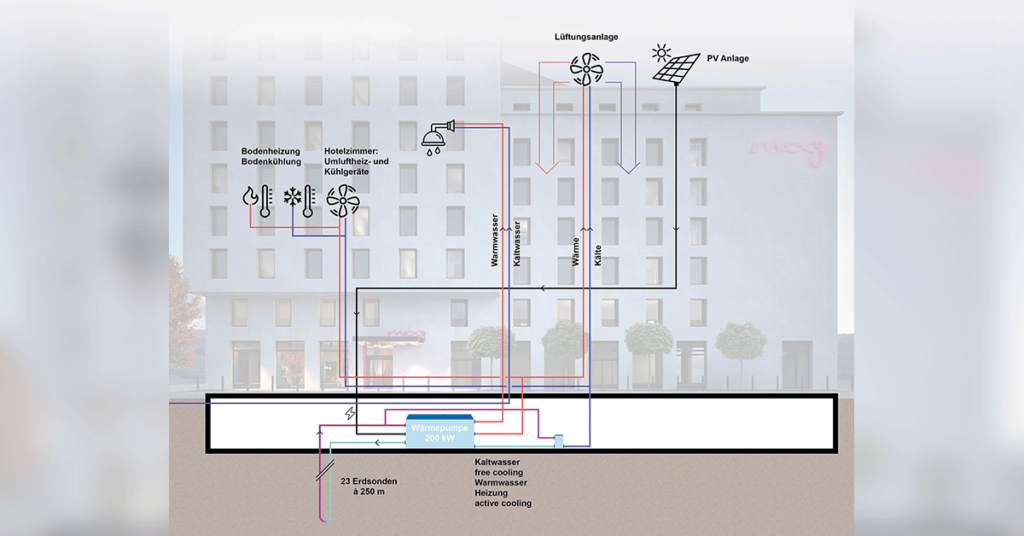
    The groundbreaking ceremony for the Hotel Rotbuche in Rapperswil-Jona took place in mid-February of last year. The three requirements and specifications for the energy supply and the energy system for the new hotel were clear: energy efficiency, ecology and comfort. In order to implement these requirements, geothermal probes were drilled as an energy source for the heat pump and a sustainable energy concept was developed in cooperation with Energie Zürichsee Linth (EZL). EZL will also operate and maintain the building technology as a contractor.

    Heat recovery measures
    "The reversible heat pump can be used to provide heat for heating purposes and for domestic hot water," explains Roman Fausch, project manager for energy services at EZL. In summer there is the possibility of cooling the building in an energy-efficient way using geothermal probes, according to the expert. If there is a high need for cooling, there is also the option of using cold from the reversible heat pump. Various heat recovery measures are also installed and, thanks to an intelligent control system, also regulated as required. "In connection with energy and sustainability, it is one of the most sustainable hotel projects that we have been able to plan and implement," says Stefano Ghisleni, general planner at Ghisleni Partner AG, based in Rapperswil, Zurich, St. Gallen and Zug.

    At the Moxy Hotel Rotbuche, the natural heat comes from a depth of around 200 to 250 meters. The 23 probes, distributed over the entire construction area, withdraw 10 to 15 degrees from the ground. The heat is fed into the heat pump in the building using a carrier fluid and converted. This is how it gets into the hotel's heating and air conditioning system. The entire length of the geothermal probe control system is more than five kilometers.

    Reduction of the room temperature by up to four degrees
    Those responsible for the project emphasize that the basic need for room cooling in the warmer seasons in the Hotel Rotbuche can be covered with the environmentally friendly free cooling system. This means that the room temperature can be reduced by up to four degrees. This has a positive side effect: the dissipated heat is in turn temporarily stored in the geothermal probes and can be used for hot water preparation or in winter for heat supply. A photovoltaic system is installed on the roof to operate the heat pump. With around thirty percent, it should provide sufficient coverage to cover part of the electricity demand. "The moderately controlled balancing of heat and cold makes a continuous room climate possible without massive temperature fluctuations," says project manager Roman Fausch. The first guests will be able to feel this for themselves from the coming autumn. At this point in time, the new “Rotbuche” hotel with its 86 rooms is due to open. ■

  • Fischermätteli Burgdorf: Future-oriented area in the Minergie-A-Eco standard

    Fischermätteli Burgdorf: Future-oriented area in the Minergie-A-Eco standard

    In December 2019, the excavators drove into the former industrial site in Burgdorf and the new Fischermätteli district should soon come to life: the first apartments will be ready for occupancy in summer 2021. By 2024, ten apartment buildings with 169 inexpensive 2.5 to 5.5 room apartments and living spaces between 52 and 140 square meters are to be built in a total of three construction phases. Located in an idyllic location in the immediate vicinity of the forest, the buildings are grouped around a central meeting zone with five differently designed outdoor spaces.

    Largest Minergie-A-Eco quarter made with Swiss wood

    The Fischermätteli settlement will one day be the largest development in Switzerland that will not only be built with Swiss wood, but also meet the Minergie-A-Eco standard. This requires a positive energy balance and the expenditure for space and water heating, air renewal as well as for all electrical devices and lighting must be covered by renewable energies. The addition Eco focuses on the issues of health and building ecology and ensures a high level of living comfort. "Based on the positive experiences we have made so far, it was the only right decision for us in terms of ecology and sustainability to build the Fischermätteli in the Minergie-A-Eco standard," explains Bruno Kälin. He is Head of Marketing and a member of the management team at Strüby Konzept AG. The Strüby companies act both as builders and as full service providers (project development, architecture, engineering, production, implementation, customer service, customer service) and are also responsible for sales.

    For the Fischermätteli, the client relies on spruce and silver fir from Swiss forests: “There is no better building material than wood. It is available locally, is growing steadily, is CO 2 -neutral, creates jobs in the region and ensures a good and healthy indoor climate, ”explains Kälin. The wood required for construction is bought directly from the forest owners, sawn, glued and processed in the region. Long transport routes are eliminated, which means that the embodied energy is very low.

    Sophisticated energy concept

    The client had put out a tender for the energy concept, which ewz won. The energy service company is responsible for planning, financing, realizing and operating the energy supply. The contracts run until December 2044 and begin in stages according to construction stages. The ewz Energy Solutions division has developed an integral concept for the Fischermätteli district, which, in addition to a sophisticated heat and power supply, also includes ancillary costs accounting that covers all media.

    All buildings on the site are connected to an area heating network. The heart of the heat supply is the heating center with an output of 550 kW. Wood pellets from the region are used as energy sources. The quality management system of the working group QM wood heating plants ensures efficient heat production. The energy service provider finances and implements the heating center and the lines for heat distribution to the house. The client, on the other hand, builds the installations for the domestic hot water and for the fine distribution of heat in the houses. A heat pump instead of wood heating could not be considered due to the geological conditions at the site.

    100 percent renewable solar power

    In addition to the heat supply contracts, ewz agrees electricity supply contracts with the owners. These regulate the supply of electricity to a total of seven floor and site owners. Since the Minergie-A building standard requires 100 percent coverage with renewable electricity, a photovoltaic system is installed on every house roof. The ten plants in the final stage will have an output of 722 kWp. According to project manager Christian Rolli from ewz Energielösungen, the challenge was to achieve the required solar power yield and still have enough space on the roofs for maintenance and servicing of the photovoltaic modules. The solution was to choose monocrystalline high-performance modules with a higher degree of efficiency, which produce more yield in less space, but this is reflected in a higher price. Around 3200 m 2 of photovoltaic modules are installed on the site. If, for example, there is such a high overproduction during the summer holidays that not all of the electricity can be fed into the grid, production can be reduced.

    The overall concept worked out by ewz Energielösungen convinced the client: "Our specifications for an ecological and economical solution that can be implemented and maintained holistically by one partner were implemented very well by ewz," says Bruno Kälin.