Tag: ökologisch

  • Modulare Einbauten für Zwischennutzungen: Erste Prototypen erstellt

    Modulare Einbauten für Zwischennutzungen: Erste Prototypen erstellt

    «Das Surren eines Akkuschraubers klingt durch das DISPO in Nidau. In der alten Fabrikhalle, die Raum bietet für Kreative, Kultur- und Gewerbetreibende, entstehen an diesem Tag vier Prototypen von Raummodulen, dank denen es künftig möglich sein soll, Zwischennutzungen von leerstehenden Gebäuden und Brachen einfach und nachhaltig umzusetzen. Ungenutzten Räumen soll damit ein ökologischer, ökonomischer und sozialer Mehrwert verliehen werden. Dieses Ziel verfolgen Forschende des Instituts für Holzbau, Tragwerke und Architektur IHTA der Berner Fachhochschule BFH gemeinsam mit Partnern aus der Wirtschaft im Innosuisse-Forschungsprojekt «àDisposition».

    Verschiedene Modullösungen getestet
    Im Projekt entwickeln die Forschenden einen modularen Baukasten für Raummodule und Innenausbauten. Eine zentrale Komponente ist ein Konfigurator, dank dem Projektideen einfach geprüft, dargestellt und zeit- und ressourcensparend umgesetzt werden können. Auf der Basis von digitalen Entwürfen erstellen die Forschenden der BFH in Zusammenarbeit mit den Projektpartnern nun Prototypen im Dispo in Nidau. Anhand von diesen untersuchen und verbessern sie verschiedene Modullösungen. Das Projektteam testet unterschiedliche Systeme, Verbindungselemente und Segmentformen und kann bereits nach kurzer Zeit vielversprechendste Strategien für ein leichtes, wiederverwendbares und einfach rekonfigurierbares, modulares System identifizieren.

    Zeit für Aufbau variiert je nach Fabrikationsgrad
    Die Anforderungen an die modularen Einbauten sind hoch: Auf- und Abbau soll für Laien möglich sein und die Bauteile sollen leicht genug sein, dass es nur zwei Personen für die Montage benötigt. Die Einbauten sollen zudem anpassungsfähig sein, sich einfach umgestalten lassen sowie gut zu transportieren und zu lagern sein. Während des Aufbaus der Prototypen zeigt sich bereits, wie wichtig es ist, den idealen Grad der Vorfabrikation auszuwählen. Werden die Rahmen der Module bereits zusammengeschraubt angeliefert, können die Einbauten in kürzester Zeit aufgestellt werden. Transport und Lagerung gestalteten sich jedoch als schwieriger. Umgekehrt dauerte der Aufbau deutlich länger, wenn die Bauteile einzeln und dadurch kompakt angeliefert werden.

    Wichtigkeit der digitalen Durchgängigkeit
    Ein weiterer Aspekt, den die Forschenden mit der Produktion und dem Aufbau der Prototypen testen, ist die digitale Kette «Design to Production». Die Module werden im Konfigurator entworfen, die Daten für die Produktion anschliessend automatisch in CadWork exportiert. Diese Dateien bildeten die Grundlage für Materialbestellungen und den Produktionsprozess. Hier zeigte sich die Wichtigkeit der digitalen Durchgängigkeit für einen schnellen und einfachen Produktionsprozess.

    In einem nächsten Schritt befassen sich die Forschenden mit der Ausstattung der Module. So sind die Wände ein weiteres Gestaltungselement und zusätzliche (Dämm)Schichten müssen den Anforderungen an die Schall- und Wärmedämmung gerecht werden. Diese Anforderungen unterscheiden sich je nach Nutzung stark. «àDisposition – Spaceship Planet Earth. Sustainable and temporary use of buildings and vacant sites through simple and modular structural measures» ist ein von der Innosuoisse gefördertes Forschungsprojekt, das bis Juni 2025 läuft. Projektpartner sind C2 Beat Cattaruzza GmbH, Beer Holzbau AG, Pius Schuler AG, Prona AG und Bauart Architekten und Planer AG.

    Quelle: www.bfh.ch

  • Green steel makes Forster Campus particularly sustainable

    Green steel makes Forster Campus particularly sustainable

    Forster Profilsysteme is having a new company headquarters built in Romanshorn. There, activities and employees of the two previous locations in Arbon TG are to be combined. The new Forster Campus, covering around 30,000 square metres, will include a production and logistics hall, an office building and a technology centre.

    The building complex is to receive Gold Level certification of the international Leadership in Energy and Environmental Design (LEED) standard for ecological building. Only particularly sustainable buildings can receive the highest certification. To achieve this, CO2-reduced steel, so-called green steel, will be used in the construction of the campus.

    Debrunner Acifer AG, a member of the Debrunner Koenig Group in St.Gallen, supplied a total of 600 tonnes of green steel for the Forster Campus. The order thus constitutes the first major project with green steel for the B2B trading partner and service provider in Switzerland. “Of course, conventional steel is also 100 per cent recyclable,” Willi Lüchinger, CEO of Forster Profilsysteme AG, is quoted as saying in a corresponding press release from Debrunner Acifer. “But with the use of CO2-reduced steel, we go one step further in sustainability: thanks to Green Steel, we achieve the LEED Gold level.”

  • Lucerne North on the way to becoming a Smart City

    Lucerne North on the way to becoming a Smart City

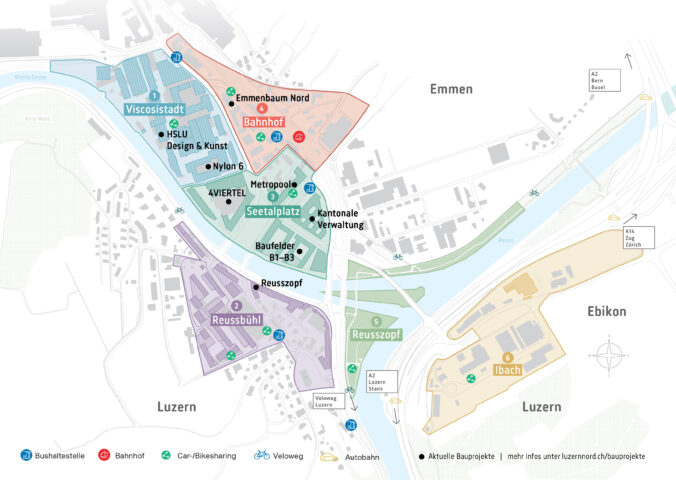
    Lucerne North is a development focus of the Canton of Lucerne. In the coming years, 1,500 new flats, 4,000 additional jobs, 850 study places, two recreation zones and various cultural facilities are to be built here step by step.

    In order to become a modern, ecological and lively centre on the river, Lucerne North is to develop as a Smart City. A Smart City uses technologies, innovations and data to improve people’s quality of life, make the location more attractive for businesses, use the infrastructure more efficiently and conserve resources.

    So far, Central Switzerland has lacked concrete examples of the smart city approach in an area development. Lucerne North is to become a first practical example with a pioneering character – with the simultaneous developments of the city of Lucerne towards a Smart City as well as possible cooperations on the way to a Smart Region Lucerne. The municipality of Emmen, the city of Lucerne, the canton, the transport association, the business development agency, companies, site developers and the population are involved in this networked approach.

    The partners involved are convinced that the Lucerne North area is particularly suitable as a smart city, as there are an above-average number of innovative companies, investors and organisations on site and cooperation already works well.

    Lucerne North is divided into six sub-areas. The adjacent areas of Seetalstrasse and Littauerboden are also part of the development focus.

    Smartness has many dimensions
    The Smart City approach is characterised by six dimensions: “Mobility”, “Living”, “Economy”, “Environment”, “Governance” and “People”. In the Smart City dimensions “Living” and “People”, the participatory pilot project “Quartiereffekt” was a milestone in Lucerne North. It enables the population to finance and implement their own ideas for neighbourhood design. But exciting projects were also developed on a smaller scale, such as a smart box from which the population can spontaneously borrow balls, badminton rackets and other games free of charge via an app.

    The “Offcut” materials market in the Reussbühl area pursues the goal of a circular economy by recycling residual and used materials, in line with the “Environment” dimension.
    The “4VIERTEL” development on Seetalplatz provides new approaches in the “Mobility” dimension and provides its residents with a mobility station with sharing vehicles such as e-cars, e-scooters, e-cargobikes and e-bikes. In addition, all car-free households receive annual vouchers for public transport, a bicycle service or the in-house sharing service.

    In the “Economy” dimension, a new research cooperation for sustainable textiles was established in 2022 with the Viscosistadt Lab. It aims to realign the textile competences at the location in Lucerne North.

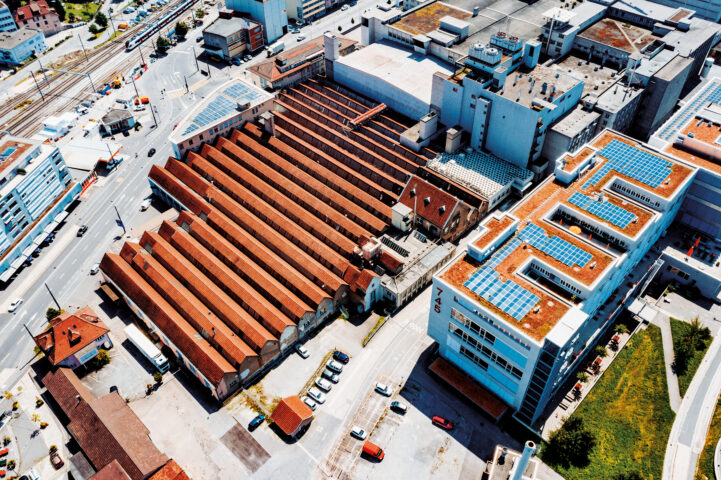
    Viscosistadt is gradually developing into the creative part of Lucerne North.

    Transformation in full swing
    The transformation of Lucerne North is in full swing. While some projects are under construction, important planning decisions have been made for others.

    In Viscosistadt, a historic industrial building of the former Nylon-6 factory is currently being converted. This will create about 20,000 square metres of new space for office and commercial use. Right next door, the construction site for the “4VIERTEL” development is in the final phase. The first residents of Lucerne North will move in here from summer 2023.

    Near Emmenbrücke station, 42 new flats will be built in “Gerliswil Central” by 2024. The Emmenbaum Nord building and the newly designed Schützenmatt district will give the area directly around Emmenbrücke station a fresh face.

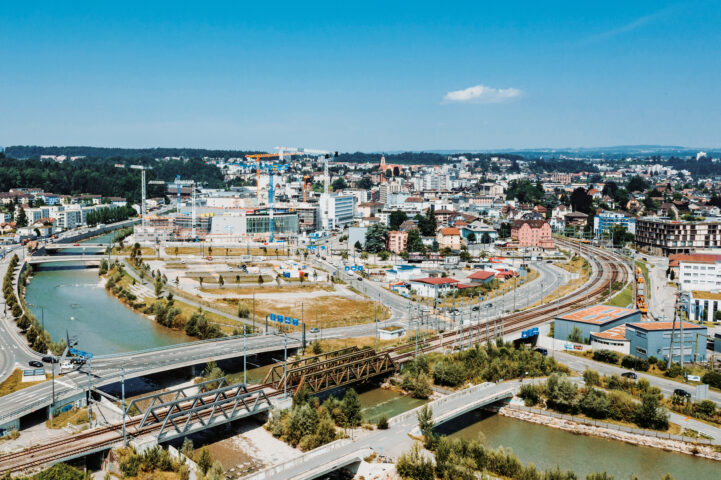
    An urban location with high density is being created around the new Seetalplatz.

    The Rüüssegg housing cooperative’s development on Seetalplatz is about to receive the building permit for around 380 flats. Directly opposite the Kleine Emme in Reussbühl, 80 cooperative flats will also be built from 2024. The “Metropool” project of the Luzerner Kantonalbank and the cantonal administration on Seetalplatz are about to start construction.

    The Reussbühl West area has a somewhat longer time horizon. The CKW site, which is used for commercial and industrial purposes, is to become an attractive and lively urban district in the coming years.

    Even if no new flats have been occupied yet, Lucerne North is already alive today. Various temporary uses such as the cultural meeting place “NF49” (until November 2022) or the “Garage Emma” with studios for creative people, numerous events such as “Design Schenken” or the Swiss championship of bicycle couriers, cinemas and leisure facilities such as the “Adventure Room” brought around 105,000 visitors to Lucerne North last year. In addition, there are thousands of guests at the summer bar “Nordpol” on the Reuss.

  • Sustainable living quarters: big leaps instead of small steps

    Sustainable living quarters: big leaps instead of small steps

    The energy transition can only be achieved with the housing industry. Because almost 40 percent of the world’s CO 2 emissions come from buildings, and most of it from residential buildings. In order to achieve the climate protection goals, European and national regulations are therefore increasingly aimed at the construction and housing sectors.

    However, it is not only increasingly stringent regulations that are forcing builders and owners to pay attention to sustainability. Irrespective of this, investors are increasingly demanding that ecological and social criteria be taken into account in real estate projects, and the EU Disclosure Regulation ensures more transparency in this regard. Properties that fail to meet sustainability criteria will lose value and find it increasingly difficult to find buyers and tenants.

    In this way, the market creates incentives for builders and owners to make their properties more sustainable. The “impact” idea is becoming more and more important: It is not about complying with the regulations with the least possible effort, but about creating the greatest possible benefit for the environment and society with reasonable effort.

    It is not primarily a question of planning new buildings at the drawing board according to the latest ecological standards. Because most of the houses that we will be living in in ten, 20 or 30 years have already been built. And many of them have the energetic standard of the seventies and therefore no features to keep energy consumption and greenhouse gas emissions within limits. Demolition and new construction are often not financially viable. In addition, there is the so-called gray energy, which is used for the extraction, production and transport of building materials and the construction itself. A refurbishment with unspectacular but intelligent measures often has more ecological impact than an ecological model new building.

    Strong Lever
    Quarters, i.e. entire building ensembles or districts, offer special opportunities to achieve impact. On the one hand, of course, because such projects include a large number of residential units. This multiplies the effect of measures at building level, such as improved insulation, installing better insulating windows or replacing the heating system with more energy-efficient technology.

    Above all, however, thanks to the economies of scale, the construction of complex systems is considerably cheaper because several buildings can share a common infrastructure. Energy-efficient combined heat and power plants can thus become just as economical as the use of solar energy, small wind turbines or geothermal energy. Electromobility concepts, which include, for example, charging infrastructure for electric cars or bicycles, can be implemented much more easily in a neighborhood than in a single building. Other possibilities concern common green areas that improve the microclimate or accommodate biotopes for plants and insects.

    In addition, larger neighborhood projects have spillover effects on the neighborhood and possibly even beyond. This applies in particular to the social component. In this way, facilities such as kindergartens or doctor’s surgeries, which are being planned as part of the development of the district, can also be used by residents from the wider area. The planning therefore includes the social structure beyond the boundaries of the quarter and should be carried out in close coordination with the municipality and residents. For larger projects, there should also be traffic planning in cooperation with external bodies, which works towards pedestrian and bicycle friendliness and greater use of local public transport and electromobility.

    The more a project has an impact on the neighborhood, the greater the weight that builders and owners have in negotiations with municipalities and authorities. This can also lead to urban planning decisions that increase the sustainability and thus the market value of the project, for example when a new tram stop is built for a new or redesigned quarter.

    Good contacts and negotiating power in the exchange with authorities are also important in order to influence or accelerate bureaucratic processes in terms of the sustainability of the project. One example is environmental protection, which often prevents environmentally harmful heating systems from being replaced by more efficient technology. However, authorities have some leeway when it comes to permits and are more likely to use this leeway if a permit for a large-scale project will bring significant environmental benefits.

    Possible conflicts between ecological and social sustainability must be taken into account. It is conceivable that energy-related renovations will increase rents. On the other hand, tenants are relieved of the ancillary costs, which is more important due to the recent sharp rise in energy costs. With state aid, it is conceivable to make energy-related renovations neutral in terms of overall rent.

    Climate protection is one of the most important challenges of our time, and the real estate industry has a special responsibility here. In the case of neighborhood projects, the actors have a particularly strong lever in their hands to quickly achieve noticeable effects.

  • Holcim launches concrete innovation

    Holcim launches concrete innovation

    Holcim has developed a new high-performance concrete called DYNAMax. According to a media release from the Zug-based building materials group, it can be used to build thinner and longer structures than with conventional concrete. On the one hand, this enables larger usable rooms. On the other hand, material is saved in building.

    Holcim also paid attention to the overall ecological footprint of DYNAMax. In addition to the reduced use of materials, the product is characterized by local production, “short transport routes” and a recyclable and completely reusable profile.

    DYNAMax will initially be launched in Europe, North and South America and the Asia-Pacific region in 2022.

    “Given today’s population and urbanization trends, DYNAMax is an ideal material for building smart cities. It offers high performance so that you can build more with less, without compromising aesthetics and functionality, ”says Jan Jenisch, CEO of Holcim.