Tag: Organisation

  • Streamlined management with a focus on synergies

    Streamlined management with a focus on synergies

    Mobimo Holding AG is introducing a new management structure. As of the start of 2026, the Executive Board will consist of the five divisions Real Estate, Development, Finance, Corporate Centre and the newly established Acquisitions division, the Lucerne-based real estate company announced in a press release. The reorganisation is intended to ensure “that the company remains agile and successful on the real estate market, while at the same time making even better use of the synergy potential in operational processes”, writes Mobimo.

    The Executive Board previously comprised six divisions and members. In the new model, the former property management division will be added to the real estate division. Christoph Egli, former Head of Property Management, will leave Mobimo as part of the reorganisation of the management structure.

    The previous Portfolio and Transactions and Property Management divisions have been combined in the Real Estate division. The current Head of Portfolio and Transactions, Nadia Mastacchi, will take over the management of the division. The other divisions will also be managed by existing members of the Executive Board. As Head of Development, Marco Tondel will now also be responsible for Realisation. The previous Head of Realisation, Vinzenz Manser, will move to the newly created Acquisition division. The roles of Daniel Ducrey as CEO and Jörg Brunner as CFO will remain unchanged.

  • Record figures and creative impetus for the property sector

    Record figures and creative impetus for the property sector

    The 13th edition of the Swiss real estate trade fair for investors, which took place on 15 and 16 January 2025 in Hall 622 in Zurich Oerlikon, exceeded all expectations. With a record attendance of 5,167 trade visitors and 154 exhibitors, IMMO25 confirmed its leading role as the most important trade fair for the property and finance sector in Switzerland.

    Focus on forward-looking topics
    The trade fair offered a wide range of specialist topics along the entire value chain of the property industry. The focus was on current challenges and trends such as

    • The future of construction: innovative building concepts and sustainable architecture
    • The tenant of tomorrow: New demands and changing living concepts
    • Falling interest rates: effects on the property market and investment strategies
    • Sustainability: energy-efficient buildings and climate-friendly developments

    The motto “Growth through creativity” was reflected in the numerous innovative solutions that were presented and discussed at the trade fair.

    First-hand expert knowledge
    A highlight of the event was the IMMO Forum, which offered expertise and inspiration over two days with 35 panel discussions and 150 renowned experts. The debates were not only followed by trade fair visitors, but also by over 1,900 online viewers who followed the forum live.

    Review and outlook
    The organisers MV Invest and Swiss Circle were delighted with the great success of the trade fair and thanked all exhibitors, visitors, speakers and partners for their support. IMMO25 has once again proven that it is a leading platform for the property industry, providing impetus and promoting exchange between investors, developers and experts.

    The next edition of IMMO26 will take place for the first time on 14 and 15 January 2026 in Hall 550 in Zurich Oerlikon.

  • Timber construction company introduces new organisational structure

    Timber construction company introduces new organisational structure

    Pirmin Jung Schweiz AG, a timber construction company based in Sursee, wants to revise its organisational structure. According to a press release, the company is aiming for a flexible and agile structure based on the expertise of all employees. According to the press release, decisions will be made directly at the point of decision making, independent of a predetermined hierarchy. A management team of 16 people will take care of strategic decisions. At the same time, the new organisational structure will incorporate and implement ideas from all areas.

    “We are of the opinion that we can successfully master the increasingly complex tasks and issues for us as a company and in the projects if the people with the greatest expertise in the topic work on and decide on the issues in the spirit of Pirmin Jung,” company owner Pirmin Jung is quoted as saying in the press release. “The new organisational form is an agile organism that allows us to react flexibly to challenges and drive innovation. The projects and tasks that we work on as a company are at the heart of our organisation.”

  • House of Winterthur seeks new managing director

    House of Winterthur seeks new managing director

    Since taking office in August 2020, Roth has significantly developed the organisation with fresh approaches and an increased presence on social media. Under his leadership, House of Winterthur has established itself as a dynamic regional networking platform that sets the tone with innovative event formats such as tech lunches, the Smart Health series and House cultural evenings. Roth’s commitment to expanding digital communication channels has also significantly increased visibility and engagement for the Winterthur region.

    The search for Roth’s successor is being led by a specially established nomination committee, which has the challenging task of finding a person who will continue Roth’s successful work and lead House of Winterthur into the future. Beat Schwab, President of House of Winterthur, recognises Roth as a visionary and committed leader whose work has sparked enthusiasm for the region in many people.

    With Roth’s imminent departure, House of Winterthur is not only losing an innovative designer, but also a managing director who has made a significant contribution to the modernisation and success of the location marketing organisation. At the same time, the forthcoming replacement offers the opportunity to build on the solid foundations and actively shape the future of House of Winterthur.

  • Memox acquires 2.8 million euros

    Memox acquires 2.8 million euros

    Proptech company Memox has successfully closed a Series A financing round, raising €2.8 million in capital. According to a media release, the financing round was led by Swiss Prime Site and 41 Group as well as other key players from the real estate, technology and investment banking sectors. Zurich-based Memox intends to use the sum raised to expand its positions in the so-called DACH region.

    Memox specialises in the design of meeting and conference rooms as well as the organisation of conferences in the business world. In doing so, experience as well as innovations after the Corona pandemic have been incorporated into Memox’s offers. Following the successful launch of 14 new rooms in the first half of 2023, Memox’s portfolio now comprises a total of 31 rooms in six locations in three cities. Memox is now active in Zurich, Basel and Frankfurt. The company’s operations currently generate annual revenues of €7 million, Memox announced in the statement.

    “Memox is already preparing a second round of financing to fund further market entries in Germany and Switzerland,” Dirk Reiner, CEO at Memox, is quoted as saying in the release. “With the current trends in the working world and in the real estate environment, Memox is ideally positioned to conquer the market.”

  • Holder companies increasingly act as a group

    Holder companies increasingly act as a group

    Schlierem-based real estate developer Halter AG is reorganising its management structure. According to a statement, an ecosystem of sister companies with different construction and real estate services has grown up around the company over the past ten years. This has resulted in the need for further development at the top. Halter Holding has so far hardly appeared in public as a “silent” holding company.

    In future, they will position themselves more strongly in the market. The construction and real estate industry’s path to a circular economy can only be successfully implemented with integrated value-added processes and models of cooperation in planning, execution and operation. This is linked to the use of digitalisation and digital technologies.

    In the course of the organisational development, there will be personnel changes from 1 January 2024, according to the company’s statement. Maik Neuhaus will take over from Markus Mettler as CEO of Halter AG. Mettler will now become Chairman of the Board of Directors of Halter AG and Delegate of the Board of Directors of Halter Group. Balz Halter remains Chairman of the Board of Directors of Halter Group. Alexandra Stamou joins the Board of Directors of Halter AG and becomes Head of Innovation and Products of Halter Group.

    The business unit Total Services of Halter AG, which is the largest unit with more than 200 employees, will be split up. From January 2024, there will be Halter Total Services German-speaking Switzerland and Halter Total Services French-speaking Switzerland. The new managing directors will be Diego Frey for German-speaking Switzerland and Fréderic Boy for French-speaking Switzerland. Both will then be part of the Halter AG Executive Board.

  • Digital operators: A perspective for future property management

    Digital operators: A perspective for future property management

    The digital challenge in real estate portfolios
    Digitalisation has fully arrived in the real estate industry. Great potential is seen in particular in management. Regulatory requirements, e.g. from the sustainability/ESG environment, pressure for efficiency and new user requirements or utilisation concepts really only lead to one conclusion: in the future, it will no longer be possible to operate real estate the way it was done in the last century.

    Digital solutions promise relief in very different areas of management. However, these potentials are not easy to realise: Property portfolios are acquired over years and decades. Accordingly, the process and software landscape for operating these portfolios also grows over years. Moreover, this spans numerous process steps: Systematically digitising the operation of real estate is therefore a challenge whose solution is becoming increasingly urgent.

    Instead of building more applications step by step and trying to patch up a grown overall system, various real estate owners and managers have taken a different approach in the past two years, namely that of a “greenfield approach”: How would one design a maximally digitised real estate operation if one could start all over again – on a greenfield site?

    Against this background, the first thing to consider was which “jobs” will actually have to be done in the future. It can be assumed that some traditional jobs will continue to exist, some will be eliminated by digitalisation and some will be added. The aim was to identify individual large blocks of tasks that can be understood in themselves.

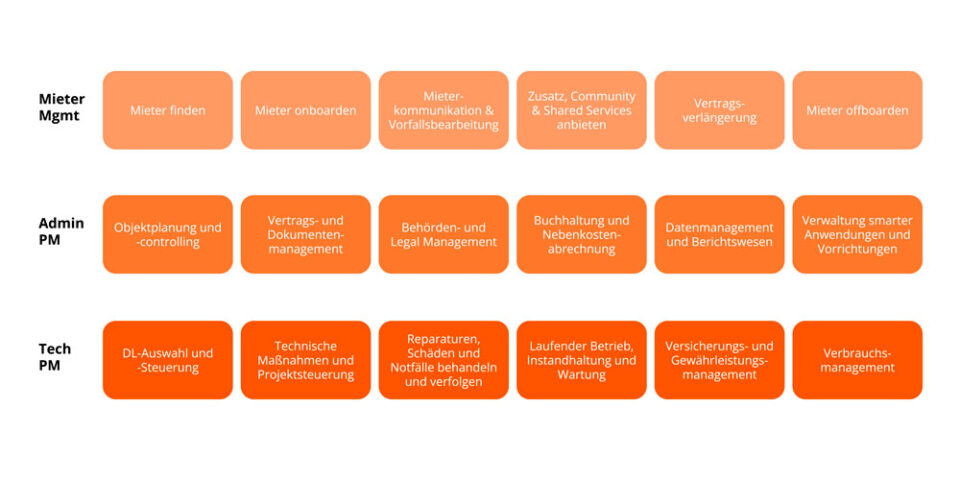
    It is helpful to divide the jobs into three large categories: Tenant management, commercial property management and technical property management. It has been shown that all essential jobs-to-be-done in real estate operations can be mapped in a 3×6 matrix.

    Building a digital operator on a greenfield site then follows the logic of supporting these individual jobs-to-bedone FIRST with modern software components in such a way that a seamless platform is created in which as many processes as possible are automated. Only THEN is it considered for which activities employees are deployed, who can then achieve all the greater added value for the users of these properties. The goal is therefore not primarily to increase efficiency, but to use the increasingly scarce personnel in management for those activities that really create added value.

    Of course, the potential benefits are not equally large in all process steps and implementation is therefore not equally urgent everywhere. Prioritisation along the dimensions of efficiency and revenue impact, influence on sustainability dimensions, tenant satisfaction and transparency is important. A toolbox that shows the possible tools in all process steps and allows prioritisation according to different functions helps to create an actual roadmap.

    It is equally important to have suitable tools at hand that connect the different systems with each other, for example an integration or orchestration platform like the one from Allthings. The goal is precisely to prevent the separate use of isolated solutions. If you make the right choice of partners capable of integration at an early stage, you establish a networked ecosystem.

    Pragmatic implementation using the example of UBS
    But how do you put this into practice? Once the vision is clear – to establish a maximum digital operator with an integrated platform via various software components – then a step-by-step approach is suitable for implementation. A whole series of real estate owners and service providers have embarked on this path in recent years.
    UBS, one of the largest real estate investors in Switzerland, is also pursuing such approaches in its digital innovation projects in real estate operations.

    UBS has chosen the path of first testing and validating individual jobs-to-be-done via individual new construction projects, which will play an essential role for an integrated platform in the future.

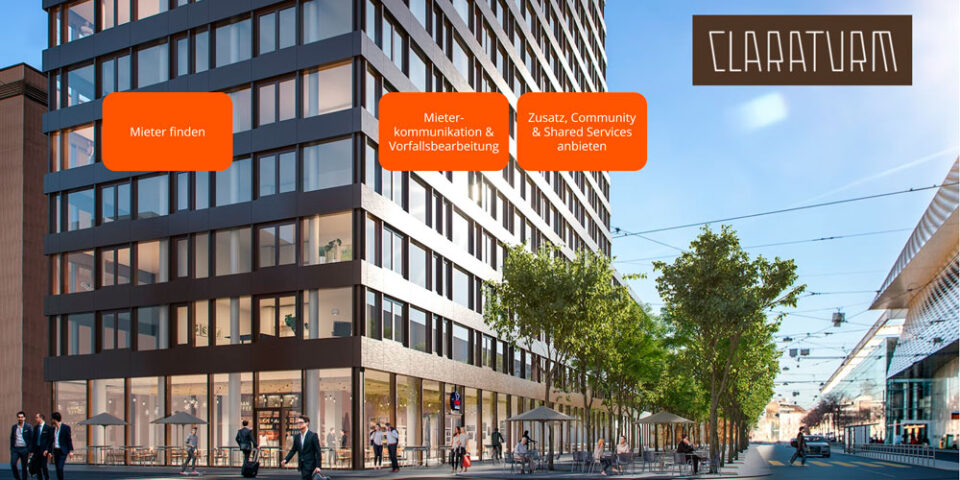
    For example, the processes “finding tenants”, “tenant communication”, “incident processing” and offering additional community services were tested on the Claraturm in Basel.

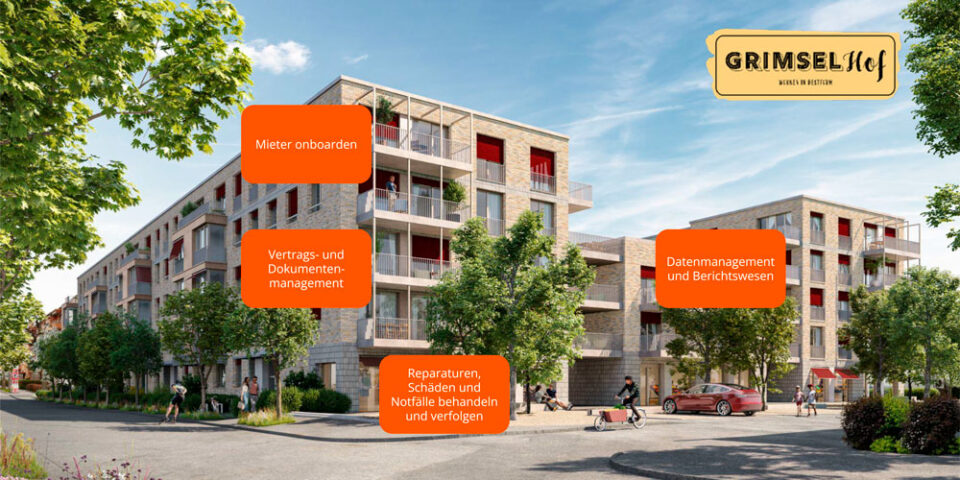
    On the combined renovation/new construction project Grimselhof in Altstetten, on the other hand, the processes “onboarding”, “contract and data management”, “document management and reporting” and new ways of processing repairs and damages were to be implemented. In this way, the various jobs-to-be-done can be validated over time and combined into an overall platform.

    The design of a plan to build digital operators is usually easy to map out in a series of 3-4 workshops. The process depicted in the diagram shows an ideal-typical sequence of a planning project for establishing a digital operator.

    Previous experience with greenfield approaches shows that a systematic implementation of a digital operator in cooperation with real estate owners and service providers makes the operation of real estate up to 30% more efficient, 100% more tenant-centred, and sustainability-oriented from day 1 – and also eliminates a lot of classic conflicting goals that result from conventional business models.

  • Office LAB becomes a new tenant in Konnex Baden

    Office LAB becomes a new tenant in Konnex Baden

    On behalf of the co-ownership, SPGI Zurich has rented additional space in the Baden connection . The Zurich company Office LAB will move into a total area of over 2800 square meters from January 2024, according to a press release . Then the provider of coworking offices will also take over the entire conference and event management for the Konnex building complex in the center of Baden.

    Office LAB has been using 800 square meters in connection with sub-letting since August of this year. The Zurich company offers office solutions for individuals and companies. These receive access to the coworking spaces in the form of day passes or fixed team offices. So far, Office LAB operates six locations. With the new location, the company is strengthening its already established presence in Baden.

    The Konnex building complex at Brown Boveri Strasse 7 is currently being completely renovated. A “city within a city” offer will be available there by mid-2023. A total of around 35,000 square meters of space will be rented for this purpose.

  • Implenia implements real estate projects in Geneva and Lausanne

    Implenia implements real estate projects in Geneva and Lausanne

    Implenia 's Buildings Division has been awarded two contracts in western Switzerland with a total volume of CHF 200 million, the Opfikon-based construction and real estate company said in a statement . Specifically, Implenia is to renovate the historic headquarters of an international organization in Geneva and build two new buildings for production and research in Chesaux-sur-Lausanne on behalf of Pulse , a company belonging to EPIC Suisse AG .

    In Geneva, Implenia will adapt the facades and security installations of the historic building to current standards, redesign the interior and modernize the equipment in the around 1,200 workplaces there. In Chesaux-sur-Lausanne, two four-storey buildings are being built, which are connected by two shared basements. Both projects are being implemented according to the principles of lean construction, explains Implenia. This approach to the planning and execution of construction projects focuses on avoiding waste and exceeding the needs of the client.

  • Luzerner Kantonalbank: Simon Kauth becomes a new member of the Executive Board

    Luzerner Kantonalbank: Simon Kauth becomes a new member of the Executive Board

    In January 2022, LUKB announced that it would adapt its organizational structure in order to increase its clout in the areas of IT and digitization. The IT department, which currently reports to CFO Marcel Hurschler, will move to the previous Market Services department on January 1, 2023. At the same time, the asset management area will be moved from the Market Services department to Marcel Hurschler’s responsibility and the area of special advice (financial planning, pension, tax and inheritance law advice) will be reassigned to sales, i.e. to the Corporate Customers & Private Banking department. In the future, the Market Services department will focus even more on IT and digitization and will bear the new name “Technology & Services” from 2023.

    In the course of this reorganization there will also be personnel changes: Leo Grüter, who has been a member of the management board of Luzerner Kantonalbank AG (LUKB) since 2010, will leave the management board at the end of 2022. The successor as Head of Corporate Customers & Private Banking will be Beat Hodel, who will head the previous Market Services department until the end of 2022.

    As of January 1, 2023, Simon Kauth will take over management of the newly structured Department of Technology & Services. Simon Kauth received his doctorate in economics from the University of St. Gallen HSG in 1997. He has many years of professional experience both in banking and on the side of the providers of core banking software (Avaloq and Finnova), most recently at management level. Born in Thurgau, Simon Kauth lives with his family in Zollikon ZH.

    “With his profile and his previous track record, Simon Kauth optimally fulfills our catalog of requirements for the management of the Department of Technology & Services: Strong IT background and profound know-how in banking,” says LUKB CEO Daniel Salzmann, explaining the choice of the new member of the management board. LUKB carried out a multi-stage selection process under the direction of Daniel Salzmann and with the support of external specialists.

  • The Swiss proptech company Immowise offers its solution in German-speaking Switzerland

    The Swiss proptech company Immowise offers its solution in German-speaking Switzerland

    Condominiums in Switzerland: An industry that only gains from digitization
    Swiss real estate is feeling the direct effects of the turn to digitization, as the most important players in the industry have accelerated the pace of increasing efficiency every year. Switzerland, with its 1.4 million owners* (including more than 445,000** condominiums), ultimately represents an important market for Immowise.

    Immowise's digital solution is easy to implement and adapts to any type of condominium. By connecting to the most important ERPs used in the industry, the platform is fully integrated into the digitization strategy initiated by the agencies. The lean cost management is also suitable for small structures and self-governing condominium associations.

    An office in Zurich serving condominium owners' associations in German-speaking Switzerland
    With the office opening in Zurich, Immowise wants to offer administrations, self-managed condominium associations or independent local administrators a solution to simplify and reduce the workload with a platform that has already proven itself in western Switzerland. By 2022, around 20 general meetings for over 500 condominium owners had already been held. Immowise wants to cover all Swiss regions by 2023. In addition, the platform will be expanded with additional modules such as the internal news service for condominium owners, the comparison of cost estimates and budget management.

    Immowise's development in German-speaking Switzerland is rounded off with the appointment of Teresa Astorina as Director, based in the Zurich region. As a recognized expert in the real estate sector, in which she has been active for over 25 years, she takes over the proptech leadership with the declared goal of converting the management of condominium associations throughout Switzerland using digital technology.

    Sebastian Chiappero, Managing Director of Wise.swiss, Immowise's parent company, adds: "20 months after the founding of Immowise, the appointment of a director marks a further step towards ensuring the nationwide rollout of Immowise. I am very pleased that Teresa will be part of this Position has joined us. Her many years of experience in the real estate industry and her skills in the area of strategy development are all plus points for Immowise". Among other things, she was also active in the management or in leading positions in companies such as Credit Suisse, m3 Real Estate, Privera or EPM.

    Teresa Astorina emphasizes: "The future of the real estate industry lies in digitization. I am very proud to be able to accompany the development of a "Swiss made" solution that offers a real service in the management of condominiums in Switzerland."

    Portrait of Teresa Astorina here for download

    About Immowise
    Immowise was founded in 2021 and is the first Swiss solution for the digitization of condominium meetings. Developed and hosted in Switzerland, this application helps administrators and condominium owners prepare, manage and follow up on meetings. It complements the wise.swiss software from EPwise AG, which was launched in 2020 and offers public administrations and companies a range of digital communication and event organization tools (eventwise, partnerwise and fundwise). https://wise.swiss/de/immowise/
    Immowise headquarters: Neuchâtel
    Offices: Geneva, Zurich