Tag: pandemie

  • Figures on the Swiss economic area

    Figures on the Swiss economic area

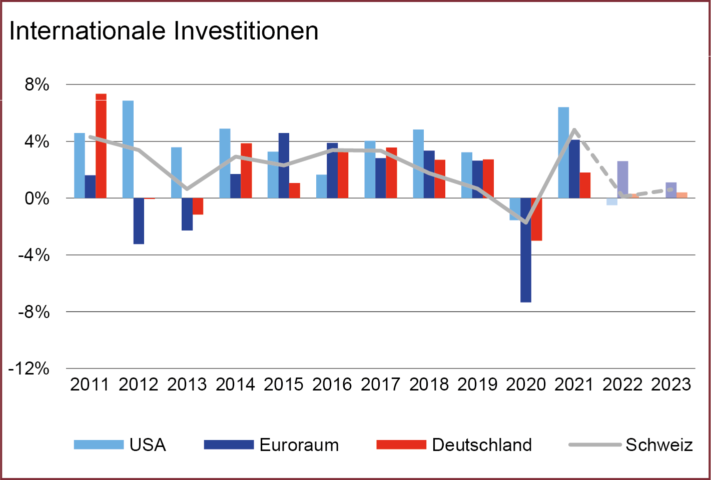
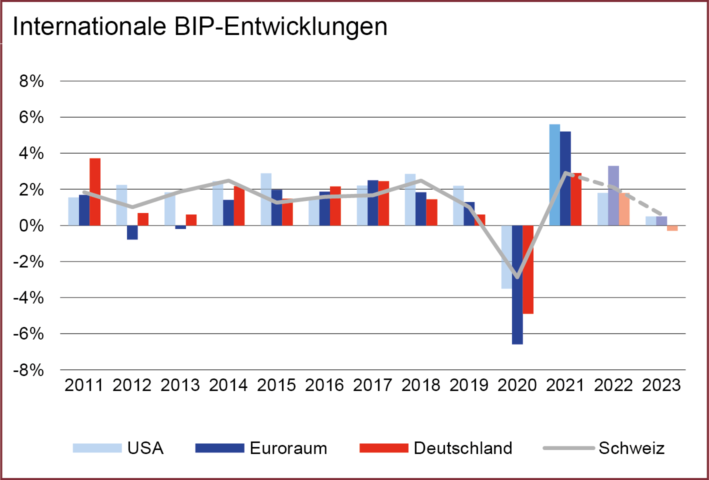
    International GDP development as well as investments have recovered excellently in 2021. However, the latest developments
    show that investment volumes are currently subdued and GDP development is cooling down worldwide. Economic analysts’ forecasts predict a slowdown in 2024 and a possible downward trend.

    The pandemic hardly plays a role in the media any more, but its consequences continue to be felt. In addition, rising energy and food prices as a result of the war in Ukraine, Corona measures by major economic players and supply chain problems have led to uncertainty, which is reflected in rising inflation rates. With the interest rate hike, the SNB was able to calm things down and is slightly above target. The forecasts of a slowdown in economic growth are reflected in a restrained development.

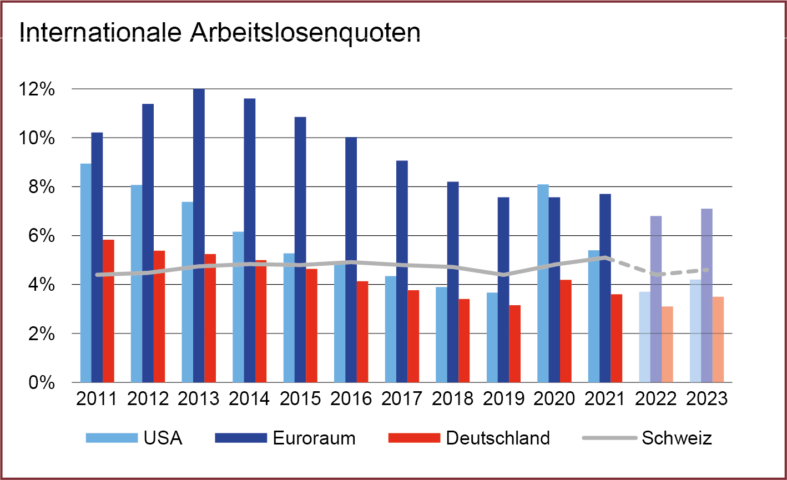
    Real incomes in Switzerland have fallen slightly, which, together with the pandemic-related pent-up demand in the consumer sector, is having a positive effect on the economy. The outlook for the labour market is good and an upswing is possible by 2024.

    The residential real estate market is robust and could not be affected by the financial crisis, the Corona pandemic or the war in Ukraine. The Swiss office market is unimpressed by the negative news from the global economy.

    Further interest rate steps by the SNB are expected and yields could rise slightly. However, due to immigration, vacancies in the periphery are falling and demand for space in the centres remains high, leading to rising market rents.

    In the area of commercial real estate, yields are not expected to rise in the near future, as interest rates could rise. There is a tendency for market values to fall, which could be cushioned by investors’ investment pressure.

  • The Swiss proptech company Immowise offers its solution in German-speaking Switzerland

    The Swiss proptech company Immowise offers its solution in German-speaking Switzerland

    Condominiums in Switzerland: An industry that only gains from digitization
    Swiss real estate is feeling the direct effects of the turn to digitization, as the most important players in the industry have accelerated the pace of increasing efficiency every year. Switzerland, with its 1.4 million owners* (including more than 445,000** condominiums), ultimately represents an important market for Immowise.

    Immowise's digital solution is easy to implement and adapts to any type of condominium. By connecting to the most important ERPs used in the industry, the platform is fully integrated into the digitization strategy initiated by the agencies. The lean cost management is also suitable for small structures and self-governing condominium associations.

    An office in Zurich serving condominium owners' associations in German-speaking Switzerland
    With the office opening in Zurich, Immowise wants to offer administrations, self-managed condominium associations or independent local administrators a solution to simplify and reduce the workload with a platform that has already proven itself in western Switzerland. By 2022, around 20 general meetings for over 500 condominium owners had already been held. Immowise wants to cover all Swiss regions by 2023. In addition, the platform will be expanded with additional modules such as the internal news service for condominium owners, the comparison of cost estimates and budget management.

    Immowise's development in German-speaking Switzerland is rounded off with the appointment of Teresa Astorina as Director, based in the Zurich region. As a recognized expert in the real estate sector, in which she has been active for over 25 years, she takes over the proptech leadership with the declared goal of converting the management of condominium associations throughout Switzerland using digital technology.

    Sebastian Chiappero, Managing Director of Wise.swiss, Immowise's parent company, adds: "20 months after the founding of Immowise, the appointment of a director marks a further step towards ensuring the nationwide rollout of Immowise. I am very pleased that Teresa will be part of this Position has joined us. Her many years of experience in the real estate industry and her skills in the area of strategy development are all plus points for Immowise". Among other things, she was also active in the management or in leading positions in companies such as Credit Suisse, m3 Real Estate, Privera or EPM.

    Teresa Astorina emphasizes: "The future of the real estate industry lies in digitization. I am very proud to be able to accompany the development of a "Swiss made" solution that offers a real service in the management of condominiums in Switzerland."

    Portrait of Teresa Astorina here for download

    About Immowise
    Immowise was founded in 2021 and is the first Swiss solution for the digitization of condominium meetings. Developed and hosted in Switzerland, this application helps administrators and condominium owners prepare, manage and follow up on meetings. It complements the wise.swiss software from EPwise AG, which was launched in 2020 and offers public administrations and companies a range of digital communication and event organization tools (eventwise, partnerwise and fundwise). https://wise.swiss/de/immowise/
    Immowise headquarters: Neuchâtel
    Offices: Geneva, Zurich

  • Investors are lining up in front of first-class properties

    Investors are lining up in front of first-class properties

    Wer heute eine Immobilie an bester Lage erstehen will, braucht viel Geld und Geduld. Vor Büro- und Wohngebäuden mit hervorragender Erschliessung bilden sich heute lange virtuelle Schlangen von Investoren, die ihre Mittel möglichst sicher anlegen wollen. Bieterverfahren treiben die Preise auf neue Höchstwerte: In der Zürcher Goldküsten-Gemeinde Zumikon etwa erwarb ein Käufer kürzlich ein nicht mehr benötigtes, nur eine Minute neben einer ÖV-Station gelegenes Feuerwehrgebäude mit einigen Wohnungen für rund CHF 21 Mio. 37 Interessenten hatten sich beworben, der Endpreis lag fast zweieinhalb Mal so hoch wie der von der Gemeinde aufgrund einer professionellen Schätzung vorgegebene Mindestpreis von CHF 8.7 Mio. Im Fokus der Anleger standen 2021 vor allem sogenannte Core-Objekte: “Als risikoarme Anlageklasse sind erstklassige Immobilien nach wie vor ohne Alternative”, begründet Yonas Mulugeta, CEO von CSL Immobilien, diese in den Zentren beobachtbare Entwicklung.

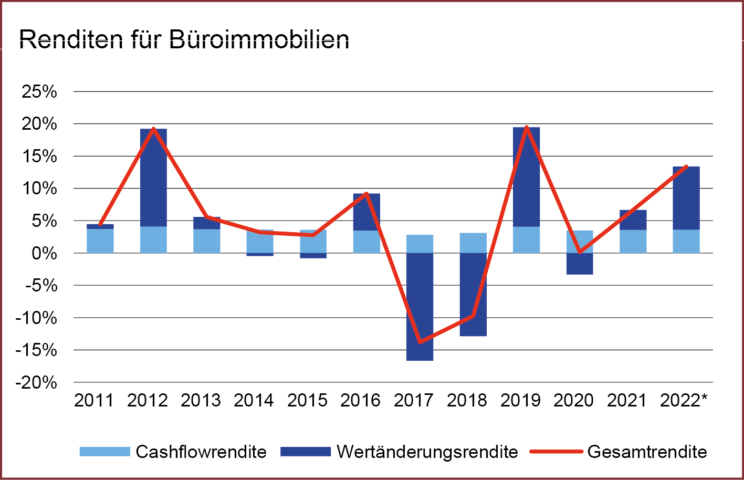
    Die Preisentwicklung führte 2021 dazu, dass die Netto-Anfangsrenditen in den meisten Segmenten des Investmentmarkts weiter auf neue Tiefstwerte sanken – dies, obwohl die meisten Investoren eher eine Seitwärtsbewegung erwartet hatten. Wohnliegenschaften erstklassiger Güte rentierten im Landesschnitt mit 1.85% (Vorjahr 2.1%). Noch stärker sanken die Renditen für Top-Büroobjekte: Diese fielen mit 1.9% (Vorjahr 2.35%) sogar knapp auf das Niveau der Wohnimmobilien.

    Ein Grund dafür: Investoren, die im Wohnmarkt nicht mehr zum Zug kamen, wichen in den Büromarkt aus. Auf Interesse stiessen 2021 auch Gewerbe- und Logistikimmobilien – dies als eine weitere Ausweichbewegung von Investoren, die vom boomenden Onlinehandel profitieren wollen.

    Leere Büros in der Peripherie

    Auch die Unternehmen fokussierten ihre Nachfrage 2021 noch stärker auf zentrale Standorte. Der grössere Teil der in den vergangenen sechs Monaten verfügbaren Büroflächen von 2.43 Mio. m2 (Vorjahr 2.26 Mio. m2) entfiel deshalb auf Liegenschaften ausserhalb der städtischen Zentren. Im Wirtschaftsraum Zürich waren in den vergangenen sechs Monaten rund 910’000 m2 Bürofläche inseriert (Vorjahr 812’000 m2). Damit ist das Angebot innerhalb eines Jahres um 12% gestiegen – ähnlich stark wie in den Wirtschaftsräumen Bern (+14%) und Genf (+12%).

    Der Fokus der Unternehmen auf zentrale Bürostandorte ist insbesondere auch auf die Pandemie zurückzuführen. Viele Mitarbeitende haben sich an das Homeoffice gewöhnt. Um sie zumindest teilweise zurück ins Büro zu holen und dort einen neuen Alltag zu etablieren, muss dieses attraktiv sein. Neben der zentralen Lage mit guter Verkehrsanbindung gehört dazu ein ansprechendes Interieur, das Kreativität und Teamprozesse fördert. Unternehmen, die dies nicht bieten können, haben auf dem Arbeitsmarkt einen Nachteil.

    Eigenheimpreise flächendeckend gestiegen

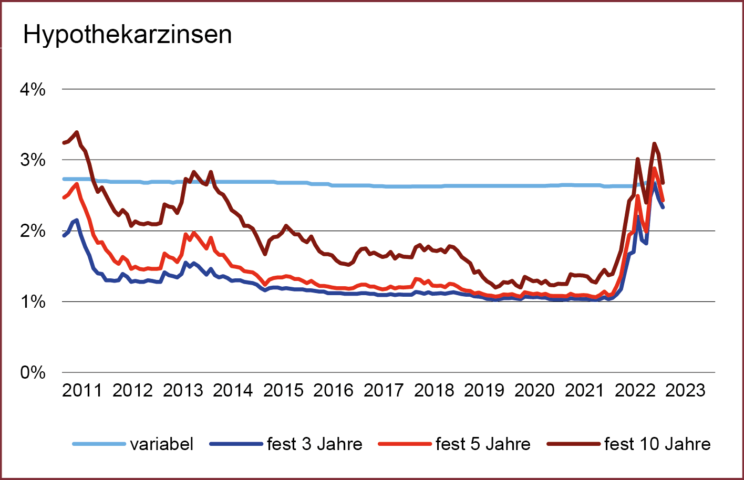
    Auch im Wohnmarkt machte sich die Pandemie bemerkbar: Das Zuhause gewann an Bedeutung. Gleichzeitig löste das Homeoffice in vielen Haushalten ein Platzproblem aus. Dies führte zu einer steigenden Nachfrage – insbesondere im Eigentumssegment, das weiterhin vom attraktiven Finanzierungsumfeld profitiert. Auf der Angebotsseite kam nur wenig Neues hinzu. Die Folge waren fast flächendeckend steigende Preise für Eigenheime. Dieser Trend dürfte sich 2022 fortsetzen – die Hypothekarzinsen bleiben auf tiefem Niveau, auch wenn sie zuletzt leicht gestiegen sind.

    Im Mietwohnungssegment wirkte sich die gestiegene Nachfrage insbesondere strukturell aus: Gesucht waren 2021 vor allem grössere Objekte, während das Interesse an 1- bis 2.5-Zimmer-Wohnungen an vielen Lagen spürbar abnahm. Die Erfahrung von CSL Immobilien im Markt zeigt: Paare beziehen heute kaum mehr eine 2.5-Zimmer-Wohnung, sondern suchen mindestens eine Wohnung mit 3.5, lieber noch mit 4.5 Zimmern. Dies zeigt sich auch in den Zahlen: Im Kanton Zürich stieg der Anteil der 1- bis 2.5-Zimmer-Wohnungen unter den leerstehenden Wohnungen 2021 auf 27%, ein Jahr zuvor lag dieser noch bei 22%.

    Die Leerstandsquote im Wohnmarkt sank 2021 aufgrund der grossen Nachfrage über das ganze Land gesehen auf 1.54% (Vorjahr 1.72%).

    Allerdings zeigt die Quote grosse regionale Unterschiede. Im Vergleich der grössten Agglomerationen weist Zug mit 0.4% den tiefsten Wert auf, Olten-Zofingen mit 3.8% den höchsten. Im Kanton Zürich lag die Leerstandsquote 2021 bei 0.72% (Vorjahr 0.91%). In der Stadt Zürich stieg die Leerstandsquote 2021 zwar minimal an, zeigte aber mit 0.17% (Vorjahr 0.15%) immer noch einen äusserst ausgetrockneten Markt.

  • Strengthen Switzerland as a location for innovation and expand the lead

    Strengthen Switzerland as a location for innovation and expand the lead

    The Swiss economy is characterized by an enormously high level of innovation and has been able to secure its leading position worldwide in recent years despite the strong Swiss franc. The vocational training system, the close interaction between research and business, start-ups and corporations as well as the high willingness to found new companies are the cornerstones of the recipe for success. The pandemic and the associated restrictions have put great pressure on the economy in all European countries.
    This is a valuable opportunity for Switzerland to further expand its lead in key areas through targeted funding with existing or new instruments.

  • Swiss office market: pandemic is leaving its first traces

    Swiss office market: pandemic is leaving its first traces

    While the advertised space in London and New York skyrocketed in the wake of the COVID-19 pandemic, the space available in Switzerland increased only moderately at the end of the 2nd quarter of 2021 compared to the same quarter of the previous year, from 5.5% to 5.8%. Although the uncertainties about the future need for office space are still very high for many tenants, a number of lease extensions and new contracts have been observed on the market – mostly for the purpose of optimizing or concentrating the location.

    Reluctant demand for office space
    The usually close link between the growth of office work and the demand for office space has decoupled during the pandemic. Despite a relatively robust development in office employment, many customers were reluctant to rent new space, especially since coping with the pandemic is dragging on and the trend towards home offices is consequently becoming entrenched. The demand for space is likely to suffer in the next few years from the fact that more and more companies are enabling their employees to partially work from home, even after COVID-19. The real estate economists at Credit Suisse still consider last year’s forecast, according to which the corona-induced breakthrough in home offices to reduce the need for office space by around 15% in the medium term, as a good benchmark. However, economic growth and the increasing proportion of office work due to the digitization effect are counter-trends, which is why real estate economists expect demand for office space to stagnate in the medium term.

    The supply of space is increasing again – but less than expected
    As a direct consequence of the sluggish demand, the office space advertised for rent is currently increasing again in all regional sub-markets without exception. In the office markets of the major centers, the supply in absolute numbers increases most strongly in the agglomeration communities around the central cities (outer office markets). In percentage terms, however, the supply has increased most in the city centers. Higher supply rates can be observed above all in those sub-markets that are currently recording a high level of space access. For example, the increased construction activity in Basel is making a significant contribution to the increase in the available space at the knee of the Rhine. In contrast, the comparatively intact market situation on the Zurich office market is closely related to the low level of construction activity. The comparison between Lausanne and Geneva is interesting: While weak demand was responsible for the increase in the supply of space to 12.3% in the city on the Rhone, Lausanne benefited from relatively robust demand despite higher construction activity, so that the supply of space here increased significantly less.

    Investors are planning less office space
    In the past twelve months, building permits for office space with an investment volume of CHF 1,598 million have been granted. This is around 17% below the long-term average since 1995. Investors have become more cautious about investing in office buildings and are holding back on new projects as long as the uncertainty regarding future space requirements is not cleared up. In a long-term comparison, the amounts approved for office renovations remain at a low level. In most cases, replacement new buildings are preferred to renovations today. Conversions in apartments, which are increasingly being considered – especially in the Bern office market – are not included in these figures. This reluctance on the part of investors should help ensure that most office markets are unlikely to develop too large imbalances over the next few quarters.

    Home office only slows down space requirements temporarily
    Based on a study commissioned by two federal offices on industry developments up to 2060, the real estate economists at Credit Suisse derive the development of office employment up to 2060 and use this to forecast long-term demand for office space. Current trends such as employment growth, the digitization of many work areas, but also the trend towards home offices are developing in the opposite direction. While home office reduces space requirements in the medium term, the increasing digitization of all areas of life and work is increasing the office quotas – i.e. the proportion of employees with an office workstation – in all industries and thus generating a large need for additional office space in the long term. Between 2000 and 2019, the average office rate in Switzerland climbed from 34% to 45%. According to the modeling, it should increase further to 60% by 2060. Over time, this effect is likely to overshadow the trend towards home offices, which is reducing space, and generate significant additional demand for office space in the long term.

    Immediate view streaked through
    In the short term, there are two opposing developments that are having an impact on the demand for office space. On the one hand, the absorption of space is likely to continue to be resinous, despite stronger employment growth, and to lag behind the usual level. A further increase in the supply of space is therefore possible, especially as there have only been a few cases of large-scale abandonment or reductions in space due to the COVID-19 pandemic. However, such dismantling plans exist. On the other hand, a certain amount of demand is likely to have built up. The real estate economists at Credit Suisse are forecasting a renewed increase in supply, particularly for large and peripheral spaces. They also expect a further increase in vacancies next year and ongoing pressure on rental prices, which could be a little higher than the current minus of 0.1%.

    Figure: Expansion and supply in the large and medium-sized centers
    Circumference: stock of office space; Expansion: building permits for the last four years compared to the long-term average; Supply quota in% of the 2018 portfolio

    The full study on “Swiss office space market 2022” is available in German here .

  • Central Switzerland remains an attractive company location

    Central Switzerland remains an attractive company location

    The cantons of central Switzerland also attracted many new companies during the pandemic, according to an article in the “Luzerner Zeitung”. Uri has helped 16 companies set up in the canton. As Stefan Büeler, Head of the Office for Economics and Public Transport at the canton of Uri, explains in the article, he sees the canton on track to be able to achieve a similar number again in 2021. The canton benefits from major projects such as the Altdorf cantonal railway station, the cantonal hospital, the construction of the second Gotthard tube and the tourist development in Andermatt.

    Meanwhile, the canton of Schwyz recorded a record number of start-ups last year. Urs Durrer, head of the office for economy of the canton Schwyz, attributes this in the article to successful settlements. The establishment of the American software company Palantir was a great success. Overall, there are currently more settlement projects to be managed than before the pandemic, said Durrer.

    The canton of Lucerne settled 19 companies last year. The canton of Zug sees itself back at pre-crisis level when it comes to settling in. The canton of Nidwalden did not experience any slump during the pandemic.

    During the pandemic, numerous settlement projects could be prepared, which are now being implemented, as several business promoters emphasize in the article. For example, many international companies had their settlement projects that they had to postpone due to the pandemic implemented in the first half of 2021, says Reto Sidler, media spokesman for the Greater Zurich Area . The location marketing organization and its member cantons – Schwyz, Zug, Uri and six other cantons – were able to relocate 55 companies from abroad last year.

  • Pandemic stimulates housing market

    Pandemic stimulates housing market

    The number of advertisements for rental apartments on Swiss real estate portals increased by around 13 percent year-on-year between April 2020 and March 2021, writes SVIT Switzerland in a statement on the current online housing index (OWI). It is prepared every six months by the Association of the Real Estate Industry in cooperation with the Swiss Real Estate Institute . In the current OWI, the analysts registered around 513,000 advertisements for rental apartments.

    The average period for which an apartment has to be offered until it is rented has simultaneously been reduced by two to 32 days, the analysts further explain in the press release. For them, the shortened advertising time and the increasing number of advertisements are a sign of increasing demand on the rental housing market with a simultaneous decrease in rental periods. "It can be assumed that the pandemic was the trigger for many tenants to review and adjust their own living situation," the message says.

    In 21 of 26 cantons, the analysts observed a year-on-year decrease in advertising time. The advertising times in French-speaking Switzerland have hardly changed, while in German-speaking Switzerland they have decreased in all cantons. The canton of Zug currently has the shortest advertising time at 14 days. Ticino ranks at the other end of the scale. Here, apartments have to be advertised on average for almost two months before they can be rented.

    In the cities, the analysts observed a “sharp rise” in advertisements for rental apartments in the reporting period. After 3.5 percent in the previous year, the number of advertisements in the “Corona year” in the twelve cities examined increased by 32 percent. However, because the average length of advertising has barely increased, the analysts assume that there will be relocations within the cities. "The much-cited urban escape" could not be proven with the figures, it says in the message.

  • WWZ Group defies the pandemic

    WWZ Group defies the pandemic

    According to a statement from the WWZ Group , the Zug-based energy, telecommunications and water supplier generated total net sales of CHF 227.6 million in the 2020 financial year. In a year-on-year comparison, this corresponds to a marginal decrease of 0.3 percent.

    "Despite the corona pandemic, WWZ was largely able to achieve its goals," CEO Andreas Widmer is quoted as saying in the press release. "Although energy sales fell as a result of the lockdown and the warm weather, we were still able to keep net sales at the previous year's level." In addition, the group has pushed ahead with "expanding our strategic growth areas", explains Widmer.

    The CEO particularly points out the area of district heating. In the year under review, the group's flagship project, Circulago, put the first district headquarters into operation. Circulago uses the energy of the Zug lake water to generate heat and cold.

    In the year under review, WWZ invested a total of 87.0 million francs in maintaining the infrastructure and expanding district heating and telecommunications networks. As a result of these high investments and increased depreciation, the operating result at EBIT level fell by 10.8 percent year-on-year, explains WWZ. Specifically, an operating result of 37.4 million francs was achieved. At 39.0 million francs, consolidated profit was 19.1 percent lower than in the previous year.

    For the current year, the group assumes that investments, operating costs and depreciation will remain high. "The transition from fossil natural gas to renewable district heating and the establishment of further growth areas will temporarily burden the income statement," explains WWZ CFO Andreas Ronchetti Salomon. However, the group is well equipped to continue its strategic development “even under difficult conditions”.

  • "Best overall package thanks to the Spirit of Zug"

    "Best overall package thanks to the Spirit of Zug"

    To person
    Beat Bachmann is lic.oec. HSG and has management experience in the areas of business development, sales, finance and project management in domestic and foreign markets. His industry experience includes life sciences / medical technology, wholesale / sales of consumer goods, real estate, information and communication technology.

    You are the head of the Business Contact Point in the Canton of Zug. How can you imagine a normal working day?
    Beat Bachmann: Every day is different. As a "one-stop-shop", we primarily support and advise local companies on a wide variety of issues. This also includes support in finding office space. With over 100 company visits per year and by networking the companies with one another in the industry clusters, we help ensure that the companies can operate successfully in a business-friendly location. In addition, we support many companies each year in setting up in the canton of Zug.

    How are the companies based in the canton with regard to the pandemic?
    The Zug economy with its strong international ties is also affected and cannot escape the structural changes. The effects are to be mitigated thanks to the measures taken by the federal government and the canton. Due to the strong constitution of Zug's economy before the Corona crisis and the broad diversification, I estimate that the negative effects will be slightly lower compared to the rest of Switzerland. Nonetheless, our team was able to look after the same number of relocations in 2020 as in previous years.

    In the Credit Suisse location ranking, Zug almost always ranks first – not least because of the low corporate income tax rate of 12 percent. What else do you offer more than other cantons?
    We primarily offer the best overall package of excellent location conditions: These include long-term financial and political stability, tax and finance policy, great innovative ability, high availability of skilled workers in important industry clusters and efficient infrastructure. The fascinating living space and thus the quality of life are also very important. Last but not least, we often hear that economic friendliness – our “Spirit of Zug” – is very much valued.

    What tasks does the Business Contact Point take on in site development?
    In particular, we help ensure that the needs and requirements of the economy and companies are incorporated into the site developments. And when the properties are completed, we offer support in arranging the space for new tenants or buyers.

    Does the site development show that the potential is being exhausted?
    We are very happy that the landowners and site developers have made a significant contribution to the sustainable and qualitative development of the canton for decades. It is in line with the long-term strategy of the government council that Zug should remain an attractive place to live and live. There is still enough arable land. I therefore think that the canton of Zug can continue to develop in this way over many generations.

    «Zug, Baar and Rotkreuz score points with the
    Companies"

    Several commercial buildings are under construction in the canton of Zug. In the wake of the pandemic, however, the trend is towards home offices. Still, are you confident that all of these projects can be brought to life?
    Yes, I am confident that these surfaces will be absorbed. Switzerland and the canton of Zug are and will remain a leading international economic area. In the case of new settlements, the availability of ready-to-move-in space is an important location factor. It is difficult to estimate the long-term impact of Covid-19 on office space demand. The trend towards more home offices is countered by a trend towards more space per capita, as well as co-working spaces / business centers.

    Besides Zug, which city in the canton is the most popular location for companies?
    On the one hand, the Lorzen plain (valley communities) has had the most companies and jobs for decades. Since the canton records around 40% train commuters on working days, the proximity to train stations with IC and express train connections is playing an increasingly important role. Accordingly, along with Zug, Baar and Rotkreuz have been the most popular locations in recent years; Cham follows behind.

    What makes the canton of Zug attractive as a place to live?
    Zug offers a good international infrastructure, excellent schools and political stability. The standard of living is high and the living spaces are intact. There are lakes, mountains and diverse landscapes in the smallest of spaces. Zug therefore offers an outstanding quality of life and the proximity to central Switzerland and Zurich.

    How do you assess the current demand on the housing market?
    It is consistently high in the canton of Zug. At the same time, the vacancy rate in the canton of Zug is only increasing minimally.

    How do you rate the building potential in the housing market?
    Since we at the Business Contact Point primarily deal with companies and, accordingly, with office and commercial space, I am not an expert on the housing market. However, I observe that many apartments have been built unchanged for decades and that they are constantly finding residents. As the smallest full canton in Switzerland in terms of area and due to our sustainable growth strategy mentioned above, we will continue to see a high proportion of commuters in the future.

  • SF Urban Properties can increase profits

    SF Urban Properties can increase profits

    Despite the pandemic, SF Urban Properties AG can look back on “a gratifying 2020 financial year”, writes the real estate company belonging to Swiss Finance & Property Group AG in a press release . Specifically, the company was able to increase its operating result at EBIT level from 27.0 million to 32.0 million francs year-on-year. The net profit before revaluations increased by 92.8 percent compared to 2019 to 23.0 million francs. Net profit including revaluations improved by 23.8 percent to 23.0 million francs.

    As a background for the good developments, SF Urban Properties cites the successful sale of a property and the vacancy rate, which was kept at a low 2.62 percent despite the pandemic. As in the previous year, shareholders are to be paid a dividend of CHF 3.60 per listed ordinary share. With an equity ratio of 46.4 percent, the company continues to be “robustly financed,” writes SF Urban Properties.

    In the current year, the real estate company intends to concentrate on the economic areas of Zurich and Basel as before. In the year under review, SF Urban Properties was able to successfully market the Sandreutergarten residential development planned in Riehen BS, the real estate company reports. Nine out of ten of the units under construction since the end of 2020 have already been sold. In the development project at Klusstrasse 38 in Zurich, twelve of a total of 13 units were reserved in the reporting year and two of them had already been legally sold.

  • Pandemic cuts profits at Zug Estates

    Pandemic cuts profits at Zug Estates

    According to a statement from the Zug Estates Group , the real estate company was able to increase its property income in 2020 by 6.1 percent year-on-year to 57.8 million francs. In the accommodation business, income from the effects of the pandemic was reduced by 57.8 percent to 7.0 million francs. In 2020, income of 72.5 million francs was generated from the sale of properties. In the previous year, 45.6 million francs were posted here.

    In 2020, income would have been offset by 15.6 percent higher expenses of 9.0 million francs year-on-year, writes Zug Estates. As a result, the operating result before depreciation and revaluation fell by CHF 3.8 million to CHF 49.6 million. The reported operating result (EBIT) was CHF 43.7 million, 38.0 percent below the 2019 figure. Consolidated earnings excluding revaluation and special effects fell from CHF 31.4 million to CHF 25.9 million.

    The value of its own portfolio of real estate increased by 1.5 percent to 1.65 billion francs in the year under review, explains Zug Estates. In addition, in 2020 the company was able to renew leases with a total volume of over CHF 2.6 million per year. For the current year, Zug Estates anticipates increasing rental income and lower property costs compared to the year under review.

  • Parcel system should reduce delivery traffic

    Parcel system should reduce delivery traffic

    In the pandemic, the already growing online trade continued to grow, write the construction and transport department of the canton of Basel-Stadt , the association Pro Innenstadt Basel and the logistics cluster Region Basel in a joint message . The provider-neutral parcel systems they have developed are intended to remedy this. As part of a pilot project, the first of the so-called Smart Boxes has already been set up on Claraplatz.

    Another smart box is to be set up at St. They want to test the acceptance and effectiveness of the parcel systems by February 2023. "The current pilot project is intended to show how much the offer is being used and how much the daily traffic volume can be reduced with it," said Deborah Strub, chairwoman of the Basel region logistics cluster, quoted in the press release.

    The project is financed by the Office for Mobility of the Canton of Basel-Stadt and the Pro Innenstadt Basel association. “Residents of Basel can conveniently have the parcels they have ordered delivered to the Smart Box Basel, where they can pick them up around the clock,” explains the managing director of the association Mathias F. Böhm. The package systems are manufactured and operated by Huber AG . She has also developed a digital application for using the Smart Boxes.

  • Plazza defies the pandemic

    Plazza defies the pandemic

    Plazza AG achieved a very positive result in 2020 and exceeded its own expectations, writes the Zurich real estate company in a press release . Specifically, the company, which has been listed on the SIX since 2015, was able to increase its property income from CHF 24.3 million in the previous year to CHF 24.6 million in the year under review. At the same time, the operating result before depreciation and revaluation increased from 18.9 million to 20.0 million francs.

    The profit was 63.3 million francs, compared to 36.7 million francs in the previous year. The increase is primarily due to success in revaluations, explains Plazza in the press release. Without taking them into account, the profit remained unchanged from 2019 at 17.0 million francs.

    Plazza cites the high proportion of residential properties in its own portfolio as the background for the good developments. It was unchanged at 73 percent in the year under review and will continue to rise this year through the purchase of 80 apartments in the Tiergarten estate in Zurich's Friesenberg district, the statement said. According to her, none of the apartments managed by Plazza had been vacant by the end of 2020. Overall, the real estate company was able to reduce its vacancy rate year-on-year from 4.0 to 3.7 percent. The company writes that it mainly affects free commercial space.

    For the current year, Plazza is aiming for an operating result before depreciation and revaluation "at least in the order of 2020". Subject to the building permit expected in the first half of the year, the first stage of the development project in Crissier VD is to be tackled. The construction of a nursing home for a foundation and a primary school for the community of Crissier were agreed in the reporting year.

  • GuestReady teams up with Airhosted

    GuestReady teams up with Airhosted

    In the past four years, GuestReady has established itself as a specialist in six countries with its services for providers of short-term rentals, explains a report on Startupticker.ch. Despite severe setbacks during the coronavirus pandemic, the start-up from Appenzell Ausserrhoden managed to raise “fresh funds” through a swarm financing campaign at the end of 2020. She wants to use GuestReady for the development of the Swiss market. "Switzerland has become even more exciting for us due to Corona and the effects on travel behavior," Alexander Limpert, co-founder of GuestReady, is quoted in the report.

    To realize the plans, GuestReady is working with the Zug start-up company Airhosted . The company manages short-term rentals in a total of 18 cities in Switzerland and aims to bring this specialist knowledge to bear in the partnership. GuestReady, in turn, will equip the partner “with the necessary technology” and the specialist knowledge to also win real estate companies and other corporate customers.

    The two partners want to be able to look after 500 properties in Switzerland by the end of next year. "Thanks to more local guests, classic destinations in the mountains in particular are already showing higher occupancy rates again," explains Limpert in the article. "In addition, the number of vacation rental owners who want a professional rental service is increasing."

  • Swiss Prime Site defies the pandemic

    Swiss Prime Site defies the pandemic

    According to a message from Swiss Prime Site , the Solothurn-based real estate company generated total income of CHF 792.9 million in the 2020 financial year. In the previous year, 1.26 billion Swiss francs had been booked. Swiss Prime Site attributes the decline primarily to the sale of its subsidiary Tertianum, which was completed in February 2020.

    The profit from the sale was also reflected in a strong increase in the operating result (EBIT). In the year under review, 762.3 million francs were posted here, compared to 628.3 million in the previous year. Net profit increased year-on-year from 608.5 million to 610.4 million francs. Without taking into account revaluations and deferred taxes, the profit increased from 315.7 million to 476.6 million, writes Swiss Prime Site.

    In 2020, the core real estate business generated a total of 431.0 million francs in rental income, 1.4 percent less than in 2019. The operating result fell year-on-year from 572.9 million to 555.0 million francs. At the same time, the value of the real estate portfolio increased by 4.7 percent to CHF 12.3 billion. Swiss Prime Site intends to make its real estate portfolio climate-neutral by 2040, explains the real estate company in the press release.

    In the same announcement, the company announces a change in the group management. CFO Markus Meier decided to leave Swiss Prime Site for personal reasons, writes the real estate company. Marcel Kucher, who is currently CFO of the Peach Property Group, is to be his successor at the beginning of July. "With his broad wealth of experience in the areas of capital markets and digitization", Kucher will "optimally complement and further strengthen the management team of our group", Board member Barbara Frei-Spreiter is quoted in the announcement.

  • PSP Swiss Property defies the pandemic

    PSP Swiss Property defies the pandemic

    According to a statement from PSP Swiss Property , the Zug-based real estate company generated real estate income totaling CHF 296.27 million in the 2020 financial year. Compared to the previous year, this corresponds to a growth of 2.0 percent. The operating result (EBITDA) excluding real estate successes and valuation differences amounted to CHF 271.06 million in 2020, 5.8 percent more than in 2019.

    The net profit in the year under review was CHF 292.1 million, compared to CHF 453.4 million in the previous year. PSP Swiss Property attributes the decline to one-time effects. In the previous year, for example, a tax effect and the sale of two investment properties had a positive impact. In addition, the portfolio revaluation in 2019 brought in a total of CHF 244.2 million. In the year under review, the corresponding figure was 101.6 million francs.

    The balance sheet value of the PSP Swiss Property portfolio as of the end of 2020 was CHF 8.577 billion. As of the 2019 reporting date, the value was 7.982 billion francs. The vacancy rate was reduced from 3.5 to 3.0 percent within a year. The real estate company provides details of the portfolio change in the notification.

    For the current financial year, PSP Swiss Property is aiming for an EBITDA excluding real estate gains of around CHF 275 million. The vacancy rate is expected to increase to 4.5 percent.

  • Mobimo is defying the pandemic

    Mobimo is defying the pandemic

    Mobimo generated an operating result (EBIT) of CHF 145.8 million in the 2020 financial year, the real estate company informed in astatement . Excluding revaluation effects, the operating result was CHF 111.5 million. In the previous year, the corresponding values were CHF 134.0 million and CHF 82.5 million, respectively.

    The development and sale of properties proved to be growth drivers in the year under review. The year-on-year success here had risen from CHF 3.0 million to CHF 36.8 million. The revaluation gain, however, fell year-on-year from CHF 51.5 million to CHF 34.3 million. Mobimo writes that it was mainly generated operationally in the reporting year.

    The real estate company posted rental income of CHF 105.1 million in the year under review. This only just fell short of the value of CHF 106.7 million in 2019. At the same time, Mobimo supported its own tenants from the catering, hotel and retail sectors with rent relief totaling 6.5 million francs due to the pandemic.

    Mobimo's real estate portfolio increased from CHF 3.3 billion to CHF 3.4 billion in the course of the year under review. The average gross return remains unchanged at 4.5 percent, the company informs in the announcement. As of the end of the year, Mobimo had investment properties under construction in the amount of CHF 90 million and in planning in the amount of CHF 490 million.

  • Pandemic accelerates real estate trends

    Pandemic accelerates real estate trends

    Yonas Mulugeta, CEO of CSL Immobilien , sums up the findings from the current CSL Real Estate Market Report 2021 . According to a corresponding press release, this applies in particular to the office market. The vacancy rate for offices has reached a high: the available supply of commercial space has increased by 23 percent to 2.26 million square meters in the course of the past year. That is the highest value since 2014.

    At the same time, however, the demand for central locations in major centers such as Zurich increased. The authors of the report deduce from this that the home office is not the end of the office. Instead, office space would be used more as social meeting and collaboration places. Because "Location factors such as an urban environment with attractive lunch or leisure options or proximity to customers and industry meeting points have become more important as a result of the pandemic".

    The vacancy rate in the residential market has also reached a high. In the previous year, the Swiss average rose from 1.66 to 1.72 percent – a value that was last reached in 1988. Outside the major centers, high vacancy rates of over 2 or 3 percent are not uncommon in all of Switzerland. CSL expects vacancies to continue to rise and rents to fall in 2021. Residential property has benefited from the increased value of a beautiful home during the pandemic. Because of the increasing number of homeworkers, real estate in more peripheral locations would have found buyers more easily.

    For multi-asset investors in particular, real estate investments have become a replacement for bonds with negative interest rates. Returns in all real estate asset classes continued to decline.

  • Pandemic strengthens real estate market

    Pandemic strengthens real estate market

    Almost all of the 74 experts surveyed by EY for the Real Estate Investment Market Switzerland 2021 trend barometer rate the attractiveness of the Swiss real estate market as attractive to very attractive, EY informs in a message on the trend barometer. Compared to last year, the attraction to investors has even increased slightly again, it is said there. Only 15 percent of those surveyed expect a decline in investment volume. In the 2020 trend barometer, the corresponding value was 17 percent.

    “On a global level, we see a lack of investment alternatives, high investment pressure and increasing economic uncertainty as drivers for the real estate asset class,” Claudio Rudolf, author and head of Transaction Real Estate at EY in Switzerland, is quoted in the press release. Specifically, Rudolf names the pandemic and Brexit as the drivers for volatility. “Against this background, investors recognize a safe haven in the Swiss real estate market that is more resistant to crises than in other countries,” says the real estate expert.

    However, the barometer also shows differences within the sectors. "While the developments in the different real estate sectors were more closely correlated in the past – according to the motto 'the tide lifts all boats' – the corona pandemic is making the real estate market more differentiated," explains Daniel Zaugg, Head of Real Estate at EY in Switzerland. Sectors that are less risky, such as residential real estate, are likely to benefit from increased risk aversion among investors, the press release said. The barometer for office properties in central locations and the holiday hotel industry sees good opportunities for a quick recovery from the pandemic. Business hotels, office properties in the periphery and shopping centers, on the other hand, do not see any good chances of recovery in the long term either.

  • Hypomarket ignores pandemic

    Hypomarket ignores pandemic

    During the first wave of the pandemic, the mortgage market reacted very nervously, writes Comparis in a statement on the current mortgage barometer of the online comparison service. The interest rates for ten-year fixed-rate mortgages rose from 0.98 to just under 1.20 percent towards the end of the first quarter of 2020, it said. The second wave of the pandemic, on the other hand, “has left the mortgage market cold so far,” says Comparis financial expert Frédéric Papp as quoted in the press release.

    According to the Comparis surveys, interest rates for fixed-rate mortgages with a ten-year term were between 1.04 and 1.07 percent in the last quarter of 2020. The interest rates for fixed-rate mortgages with a five- and two-year term remained constant over the quarter under review at 0.90 and 0.86 percent, respectively.

    Specifically negotiated mortgages usually had significantly lower interest rates than these target rates, explains Comparis in the press release. The company HypoPlus, which belongs to the Comparis Group, offers ten-year fixed-rate mortgages from an interest rate of 0.61 percent. In the coming months, "more dynamism can be expected in the mortgage market," predicts Papp. He assumes that competition among providers will intensify in favor of mortgage borrowers.

  • The effects of the pandemic on industry and construction are weakening

    The effects of the pandemic on industry and construction are weakening

    According to a statement from the Federal Statistical Office ( FSO ), production in the secondary sector in Switzerland fell by 4.4 percent year-on-year in the third quarter of 2020. At the same time, sales by Swiss companies in industry and construction fell by 6.3 percent. The coronavirus pandemic is thus "continuing to leave its mark in the secondary sector," write the FSO analysts. Compared to the previous quarter, however, the declines were "only about half as large".

    In the industrial sector, production fell 5.1 percent year-on-year in the quarter under review. A weakening of the decline was observed over the three months. It was the strongest in July at 6.7 percent. In August production was 5.6 percent below the previous year's figure, in September the minus weakened to 3.8 percent.

    In the construction industry, production decreased by 0.4 percent in the third quarter of 2020 compared to the third quarter of 2019. A decline of 7.2 percent was recorded in building construction. In contrast, production in civil engineering and other construction trades increased by 4.6 and 2.9 percent at the same time.

    Sales in industry were 7.9 percent lower in the reporting quarter than in the same quarter of the previous year. Gradually weaker declines between 9.7 percent in July and 5.6 percent in September were observed in the individual three months.

    Sales in the construction industry fell 0.6 percent below the previous year's figure in the third quarter of 2020. Here the range ranged from a minus of 6.9 percent in building construction to a plus of 5.1 percent in civil engineering.

  • Real estate market defies the pandemic

    Real estate market defies the pandemic

    300 players in the real estate market took part in this year's summer survey, CSL Immobilien informs in a press release . The record high participation shows "how strongly real estate companies, funds and investors are currently interested in exchanging current market information," it said. According to the results of the survey, the economic downturn associated with the coronavirus pandemic had little impact on the real estate market.

    "The turning point in the real estate market caused by the pandemic is significantly less than expected," said Patricia Reichelt, Head of Research & Market Analysis at CSL Immobilien, quoted in the press release. According to the results of the survey, the differences in the housing market compared to the previous year are “so minimal in all five regions in both the property segment and the rental housing market that no general trend is discernible,” the press release said. When it comes to the development of purchase prices, the market players anticipate that the prices for single-family houses will rise more significantly than the prices for condominiums.

    But the demand for office space is "still there despite the corona shock," writes CSL Immobilien. Here, growing or newly founded companies generated additional demand “despite overall falling overall demand”, explains the company. “In the Greater Zurich Area, demand in these two categories fell by a third compared to the previous year. But still 16% of the survey participants stated that growth or start-ups were the main motivation for the demand ”, it says in the communication. In Basel this would be the case for a third of those surveyed, in Bern for 16 percent. In Geneva and Lausanne, however, growth or start-ups were not mentioned as a reason for demand. In the opinion of CSL Immobilien, however, the additional demand could mean that the demand for office space will fall significantly less sharply in the coming years than after the financial crisis in 2008.