Tag: Papierfabrik

  • The transformation of the Papieri site

    The transformation of the Papieri site

    The Papieri site in Biberist, Solothurn, can look back on a long industrial history: Its existence began in 1862 as the site of the “Papieri” paper mill. After almost 150 years, the factory ceased operations in 2011, most recently owned by the international paper group SAPPI. Subsequently, HIAG from Zurich acquired the 60,000 square metre site – with the aim of creating a lively and diverse quarter.

    However, the industrial spirit that is strongly anchored here is not to be lost: The “Papieri” is to continue to be used for commercial and industrial purposes. The location and general conditions of the area are still ideally suited for this. The site can be reached in a few steps from Biberist Ost railway station. In addition, it is served by the bus stops Biberist Emmenbrücke and Biberist Derendingenstrasse (BSU). Attractive pedestrian and bicycle connections are also planned for the medium term.
    HIAG has worked out a sustainable development strategy in close consultation with the canton, municipalities and other stakeholders. As early as 2013, an urban planning study was carried out in collaboration with five architectural firms. The findings of this study commission formed the basis for the master plan, which was completed in 2015 in consultation with the municipality of Biberist. The partial zone plan revision is currently underway. This is currently undergoing a cantonal preliminary examination.

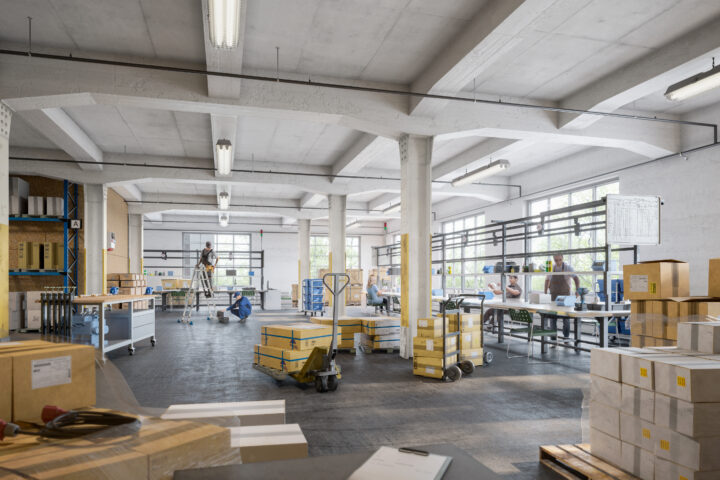
    The long-term planning envisages a division of the site into two parts: The “West” area near the Biberist East railway station comprises about one third of the total area and is to become an area open to the public with quiet commerce, services, leisure, culture and housing. No concrete residential projects are planned yet. But: “The future usage regulations allow for a residential share in the western area,” says Dominik Ulrich, project developer of HIAG Immobilien Schweiz AG. The eastern area towards Derendingen, on the other hand, will be transformed into a workplace area for the manufacturing industry.
    nightnurse.ch

    Access to the publicly accessible western area of the site is already from the southwest. In future, the triangular Papier-Platz will mark the beginning of the site. The square is enclosed by the striking existing building at Fabrikstrasse 1, which will be made fit for the planned transitional uses by mid-2023: On the ground floor, spaces between 160 and 1000 square metres will be rented to commercial and service providers. The rooms on the upper floors are ideally suited for commercial and storage space as well as studios. Offices are also available in the neighbouring building. “The transitional use of Building 1 is planned for up to ten years. The goal is to establish uses that will last in the long term,” explains Ulrich. The dismantling of the machinery was a prerequisite for opening up the area. The machines were successfully sold in recent years and transferred to new owners.

    The centre of the area, and thus the centre, is the square by the canal: Demolition work is currently underway here to create open spaces and breakthroughs in the hall structures. So far, 17,000 tonnes of material have already been removed. HIAG attaches great importance to sustainability: 14,000 tonnes of it will be processed into granulate on site and reused. The deconstruction work is scheduled to be completed by the end of this year. From mid-2023, the construction of a new modern building is planned, which will offer around 15,000 square metres of usable space for trade, production and offices. The first tenants are expected to move in by the end of 2024. According to Ulrich, concrete negotiations are currently underway with prospective tenants.
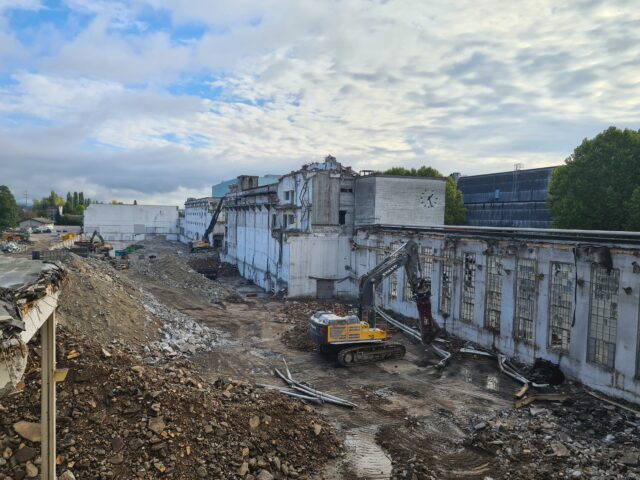
    Demolition work is currently underway in the middle of the site.
  • From paper to quarters

    From paper to quarters

    “The construction progress of the five buildings of the first construction phase is on schedule despite the pandemic,” says the person responsible for communication, Kathrin Sonderegger. In the southernmost high-rise building with condominiums (Papieri-Suites), the shell is already up to the fifth floor. In the former PM1-4 paper machine halls, new staircases, floor ceilings and apartment partition walls are being installed, as well as the renovation of the facade for the spacious loft apartments and studios (Papieri-Lofts). The new building with 160 rental apartments running parallel to this – 30 of them in the inexpensive range – is also well advanced in terms of shell construction. The Maschinengasse that is emerging between the two buildings is also slowly becoming recognizable. This will be animated at the end of 2022 by the various users of the one or two-story adjoining studios. Underground car parks 1 and 2 are currently under construction, and their parking spaces can be equipped with charging stations for electric cars in a future-proof manner.

    Planning of the second construction phase is well advanced
    The newly renovated and listed Lokremise was handed over to its new owner at the end of the year. Sonderegger says: "After the renovation of the workshop building, the second commercial conversion of a historic building on the site became a reality." At the end of the year, the construction of the new Ringstrasse (Papieri-Ring) began, which is part of the main development of the area and encircles the buildings of the second construction phase. As part of the second construction phase, in addition to the commercially used replacement building for the silo building, two high-rise residential buildings with 61 owner-occupied and 36 rental apartments will be built. Commercial space and a day-care center are planned on the ground floors. 64 micro-apartments complete the housing offer.

    CO2-neutral energy system
    Those responsible for the site development pursue the goals of the 2000 Watt Society. It is worth mentioning the sustainable energy supply of the Papieri area with a self-sufficient, CO2-neutral heating and cooling supply. A significant amount of electricity is generated by the company's own river power plant and photovoltaic systems on the building roofs. The construction of the energy center has been completed and the installation of the technical systems is in full swing. Also as part of the energy system, around 100 geothermal probes have already been drilled and installed to a depth of 320 meters. The energy system will be put into operation in autumn 2021, so that the existing houses and the buildings under construction can already be supplied with sustainable heat this winter. “In addition to the building permit, the canton's concession for the operation of the run-of-river power plant is available, the renovation of which will start in early summer 2021. The area of the former wastewater treatment plant (ARA) will be completely renatured, landscaped and supplemented with a small river arm ”, says Sonderegger.

    Huge interest
    The Cham Group is already seeing a great deal of interest from the population: "The residents find out what is happening on the site and we try to get updates accordingly," says Sonderegger. Unfortunately, the corona pandemic is currently making events such as the open construction site day in 2019 for residents and interested parties impossible. The reactions at the time were overwhelming. “The same thing can also be seen in sales: there is great confidence in our site development and the quarter that is being created here. The first apartments that came on the market at the end of 2019 were reserved within a week. Over 3000 people have subscribed to our newsletter. » One reason for the trust is that the Cham Group will be there as the owner and builder. The team has its offices on the site and is on the pulse of what's happening. Suggestions can be reacted to, feedback and inputs flow directly, and any reservations are defused.

    On June 4, 2020, when the foundation stone was laid, a time capsule was filled with objects typical of the time and built into the foundation of the first construction phase. It should document the building project for future generations. What was the most special item? Sonderegger explains with a laugh: “In view of the fact that we can't even have lunch in a restaurant at the moment, and many people miss this time together in the team, the current menu cards from the surrounding restaurants are items of particular relevance. Who knows whether meat will still be eaten in 100 years' time – then minced meat tats might be part of a forgotten meal. "