Tag: Photovoltaikanlage

  • At home close to nature

    At home close to nature

    Attention: In Niederweningen, 36 child-friendly terraced single-family houses with 4.5 and 5.5 rooms are being built on a plot of around 11,000 m². You have your own private garden, and the 21 spacious apartments in condominium ownership with 1.5, 3.5 and 4.5 rooms have a covered outdoor area or garden. The settlement is traffic-free and may only be entered in exceptional cases. An underground car park with direct access to the corresponding residential units and above-ground visitor parking spaces complete the unique living experience: “The sweet life moves into the Gupfengarten and a relaxing and carefree retreat is offered,” says Alexandra Schlegel, who is responsible for marketing this project at Steiner AG responsible for. “In terms of size and price, the project is perfectly tailored to young families and couples who want to fulfill their dream of owning their own home and prefer the charming village life to the big city.”

    The Gupfengarten is located in a quiet residential area on a slight slope in the southern part of Niederweningen. The colorful and local architecture characterizes the likeable character of this project and radiates a relaxed homeliness: “The project impresses with its individuality and personality, because here you can help determine the expansion and interior with the online configurator. From our carefully coordinated and harmonious range of materials and colors you can put together your very own combination according to your individual wishes. We have already selected four well-balanced and characterful designs for you as a suggestion – let yourself be inspired and simply use the configurator on our website www.gupfengarten.ch.»
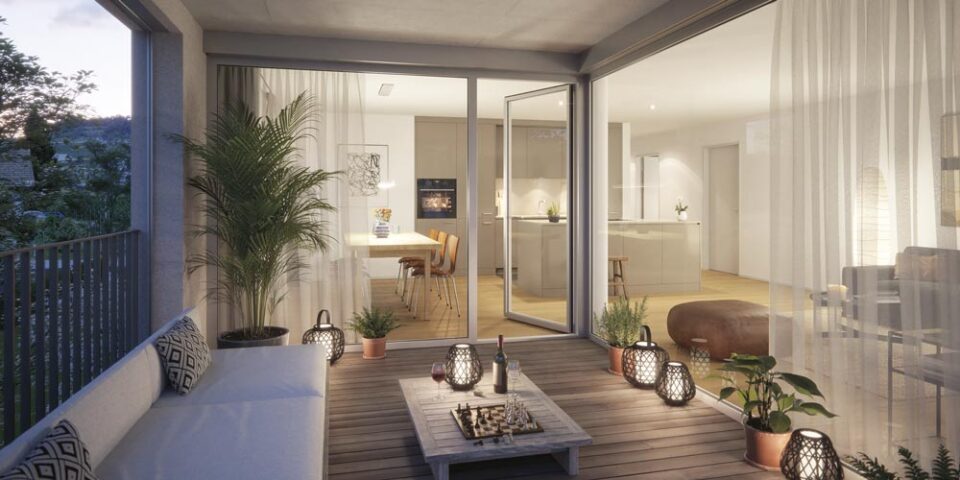
    Sustainability is a top priority in the Gupfengarten: the heat generation is almost entirely covered by renewable energy using a heat pump and geothermal probes as well as a photovoltaic system. In addition, an integral energy management system ensures an efficient and intelligent energy solution. The building shell is made of wood and achieves optimal thermal insulation values. The idea of sustainability is further implemented through the use of wood as a CO2-neutral and naturally renewable raw material. Living with a feel-good factor of 100, so to speak.

  • IJZ Schlieren receives a photovoltaic system and e-charging stations

    IJZ Schlieren receives a photovoltaic system and e-charging stations

    The municipal properties on Rütistrasse in Schlieren will be equipped with a photovoltaic system and e-charging stations by decision of the city council. In its most recent meeting, the city council for installation and operation signed the electricity works of the canton of Zurich ( EKZ ), according to the latest edition of the city council news. The IJZ innovation and start-up center Schlieren is housed in the building complex on Rütistrasse.

    The photovoltaic system will be installed on the roof of the commercial building. According to the city council news, EKZ will install 1080 panels on an area of 4200 square meters. They should produce an output of 355,000 kilowatt hours per year.

    Six charging stations for electric vehicles will also be set up. They are not only available to employees and visitors of the IJZ Schlieren. Outside business hours, they can also be used by the general public.

    For the project, it is envisaged that the electricity works of the Canton of Zurich will finance and install the systems on the two main roofs at Rütistrasse 12/14 and 16/18 as well as an additional six e-charging stations along the Rütistrasse 12/14 facade and for 20 years with one Operate full guarantee. After the end of the contract period, the installations become the property of the property owner.

    The total costs are given as around CHF 554,520.

  • Nüssli puts a large photovoltaic system into operation

    Nüssli puts a large photovoltaic system into operation

    Nüssli has put its photovoltaic system into operation. With its 8000 square meters, this is the fourth largest solar system in the canton of Thurgau. It is operated by the electricity company of the canton of Schaffhausen (EKS). According to a media release , this was also the impetus for the construction of this plant. The 1.5 megawatt hours of solar power produced annually by the approximately 4,100 modules are fed into the network of the Hüttwilen power station .

    This is two and a half times what the plant needs to be fully self-sufficient. The surplus is available to more than 300 four-person households in the area.

    "We realize sustainable or even self-sufficient buildings for our customers," Nüssli CEO Andy Böckli is quoted as saying. “With the new system, we are now taking on even more responsibility on our premises. We are happy to go one step further towards a sustainable future together with EKS and to be able to supply ourselves with electricity.”

  • Urner Kantonalbank – reliable partner for an attractive economic area

    Urner Kantonalbank – reliable partner for an attractive economic area

    The new headquarters of the Urner Kantonalbank (UKB) near the cantonal train station was occupied at the end of March 2022. The meticulously prepared rein action over three days was the long-awaited conclusion of a construction phase of around two and a half years. Various tenants of the new, five-storey service building have now also moved in. The occupancy rate of over 70% when the building was completed confirms the successful development of the location in the Uri valley floor and beyond. With the modern and attractive meeting place, the Urner Kantonalbank makes an important contribution to the new gateway to the canton of Uri in various roles. She is the client of the multifunctional building, an investor who sets economic impulses, a landlord who creates space for new companies and an employer who enables a modern and innovative working environment.

    UKB new building – lots of flexibility for everyone
    With the selected column-free construction of the entire ground floor and a glass proportion of the facade of 75%, which gives the workplaces plenty of light, the new building appears transparent and lively. The service building is certified according to the Minergie standard. In addition, the new building is connected to the district heating network of the Uri heating plant. The photovoltaic system on the roof will produce around 61,000 kWh of electricity, which corresponds to around 15 percent of the building’s total energy requirements. The flexible room layout on each floor allows for modern forms of work over a long period of time. At the same time, the flexibility promotes exchange, synergies and innovation. On the 1st floor there is a multifunctional hall for up to 99 people, which can be used for events and training not only by the permanent tenants. Of the total usable area of 6240 m², only a small area on the ground floor and 1st floor is still open for rent.

    Innovation biotope Uri – promotes innovation and education in the canton of Uri
    In recent years, a lot of work has been done in the canton of Uri to develop an attractive infrastructure for the further development of the canton in order to generate the best possible conditions for a growth market in the canton. With the upgrading of the Altdorf train station to a cantonal train station, the locational favor of the canton of Uri for new service, high-tech and commercial uses will be increased considerably, and many other opportunities for new economic impulses will arise.

    With the innovation biotope on the 3rd floor, the UKB and its partners from business, administration and politics are realizing a location for innovation and education. This is intended to serve as a nucleus for promoting innovation, education and research, but also as an organization for networking and procurement of resources for innovative companies covering the entire canton.

  • Coop builds new solar system on shopping center

    Coop builds new solar system on shopping center

    The retail cooperative Coop has installed a photovoltaic system on the roof of the Friborg Süd shopping center. According to a press release , Coop has installed a total of 60 solar systems on the roofs of its supermarkets, shopping centres, production facilities and distribution centers since 2016. The commitment is part of a new sustainability strategy for the Basel-based company.

    At 4,300 square meters, the new facility in Villars-sur-Glâne is one of the largest at Coop to date. All systems together result in an area of 115,000 square meters of solar cells. They produce 19 million kilowatt hours of electricity a year. According to the information, this corresponds to the annual electricity consumption of 5800 households.

    Coop uses the electricity to supply its own infrastructure in the sales outlets, including refrigerated shelves and lighting. The Friborg South location uses 90 percent of its solar power.

    In the future, Coop wants to switch to 100 percent electricity from renewable energy sources. As part of its sustainability strategy, the cooperative also wants to reduce its direct CO2 emissions by 20 percent by 2026. Furthermore, Coop wants to expand the transport of goods by rail and implement projects to reduce carbon dioxide along the supply chain.

  • digitalSTROM presents new products

    digitalSTROM presents new products

    According to a press release , digitalSTROM AG from Schlieren will present two innovations at the Light + Building 2022 trade fair. On the one hand, the networking specialist is presenting the integrated solution for access control. According to the announcement, this consists of the fully integrated Smart Video Doorbell and the interactive 10.1″ display, dS-Touch. With the video doorbell, residents can always keep an eye on who is ringing the doorbell. With the dS-Touch display, access control is integrated into the all-in-one solution from digitalSTROM for the first time. This includes fully centralized automation and control of lights, shutters, blinds, heating and ventilation systems and buttons.

    The dS Energy extension, which is also new, enables residents with a photovoltaic system to improve their energy balance. The self-generated energy is thus routed to the boiler or heat pump via an intelligent control system. This will also significantly reduce dependency on the electricity company, according to the statement.

    For the first time since 2018, digitalSTROM will be taking part in the trade fair from October 2nd to 6th in Frankfurt in order to present its range of smart home solutions and innovations to an international audience. “We benefit from the growing dynamics of home automation and the steadily increasing interest in digitalSTROM solutions,” Peter Lambrechts, Executive Chairman at digitalSTROM, is quoted as saying. In the difficult years for the entire industry, his company invested heavily in research and development and was able to present new products and solutions at Light + Building.