The international energy company Eaton and the agrivoltaics specialist Insolight, also based in Lausanne, have agreed on a strategic collaboration to optimise the use of solar power in agriculture. According to a press release, Eaton’s experience in intelligent energy management will be combined with Insolight’s solar technologies. In particular, it will be investigated whether Insolight’s photovoltaic systems can be coupled with Eaton’s battery storage systems (BESS) and charging infrastructure for electric vehicles. Insolight plans to install more than 100 projects with a capacity of 300 megawatt peak by 2026. For its part, Eaton intends to support the projects with technical expertise and product training.
Both companies will also support the farmers involved in the integration, commissioning and ongoing maintenance of new sustainable energy systems. Insolight’s agrivoltaic systems not only generate electricity that can be used on the farms, but also protect plantations against wind, hail and heavy rain.
“This collaboration with Eaton represents an important milestone in our endeavour to bring innovative agrivoltaic solutions to the market,” said Luiggino Torrigiani, Head of Marketing and Partnerships at Insolight, in the press release. “By partnering with Insolight, we can extend our capabilities to the agrivoltaic sector, where energy efficiency can have a real impact alongside agricultural productivity,” added Anne Lillywhite, Senior Vice President and General Manager for Energy Transition, Digital and Services at Eaton.
Building Director Martin Neukom, Education Director Silvia Steiner and ZHAW Rector Jean-Marc Piveteau gave the go-ahead for the construction work to expand and modernise the School of Engineering at the ZHAW on 13 September. The ZHAW is one of the leading universities in Switzerland with over 14,000 students, according to a press release. However, some of the existing buildings on the site of the former technical centre in Winterthur no longer meet today’s requirements. In addition, the number of students continues to grow. Campus T will therefore be modernised and expanded in several stages over the next few years.
In the first construction phase, two new five-storey laboratory buildings will be built behind the historic technical centre. They will provide urgently needed space for teaching, research and development. Various test rooms as well as a publicly accessible canteen and cafeteria will be created there. The new buildings will be connected to the district heating network of the city of Winterthur and equipped with photovoltaic systems.
As part of the first construction phase, the Eulach will also be ecologically upgraded with a public, near-natural park and flood protection will be expanded, according to the press release. Two new bridges will connect the old town and Campus T with the Büelrain cantonal school and the surrounding residential neighbourhood.
The existing TB building will be dismantled by November. At the same time, the excavation pit for the smaller TT laboratory building will be dug. Work will then begin on the shell of the first new building, which is scheduled for completion in 2027. The second new building should be ready for occupancy in 2029.
CKW wants to protect operators of small solar plants from very low market prices, especially in summer, and help them to amortise the plant. To this end, the Axpo subsidiary is already applying the minimum remuneration for solar power planned by the federal government from the billing for the second quarter of 2024, CKW announced in a press release. Operators of solar plants with an output of up to 150 kilowatts are expected to receive a minimum price for their solar power from the beginning of 2025 if the reference market price set by the Swiss Federal Office of Energy is particularly low.
CKW is basing the amount of the minimum remuneration currently paid on the draft ordinance. It provides for different minimum remuneration per kilowatt hour depending on the size of the plant. In addition, the Lucerne-based energy service provider also voluntarily acquires a guarantee of origin for solar power. This amounts to 2 centimes per kilowatt hour for small solar plants and 1 centime per kilowatt hour for plants with an output of 100 kilowatts or more.
In the press release, CKW also advises operators of photovoltaic systems to optimise their own consumption. This is particularly worthwhile in phases with low reimbursements. In addition to its own energy management solutions and battery storage systems, CKW also recommends joining forces with neighbours to optimise self-consumption. The new Electricity Act, which was approved by voters on 9 July, also opens up further options such as the formation of local electricity communities or virtual associations for self-consumption.
Alpiq has announced the sale of seven rooftop photovoltaic plants to PS Panneaux Solaires SA. The Lausanne-based electricity provider wants to bring more solar energy into the energy grid, which is why the power plants are being sold as a unit, according to a press release. At their locations in the cantons of Fribourg, Solothurn and Vaud, the plants have a total capacity of 5.5 megawatts peak.
Alpiq would like to concentrate more on its core business of highly flexible power plant solutions, according to the press release. The planning, construction and operation of photovoltaic plants “that are not closely related to the core business” will therefore be discontinued. “The challenge is to integrate weather-dependent electricity production from wind and solar energy into the energy system,” said Amédée Murisier, Head of the Switzerland business division and member of the Alpiq Executive Board. PS Panneaux Solaires SA, the operating company of the Gefiswiss Energy Transition Fund, is the ideal “buyer to continue operating the seven plants, which will continue to produce solar power for many years to come”, it says.
The energy transition requires flexible solutions for greater security of supply. Alpiq wants to use its portfolio to promote the use of renewable energies as well as the expansion of storage solutions and the generation of winter electricity. With its portfolio of highly flexible power plants, the company says it sees itself as a “pioneer of the energy transition”.
Alpiq is primarily involved in hydropower plants, such as the Nant de Drance and FMHL pumped storage power plants. Their efficient large-scale batteries with a capacity of 1,400 megawatts are an ideal means of feeding the growing proportion of photovoltaic electricity into the grids as short-term daily or weekly storage.
Das Projekt «Rolf-Liebermann-Weg» entwickelt von Mettler Entwickler AG mit der Bauherrschaft Asga Pensionskasse, profitiert von seiner einmaligen Lage am Stadtrand von Zürich, zwischen dem Schulhaus Staudenbühl und den idyllischen Grünflächen des Hürst-Gebiets. Die Hanglage eröffnet spektakuläre Ausblicke auf den Zürichberg und die Alpen, während die gute Anbindung an das Verkehrsnetz und die Nähe zu Einkaufs- und Dienstleistungszentren urbanen Komfort bieten.
Die geplante Wohnsiedlung zeichnet sich durch ihre L-förmige Anordnung aus, die grosszügige Freiräume für Gemeinschaftsaktivitäten und individuelle Entfaltung lässt. Der vielfältige Wohnungsmix reicht von kompakten 1½-Zimmer-Wohnungen bis zu geräumigen 5½-Zimmer-Wohnungen, um ein breites Spektrum an Bewohnerinnen und Bewohnern anzusprechen – von Singles über Senioren bis hin zu Familien.
Architektonisch setzt das Projekt auf einen innovativen Hybridbau. Eine Kombination aus tragendem Mauerwerk im Inneren und einer ästhetisch ansprechenden, hinterlüfteten Holzfassade. Betonelemente in den Untergeschossen und den Erschliessungskernen sowie die Wohnungstrennwände garantieren Stabilität und Privatsphäre. Die begrünten Dächer fördern die Biodiversität und das Mikroklima der Siedlung und werden durch die Integration von Photovoltaikanlagen ergänzt, die nachhaltige Energiegewinnung unterstützen.
Mit der geplanten Fertigstellung Ende 2027 setzt der «Rolf-Liebermann-Weg» neue Massstäbe für modernes, nachhaltiges Wohnen in Zürich, indem er die Balance zwischen Natur und städtischem Leben meisterhaft gestaltet.
The city administration of Lucerne wants to free itself from fossil fuel consumption by 2035. According to a press release from the city, the first step is to replace around 200 service vehicles from petrol and diesel with electric drives by 2030. By the target year of 2035, the heating systems and hot water supplies in the city’s 150 or so properties are also to be converted from oil or gas firing to renewable systems such as heat pumps. Photovoltaic systems are to generate electricity on the roofs of these buildings. This could cover 35 to 40 per cent of the city’s current demand.
In a recent report, the administration was already able to point to 65 converted properties in the conversion of heating systems that began five years ago. The aim of the heating system conversion is to emit a total of 3300 tonnes less CO2 from 2035. The costs of the conversion are estimated at around CHF 60 million.
“We are not only calling on other property owners to take action, we are also getting involved ourselves,” Katja Dürst, Head of the Environmental Protection Department, is quoted as saying in the press release.
Stadtwerk Winterthur is ready to start building four more photovoltaic systems. They are to be installed on the roofs of the Winterthur theatre, the Wülflingen swimming pool, the Mattenbach primary school and the temporary Tössfeld gymnasium, the municipal energy and water supplier announced in a press release. Together, the four new systems are expected to generate around 254 megawatt hours of electricity per year.
Stadtwerk Winterthur is responsible for the construction and operation of the plants. They will be financed from the city of Winterthur‘s 90 million framework credit, which was approved by the Winterthur electorate in September 2012. The city council is providing a total of CHF 707,000 from this pot for the construction of the four specific plants. The expansion of solar energy serves the city of Winterthur’s goal of achieving net-zero CO2 emissions by 2040.
Two consortia from the cantons of Zurich and Basel were selected from among the applicants, which impressed with their expertise and innovative approaches. The awarding of the projects to the consortium of Elektrizitätswerke des Kantons Zürich (EKZ), Helion AG and mha gmbh as well as the consortium of Industrielle Werke Basel (IWB) and TNC Consulting AG (TNC) marks a decisive step towards promoting renewable energies in the region.
In particular, the initiative of the EKZ-Helion-mha consortium to erect large-scale solar carports at cantonal motorway service stations represents a double innovation.
In addition to producing clean energy, these carports help to reduce the use of air conditioning by providing shade. With a planned capacity of almost 8.5 megawatts, they are aiming to realise ten photovoltaic systems and are also exploring the possibility of installing solar panels on noise barriers, retaining walls and a bridge.
The IWB-TNC consortium is focussing on the installation of almost 1.8 megawatts of photovoltaic systems in the Bernese Oberland region, distributed across various structures such as retaining walls and bridges. The feasibility of these projects is ensured by comprehensive studies.
The first planning steps for these pioneering solar installations will begin in April 2024, underlining the canton’s commitment to the national Energy Strategy 2050 and to achieving the net-zero target by 2040. This selection process emphasises the Canton of Bern’s desire to take a leading role in the implementation of energy solutions and at the same time promotes the participation of local stakeholders in the energy transition.
According to a press release , the Valais energy supplier Oiken andStuder Innotec are launching an innovation project to utilise photovoltaic systems and battery storage for the general power supply through a virtual power plant. The aim is to make the best possible use of and optimise variable and unplanned electricity generation in private homes or neighbourhoods. The project, which is financially supported by The Ark Foundation, is being developed in collaboration with the Icare Institute in Sierre VS. The test phase will begin in 2024.
The aim of the project is to bring together small energy producers with the combined output of a large power plant to create a virtual power plant (VPP), according to the press release from Oiken. The accelerated development of decentralised and unplanned energy generation from photovoltaic systems (PV systems) in “residential power plants” is fundamentally changing the management and control of the electricity grid.
According to solar statistics, PV systems with a total capacity of 4.7 gigawatts were installed in 2022, producing 3.8 terawatt hours or 6.7 per cent of Switzerland’s electricity consumption. The proportion of solar energy generated already exceeds the proportion of other energy sources such as gas, hydropower or biomass during the day in summer.
At a local level, such as single-family homes, the aim is to improve self-consumption and optimise the feeding of electricity back into the grid by making the best possible use of batteries. At the next level up, such as a neighbourhood, the project focuses on the development of intelligent energy management for several systems. At the level of the region or the DSO (distribution network operator), the aim is to evaluate and combine local flexible power generation using a VPP solution.
AEW Energie AG has installed a photovoltaic (PV) system on two pitched roofs of Swisspearl Schweiz AG, formerly Eternit (Schweiz) AG, in Niederurnen. According to a press release, 3144 solar panels have been installed on an area of 6282 square metres. The system is operated under a contracting model: Swisspearl Switzerland receives a preferential price for the electricity produced on site in return for providing the roof area. The contract runs for 30 years.
The plant on the production hall of Swisspearl, a supplier to the construction industry, produces 1270 megawatt hours, which corresponds to the electricity requirements of 290 households. 85 per cent of the electricity produced is consumed on site and the rest is fed into the power grid. This installation at Swisspearl Schweiz AG expands the AEW portfolio to 81 systems with a total peak output of 25.7 megawatts.
“The PV system provides Swisspearl Schweiz AG with ecological, local and cheap electricity without having to worry about the photovoltaic system,” said René Wüst, Project Manager at AEW Energie AG, in the press release. “This allows them to concentrate on their core business. The new hall offers ideal conditions for the construction and thanks to the early involvement of all those involved and the constructive cooperation, the installation went smoothly.”
tb.glarus is also enabling tenants to participate in the expansion of solar energy. As the Glarus-based utility announced, it commissioned the system at the Stampfrüti stable on 23 November. This is the company’s sixth solar community and the largest to date in the canton of Glarus.
With an area of 707 square metres, the system is expected to generate 128,000 kilowatt hours of electricity per year. According to tb.glarus, 95 per cent of the 707 solar panels have already been sold. The one-off investment in the Stampfrüti plant offers tb.glarus customers a fixed credit for solar power over 20 years.
The six solar communities have a total output of 519 kilowatt peak and generate around 490,000 kilowatt hours per year on an area of over 2500 square metres. tb.glarus is looking for further roof areas that are suitable for solar communities.
Nach der Stilllegung des Rigips-Areals in Heimberg öffnet sich eine seltene Gelegenheit zur Neugestaltung. Das Projekt «Louelipark» nimmt diese Chance wahr und zielt auf ein ausgewogenes Quartier, das Wohn-, Gewerbe- und Freiräume intelligent kombiniert, wodurch Heimberg an Attraktivität und Mehrwert gewinnt.
Hinter dem ambitionierten Vorhaben stehen die Berner Pensionskasse und die Frutiger AG. Ihre Vision? Die Transformation des ehemaligen Industrieareals in bis zu 300 Wohneinheiten, ergänzt durch Gewerbeflächen, die insgesamt ca. 4.000 Quadratmeter umfassen und Platz für etwa 100 Arbeitsstellen bieten. Obwohl der Schwerpunkt nicht auf Handelsbetrieben liegt, werden Handwerksunternehmen, Büros und produzierende Gewerbebetriebe in den Räumlichkeiten eine neue Heimat finden.
Die strategische Lage des Areals, nur einen Steinwurf vom Heimberger Bahnhof entfernt und direkt an der Stockhornstrasse gelegen, stellt sowohl für Anwohner als auch für Geschäftstreibende eine unschlagbare Lage dar. Dank seinen grosszügigen Aussenräumen und den unterschiedlichen Nutzungsmöglichkeiten weist das Quartier Zentrumsqualität auf und stellt damit einen Mehrwert für die Nachbarschaft und die ganze Gemeinde dar. Das Herzstück bildet der grosse Quartierpark, der zwischen dem Gewerbebau und den Wohnbauten liegt. Entlang des Loueligrabens bietet er Erholungsraum, Spielflächen und Plätze zum Verweilen. Das durchlässige und grüne Quartier bietet seinen Bewohnenden höchste Lebensqualität und ein naturnaher Lebensraum für Tiere. Im Betrieb nutzt der Louelipark erneuerbare Ressourcen, Photovoltaikanlagen produzieren vor Ort Strom und die Wärme wird aus dem Grundwasser gewonnen.
Weiter hervorzuheben ist der partizipative Ansatz: In der Phase der öffentlichen Mitwirkung konnten diverse Stakeholder ihre Meinungen und Anregungen in den Planungsprozess miteinbringen.
Die kantonale Vorpüfung ist der kommende Planungsschritt. Voraussichtlich im Sommer 2024 wird das Projekt öffentlich aufgelegt. Die anschliessende Abstimmung über die Überbauungsordnung ist ca. im Frühjahr 2025 vorgesehen. Der «Louelipark» markiert einen Meilenstein in Heimbergs Entwicklung, wobei eine hohe Lebensqualität und nachhaltige Werte im Mittelpunkt stehen.
Insgesamt verdeutlicht das Projekt einen fortschrittlichen Ansatz in der Gemeindeentwicklung von Heimberg, indem es Wohn-, Gewerbe- und Freiflächen ideal miteinander verknüpft und so zur Steigerung der allgemeinen Lebensqualität beiträgt.
The Swiss Solar Energy Society(SSES) and the Association of Independent Energy Producers(VESE) have launched the new SolEctif platform. According to a press release, the project aims to support solar cooperatives both with their foundation and with the next step, professionalisation.
Solar cooperatives in Switzerland play an important role in realising the energy transition with renewable energies. However, these organisations are mostly run on a voluntary basis and often face major financial or ownership problems that prevent them from installing and operating effective systems. With the support of SwissEnergy, SSES and VESE now want to accompany solar cooperatives on their way forward. With the SolEctif project, the partners are supporting the cooperatives in setting up new businesses, professionalising their operations and finding suitable roof areas.
The centrepiece of the platform is the handbook “How to set up and run a solar cooperative”, which can be downloaded free of charge or ordered as a print version for a fee. Here, interested parties can find out which obligations and processes need to be observed when setting up a cooperative. In addition, the first starter workshops will be held in Zurich Oerlikon in May 2024. From January 2024, interested parties will receive the new SolEctif newsletter every six months.
Rhenus Switzerland is putting a total of 2511 photovoltaic modules into operation on the roof of the logistics building in Schaffhausen, which has been fitted with a special film. This system is expected to generate around 1,100,000 kilowatt hours of electricity. According to a press release, this is roughly equivalent to the consumption of 220 households.
The building was renovated in just under four months. The solar power generated on 6700 square metres will be fed directly into the Rhenus grid. Rhenus intends to use this to operate three buildings with office, warehouse and rental space. This will ensure that the logistics areas with a total of 23 loading bays and over 15,000 pallet spaces as well as block storage and picking areas are supplied with energy.
“When it comes to sustainable logistics, we at the Rhenus Group prefer to be two steps ahead,” said Andreas Stöckli, CEO of Rhenus Alpina. “We are laying the foundations for more efficient and climate-friendly goods handling with the latest addition to our photovoltaic system in Schaffhausen and also at logistics centres in Basel and Spreitenbach. We need innovative solutions that not only benefit the environment and society, but also our customers.”
The German Rhenus Group is one of the world’s leading logistics service providers with 39,000 employees at 1120 sites and an annual turnover of EUR 8.6 billion. The company has 15 sites in Switzerland.
The Umwelt Arena in Spreitenbach is presenting a special exhibition on solar power together with the electricity utility of the city of Zurich(ewz). According to the announcement, the special exhibition, which will be open all day from 3 November to 28 April 2024, will focus on the history of the development of solar power, the function and installation of solar power and the potential of the sun to generate electricity.
The ewz special exhibition shows the huge potential for climate-friendly solar power production that lies dormant on rooftops and how fundamentally uncomplicated it is to take action yourself to have a solar system installed, according to the press release. However, there are still reservations and outdated myths about the construction and utilisation of solar systems. The exhibition therefore sheds light on various aspects, including, for example, how a solar system and flat roof greening can ideally complement each other. On a journey of discovery, visitors are given information about the development of solar energy over the last few decades. They can also take part in a solar quiz.
The Umwelt Arena would like to point out that those particularly interested in the topic of solar power and visitor groups such as companies, clubs or schools can combine a visit to the special exhibition with a guided tour of the SonnenTrail. The possible uses of solar thermal energy and photovoltaics are presented.
According to the Umwelt Arena press release, guided tours must be booked in advance by telephone or online.
Mit dem Solarfaltdach «HORIZON» hat dhp ein Produkt entwickelt, mit dem bestehende Infrastrukturflächen für die Solarstromproduktion genutzt werden können. Dies bedeutet, dass die darunter liegende Fläche weiter ohne Einschränkung genutzt werden kann, während gleichzeitig Solarstrom produziert wird. Anwendungsbereiche für das Solarfaltdach sind Kläranlagen, Parkplätze, Logistikareale und anderes mehr. Die Stromeigenversorgung dieser Anlagen kann dank «HORIZON» deutlich erhöht werden.
Ein Solarfaltdach für 45 Autobahnrastplätze Die Kerntechnologie ist eine ästhetische Leichtbaukonstruktion. Diese ist nicht nur platzsparend, sondern auch ökologischer, da bis zu 50% weniger Material verbaut wird. Das Einfalten der Modulbahnen verhindert das Einwirken von Kräften, die durch Sturm, Hagel und starken Schneefall entstehen. In schneereichen Regionen fallen damit Winterverluste weg, denn die Module bleiben schneefrei und produzieren mit den ersten Sonnenstrahlen wieder Strom.
Vor kurzem wurde bekannt, dass das Solarfaltdach über 45 Autobahnrastplätzen in der Romandie und in den Kantonen Wallis und Bern installiert werden soll. Den Zuschlag erhielt das Solarfaltdach deshalb, weil es grosse Höhen über Boden (>6 m) und weite Stützenabstände ermöglicht. Dies ist wichtig für grosse Fahrzeuge wie LKW, Sattelschlepper oder Cars, die die Rastplätze nutzen.
Bereits neun Projekte in Deutschland «Das Interesse aus dem EU-Raum ist gross und fast täglich kommen Anfragen aus aller Welt in Zizers an», sagt Gian Andri Diem, Co-Founder und geschäftsführender Partner von dhp. Stand heute sind 16 Schweizer Solarfaltdächer realisiert, davon drei im Kanton Graubünden. In Deutschland werden dieses Jahr 2023 die ersten Projekte in Betrieb gehen. Rund 40 weitere Projekte stehen in unterschiedlichen Planungs- und Ausführungsstadien. Das Solarfaltdach wurde unter anderem ausgezeichnet mit dem Watt d’Or, dem Schweizer Solarpreis und dem Schweizer Zukunftspreis.
Despite bottlenecks in skilled labor and blocked supply chains, 58 percent more photovoltaics were installed in 2022 compared to the previous year. Swissolar points to the figures now published by the Swiss Federal Office of Energy in a media release. According to the figures, solar modules with an output of 4.74 gigawatts were installed in Switzerland at the end of 2022. This covered almost 7 percent of Switzerland’s electricity demand over the course of the year. This production was equivalent to half of the Gösgen nuclear power plant.
This amount of solar power must be increased sevenfold in the next twelve years, according to the association: “With the overcoat decree currently being discussed by parliament, it must be possible to create the necessary framework conditions for this.” That is quite realistic, also with the help of the solar express law for the accelerated building of alpine plants. On suitable roofs and facades alone, 70 terawatt hours could be generated annually. That would be twice what the National Council and Council of States have set as a target for renewable energies by 2035.
Demand for battery storage has also more than doubled compared with the previous year. With the storage capacity of all the battery storage systems installed to date, 35,000 households could be supplied with electricity for a day, according to the data.
For the current year, Swissolar expects a photovoltaic expansion of 20 to 30 percent. This is expected to pick up further momentum from October 1 with the new vocational apprenticeships of Solar Installer:in EFZ and Solar Assembler:in EBA. “Now,” says Swissolar Managing Director Matthias Egli, “we need a clear signal from politicians that solar energy offers long-term career prospects.”
AMAG Zuchwil/Solothurn has installed and commissioned a photovoltaic system on the roof of the VW and Škoda building. On an area of 726 square metres, 367 solar panels are to produce 155,978 kilowatt hours of energy per year. With the same performance data, the garage expects to have a second system installed on the roof of its Audi and Seat building by the end of the year.
“The fact that we are now also one of the AMAG businesses that can produce our own electricity with a photovoltaic system not only makes us proud, but also more sustainable and independent,” AMAG Solothurn’s managing director Raphael Biberstein is quoted as saying in a media release. “We need the electricity primarily for customer vehicles and for our own fleet.”
By 2025, around 75,000 square metres of AMAG’s roof surface will reportedly be equipped with solar modules. This is roughly equivalent to the area of ten football pitches. This means that the car dealer will produce more than 20 per cent of its current electricity consumption itself.
To the north-east of Neuhegi town centre, a Minergie-ECO certified commercial building called FAHRWERK will be completed in the “Hegmatten” commercial and industrial district by winter 2024. As the name suggests, the new building will have floors that can be driven on as far as possible. Flexible rental space of around 10,500 square metres is planned. The spaces will be rented from 1,500 square metres. A modern and spacious lobby is planned for the reception of guests. Shared spaces are also planned on the attic floor with bookable meeting rooms.
Thanks to a floor load capacity of up to 2 tonnes per square metre and ceiling heights of 4 to 5 metres, and even up to 9 metres on the ground floor, FAHRWERK is suitable for a wide range of industries. Conceivable, for example, are furniture factories, workshops and handicraft businesses, showrooms or tech labs. Although the focus is on the manufacturing industry, workshops or companies from the handling logistics and automotive sectors, great importance is attached to a high degree of representativeness. Trucks will find spacious delivery zones on the ground floor. In addition, 100 car parking spaces and 66 bicycle parking spaces are planned.
The property is optimally connected to the A1 via the “Oberwinterthur” motorway junction. The accessible new commercial building can be easily reached by bus via the “Technopark” bus stop. It is also in the immediate vicinity of Oberwinterthur railway station. By S-Bahn, the journey time from Oberwinterthur station to Winterthur station is just three minutes. The nearby Eulachpark – Winterthur’s largest and youngest park – is ideal for a relaxing lunch break in nature.
The Neuhegi urban development area has already been transforming itself for several years and is to become a second urban centre of Winterthur. Already today, internationally active high-tech companies are located here.
HIAG Immobilien Schweiz AG is responsible for the development and letting of FAHRWERK.
AEW Energie AG has installed and commissioned a 13,000 square metre solar plant with 5000 modules in Rheinfelden. It is located on the roof of the Isemeyer site and is one of the largest in the energy provider’s portfolio.
According to a press release, it generates about 1.9 gigawatt hours of solar power annually. About a third of this is taken directly on site by the leased companies. The rest is fed into the AEW grid.
The plant is operated on a contracting model: it belongs to AEW, which pays for the installation and maintenance costs. In return for providing the space, Soluma AG as the owner will receive a contractually agreed fixed price from AEW for the electricity drawn from the roof for the next 30 years. There are no additional costs for the tenants either. Before the installation of the 5,000 solar panels, the roof of the industrial halls was additionally insulated at AEW’s expense, thus improving the energy efficiency of the building envelope.
Last but not least, the environment also benefits, says AEW. “Because the amount of this installation alone could supply 420 four-person households with electricity for an entire year.”
Nine of Daetwyler ‘s 27 production sites already cover their electricity needs entirely from renewable energy sources, the Uri-based industrial group says in a statement. Most of the energy is sourced from local electricity suppliers. However, Daetwyler also produces its own solar power for self-consumption at six locations.
A start was made in 2021 on the roofs of the Indian plant in Kesurdi. Some 8000 square metres of solar panels installed there will reduce the Group’s CO2 emissions by 1500 tonnes annually, Daetwyler writes. Last year, another five production sites in Switzerland, Italy and Germany were equipped with photovoltaic systems. In total, the systems at the six sites are expected to supply around 4.4 gigawatt hours of solar power annually for Daetwyler’s own consumption.
The switch to electricity from renewable sources, combined with measures to improve energy efficiency, has led to a 4.7 percent reduction in CO2 emissions in 2022 compared with the previous year. Daetwyler aims to achieve climate-neutral production worldwide by 2030. To this end, the Group is currently examining further projects, such as the installation of solar cells on the façade of the plant in Schattdorf UR. Daetwyler also intends to increase the share of electricity from renewable sources at the sites of Xinhui and QSR, acquired in 2022.
According to a press release , Younergy Solar wants to democratize solar energy and is issuing a green bond worth CHF 5 million. Younergy’s business model is understood as democratization. The Lausanne-based company installs photovoltaic systems on the roofs of its customers and assumes the entire costs of installation, maintenance and monitoring. As a result, customers – from single-family homes to large companies – produce their own electricity without any upfront investment and instead only pay for the energy produced. When the amortization period has expired, the system becomes the property of the customer. This means that everyone can generate and use solar power regardless of their personal budget.
“We are the only ones in Switzerland that cover single-family homes as well as buildings with larger roofs. That was the key to our rapid growth,” Pedro Miranda, CEO and co-founder of Younergy, is quoted as saying. “The energy transition is mainly taking place at the local level. That’s why we want to expand this solution further,” Miranda continues. The sharp increase in energy prices and the uncertain energy supply in connection with the geopolitical situation required local supply. Electricity prices are likely to rise by more than 20 percent in Switzerland in 2023. With the Younergy solution, on the other hand, significantly lower prices are possible for private individuals and companies. The demand is therefore increasing sharply.
So far, the company, which was founded in 2015 by a group of solar energy experts at the Swiss Federal Institute of Technology in Lausanne ( EPFL ) and is funded by the Swiss Federal Office of Energy ( SFOE ), already operates 480 such photovoltaic systems throughout Switzerland.
Enormous solar potential After a steady increase over the years, photovoltaics recorded a record increase in 2020. According to the "Solar energy statistics" of the Federal Office of Energy (SFOE), around 118,000 photovoltaic systems with an output of almost 3 gigawatts were installed at the end of 2020. The strong market growth continued in 2021, so that according to Swissolar, photovoltaics (PV) today covers more than 6 percent of Switzerland's electricity requirements. Experts assume that this trend will continue, not least in view of the efforts towards much more energy independence.
Ecological and economic advantages Photovoltaic systems bring a whole range of advantages for owners of real estate portfolios. On the one hand, they can protect themselves against rising electricity prices. On the other hand, they already meet possible future self-production specifications today. Also with regard to subsidies, new rules will make the production of solar power more attractive in the future. In addition, portfolio owners with their own solar systems benefit from a clear reputation advantage.
In most cases, PV power from your own roof is cheaper than power from the grid. The fact that power consumption due to heat pumps and electromobility will continue to rise in the future contributes to the financial attractiveness of PV systems. Improving the ecological balance sheet is also becoming increasingly important, because sustainability aspects are part of the strategy of more and more companies. Furthermore, PV systems are also interesting because they increase the value of real estate. If the photovoltaic systems produce more electricity than can be consumed on site, it is possible to use the solar power in other properties.
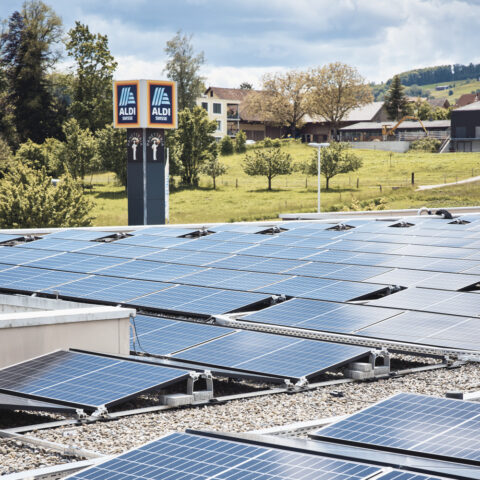
In the ALDI SUISSE solar project, for example, sustainability and cost-effectiveness play a key role. In just over a year, ewz equipped 68 store roofs between Romanshorn and Geneva with photovoltaic systems. ALDI SUISSE uses most of the solar power itself for its own branch operations. Thanks to the large PV systems, the implemented solution enables a high solar yield with an average self-consumption of 55 to 60 percent.
High self-consumption increases profitability There is already a heat pump in around 90 percent of new buildings, and new registrations of electric cars are continuing to rise sharply. However, heat pumps and electric vehicles are only really low in CO2 if they use renewable electricity. The combination with a photovoltaic system therefore makes sense: Solar power reduces CO2 emissions, and high self-consumption increases the profitability of the PV system. This is because the production costs for solar power are lower than the electricity tariff for households and because the energy suppliers pay a low tariff for the solar power fed into the grid.
A good way of using a large part of the solar power yourself is to organize several end users in a group for self-consumption (ZEV). These are possible both in rental properties and among property owners. The degree of self-consumption of photovoltaic systems is on average 30 to 40 percent. This value can be significantly increased with self-consumption solutions.
A large part of the electricity is used on site through the targeted control of consumers such as heat pumps or electric vehicles. The advantage for property owners and their tenants: the cost of solar power, at 8 to 16 centimes per kilowatt hour, is lower than the electricity tariff for households, which costs 15 to 25 centimes per kilowatt hour.
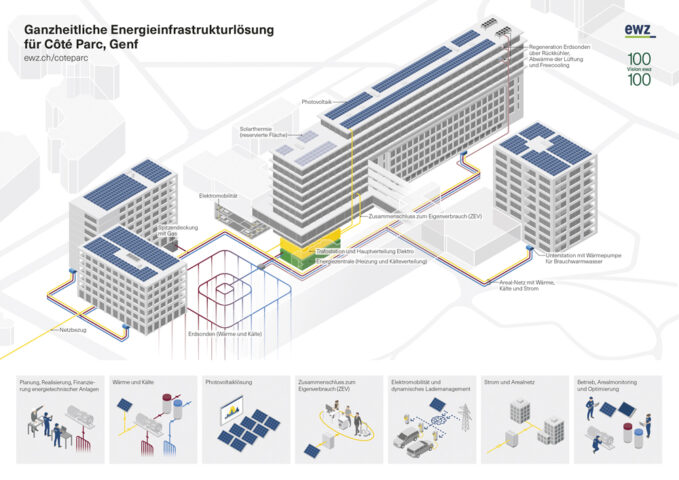
An interesting practical example of this is the "Côté Parc" project in Geneva. 776 photovoltaic panels on the roofs of the area form the basis for an integrated solar solution with heat pumps, charging stations for electric cars and the area's own power grid, including self-consumption for the users.
For property owners with large roof areas (from approx. 700 m2), a contracting model is an option worth considering. The provider takes over all services – from planning to financing, implementation to operation over several decades. Including the integration of photovoltaic systems, it is a holistic energy solution with heating, cooling, electromobility and self-consumption models.
Business customers of ewz can rely on efficient and tailor-made solutions from competent teams with many years of experience. Investment, maintenance and repair costs are not incurred during the contract period. After the end of the contract period – usually 20 to 30 years – the photovoltaic system becomes the property of the customer.
According to a press release , the electricity works of the city of Zurich ( ewz ) have sold 7,544 square meters of solar space. This means that the demand for solar energy has doubled compared to the previous year. The increased popularity of sustainably produced electricity is attributed to the commitment to the net zero goal, the solar offensive launched by the city and the consequences of the Ukraine war.
ewz announces that with the second high-alpine solar system currently under construction in Graubünden with an area of 1795 square meters, it will again rely on the willingness of the public to participate in local solar systems and thus accelerate the energy transition.
The large-scale photovoltaic system in the high mountains is to be built in the course of the summer on the dam wall of Lago di Lei. According to the company, it has a potential of 1,000 photovoltaic modules that could generate 380 megawatt hours of electricity per year. The dam wall belongs to the power plants Hinterrhein AG, in which ewz has a stake.
ewz customers in the city of Zurich and in the Mittelbünden supply area now have the opportunity to participate on the ewz website for as little as half a square meter for CHF 280. In return, ewz announces that it will credit 90 kilowatt hours of sustainably produced electricity from renewable energy to the bill every year for 20 years.
Allreal has developed a sustainability strategy (ESG) that sets ambitious and specific goals and can be measured against these annually in the future. Allreal creates value through full CO2 neutrality (Environment) By 2050 at the latest, Allreal aims to achieve full CO2 neutrality for its investment property portfolio. By the end of 2022, the company will therefore ensure full consumption recording of the investment properties and develop individual property strategies. In addition, the company will start a broad-based expansion of photovoltaic systems and building management systems. In order to achieve the reduction path, partial compensation of the CO2 emissions will be made from 2022. The active control of user behavior should make a further contribution to lowering emissions. In addition to “green lease” contracts, there is also the promotion of electromobility and the creation of financial incentives to encourage sustainable user behavior among tenants. By the first half of 2024, at least 20% of the garage parking spaces will be equipped with an electric charging station (800 charging stations).
With a view to the activities of general contracting, Allreal relies on the consistent use of reusable materials. In the case of in-house projects, the entire life cycle of a material is taken into account as quickly as possible. Allreal creates values by assuming responsibility (social) In the area of society, Allreal advocates comprehensive occupational health and safety as well as real equal opportunities. The company already offers an attractive working environment which, thanks to the flexibilisation of working hours (part-time work / partial retirement), enables work and family to be reconciled. Further related measures are being expanded on an ongoing basis.
Tenants without their own roof helped finance IWB ‘s second solar system. You have acquired an individual share in the planned solar system on the Spittelmatthof near Riehen BS through the participation model Sonnenbox Crowd. In return, they will receive an electricity credit of 100 kilowatt hours per invested square meter over a period of 20 years.
This second system is 350 square meters and will have an output of 72 kilowatts. That corresponds roughly to the electricity needs of 25 to 30 households. As stated in a press release , it only took a few weeks to fully finance them.
The preparations for its construction were already under way. It should be completed by the middle of next year. The installation of the first swarm-financed system is also imminent. It is being erected on a roof by IWB in Basel’s Gundeli district. “The great demand spurs us on to offer the people of Basel more solar systems soon,” Martin Albrecht, product manager of the Sonnenbox Crowd, is quoted as saying. “We are looking for other suitable roofs for this.”
According to a media release by the Federal Office of Energy (SFOE), the federal funds for photovoltaic systems are having an effect: The record construction of photovoltaic systems from 2020 will probably be exceeded this year.
According to the information, more than 18,000 photovoltaic systems with a total output of 360 megawatts were registered for one-off remuneration from January to the end of October 2021. That is around 25 percent more than in the same period last year. In the third quarter, their number even increased by 40 percent.
All system operators who have submitted their complete application to Pronovo AG on time could expect a payment. A total of CHF 150 million would be paid out as a one-off payment for 26,000 small photovoltaic systems. 500 applications have been received for large photovoltaic systems. As confirmed by the SFOE, the planned funding amounts could be paid out to all applicants who correctly submit their application by the respective deadline in the coming year.
No further systems were added to the feed-in tariff system in 2021. After completion, 19 photovoltaic, 79 hydropower, 422 wind energy and 42 biomass projects would have received funding approval.
The investment contributions made available for small and large hydropower plants were only partially called up in 2021. New requests could be processed immediately without a waiting list.
No applications have been received for an investment contribution in favor of electricity-producing sewage gas and waste incineration plants, wood power plants or geothermal projects. New ones could be processed immediately.
The AMAG Group has put a new photovoltaic system into operation at its Winterthur location, informs the automotive trading group for all brands of the Volkswagen Group in a message . The system built by Helion with an output of around 157 kilowatts peak was installed on the roof of the AMAG building for Volkswagen and VW commercial vehicles. The group intends to use around 60 to 65 percent of the approximately 158 megawatt hours of solar power expected annually.
“With the solar energy obtained from the photovoltaic system, we can cover around 60 percent of our electricity requirements at the Zürcherstrasse 312 location in Winterthur,” Martin Zgraggen, Managing Director of AMAG Winterthur, is quoted in the press release. “The increasing number of electric vehicles means that more electricity is required, which the new solar system supplies us.”
The AMAG buildings for the Audi and Skoda brands in Winterthur were equipped with a solar system back in 2013, the press release explains. The group had the first photovoltaic system installed on the roof of its central spare parts warehouse in Buchs ZH in 2008. In the current year, in addition to the new system in Winterthur, two further solar systems were installed in Wettswil am Albis ZH and in Basel.
The automobile trading group with its headquarters in Cham ZG wants to be completely climate-neutral by 2025. To this end, solar systems are to be installed on an area of around 50,000 square meters by 2024. The group is looking into a deployment for a further 100,000 square meters of space at AMAG locations.
Stadtwerk Winterthur is consistently pursuing the conversion of the energy supply to renewable energies, explains the energy company of the City of Winterthur in a communication on the 2020 annual financial statements . In the year under review, Stadtwerk Winterthur installed 14 new photovoltaic systems, among other things. Since April, only biogas and CO2-compensated natural gas have been offered as basic gas products.
In order to promote the switch to district heating, the company also refrains from actively selling new gas connections. The basic supply of electricity has been offered exclusively through electricity from renewable energy sources since the beginning of 2020.
Stadtwerk Winterthur explains in the press release that biogas is currently around 13 percent of the total sales volume. This year the share is to be increased to 33 percent. The company also plans to install 100 new photovoltaic systems by 2025. In addition, it is planned to renew incineration line 2 of the waste incineration plant in the Grüze. This means that additional areas can be supplied with district heating, writes Stadtwerk Winterthur.
In the year under review, Stadtwerk Winterthur generated total sales of 239 million francs, slightly below the previous year's figure. The profit, on the other hand, has increased significantly to 33 million francs, explains the company. The communication cites very good purchase prices for electricity and gas as a background.
ewz offers people who want to actively participate in the energy transition the opportunity to acquire stakes in photovoltaic systems. This type of crowd financing enables the construction of new systems, for example on school roofs. According to a press release , ewz is offering a total of 4,000 square meters of new space for this purpose.
Of this, 1,100 square meters of photovoltaic area are now available on the Falletsche municipal school building in Leimbach. The Rebhügel school buildings in Wiedikon, Kolbenacker in Seebach and Mattenhof in Schwamendingen will go online in the course of the year. A maximum of ten square meters of participation at CHF 250 per household can be purchased on the Internet. In return, customers receive 80 kilowatt hours of sustainably produced solar power from Zurich per square meter of participation credited to their electricity bills.
The last square meters of participation are still available for the first large-scale high-alpine solar system in Switzerland, which has already been completed on the ewz dam in Graubünden's Bergell. Because the yield is more than twice as high as in the Unterland, both the participation price and the credit are higher there.
Wir verwenden Cookies zur Unterstützung und Verbesserung unserer Dienste. Mit der Nutzung dieser Website erklären Sie sich mit der Verwendung von Cookies einverstanden. Weitere Informationen finden Sie in unserer Datenschutzerklärung.