Tag: Pirmin Jung

  • Zurich Airport is rebuilding Dock A

    Zurich Airport is rebuilding Dock A

    Zurich Airport has chosen the Raumfachwerk project as the winner of its competition for the construction of the new airport terminal Dock A with tower and dock root. It prevailed against ten competitors and is intended to replace the existing and aging Dock A.

    From 2030, according to a statement from Zurich Airport, “probably the largest airport dock to date made primarily of wood” will be built next to the existing Dock A while operations continue. The investments are estimated at around CHF 700 million.

    The planning team for this project is led by the renowned architect Bjarke Ingels. In addition to his Copenhagen and New York-based architects’ office BIG , the largest architecture and engineering company in the USA, HOK , is also involved, as is the Zurich architects’ office 10:8 . For example, it was responsible for the conversion of Zurich Oerlikon station. The London engineering and consulting company Buro Happold , which is experienced in airport construction, is also part of this team, as is the engineering office Pirmin Jung from Rain, which specializes in timber construction.

    According to Bjarke Ingels, the team tried to meet the complex global challenge of CO2 reduction with the simplest possible solution, a space structure made of solid wood: “A simple but expressive design that is rooted in tradition and committed to innovation and the cultural and natural elements of Swiss architecture.”

  • Three sustainable residential buildings for the Gotthard road tunnel workers

    Three sustainable residential buildings for the Gotthard road tunnel workers

    Since 1980, the Gotthard road tunnel has been the most important Swiss car corridor through the Alps. After more than 40 years of operation, this is in need of renovation. The Federal Roads Office (Astra) is building a second tube by 2029 so that the road connection can be used without interruption despite the repairs. In order to offer the teams involved in the construction optimal accommodation during their assignments, the Astra announced an architecture and investor competition. The contract was awarded to Swiss Property, which developed its project together with the engineering office Pirmin Jung. They convinced the jury with three buildings; two of them in element and one in modular construction as well as a digitized planning and construction with the Timber OS system developed by Swiss Property. This enabled the optimal balance between yield, costs and energy consumption to be calculated.

    The three buildings are named Dammastock, Galenstock and Rhonestock. Your future residents are surrounded by rock, concrete, dust and noise every day. For this reason, the rooms were deliberately designed with a high feel-good factor and a warm atmosphere. A main component used in construction is local wood.

    The Dammastock is the largest of the three buildings: in 2021, 102 single rooms, each with an area of around 14 square meters, as well as an underground car park were built here. The Dammastock has been ready for occupancy since December 2021. The facade consists of saw-grey spruce and fir wood. The building is to be dismantled in 2032: Thanks to the 105 individual wooden modules used, the Damma
    stock can be easily dismantled, transported and reassembled at another location. Possible conversions include a temporary school building, an asylum home or guest rooms.

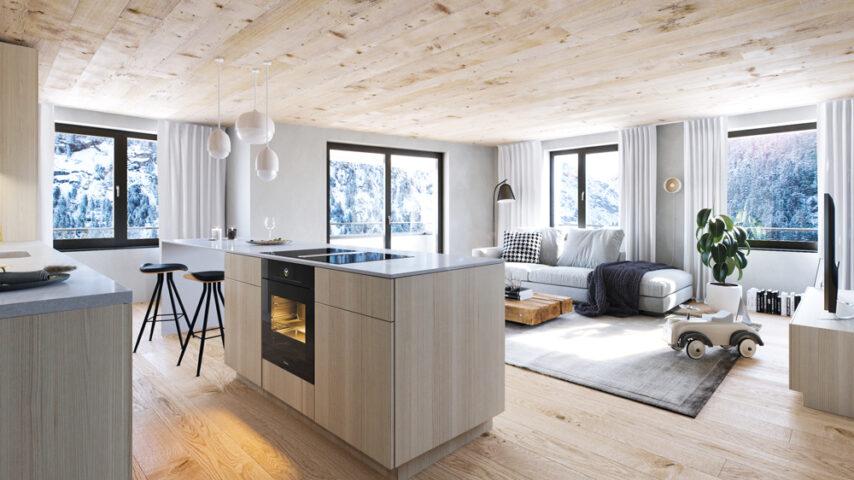
    The other two buildings, Galenstock and Rhonestock, will be erected as hybrid structures with 72 single rooms of 14 square meters each. Both will have a staircase core made of reinforced concrete. The buildings consist of system timber construction elements made of spruce and fir wood and, thanks to the alpine architecture, harmonize perfectly with their surroundings. After the tunnel work, these buildings can be used on the spot in the long term: the interior design allows for an uncomplicated conversion into 16 apartments with areas of 40 to 110 square meters. The three buildings in Göschenen thus create a benefit that goes beyond the tunnel project.

    The interior rendering shows what an apartment could look like after conversion.