
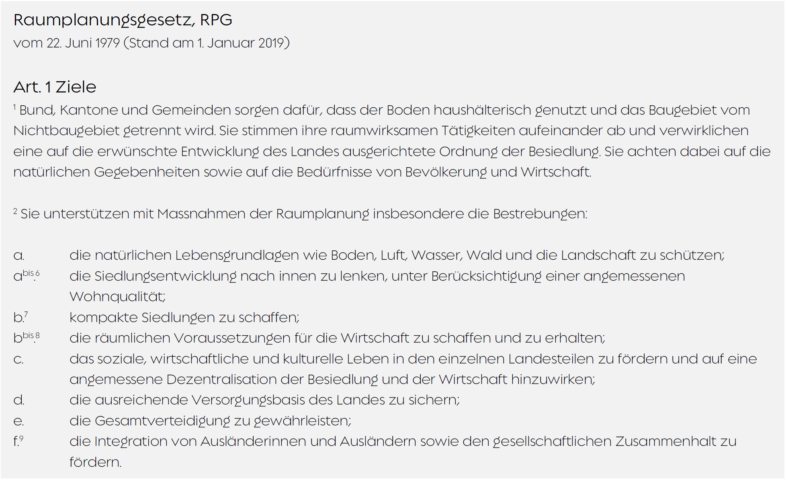
In reality, however, the cantonal and municipal planning instruments are incomplete, rigid, purely quantitative and do not pursue a three-dimensionally developed picture of the future. The consequences are well known: Inconsistent cityscapes, insufficient densification potential, growing traffic volumes, uncoordinated infrastructural facilities and, finally, a dissatisfied population.
Forward-looking spatial planning with new concepts is indispensable, because the current sluggish planning instruments of spatial planning are obviously at odds with the dynamic process of urban planning and to date fail to achieve the goals defined in the RPG.
With the use of the already existing GIS data, the potential impacts on all relevant topics such as interior densification, land use, transport, energy consumption, greenhouse gas emissions and many others could be visualised, evaluated and communicated in a participatory manner throughout Switzerland on the basis of qualitative future scenarios – and beyond the cantonal borders.
Buildings in the context of spatial planning
Spatial planning also creates the framework conditions for the development of neighbourhoods and ultimately of the building stock. When we talk about sustainable buildings, it is not enough to look at them in isolation and focus solely on their substance. Buildings are to be understood in their context and thus in consideration of their contribution to the reduction of traffic volume, to densification and to social integration. Following this logic, the two standards SNBS Building Construction for Building and SSREI for Existing Buildings have been developed in Switzerland. In terms of their content, both are unique in an international comparison.
Source www.ssrei.ch
