Tag: Portfolio

  • Takeover of construction company in Peru

    Takeover of construction company in Peru

    Holcim has finalised the acquisition of Compañía Minera Luren, according to a company press release. With the Lima-based company for specialised construction solutions, the Zug-based building materials group believes it is well positioned to expand its business in Peru and accelerate growth in Latin America. Holcim believes that this acquisition will create “significant synergies” in Peru and Latin America. This is because the product portfolio complements Holcim’s existing business in Peru “to a high degree”.

    Founded in 1956, the family-owned company Compañía Minera Luren manufactures masonry systems and other specialised building materials, including minerals for industrial applications, under its La Casa brand. The company specialises in wall systems that combine energy-efficient insulation and special mortar.

    “The acquisition of Compañía Minera Luren will expand Holcim’s product portfolio,” says Oliver Osswald, Head of Region Latin America. Their wall systems would enable Holcim to “offer customers fully integrated complete solutions, from foundations and flooring to walls and roofs”.

  • Canton of Zug strengthens its property portfolio

    Canton of Zug strengthens its property portfolio

    The Building Directorate is legally responsible for the construction and maintenance of the canton’s own buildings. The financial framework conditions are carefully analysed in order to make targeted use of both the maintenance and investment budgets. Sound, long-term planning is becoming increasingly important in order to ensure that the buildings retain their value.

    Strategic guidelines for property management
    The Canton of Zug’s real estate strategy is based on the overarching objectives of the Cantonal Government and the specific guidelines of the Building Department. Priority is given to maintaining existing infrastructures rather than building new ones. The targeted use of resources ensures future-orientated buildings that meet the requirements of sustainability and efficiency.

    Cost and benefit efficiency as guiding principles
    The Building Directorate pursues a differentiated strategy that focuses on cost control and the fulfilment of public tasks.
    Properties that do not directly serve a public purpose are used for value creation or exchange transactions in order to optimise the management of the portfolio.

    Investment requirements and future developments
    The Building Department has further expanded the cantonal property portfolio. With the projects realised, the value of the portfolio has risen to CHF 1.06 billion by 2023. Further investments are planned for the coming years. Planned major projects in the education and administration sectors will contribute to the canton’s infrastructural development and strengthen the economic attractiveness of the region. A forward-looking real estate strategy ensures that the canton of Zug makes optimum use of its property portfolio and is equipped to meet future requirements.

  • Changing investment strategies due to rising interest rates

    Changing investment strategies due to rising interest rates

    Just as sailors avoid the Bermuda Triangle, investors must also consider the risks of their investments. The magic triangle of investment strategy – liquidity, profitability and security – is now being expanded to include ESG factors. This step is also supported by the “Lost in Transition” study by the Lucerne University of Applied Sciences and Arts. Institutional investors are placing greater emphasis on ensuring that their investments are sustainable in the long term, even if this leads to lower returns in the short term.

    A look at Swiss pension funds
    Swiss pension funds have diversified their investments, although the proportion of real estate varies from fund to fund. The analysis of the Swisscanto Pension Fund Study 2023 shows that real estate is gaining in importance compared to equities and bonds. This trend can also be observed among other institutional investors, whereby the real estate ratio in the portfolio should be between 10% and 25% in order to ensure optimal diversification.

    The impact of rising interest rates on the asset classes
    Rising interest rates have a negative impact on all three main asset classes – equities, bonds and real estate. For bonds, interest rate rises lead to price losses, while for equities they reduce their attractiveness. Real estate investments become more expensive, which leads to a decline in demand and thus to a fall in prices. Institutional investors are reacting to these developments by realigning their portfolios and reducing their real estate holdings in order to lower their leverage ratios.

    The difficult market environment and its impact on real estate investments
    Sentiment on the real estate market is subdued due to rising interest rates and uncertainty on the financial markets. This is reflected in the Swiss Real Estate Sentiment Index, which measures the expectations of market participants. Investments in real estate are becoming less attractive, but the current market environment also offers opportunities, especially for investors who are prepared to invest for the long term and weather the market fluctuations.

    Rising interest rates pose a challenge for institutional investors, especially those who have invested in real estate. A realignment of the investment strategy and prudent portfolio optimization are crucial to achieving long-term returns and minimizing risks.

  • Global real estate as a strategic opportunity – new cycle imminent

    Global real estate as a strategic opportunity – new cycle imminent

    Despite the challenges posed by interest rate hikes over the past two years, the global property market remains an attractive field for investors. Although there has been a marked correction in property prices internationally, the core market segment is robust and promises attractive returns. The expectation of interest rate cuts, particularly internationally, emphasises this opportunity, especially for investors with a focus on the Swiss market, by offering a chance for improved diversification and higher returns.

    The adjustment in property prices combined with a decline in transaction activity has caused valuations to fall in many markets – by up to 30%. Despite these developments, letting profiles remain stable and demand positive, with a few exceptions such as the US office sector. With interest rates expected to fall, we forecast that financing rates will return to below equity yields later this year, with property yields offering attractive spreads over government bonds.

    A diversified global property portfolio offers protection against local market downturns and minimises regional risks. Property markets around the world do not move completely in sync, which presents a unique opportunity for investors to optimise their portfolio. In addition, the different duration and phase of property cycles in different markets enables strategic investment and divestment decisions.

    Increasing digitalisation and the need for data centres illustrate the importance of a global approach to real estate investment in order to benefit from such emerging trends. The Swiss market alone offers little opportunity to invest in such specialised segments at an institutional level. In addition, the higher liquidity of international markets compared to the Swiss market offers advantages in terms of returns and market adaptability.

    Long-term comparisons between the KGAST index for Swiss funds and the international NFI-ODCE index for US funds show a significant outperformance of US property, underlining the benefits of global diversification. In view of the impending interest rate cuts and the potential market turnaround in various international property cycles, investors have a strategically favourable time to benefit from the current market corrections and position themselves for future growth. Investing in global property therefore appears to be a wise decision to expand portfolio diversification, gain access to growth markets and benefit from attractive entry prices.

  • Distressed debt will further strengthen the trend towards private debt financing

    Distressed debt will further strengthen the trend towards private debt financing

    While in the past the financing needs of property investors were primarily covered by traditional bank loans (real estate loans), banking regulation has created scope for alternative financing models. As a result, there is unlikely to be a major wave of purchases of non-performing loans (NPLs). This is because the capital structure of financing is completely different today than it was during the financial crisis, as the banks’ senior share is significantly lower. Back then, it was worthwhile for NPL specialists to buy large NPL portfolios from the banks at a discount and realise them because valuable collateral was available. Today, however, mezzanine financing is under water because activity on the transaction market has decreased enormously.

    In the increasingly fragmented financing landscape, we see a growing need for advice on refinancing. This is because a number of standstill agreements with financiers are expiring in the current market shakeout phase. In the course of refinancing negotiations, project developers and portfolio holders are finding that they are unable to fulfil additional requirements. At the latest when companies with high debt ratios present their annual financial statements for 2023, we therefore assume that further market participants could run into acute difficulties.

    In this situation, we expect more products to come onto the market: both in the form of non-performing loans that are sold and in the form of properties that serve as collateral. However, the turnaround in interest rates means that supply and demand on the transaction market have not yet come together for long stretches. Many market participants are acting cautiously and there is a lack of liquidity on the market. As a result, it is becoming increasingly difficult for investors to find an exit for non-performing exposures.

    At the same time, it can be observed that increasingly strict regulatory requirements and valuation specifics (rating, equity backing) mean that certain industry segments, submarkets or projects are hardly being financed by banks, or only at very unfavourable conditions. Banks typically adopt a pro-cyclical market behaviour. Economic downturns lead to lower corporate profits and therefore to rating downgrades. The capital backing required by banks increases, leaving little room for manoeuvre for new business. In addition, after the expiry of fixed interest rates, there are more risky loans on the books whose property income can no longer generate the higher interest rates. Anti-cyclical investment and financing strategies are very difficult to implement in this phase. It is precisely in this situation that alternative, entrepreneurial financing partners are becoming increasingly important.

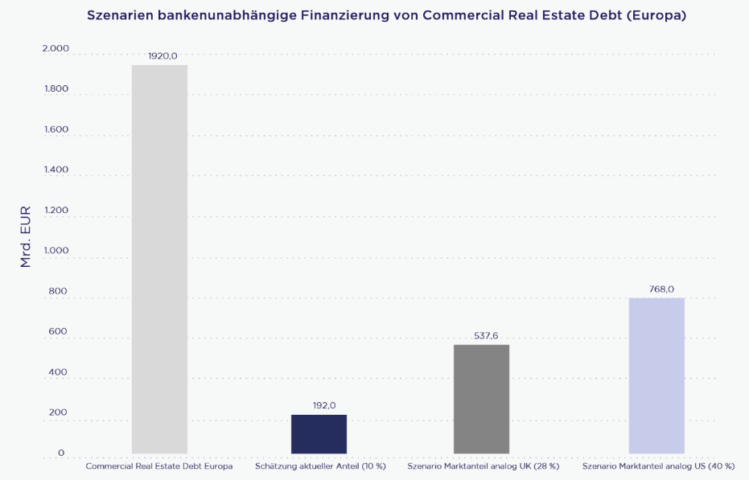
    As we pointed out in a study at the beginning of the year, the trend towards B2B and private debt financing will therefore continue to strengthen, although this growth will take place almost exclusively in the B2B sector for regulatory reasons.

    The high financing volumes and customised structures require professional management and controlling. Efficient real estate private debt funds will therefore play a key role in the expected market growth in the private debt financing segment. Providers who can handle the entire process from origination to reporting and repayment have an advantage here.

    Source graphic: Barings Bank, PGIM RE, Bayes Business School, London; Empira – own calculation and presentation as at December 2022.

  • Early planning phase is crucial for net zero in real estate

    Early planning phase is crucial for net zero in real estate

    A broad-based portfolio study by Implenia shows how climate-neutral buildings can be realised. For this study, the construction company’s Real Estate Division examined 36 of its own development projects in Switzerland. According to a press release, this study reveals the most important levers for decarbonising buildings over their entire life cycle, both in terms of emissions during their construction and during operation.

    Implenia has compiled these influencing factors in a white paper. It is aimed at investors, developers and clients who want to bring their project onto a net-zero target path.

    According to this analysis, the most effective levers for decarbonisation can be found in the early planning phase, starting with site selection. This is because if the site conditions are unfavourable in terms of renewable energies, it is much more difficult to achieve net-zero use.

    In addition, building parameters set early on also have “a significant impact on emissions targets”. These include shape, compactness, orientation, basement and support structure. “With the right combination of location, design, the use of renewable energies, intelligent systems and ecological materials, we develop buildings in which future generations can live and work sustainably,” says Marc Lyon, Head Real Estate Development Switzerland at Implenia.

  • Real estate fund from Swiss Life Asset Managers generates stable income

    Real estate fund from Swiss Life Asset Managers generates stable income

    The Swiss Life REF (CH) ESG Swiss Properties real estate fund closed the first half of the 2022/23 financial year “with low vacancy rates and stable income”, Swiss Life Asset Managers announced in a statement. Specifically, income of CHF 20.26 million was realised. In addition, there was a capital gain of CHF 3.81 million from the sale of a residential portfolio consisting of five smaller apartment buildings. The rent default rate was reduced from 2.97 to 1.76 per cent compared to the end of March 2022.

    The net asset value rose year-on-year from 112.01 francs to 114.34 francs. The fund currently holds 161 properties with a total value of 2.562 billion francs. At the end of 2022, Swiss Life Asset Managers had acquired 15 properties with a total market value of CHF 242 million.

    Since the fund’s launch in November 2015, Swiss Life REF (CH) ESG Swiss Properties has posted an annualised performance of 6.04%. This means that the price performance and distributions are 2.01 percentage points above the SXI Real Estate Funds TR benchmark index, explains the asset manager, which is part of the Swiss Life Group.

  • The balance between realistic analyses and visionary creations

    The balance between realistic analyses and visionary creations

    On behalf of the client, real estate developers look for suitable sites for a real estate project or ideas for the use of an existing property. At the beginning of a project, they investigate the potential of a site and prepare feasibility studies for various use options. They initiate contact with the municipal spatial planning and building authorities for clarification.

    Real estate developers lead interdisciplinary teams of experts, including architects, authorities, real estate marketers, cost planners, lawyers and client representatives. They work on financing solutions, assess valuations as well as land purchase and work contracts. They plan the construction project, analyse the planning basis and ensure compliance with legal regulations and standards. At the end of a project, they ensure that the property goes smoothly into operation and that the relevant documentation is handed over to the client.

    For professional handling, real estate developers have knowledge of market research and real estate marketing, investment appraisal, planning and construction processes as well as planning and construction law.

    Requirements for training
    A 3-year basic vocational training, school-leaving certificate, degree from a higher technical college, university or equivalent qualification is required for the federal certificate. Analytical skills, good business and construction knowledge as well as customer and service orientation are essential for the training.

    The training lasts 1 1/2 years and can be completed part-time.

    Gérard Lerner, how would you describe your day-to-day work in five sentences or less?
    The day-to-day work of a project developer is many-sided and varied. In the search for new development opportunities, one is constantly in conversation with brokers, private and institutional property owners and project sellers. An essential part of the daily acquisition routine is the clarification of building regulations based on the applicable planning and building laws as well as discussions with the authorities and architects. Furthermore, profitability calculations and general market analyses play a central role in the evaluation of project opportunities.

    What basic training is suitable for later work as a real estate developer?
    In my opinion, you have good prerequisites with interdisciplinary courses of study such as architecture and urban planning.

    There are various training programmes. Which course do you recommend to future professionals?
    You certainly can’t go wrong with an architectural education in combination with construction economics and construction law.

    What talents and qualities are important?
    In this profession you benefit from conceptual, creative and networked thinking. A flair for numbers as well as curiosity, openness and flexibility are also important.

    What do you particularly like about your job?
    I especially like the variety and the interdisciplinary processes – you are in constant exchange with the most diverse actors such as owners, authorities, user groups, investors, banks and sellers. Every day you balance between realistic analyses and visionary creations, which I find very exciting.

    How do you become a good real estate developer?
    To develop real estate, you need, above all, broad and well-founded experience in the fields of architecture, construction economics and building law. Proactive behaviour, networked thinking, decisiveness and sociability are indispensable social skills that you should have.

    What advice would you give to young professionals in order to successfully gain a foothold in the profession?
    You have to have stamina and be far-sighted. A passion for creativity, curiosity and openness also pave the way to success.

    What milestones and highlights have you achieved and experienced in your professional life so far?
    After my studies, I gained various experiences as a design architect in different architecture firms in Germany and abroad. In the process, I was able to gain fundamental knowledge in construction project planning. Afterwards, I had the opportunity to work as a construction trustee on major construction projects such as Europaallee Zurich. During this time, I was able to gain valuable experience in the areas of technical tenders, contracting and construction processes. In recent years, I have been increasingly active as a client representative and construction manager for private companies such as Visionapartments. In the role as Head of Real Estate, I was able to apply my entire knowledge of acquisition, development, planning, contracting and realisation. I reached a milestone in my professional life a year ago when I started working for Schmid Immobilien AG. A company rich in tradition with highly concentrated competence, experience and quality standards.


  • Fundamenta Real Estate reports strong operating result

    Fundamenta Real Estate reports strong operating result

    According to a media release, the real estate company Fundamenta Real Estate in Zug increased its operating result in 2022 and maintained the value of its real estate portfolio at over CHF 1 billion. This billion mark had been exceeded for the first time at the end of 2021. It now stands at 1216.4 million francs, according to the annual report for 2022, 10.7 per cent higher than the previous year.

    Fundamenta Real Estate’s operating result rose by 12.4 percent to CHF 19.9 million. Net profit, also due to positive revaluation effects, was CHF 22.3 million. Net actual rental income increased by 10 percent to 40.9 million Swiss francs and thus exceeded the 40 million mark for the first time. In the previous year, it was 37.2 million francs. The company also points to a record low vacancy rate of only 1.6 per cent compared to 2.5 per cent in 2021. This and the acquisition of six existing properties, the completion of a development project and its transfer to the portfolio had contributed to the high net actual rental income.

    After the share price had increased by a total of 26.7 percent in the two previous years, it fell by 17.2 percent to CHF 16.10 (previous year: CHF 19.45) in the reporting period due to market conditions. The market capitalisation at the end of the year was 484 million Swiss francs compared to 584.7 million a year earlier.

    For the 2022 business year, the Board of Directors will again propose a distribution of CHF 0.55 per share at the Annual General Meeting on 5 April, as in the previous year. The entire Board of Directors (BoD) will stand for re-election at the Annual General Meeting. Board member Herbert Stoop has announced that he will not stand for re-election at the 2024 general meeting.

  • On course for expansion – Woonig takes over Scantick

    On course for expansion – Woonig takes over Scantick

    "We are pleased to be able to provide our customers and interested parties with an expanded range of products and services with the acquisition of Scantick" – Erich Linus Birchler, founder and CEO of Woonig AG

    In addition to the smart ticketing module, the communication module will also be expanded to include an innovative component. In the future, for example, pinboard messages from the Woonig Infocenter can be displayed directly at the properties via a “low-power display”.

    About Scantick
    Scantick, based in Zweidlen Zurich, is a ticket system with which messages can be recorded quickly and easily via a QR code and faults and problems can be eliminated. Scantick is active in the real estate management, sanitary and commercial/manufacturing sectors.

    About Woonig
    The IT company Woonig, based in Bottighofen on Lake Constance, offers a "Software as a Service" (SaaS) communication and interaction platform for real estate management (RE Edition) and for service providers (DL Edition), for digitizing and automating the processes between real estate managers , tenants/owners and service providers.

    The Woonig software is easy to integrate, configure and can be used productively in just a few steps. Woonig also offers standard interfaces to common real estate management systems.

  • Peach Property records record number of new leases

    Peach Property records record number of new leases

    According to a media release , the Peach Property Group has reached a new high in new lettings in Germany. The letting success has reduced the number of vacancies, while at the same time rental income has increased. For example, more than 15 percent growth was recorded for newly rented apartments compared to the average price per square meter for the group at the end of 2021. According to the announcement, the Peach Property Group's rent for existing properties continues to be below the average market rent. The continuation of the restructuring program also contributed to the group's solid financial structure. Around 1,400 units have been modernized, 15 percent of which have been brought up to date in terms of energy.

    The positive half-year balance reflects "the efficiency and scalability of the group's digital rental platform" and underlines "the potential for rent increases in the portfolio". "We have never renovated and rented out so many apartments," says Dr. Thomas Wolfensberger, CEO of Peach Property Group AG, quoted.

    Peach Property describes the sale of twelve of the planned 56 residential units in the new Peninsula development in Wädenswil on Lake Zurich as a strong signal for the Swiss portfolio. In addition to the portfolio optimization, the financing structure is developing positively as a result of successful capital management. A bond maturing in February 2023 was bought back early at a price of 94 percent.

    For the second half of the year, the group expects net rental income of CHF 113 to 118 million and an operating result of CHF 18 to 21 million.

  • Avobis takes over Kreditfabrik

    Avobis takes over Kreditfabrik

    Zurich -based Avobis has taken over the credit factory from Horgen ZH via Avobis Invest AG. The real estate and mortgage service provider, which specializes in independent, integrated and technology-based real estate and financing solutions, intends to use the integration to further expand its market position in mortgage servicing.

    As Avobis writes in a press release , both companies are leading providers of mortgage services. Avobis has been strongly positioned in servicing solutions in the mortgage market for 25 years. Kreditfabrik specializes in services for the processing, management and risk assessment of mortgages.

    Thanks to Kreditfabrik's customer relationships, Avobis will have a credit volume of over CHF 12 billion after the takeover and will be able to underline its "number 1 position in the market". "Avobis is the largest provider on the Swiss market that can support pension funds, investment foundations, insurance companies and all types of banks as mortgage servicing customers with the right solution for them," says Andreas Granella, Managing Director of Avobis Invest AG . As an asset manager for collective capital investments, Avobis Invest AG offers services for all customer segments.

    In order to complete the range of services "along the entire real estate value chain", Avobis Invest AG also wants to create additional investment opportunities for institutional investors in the coming year by introducing new products.

  • Warteck Invest grows profitably

    Warteck Invest grows profitably

    Despite the ongoing pandemic, 2021 was a successful financial year, Warteck Invest wrote in a statement . Specifically, the Basel real estate company increased its net profit by 2.4 percent to CHF 27.4 million. Excluding the gain from the revaluation of properties, growth of 5.6 percent to CHF 17.4 million was realised.

    At CHF 36.9 million, rental income was 0.4 percent up on the previous year. Financial expenses fell year-on-year by 2.6 percent to CHF 5.5 million. The vacancy rate was reduced by 0.6 percentage points to 2.4 percent compared to 2020.

    The market value of Warteck Invest’s real estate portfolio increased by CHF 35.8 million to CHF 874.4 million in the course of the year under review. The increase was not achieved through acquisitions, but through investments in new construction and renovation projects and the resulting revaluations. In the past financial year, the real estate company invested a total of CHF 22.8 million in ongoing projects. A project pipeline with a total volume of over 270 million Swiss francs should generate further growth over the next five to seven years.

  • Zurich's real estate fund is now in the top 3

    Zurich's real estate fund is now in the top 3

    In just two years, Zurich Invest AG has become an important provider of real estate investments, the company writes in a press release . With the capital increase in September and a future total volume of CHF 1.3 billion, your fund “ZIF Immobilien Direkt Schweiz” will become one of the largest unlisted Swiss real estate funds. Zurich Invest Ltd launched the fund in October 2018. The first capital increase took place last year.

    The real estate fund's rapid growth is possible "because Zurich , as a global insurer, is one of the most important property owners in Switzerland and has been able to build up a portfolio of attractive buildings over a long period of time," the press release said. The changed range of life insurance companies also accounts for the 80 percent share of first-class real estate in the Zurich fund. Since they now contain fewer guarantee products, less real estate is required to guarantee the obligations. "This is why Zurich has the opportunity to transfer properties in the most desirable locations to a fund."

    As it is said, the second capital increase will run for around 340 million francs and will take place on October 21. The subscription period is from September 21st to October 2nd. The new tranche comprises a total of 20 properties. "In addition to their prime location, the buildings are characterized by the fact that we are pursuing the goal of operating them in a CO2-neutral manner in the future," said Martin Gubler, CEO of Zurich Invest AG. The first two tranches of the fund in 2018 and 2019 were heavily oversubscribed. He is "extremely satisfied" with his performance.

  • Peach Property wins Ares as anchor shareholder

    Peach Property wins Ares as anchor shareholder

    The Peach Property Group is planning to make further portfolio acquisitions in Germany, explains the Zurich-based company, which specializes in residential real estate, in a press release . Peach Property intends to raise the funds by increasing the capital base by CHF 200 million. A mandatory convertible bond is to be placed for this purpose.

    The subscriber of three quarters of the mandatory convertible bond has already been determined, Peach Property informed in the message. Specifically, a fund of the globally active manager of alternative bonds, Ares Management Cooperation , will subscribe to 150 million francs. This means that Ares will secure a stake of around 30 percent in Peach Property and become the largest single shareholder in the Zurich real estate company, according to the announcement. In the course of the entry, the Managing Director of the Ares Real Estate Group, Klaus Schmitz, is to be elected to the Board of Directors of the Peach Property Group.

    "We are very pleased to be able to win Ares as a new anchor shareholder with extensive experience in the German residential real estate sector", Thomas Wolfensberger, CEO of the Peach Property Group, is quoted in the press release. Ares, in turn, sees the stake in the Zurich real estate company "as an excellent opportunity to invest in one of the more defensive asset classes in Europe and at the same time to benefit from the attractive growth of the Peach Property Group", explains John Ruane, Co-Head of the Ares European Real Estate Group.