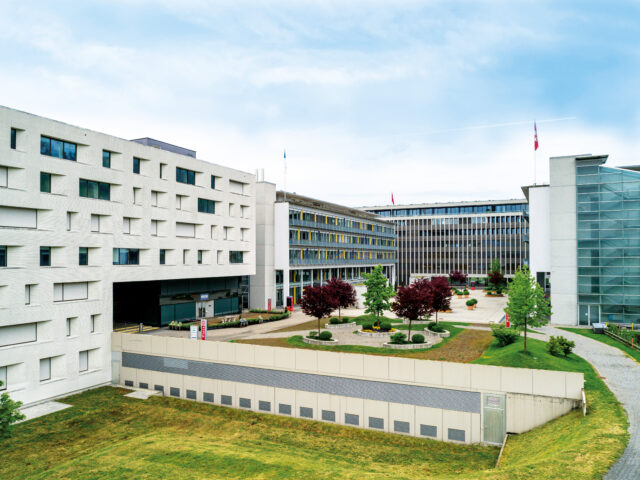
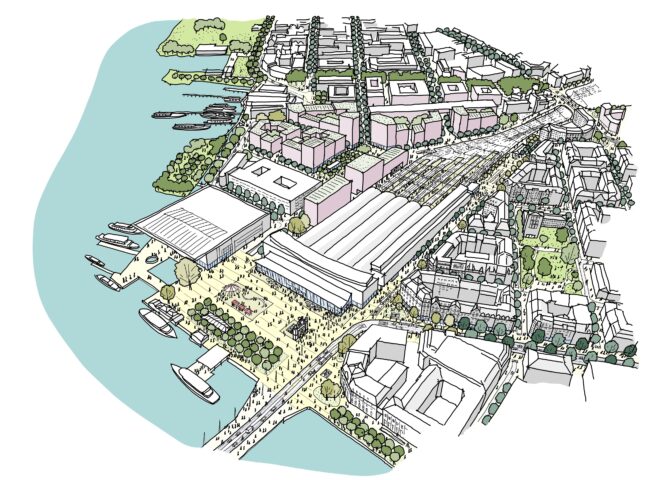
Word has spread about the high quality of life in the city of Winterthur. More and more people live, work and study here. The city in the Zurich economic region currently has over 120,000 inhabitants, around 75,000 employees, almost 11,000 university students and around 11,000 students at vocational schools. The municipal forecast predicts a population growth to around 135,000 people by 2040. Winterthur wants to use this growth as an opportunity to develop existing urban qualities by setting spatial priorities.
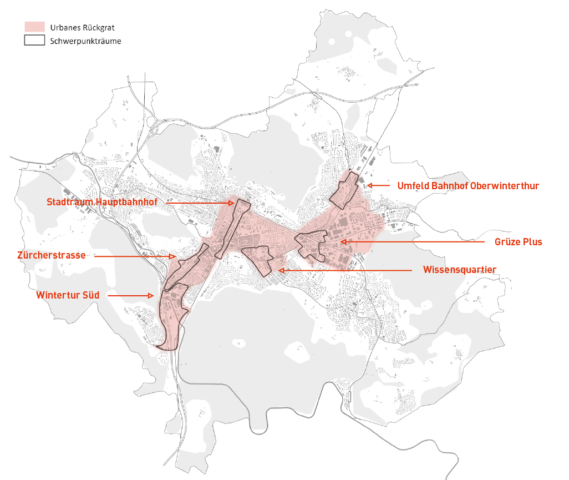
The majority of this development is to be driven and directed within Winterthur’s already very dynamic urban backbone (see diagram), complementing the existing settlement structure. The city is to be densified along the main traffic axes from Töss in the southwest to Oberwinterthur in the northeast and the diversity of uses is to be increased.
Densification along the urban spine From an urban planning perspective, there are six areas with enormous growth and densification potential. The city concentrates on six priority areas along the urban spine (cf. diagram): Winterthur South, Zürcherstrasse, Main Station Urban Area, Knowledge Quarter, Grüze Plus and the surroundings of Oberwinterthur railway station. Here, more living space, new jobs, and additional recreational and cultural spaces are to be created. Attention will be paid to a high quality of supply that enables short distances and thus also contributes to net zero by 2040.
Careful development of the neighbourhoods The existing neighbourhoods will not be forgotten – on the contrary. The spatial focus on high-quality inner development along the urban spine relieves them of the pressure of densification. Selective densification remains possible in suitable locations, so that the residential offer there can also be developed in a diverse manner and the qualities of the outdoor spaces can be improved. The objective set out in the “Spatial Development Perspective Winterthur 2040” to promote so-called “5-minute neighbourhoods” is an important concern of the city and contributes to a sustainable interplay of living, working and open space and thus to maintaining the high quality of life so highly valued today.
In future, Inventx customers will benefit from specific certified expertise around Microsoft Azure solutions and the strengthened partnership between the two companies. Inventx strategically relies on a hybrid approach in the accompaniment of projects in the empowerment of their customers to exploit the full potential of multi-cloud ecosystems. This enables Inventx customers to deliver services in a more agile, efficient, resilient and scalable way, while accelerating their digital transformation. The specific cloud mix in each case ensures that customers are and remain optimally positioned for their needs in the long term.
“We are proud of the confirmation of our expertise. Inventx has maintained an intensive collaboration with Microsoft since 2015. Now the way is clear to expand the Community Cloud we have built up with the Azure Cloud and thus to use the full potential of the cloud,” says Markus Stutz, Cluster Leader Multi-Cloud & PaaS at Inventx.
in 2022, the Microsoft Partner Network (MPN) became a differentiated Microsoft Cloud Partner Program (MCPP). The new programme allows end customers a more detailed and transparent assessment of their service provider’s competencies.
The city of Baden is the focus of a new research project on the reuse of building components at city level, according to a media release. The research programme Buildings and Cities of the Swiss Federal Office of Energy(SFOE) has been implemented with the participation of the Zurich-based company intep (Integrale Planung GmbH) and the Swiss Federal Institute of Technology Zurich(ETH) with Baden as a case study since January.
The project will run for about two years and is largely financed by the SFOE. The city of Baden is contributing about a quarter of the project costs and the Federal Office for the Environment(FOEN) is also participating. “The city of Baden will benefit from tailor-made findings, especially for the city’s own construction projects and the ongoing revision of the land-use planning,” Markus Schneider, the city mayor, is quoted as saying.
In the research project “Re-Use on the way to the net-zero target for buildings”, the focus is not on recycling building components, but on direct reuse in other buildings. For the project, component flows are being modelled, the environmental impact is being determined and the necessary framework conditions and measures for broad application are being systematically recorded, according to a statement from intep.
“The CO2 emissions of a building over its entire service life – i.e. not only during operation but also during construction – are an important and still underestimated potential for the necessary reduction of CO2 emissions to net zero,” Nadja Lavanga, project manager at intep, is quoted as saying.
Christian Vogler, energy coordinator of the city of Baden, names as reduction potentials “the preservation of existing buildings instead of new ones, circular and resource-saving construction methods, the reuse of building components and recycling”.
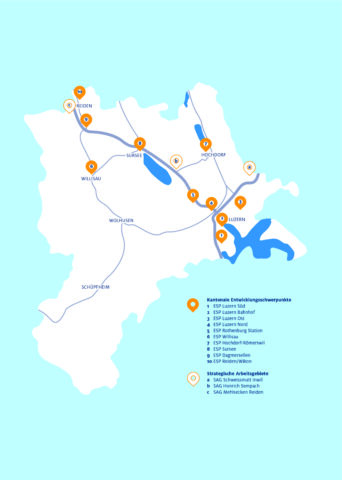
The cantonal development priorities were already defined in the 2009 cantonal structure plan. Even before the Swiss population approved the Spatial Planning Act, the cantonal planners had already focused on an increased spatial concentration of future economic development along the most attractive transport locations. Further planning instruments are available for the more decentralised locations, so that adequate business development is also possible there .
Integral spatial and economic development The coordination of settlement and transport is a central element in the further development of the cantonal development focal points (ESP). Only when infrastructures and growth are in good symbiosis will functioning areas be created in the long term. The optimisation of transport access is often the basis for ESP development. In addition to planning roads and railways, the Canton of Lucerne focuses in particular on promoting sustainable mobility, not least with regard to climate policy goals. The companies, for their part, are called upon to introduce a company mobility management system and to do their part to ensure that traffic can flow optimally.
Instrument for coordinated location promotion Thanks to its central geographical location and constant work on the most important location factors for companies, the Canton of Lucerne is particularly attractive as a business location today. Due to the close cooperation of the canton with the regions and municipalities in location and business promotion, the cantonal ESPs are the most important link to spatial planning. All development focal points should be provided with available, attractive land offers, combined with a promising marketing profile. The basis is laid in the jointly supported area management of the ESPs in cooperation with the landowners and investors.
Strategic working areas as a special offer Strategic working areas (SAG) are coherent larger areas that are defined in the structure plan. There are currently three such areas in the canton of Lucerne. They are between 10 and 30 hectares in size. This is a lot of space to realise big ideas and projects. According to the criteria formulated, their use is reserved for particularly high-value-added companies and real estate developments. The development of the sites is carried out in close coordination with the Canton of Lucerne and the respective local communities. The Lucerne Economic Development Agency acts as the first point of contact for potentially interested parties.
Lucerne city region
ESP Lucerne South Nestled between Lucerne, Horw and Kriens is a diverse settlement area with an urban character and directly adjacent recreational area. The ongoing transformation into an urban, creative and sustainable living and working area is in full swing. Lucerne South has excellent regional and national transport connections. The “Freigleis” bicycle highway is particularly popular as a work and leisure connection. www.luzernsued.ch
ESP Lucerne North The Smart City Lucerne North is where Emmen and Lucerne, the two most populous municipalities in the canton, meet. The urban heart of the ESP perimeter, which stretches from Littau railway station to Waldibrücke railway station, is currently being built around Seetalplatz, which is ideally accessible and picturesquely situated on the Reuss and Kleine Emme rivers. The largest ESP in terms of area offers a wide range of services for businesses and the population. www.luzernnord.ch
ESP Lucerne East The Lucerne East area comprises six Rontal municipalities. Directly connected to the A14 motorway and accessible by all means of transport, Lucerne East lies directly on the axis of the economic areas of Lucerne, Zug and Zurich. In addition to large industrial firms, internationally oriented companies in particular are located here. At the same time, the green hills of the region and the nearby water space of the Reuss River offer local recreation on the doorstep. www.luzernost.ch
ESP Lucerne railway station The world-famous postcardLucerne is the cultural and economic metropolis of Central Switzerland. The project of the century, the through station, will ensure Lucerne’s national and international accessibility in the long term and enable the expansion towards sustainable mobility in the entire metropolitan region. The city centre on the lake will take on a new character as new, unique urban development opportunities are created in the immediate vicinity of the station.
ESP Rothenburg Station This ESP, located in the north of the city region, is characterised by a high location quality and development dynamics and has great potential for further development. An overall settlement and transport concept is currently being developed in a cooperative process, which will form the basis for the future structural, transport-friendly and economic development of the area.
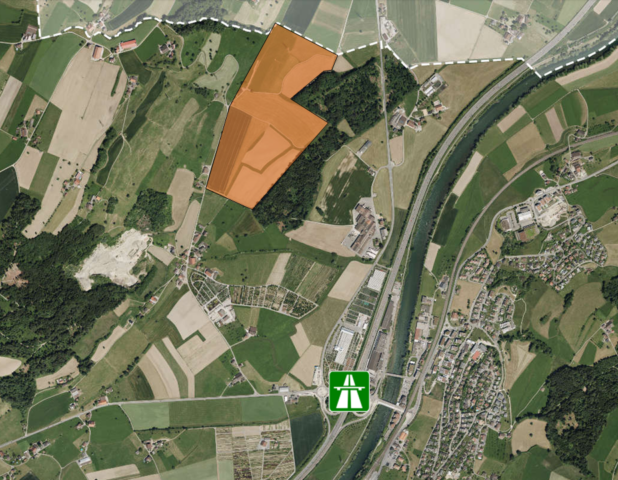
SAG Schweissmatt Inwil The largest of the three strategic working areas in the canton of Lucerne is located in the municipality of Inwil. The almost 30-hectare site is located in the immediate vicinity of the A14 motorway (main transport axis Lucerne-Zug-Zurich) and is in the process of being prepared under planning law for the settlement of a large-scale enterprise with high added value.
Sursee, Seetal, Willisau and Wiggertal regions
ESP Sursee The development of the city and region of Sursee into a modern small-town centre on Lake Sempach has been in the offing for decades. The town is also interesting as a business location. Over the years, numerous companies have settled here, benefiting from the perfect rail and road connections. With its inclusion in the agglomeration programme, the town of Sursee is about to take the next step in its development. From the working area in the north of the town, companies can reach their customers throughout Switzerland within a short time.
ESP Hochdorf-Römerswil Hochdorf is the regional centre of the Lucerne Lake Valley. The high quality of the landscape meets exciting companies here. Industry in particular has settled in the Seetal over the course of time. This has left its mark. Even today, the Seetal is still the region with the highest proportion of second sector companies. The large reserves of building land are a major advantage of the ESP and, in particular, its potential. A utilisation and development concept is currently being drawn up.
ESP Reiden / Wikon The municipalities of Wikon and Reiden are located on the border with Canton Aargau and have excellent transport connections with their own motorway exit to the A2. In addition to the north-south connection, the east-west connection A1 is also in the immediate vicinity. This location and also the industry- and fabric-friendly environment (the ESP borders residential areas at only a few points) make the ESP a highly sought-after location for companies.
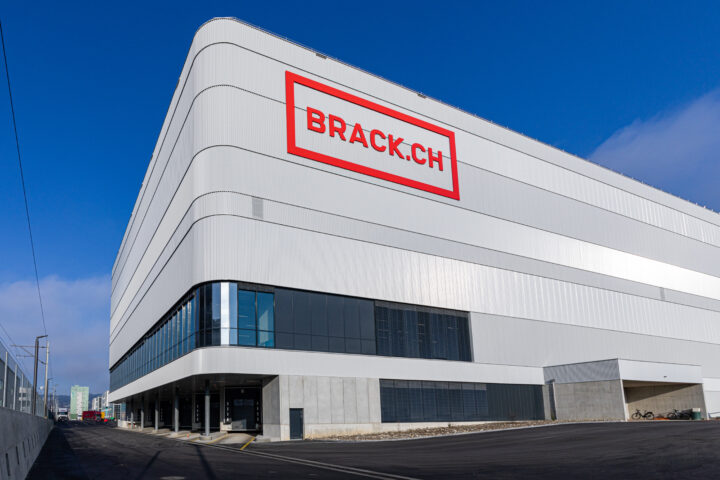
ESP Willisau The pretty little town of Willisau is the regional centre of the Lucerne hinterland. Small and medium-sized commercial and industrial enterprises from various sectors have settled here. Competec Logistik (Brack) is a major newcomer to the area, and the company continues to expand in Willisau. There are still building land reserves, and urban development is underway on the former Wellis site. The spatial and utilisation vision for the Willisau ESP is currently being drawn up for its further development.
ESP Dagmersellen The Dagmersellen development focus has excellent transport connections. It is located in the immediate vicinity of the A2 motorway junction, the railway station is within walking distance, and there is also an industrial railway siding. The ESP is characterised by large industrial companies such as Pan Gas, Misapor, Emmi and Hiestand, and has a large range of warehousing and logistics facilities, especially through Galliker AG. The ESP still has potential for expansion.
SAG Honrich Sempach The strategic working area is located directly on the motorway. Nearby, the old Swiss fought for their independence in the famous Battle of Sempach. The profile is also independent. Where else can companies find 10 hectares of land with a lake view for development today? The Städtli, which was awarded the Wakker Prize, convinces with its high quality. There is one condition: the land is reserved for value-added companies and uses.
SAG Mehlsecken Reiden The location of SAG Reiden could not be more central. Situated between the cities of Basel, Bern, Lucerne and Zurich, it lies at the crossroads of the A2 and A1 motorways that cross the country. The Reiden motorway junction is right next to the site. The approximately 20 hectares of land offer strategic development opportunities for a high-value-added company that would like to take advantage of the favourable location and the high potential for the next big step.
InfraWatt demands that climate neutrality of infrastructure facilities and their fair financing be made mandatory as well as the achievement of the net zero target. This, it says, will make fee financing possible. “Infrastructure facilities want to make an active contribution within the framework of the net-zero strategy by avoiding climate-relevant emissions and also offering further reduction services,” writes the association for energy use from wastewater, waste, waste heat and drinking water in a position paper.
However, many measures are not implemented “because they are not yet part of the core task”. Therefore, the position paper should “outline the principles so that these potentials can be used”. In order to further promote greenhouse gas neutrality, the InfraWatt board has founded the decarbonisation working group.
The association formulates three goals for infrastructure plants: First, they must avoid direct emissions of climate-impacting gases and substances, and second, they must exploit their potential to substitute fossil fuels. Thirdly, “point sources from infrastructure facilities” would have to be used for CO2 removal and offered as a service for negative emissions.
According to the concept, the additional costs for a climate-neutral operation of the facilities should be covered by fees and the expenses for substitution services and negative emissions should be provided as a service. It must be clearly regulated what is to be financed by fees and what the end customers are to pay. Other options, such as the polluter-pays principle, should apply to negative emissions.
The construction industry produces the most waste in Switzerland with a share of 84 percent. This makes it all the more important to establish the so-called circular economy: the materials and products used in construction should be returned to the cycle after the life cycle of a building. The three “R’s” are decisive: reduce, reuse and recycle. In a functioning circular economy, as little waste as possible is produced. However, according to a study by the economic researchers at the Swiss Federal Institute of Technology (KOF) and the Bern University of Applied Sciences (BFH), only 8 to 12 per cent of Swiss companies are involved in the circular economy.
One company that has dedicated itself to precisely this endeavour is Madaster. in 2017, the company was founded in the Netherlands and expanded to Switzerland a year later as its first international location. Madaster sees itself as a cloud platform that enables users to transparently present the data of their construction projects. Users can create a material passport based on a BIM (IFC) or Excel document. This is possible for new buildings as well as for existing properties. Components and materials used are recorded – the system automatically supplements the data with information on recyclability, separability, sustainability as well as financial value, thus creating a valuable data source. Madaster thus enables the planning and use of buildings as raw material storage facilities. In the long term, this should drastically reduce the amount of waste and CO2 emissions during construction.
The industry recognised the added value of this service early on: “More and more builders and their service providers are using the material passport, creating best-practice examples from which the industry can learn. Because those who build circularly build for the future,” explains Marloes Fischer, CEO Madaster Services Switzerland. The company distinguishes between strategic partners, so-called Kennedys, who have supported the development, launch and implementation of the online platform financially and conceptually, and partners that include developers, architects, contractors, consultants, engineers or banks. “11 Kennedys have supported the launch of Madaster in Switzerland. Currently, Madaster has over 30 partners,” Fischer elaborates. In addition to the Federal Office for Energy and the Environment (Bafu), other well-known names such as Eberhard, Mobimo, Pirmin Jung, Integral Baumanagement AG and Swiss Prime Site are listed among Madaster’s partners and Kennedys.
Enormous potential of the circular economy Holcim Switzerland is also one of Madaster’s well-known partners. By 2050, the company wants to produce exclusively climate-neutral and fully recyclable building materials. To achieve this transformation, Holcim is working with various levers and clearly defined interim targets for 2030. The company sees enormous potential in the circular economy to effectively address challenges such as climate change or resource scarcity. With innovative solutions, Holcim returns waste to the material cycle and reuses concrete again and again.
For example, Holcim produces the world’s first resource-efficient cement called Susteno 4. Industrially processed mixed granulate is used as a grinding material. In addition, a large part of the fossil fuels is replaced by alternative materials, such as waste or sewage sludge. Since its launch in 2018, cement has become the second-largest product in the Holcim portfolio with a share of 10 percent. The sustainable concrete Evopact is also based on Susteno cement and saves 10 percent CO2 compared to standard concrete. Holcim aims to generate a quarter of ready-mixed concrete sales with this by 2025. Bettina Kallenbach, Marketing Manager Holcim Central Europe West, is convinced: “Concrete will be difficult to replace in the near future. But concrete is a building material that makes sustainable construction possible on a wide variety of levels – as long as you face up to the challenges.”
Holcim has been dealing with topics such as the circular economy, decarbonisation and renewable energy for a long time. Kallenbach is convinced: “For net zero, Carbon Capture and Use and Storage (CCUS) will be an important lever. Holcim is working on scalable measures and solutions in this regard.” In addition, Holcim already operates several recycling processing plants throughout Switzerland. Together with partners, the company is thus pursuing the goal of processing high-quality new building materials for the respective local market from regional excavated material, concrete and mixed demolition waste. At the same time, this increases the use of alternative raw materials and fuels in cement production and saves primary resources and landfill space throughout Switzerland.
Holcim cites the renovation of the Aroser tunnel as an example: the large quantity of contaminated excavated material is processed at the Untervaz cement plant and made into cement, which is then used in the 300-metre-long tunnel. This closes the building material cycle. With its subsidiary “Geocycle”, the company also significantly reduces CO2. With “co-processing” in the plants, the company ensures the thermal utilisation of combustible waste and recycles mineral waste into new clinker and cement. This enabled the group to save around 150,000 tonnes of CO2 in 2021 by recycling 160,000 tonnes of combustible industrial waste in cement production.
Thanks to Madaster, building materials in existing buildings are given an identity and a value The fact that the circular economy has great potential is also shown by the study mentioned above. According to this study, innovative Switzerland has advantages in creating the transformation and generating sustainable competitive advantages. At present, however, the possibilities and knowledge to adapt existing products and services to a circular economy are often still lacking. The parliamentary initiative “Strengthening the Swiss circular economy” aims to create new framework conditions for a modern and environmentally friendly circular economy. The consultation in October 2022 showed that a large majority welcomes the anchoring of resource conservation and the circular economy in the Environmental Protection Act.
In the construction industry, the focus is currently on recycling, one of several possible entries into circular construction. Fischer says: “The business activities of companies are likely to move increasingly in the direction of manufacturing recyclable products, circular tenders and competitions, and documenting materials and components used in buildings.” Madaster offers a sophisticated tool for the latter in particular. Bettina Kallenbach agrees: “A cadastre of installed materials is an important building block with regard to closing cycles. Future generations must have access to data that shows which building materials are used where and in what quality. This gives building materials in the inventory an identity and a value. Madaster provides the central digital platform for this.”
Considering that Switzerland aims to halve greenhouse gas emissions by 2030 and that emissions from transport, buildings and industry must be reduced by up to 90 per cent to achieve climate neutrality in 2050, sustainable and circular working becomes all the more important. The first companies like Holcim are setting a good example. But here the entire real estate and construction industry has the chance to take a pioneering role.
CO2-enriched recycled concrete EvopactRECARB, which Holcim supplied to V-Zug for the new “Zephyr Ost” building.
Flexible forms of accommodation, so-called flexlodges, could strengthen Graubünden tourism. However, the opportunities that the niche segment offers in addition to the classic accommodation in hotels and holiday apartments have so far hardly been used. According to a press release , scientists from the Institute for Tourism and Leisure at the University of Applied Sciences in Graubünden discovered this on behalf of the Office for Economy and Tourism in Graubünden .
The new forms of accommodation include safari tents and yurts, trailers and buses, as well as sleeping barrels, houseboats and tree houses. They are characterized by their closeness to nature. Compared to hotels and holiday apartments, they offer a better cost/income ratio due to lower investment costs. They also enable operators to react more flexibly to peaks in demand. In addition, Flexlodges appeal to a wide range of target groups. Furthermore, they often provide spectacular and thus particularly media-effective image material for communication and marketing measures.
However, the basic study also shows that the opportunities for innovative business ideas in this area have hardly been exploited to date. Reasons include a lack of orientation for providers and complicated legislation regarding spatial planning. In addition, due to the lack of uniform terms and platforms, the offers are often difficult to find or can only be found by chance. All in all, flexlodges are still not well known.
The scientists therefore recommend the "creation of framework conditions, the promotion of cooperation between the actors involved, the provision of information and the marketing of offers".
Switzerland could generate significantly more electricity from wind energy than previously assumed. According to a study by the Bern-based company Meteotest on behalf of the Swiss Federal Office of Energy ( SFOE ), wind turbines could produce 19 terawatt hours in the winter months alone, according to a press release from the SFOE. In a previous study from 2012, the scientists had assumed 3.7 terawatt hours per year. For comparison: Switzerland consumed a total of 58.11 terawatt hours of electricity in 2021.
With 17.5 terawatt hours, most of the potential lies in the Central Plateau. In the Jura arc and in the large Alpine valleys together, more than 7.8 terawatt hours could be produced per year, in the Alpine region over 4.2 terawatt hours.
Both political conditions and technology have evolved since the last study. Today's wind turbines are taller, have larger rotors and produce much more than older systems. In addition, more areas such as forests and areas in the Federal Inventory of Landscapes and Natural Monuments ( BLN ) are eligible "with the recognition of national interest for wind farms". However, they are subject to higher demands on wind energy production.
"Even a partial expansion of 30 percent of the total wind energy potential – which corresponds to around 1000 wind turbines – could make a significant contribution to a more secure electricity supply in Switzerland and to reducing dependence on foreign countries," says the press release.
Inhabited areas with a buffer of 300 meters, protected landscapes such as moors, national parks and biotopes as well as secret facilities of the Federal Department of Defence, Civil Protection and Sport were excluded from the calculation.
The Federal Office for Armaments wants to set up one of the first small wind and solar systems in Switzerland in the Alpine region next to the middle station of the former military transport cableway above Medel, armasuisse informs in a press release . The test system is intended to test “the suitability of a hybrid system for generating sustainable energy in alpine terrain”, it says there.armasuisse Immobilien has now submitted a corresponding planning application. It can be viewed from August 29th to September 28th at the Municipality of Medel.
The planned small wind turbine with bifacial solar panels is scheduled to go into test operation next autumn. Armasuisse expects a yield of 27 megawatt hours per year for the wind turbine, for the wind flower the estimated annual yield is 35 megawatt hours. Based on the evaluations of the actual results planned for the fourth quarter of 2024, armasuisse wants to decide whether a total of nine hybrid systems will be installed in the La Stadrea area in Surselva. The location offers "good conditions both in terms of existing and no longer used infrastructure, as well as in terms of wind conditions and solar radiation," writes the Federal Office.
Multifunctional building panels made from fiberglass-polymer composites could significantly reduce the energy consumption of buildings. This is the conclusion reached by researchers from the Laboratory for Heat Technology for the Built Environment ( TEBEL ) at the Swiss Federal Institute of Technology in Lausanne ( EPFL ). Such composite materials could become the most important building materials alongside concrete, steel and wood, according to a press release from EPFL.
"With the current construction methods, each building element only fulfills a single function", the assistant professor at the EPFL faculty for architecture, civil and environmental engineering and TEBEL director, Dolaana Khovalyg, is quoted as saying. This is "out of date and labor-intensive and time-consuming". As a result, the conventional construction method is associated with a high proportion of bound energy. Alternative solutions are modular, prefabricated, multifunctional building elements. They could reduce the embodied energy of buildings.
Engineers from TEBEL and the Composite Construction Laboratory have shown that panels made of fiberglass-polymer composites can be used as structural elements in buildings. The team has developed a system in which water circulates through the hollow structures and the panels become elements for underfloor heating. It is also possible to use the hollow cells for electrical lines and ventilation ducts. This would also improve the use of the building space.
Computer simulations on a building in the EPFL Innovation Park have shown that the panels guarantee sufficient thermal efficiency and structural fire resistance. In addition, their construction offers the same room comfort as conventional underfloor heating. Because of the lower water temperature, it would use much less energy.
Eastern Switzerland is certainly the part of the country with the greatest potential for discovery. Development companies have avoided this part of the country for a long time and are gradually discovering its advantages. The growth rates had an inhibiting effect for a long time. But at its core there is a volcano smoldering beneath eastern Switzerland that only needs to be ignited.
Development areas from west to east In the area of site development, eastern Switzerland offers numerous pearls that can be discovered. A conversion area for the Swiss Army is slumbering right next to the Frauenfeld station area. In the canton of Thurgau, however, there is currently a particular focus on the development area in Wil-West near Münchwilen, where in the future commercial and industrial uses, as well as service functions, will have their home on around 200,000 square meters. The G-Werk Bronschhofen industrial and commercial park is close by for new companies. The Uzwil location also has several pearls to show for. The Birkenhof residential development with a supermarket, fitness studio and daycare center was recently built on the Benninger site. With the CUBIC, an innovation campus was built on the Bühler AG site that deserves international renown. The city of Gossau is setting new accents in Sommerau with the expansion area of Aepli Metallbau AG. A (still) sleeping giant is also slumbering in the St. Gallen-West / Gossau-Ost (ASGO) development area: primarily commercial and industrial uses, but also service functions and housing, are to be developed there. The Lerchenfeld-Areal St. Gallen is the new location of the Innovation Park Eastern Switzerland, location of EMPA and the Business Incubator Startfeld. Business areas for start-ups and the high-tech segment are provided here. The first signs of a revitalization of the freight yard area in St. Gallen are recognizable, due to the overriding plans for traffic development (new feeder A1) the area is not available in the medium term. In return, the «lattich» is a national display object for successful temporary use. There is also an area for logistics and commercial use in the Geissberg / Altenwegen-Ost area in St. Gallen. At the St. Fiden station area, the feasibility of covering both the motorway and the track field is currently being evaluated. In the medium term, a new district with uses for research, education, services and living will be created at this location. For this purpose, the areal Bahnhof Nord lies fallow right next to the main station St. Gallen. After planning a test, the canton has issued a moratorium on further planning steps and wants to reserve the area for its educational institutions. In the Herisau station area, too, various office and residential uses are being developed with direct location on the railway tracks, along with the redesign of the station.
Attractive Lake Constance area, Rheintal technology hub The entire Lake Constance area is also of interest. Oberthurgau offers great potential for further conversions with Arbon and Saurer Werk II with its existing factory halls, which are currently used by small and medium-sized SMEs from industry, production and services. In the future, an interesting mix of living, living and working spaces is to be created here. Numerous residential developments – for example in the Raduner area in Horn – will offer further attractive housing options with more or less direct access to Lake Constance. In Rorschach, numerous new apartments and commercial uses will be built on the Feldmühle site – right next to the city train station with the best connections from Zurich to Munich. The developments in St.Margrethen are also worth mentioning, where the new construction of the Stadler Rail production plant is clearly causing a pull – commercial and residential construction is attracting in the community. After all, with the Innoparc in Heerbrugg, Eastern Switzerland has a hotspot for the opto-mechanical industry. A compression project is being planned here. Mention should also be made of the station area in Buchs, where there is a legally binding development plan. The competitive situation in the Eastern Switzerland region remains manageable overall – but the urge to develop has awakened.
Settlement desert in Eastern Switzerland with potential The number of settlements in Eastern Switzerland has collapsed at an above-average rate in recent years. Because so far Eastern Switzerland has not been the first choice for globally successful companies dealing with technologies or knowledge-based corporate functions. There are many reasons. The canton of St. Gallen missed the opportunity to accelerate travel times from the canton's capital to the surrounding centers. The disadvantageous direct taxation of private individuals and companies is also of little help. There was also a lack of development areas, which are now being prepared. The canton of Thurgau, over which the development spills from Zurich via Frauenfeld towards Lake Constance, is a bit better. The two half-cantons of Appenzell Inner- and Outer Rhodes also benefit from the influx of wealthy people from the greater St. Gallen area. But they are hardly relevant for the development of jobs.
Marketing with potential The lack of success in the relocation business of the cantons of Eastern Switzerland depends on a deliberately chosen gap: Eastern Switzerland lacks powerful marketing structures that are effective abroad. Anyone who wants to score points at the location of the competitions has to literally “stand on the mat” within four to 48 hours and present their advantages. That is why other parts of the country have created powerful, cross-cantonal marketing structures (Greater Areas), which, together with the Swiss national marketing, ensure that their corporate landscape is refreshed year after year. Eastern Switzerland operates an area under the brand «St. GallenBodenseeArea », but this has neither budget nor effect. Direct investments would also be a kind of rejuvenation treatment for Eastern Switzerland. New technologies, talents and international structures accelerate the renewal of an economic structure. And the more modern and meaningful jobs there are, the more talent a location will attract.
Eastern Switzerland is on the way there; hesitantly, but with ever better arguments – and above all potential areas.
In the heart of the city of Zurich is the university area with the knowledge and health clusters of the University Hospital Zurich (USZ), the University of Zurich (UZH) and the Swiss Federal Institute of Technology (ETH) Zurich – three successful institutions with a high international reputation. The spatial proximity of the three institutions offers unique opportunities for intensive cooperation, which brings about innovations in research, teaching and medical care. However, numerous buildings in the Zurich center university area no longer meet the requirements of modern hospital, research and teaching operations. The infrastructure has reached its capacity limits. With the generation project at the Zurich Center University Area (HGZZ), the infrastructure of the USZ, UZH and ETH Zurich is being improved and the leading position of the institutions is being secured.
Common vision The “Zurich Center University Area” building project is a Herculean task: “There are three levels of government (federal, canton and city) and three institutions (university, university hospital, ETH) involved,” says Roman Bächtold, head of the HGZZ office, which is responsible for the various projects in the Coordinated university area. “Getting the interests and needs of all these players under one roof, right in the center of Zurich, was and is a special challenge. The potential is enormous. If it succeeds, the population will benefit far beyond Zurich, and not just today and tomorrow, but across generations. ” Zurich has a unique knowledge and health cluster that integrally combines research, teaching and health care in a very small space. It is important to secure and strengthen this advantage. This shared vision made it possible to unite the parties. That was and remains demanding and time-consuming.
Upgrading the quarter The planning goes way back. The main milestones were the location decision in September 2011, the elaboration of a master plan (2012/2013), its approval in August 2014, the tendering and implementation of the study contract for the urban space concept HGZZ (2016/2017). But the adoption of a joint white paper in March 2018 was also an important stopover on the way to our destination. The University of Zurich can be recognized from afar by its green dome. Will it stay that way? – «The green dome remains. But the quarter will be massively upgraded, greener, more accessible, more liveable, ”says Bächtold. And he adds: “There are hardly any projects in Switzerland that are so complex and varied. You come into contact with countless stakeholders from politics, business, the population and the media. This great challenge is appealing and exciting ».
Wir verwenden Cookies zur Unterstützung und Verbesserung unserer Dienste. Mit der Nutzung dieser Website erklären Sie sich mit der Verwendung von Cookies einverstanden. Weitere Informationen finden Sie in unserer Datenschutzerklärung.