Tag: Preisentwicklung

  • HEV real estate survey 2025

    HEV real estate survey 2025

    According to the survey of 432 real estate professionals, interest in property is increasing in almost all market segments. Single-family homes in particular are seeing an increase in demand, which is already above the 2024 level. Condominiums and apartment buildings also remain in demand, while the number of available properties is decreasing.

    The imbalance between supply and demand is leading to a relative shortage, the impact of which varies from region to region. This is most pronounced in densely populated central cantons and growth regions.

    Building land and new construction as bottlenecks
    The high demand for building land illustrates the growing pressure on future construction activity. Over half of those surveyed reported increasing interest in plots of land, but in most regions there is a lack of sufficient building land ready for planning.

    At the same time, construction activity remains too weak to even come close to meeting demand. High construction costs, lengthy approval procedures and a lack of land are dampening momentum. This is structurally exacerbating the supply shortage. A phenomenon that has been apparent for years.

    Price pressure continues
    Three quarters of those surveyed expect prices for residential property to continue to rise in the coming year. The combination of low new construction activity, persistently high demand and political and regulatory hurdles is creating an environment in which price adjustments are becoming the norm. For many buyer households, owning a home is increasingly becoming a math problem, especially as interest rate trends are placing an additional burden on financing.

    Structural stress test for the middle class
    Restricted access to home ownership has a long-term impact on the social structure. For decades, home ownership has been a central pillar of wealth accumulation and retirement provision in Switzerland. If this access is systematically made more difficult, the financial prospects of broad sections of the population will shift, with potential effects on consumer behavior, choice of location and family planning.

    Political and planning levers
    HEV Switzerland is therefore calling for clear political steps to break through the structural delay. Simpler approval procedures, shorter planning periods, less bureaucracy and effective measures against abusive objections. New housing supply can only be created if the regulatory framework is reliable and investment-friendly.

    A market at a turning point
    The survey makes it clear that the real estate market is at a crucial point in 2025. While demand remains robust and confidence in home ownership is unbroken, the structural shortage is jeopardizing the balance of the system. Without a correction, the price spiral threatens to become entrenched, with consequences for entire generations of prospective buyers.

    The coming years will show whether politicians, planners and market players can reverse the trend or whether the bottleneck will become the new normal in the Swiss real estate market.
  • Price development with a split picture

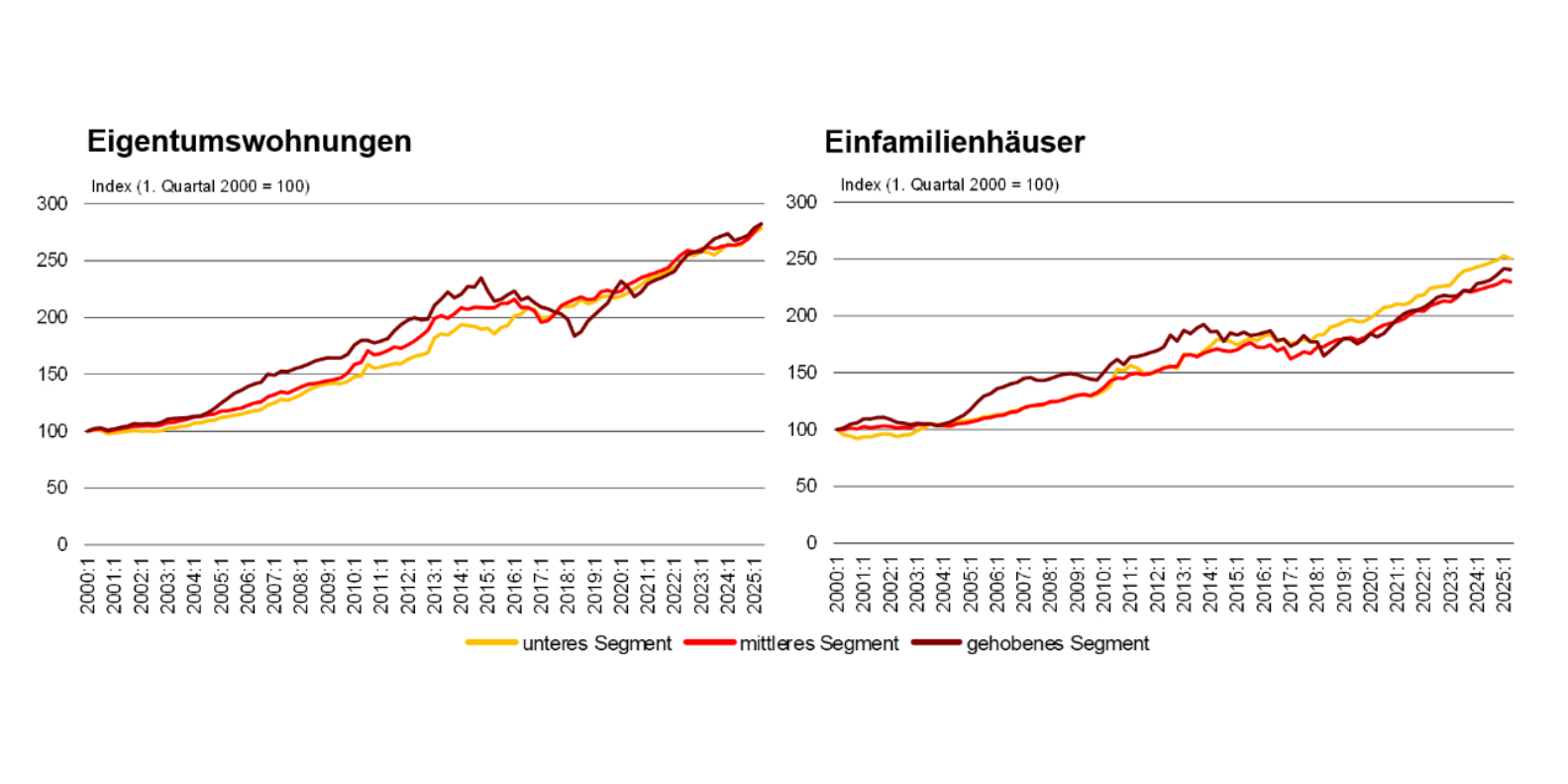
    Price development with a split picture

    According to the latest analyses by Fahrländer Partner Raumentwicklung (FPRE), prices for condominiums rose by 1.7 per cent in the second quarter of 2025 compared to the previous quarter. The middle segment was particularly hard hit with an increase of 2.5 per cent. The lower ( 1.5 %) and upper segments ( 1.2 %) also recorded price increases. A year-on-year comparison shows significant growth, particularly in the regions of Basel ( 9.1 %), Zurich ( 7.9 %) and southern Switzerland ( 7.7 %).

    Single-family homes with stable development
    The situation is different for single-family homes. Compared to the previous quarter, prices have largely stagnated (-0.6 %). The change in the individual segments remains moderately negative, -1.1 per cent in the lower, -0.6 per cent in the middle and -0.4 per cent in the upper market segment. Over the course of a year, however, the average increase is 2.5 per cent.

    Demand exceeds supply
    The sustained demand for housing continues to be met with restrained construction activity. FPRE therefore expects prices to continue to rise over the next twelve months, both for condominiums and single-family homes. Central locations in particular are likely to benefit more. Stefan Fahrländer, Partner at FPRE, summarises: “The demand for residential property remains high, which is reflected in rising prices in almost all regions of Switzerland.”

  • Holiday apartment market in the Alpine region shows stable demand despite price decline

    Holiday apartment market in the Alpine region shows stable demand despite price decline

    The UBS Alpine Property Focus 2025 evaluates the development of the holiday apartment market in the Alpine region. Five Swiss destinations top the price ranking. Engadin/St.Moritz GR takes first place with at least 22,300 francs per square metre. The top 5 are completed by Verbier VS, Zermatt VS, Gstaad BE and Andermatt UR. Prices for Alpine holiday flats rose by 2.3 per cent last year amid high demand.

    The emergence of hybrid forms of work after 2020 triggered the current high demand, according to a press release from UBS. Alpine holiday flats have become around 30 per cent more expensive since 2020. The year 2024 saw subdued price increases in the Alpine region. Prices in French and Italian destinations rose by an average of 4 per cent and in Swiss locations by 3 per cent. In Austria, they fell by 3 per cent.

    “In the short term, the price trend in the Alpine region is likely to weaken further over the next few quarters,” says Maciej Skoczek, property economist at UBS and lead author of the study. Alpine holiday flats are in high demand, but the subdued economic outlook and inflation are weighing on households, says the economist.

    The study assesses the prospects for Swiss property positively. In the face of geopolitical turbulence, this property is very popular as a safe investment. Lower mortgage interest rates and a low supply of holiday flats are also supporting Swiss prices.

    The study sees risks for the holiday apartment market in regulatory intervention: The relaxation of the Second Homes Act is likely to ease the supply situation, while the planned tightening of the Lex Koller will regulate property purchases for foreigners more strictly, according to UBS. These interventions will dampen the price trend in the luxury segment.

  • Home ownership is becoming more expensive

    Home ownership is becoming more expensive

    Prices for owner-occupied residential property rose in the third quarter of 2024 compared to both the previous quarter and the previous year, Raiffeisen Switzerland reported in a press release on the banking group’s latest transaction price index. “The price momentum on the Swiss owner-occupied property market has not weakened any further recently, so its low point is probably behind us,” says chief economist Fredy Hasenmaile. “The already significantly more favourable financing conditions and the prospect of further interest rate cuts should boost demand for residential property.”

    Prices for single-family homes in the quarter under review were 1.6 per cent higher than in the previous quarter. In a year-on-year comparison, the experts at Raiffeisen Switzerland observed an increase of 3.3 per cent. Prices for condominiums were up 0.9 per cent quarter-on-quarter and 2.8 per cent year-on-year.

    In a regional comparison, prices for single-family homes in Central Switzerland rose the most year-on-year at 13.7 per cent. Central Switzerland also led the way for condominiums with an increase of 7.9 per cent. By contrast, prices for single-family homes in the Bern and Lake Geneva regions fell by 2.1 and 3.4 per cent respectively year-on-year.

  • Real estate industry anticipates rising prices for residential properties

    Real estate industry anticipates rising prices for residential properties

    “Confidence is back in the real estate sector and is displacing the negative expectations of the two previous years,” is how KPMG introduces a press release on the latest edition of the consultancy firm’s Swiss Real Estate Sentiment Index. Specifically, the index is now back in positive territory at 29.9 points. However, the approximately 400 real estate experts and valuers surveyed for the index only expect prices in the residential real estate market to rise. They believe that prices for commercial and specialist properties will continue to fall.

    The assessment of economic development is also currently positive again at 21.5 points after two clearly negative years. “The optimistic economic outlook is linked to the easing of interest rates on the one hand and the progress made by the central banks in combating inflation on the other,” Beat Seger, real estate expert at KPMG, is quoted as saying in the press release. In terms of risk perception, stricter regulations have pushed interest rate risks into the background.

    The real estate experts surveyed expect prices to rise, particularly in the Zurich, Lucerne/Zug and Geneva regions. For the Lugano and Basel regions, however, they expect prices to continue to fall. The majority of respondents are also of the opinion that the current political initiatives are exacerbating the shortage of affordable housing.

  • UBS does not expect a seller’s market for property

    UBS does not expect a seller’s market for property

    The proportion of the population that can afford a mid-range home has fallen from around 60 per cent to around 15 per cent over the past 20 years, explains UBS in a press release on its Real Estate Focus 2024. Price increases for condominiums and single-family homes are therefore currently being driven mainly by the influx of affluent people from abroad and strong growth in upper incomes. For the current year, the real estate experts at the big bank expect prices for condominiums to rise by 1.5 per cent and for single-family homes by 1.0 per cent. However, UBS estimates that prices should pick up again from 2025 due to lower financing costs, housing shortages and an improved economy.

    Prices on the market for office space are expected to stabilise at a low level. According to the press release, prices in prime locations fell by 10 to 15 per cent last year. According to the property experts at UBS, the high interest rates are the reason why the price correction has already been completed.

    In the market for multi-family homes, sharp increases in asking rents have so far been able to compensate for the equally increased borrowing costs and the reduced attractiveness of achievable yields. “Accordingly, the purchase prices of apartment buildings have stabilised,” write the UBS experts. They assume that purchase prices will rise again from next year at the latest.

  • No easy task: marketing Swiss luxury properties

    No easy task: marketing Swiss luxury properties

    The price increase in the luxury segment in Switzerland, which reached almost 10 per cent in 2022, is coming to an end. Last year, prices for luxury homes rose by an average of around 2 per cent. Single-family homes in particular slowed down, with an increase of just over 1 per cent in 2023 compared to 8 per cent in the previous year. Growth in condominiums fell from 9 to 3 per cent. Overall, the luxury property market performed slightly weaker than the market as a whole, with prices currently 25 per cent higher than pre-coronavirus levels.

    Little support
    In the current geopolitical situation, Switzerland is considered a safe haven due to its stable institutions and high standard of living, which is a strong attraction. However, luxury property has become more expensive due to the strong franc and price trends, which has dampened international demand. The average wealth of Swiss households (excluding property) has remained unchanged in recent years. Economic growth is not particularly strong, which is affecting demand for high-priced property. According to UBS property economist Katharina Hofer, a slight decline in luxury property prices is expected for the current year.

    Three out of four of the most expensive locations are in the mountains. St. Moritz tops the list with prices per square metre of over CHF 42,000. Gstaad is close behind in the luxury segment (39,000 francs per square metre). Cologny on Lake Geneva records prices of over 35,000 francs per square metre, similar to Verbier. In other municipalities with a high proportion of luxury properties in the Geneva region and on Lake Zurich, luxury properties are priced from CHF 25,000 per square metre. For a property in good condition on 1,500 square metres of land, a purchase price of eight to ten million francs can be expected there. In Ticino, luxury prices start at just under 20,000 francs per square metre.

    Lower-cost locations are gaining ground
    A decade ago, the renowned luxury resorts of St. Moritz, Gstaad and Verbier already held their place at the top of the most expensive Swiss municipalities and were able to defend this position unchallenged. Katharina Hofer explains: “In general, luxury markets, especially traditional ones, show remarkable stability over a longer period of time. Short-term price corrections have been largely offset over the last decade.” In the Lake Zurich and Geneva regions, there have been few changes on average in the ranking of the 100 most expensive Swiss municipalities. The situation is quite different in Central Switzerland, where the municipalities analysed in the canton of Zug have moved up an average of more than 30 places within a decade. This illustrates how attractive the low-tax strategy has long made the location, particularly for people with high incomes and assets. However, the biggest winner of the last ten years is the up-and-coming municipality of Andermatt in the canton of Uri, which is increasingly being perceived as a luxury destination thanks to the construction of numerous high-priced properties. In Ticino, on the other hand, price levels have not been able to keep pace with the other municipalities due to an oversupply of luxury flats.

  • Swiss economy optimistic about the future

    Swiss economy optimistic about the future

    At the start of 2024, the KOF Business Situation Indicator for Switzerland recorded a slight decline, influenced primarily by the slowdown in foreign demand, which is particularly affecting the export industry. Nevertheless, there is cause for hope: companies from various sectors are increasingly positive about their expectations for the near future.

    The lack of demand is particularly noticeable in the manufacturing industry, with more than half of the companies surveyed reporting an inadequate order situation. Although the Swiss franc remains strong, this pressure does not appear to be on the same scale as in 2015. Nevertheless, export prospects are better than in the autumn of the previous year.

    Even though the hospitality industry, wholesalers and financial and insurance service providers are reporting a slight deterioration in their business situation, the situation in the construction, project planning and retail sectors remains stable. The service sectors are even reporting a slight improvement.

    Forecasts for business development over the next six months are more positive overall. Confidence is rising in the manufacturing industry and among service providers in particular. While wholesalers have softened their scepticism, retailers and financial service providers remain cautious.

    Despite the intention to continue hiring staff, companies are now planning to increase their workforce less frequently than at the start of 2023. The difficulty of finding suitable staff remains, although the situation has eased slightly.

    In terms of wage development, companies are expecting a moderate increase in gross wages of less than 2% in the coming year. This reflects a general trend towards lower wage increases.

    There are mixed signals with regard to price trends: while general inflation expectations are falling, companies in some sectors, particularly in the service sector, manufacturing and construction, are planning to increase their sales prices.

    The results of the KOF Economic Surveys are based on the responses of around 4,500 companies from the manufacturing industry, the construction industry and the most important service sectors, which corresponds to a response rate of around 62%.