Tag: Projekte

  • From a peripheral area to an urban neighbourhood with a vision

    From a peripheral area to an urban neighbourhood with a vision

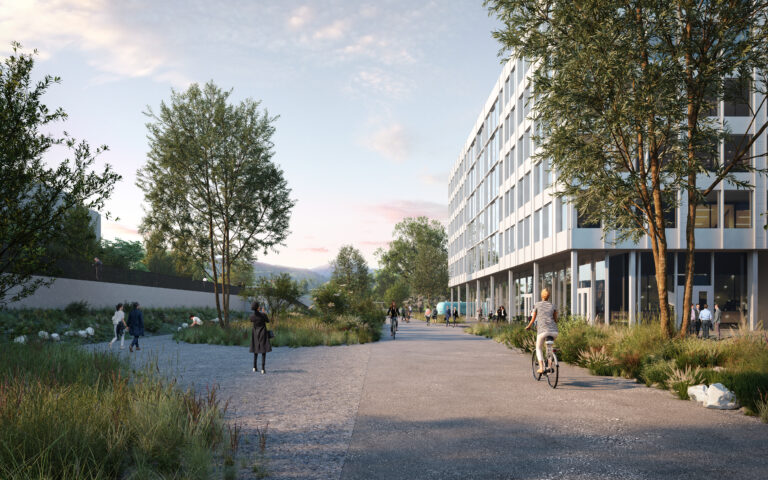
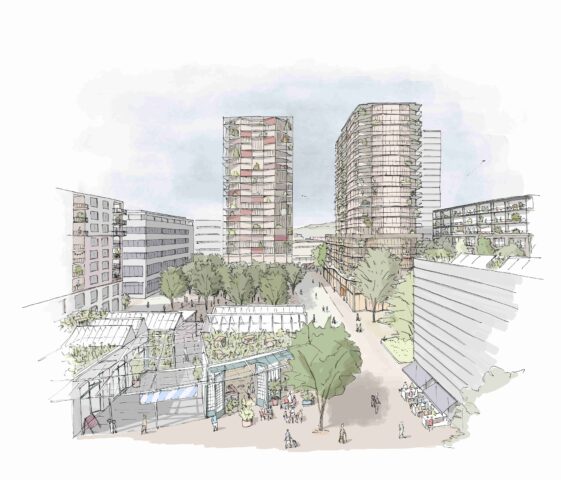
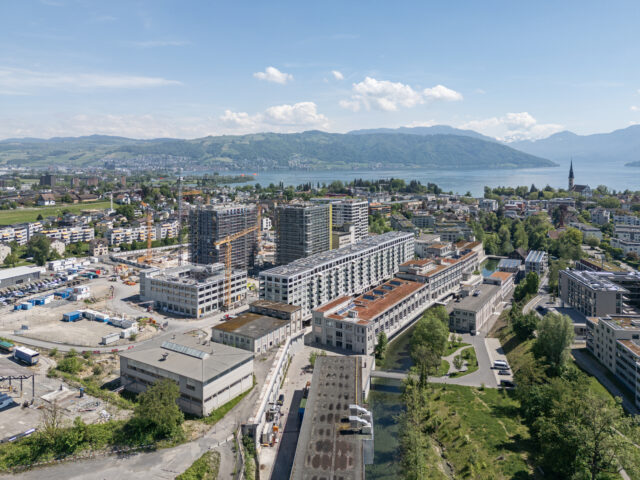
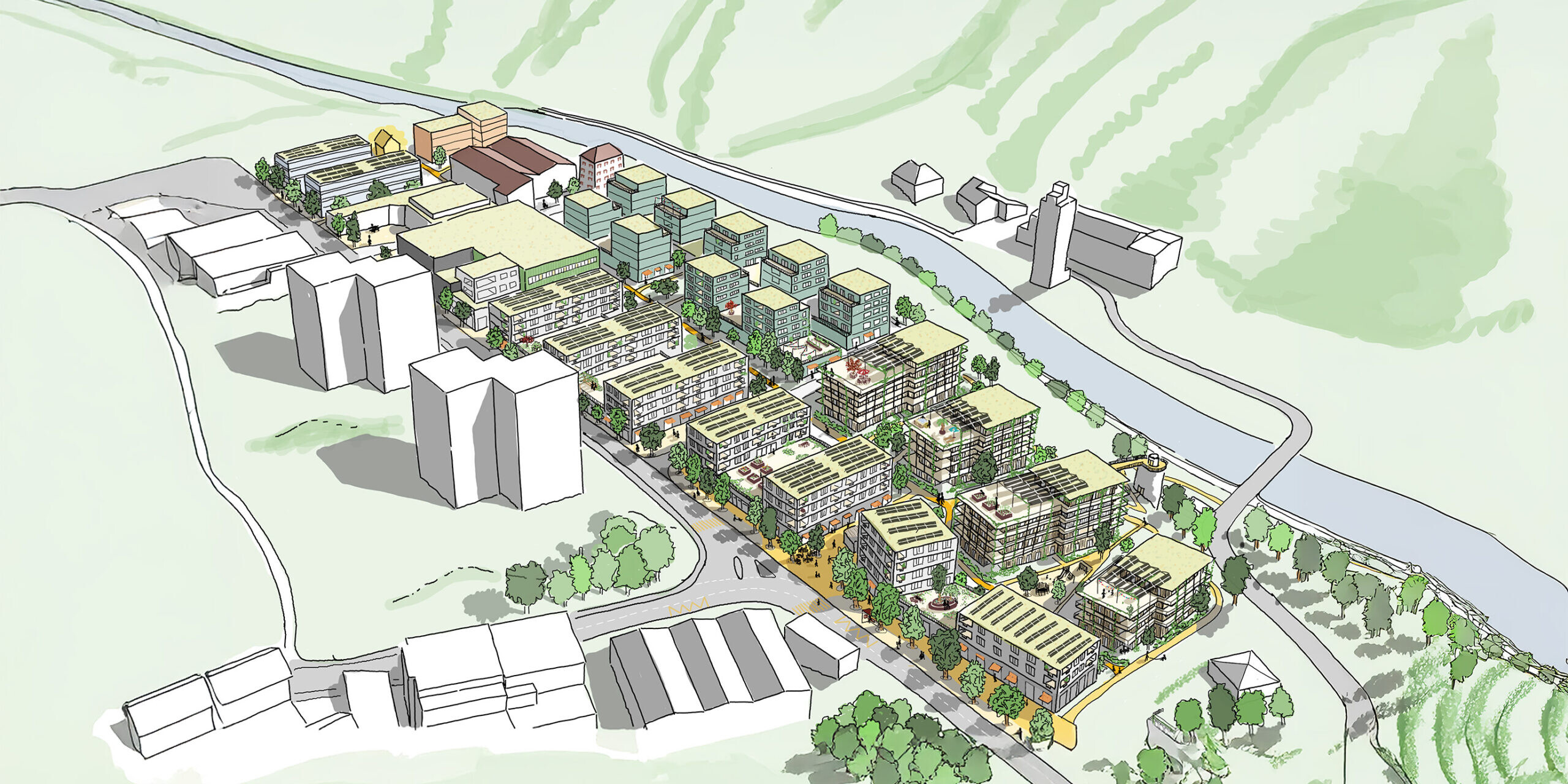
    Buchholz stands for a new urban beginning. On an area of around 36,300 m², an independent urban quarter is being created that combines living, working, exercise and socialising. The previously heterogeneous structure is giving way to a clearly organised mix of uses that combines spatial quality with ecological responsibility. The centrepiece of the development is the “green centre”. A centre with a school, sports facilities and open space, framed by high-rise residential and commercial buildings.

    From industrial site to lively neighbourhood
    The development is the result of a successful study commissioned by the Zurich architecture and planning office helsinkizurich. This formed the basis for a finely balanced indicative project with a development strategy that provides for a staged, in-depth planning process. Realisation will take place in three phases – tailored to the different interests of the owners. Particular attention will be paid to the architectural heritage: elements such as the listed powder tower will be carefully incorporated and respectfully integrated into the urban context.

    Neighbourhood life at the bottom, quality of life at the top
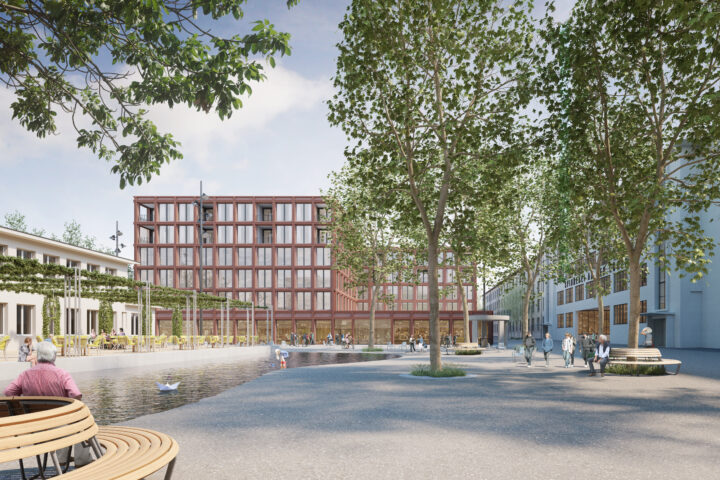
    Commercial uses and communal areas in the plinth zones along Buchholzstrasse characterise the public face of the neighbourhood. Above, light-flooded flats open up wide views of the landscape. Meeting spaces, courtyards and access axes promote social interaction. The graduated public realm allows both retreat and participation, a principle that does justice to urban life.

    Blue-green infrastructure as the backbone
    In the Buchholz neighbourhood, sustainability is not a promise, but a reality. Well thought-out water management with rainwater retention and evaporation areas relieves the burden on the infrastructure and improves the microclimate. Green roofs, permeable paving and climate-active open spaces create quality of life, are ecologically effective and have a convincing design.

    Strong identity, clear address
    The new promenade along Buchholzstrasse not only creates a functional access route, but also an identity-forming address for the new neighbourhood. The district thus positions itself between the scenic Linth area and the urban centre – open, permeable, forward-looking.

    Urban development with impact
    Buchholz is an example of urban development that thinks long-term and takes a differentiated approach. The project creates new living space and a modern form of urban quality on the outskirts of Glarus – networked, sustainable and with a view to the big picture.

  • ProKilowatt 2025 tenders set new standards

    ProKilowatt 2025 tenders set new standards

    The submission phase for projects and programs to increase electricity efficiency in the industrial and service sectors as well as in households has been running since November 2024. With 49 applications submitted by mid-April 2025 alone, interest is around 30 percent higher than in the previous year. A record that underlines the potential for sustainable energy savings.

    Flexibility for companies – paperless and plannable
    The uncomplicated, digital application process and prompt processing within just four weeks make it easier for companies to integrate efficiency projects into their operational planning in a way that fits perfectly. Larger projects with a subsidy of up to six million francs can also be submitted at any time from this year onwards – a milestone for ambitious projects such as the replacement of large production facilities or the bundling of smaller measures.

    Concrete savings
    A project in the retail sector has already been approved for up to six million francs. Replacing existing refrigeration units will save an annual amount of electricity equivalent to the consumption of 4,500 households. Projects in industry also range from the replacement of presses and the optimization of printing machines to more efficient blowers in wastewater treatment plants.

    Competitive tenders as an instrument for the future
    The ProKilowatt program is financed by the Swiss Federal Office of Energy and implemented by CimArk SA in Sion. The subsidy, financed via a surcharge on the high-voltage grids, provides impetus for an energy-saving and competitive economy. The next deadline for project applications is November 2, 2025 – an important date for all companies that want to reduce their energy costs with innovative measures and contribute to the energy transition at the same time.

  • Smart City Aarau Strategy 2034

    Smart City Aarau Strategy 2034

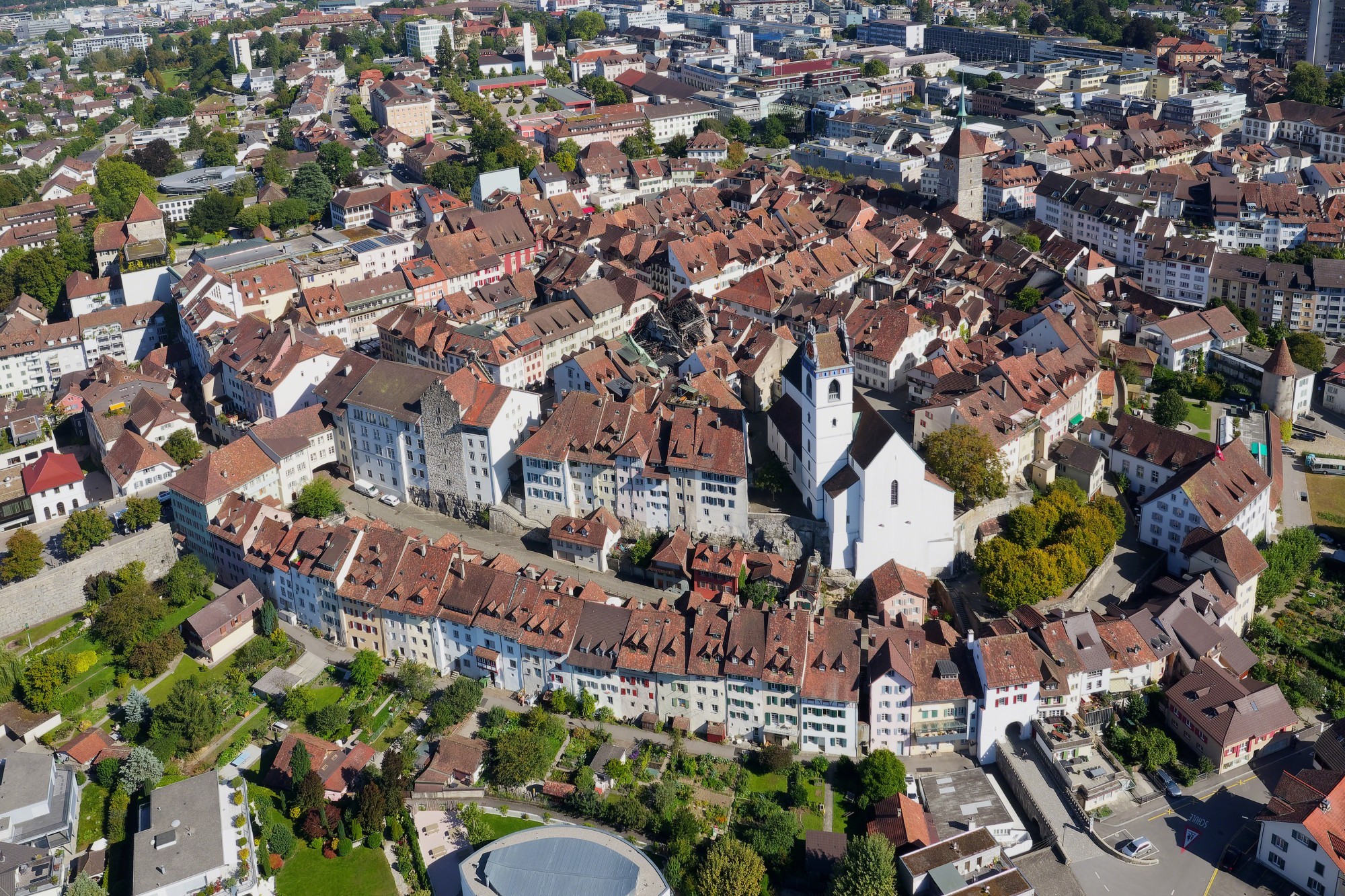
    With “Smart Aarau 2034”, the city is pursuing a forward-looking approach. The strategy does not rely on technological impetus alone, but sees digitalisation as a tool for solving complex challenges. The focus is on the needs of the population, cooperation between departments and resource-efficient implementation. Aarau is orientated towards the city’s existing development goals and integrates smart thinking into all urban projects.

    A methodological framework for real progress
    The change in strategy also means a rethink in terms of implementation. In future, projects will no longer be planned in secret, but developed in dialogue with those affected. A municipal team will provide methodical support to employees. From the initial idea to the actual tested project. Experience from the Smart City period to date shows that this approach is effective if it is applied consistently.

    Smart means networked and usable
    The new strategy puts an end to isolated islands of innovation. Instead, projects should be systemically conceived and networked across the city in future. The goal is a city that utilises its resources efficiently, can react to changes and introduces new solutions where they are actually needed. Digital tools will only be used if they contribute to quality of life or efficiency.

    Effectiveness instead of symbolic politics
    Aarau measures success not by the number of digital projects, but by their impact. The new strategic framework focuses on measurable progress. This applies to implementation, behaviour, awareness and everyday use. This makes smart thinking the new basis for urban development – comprehensible, user-centred and climate-friendly.

  • Business opportunities in the Uri valley floor

    Business opportunities in the Uri valley floor

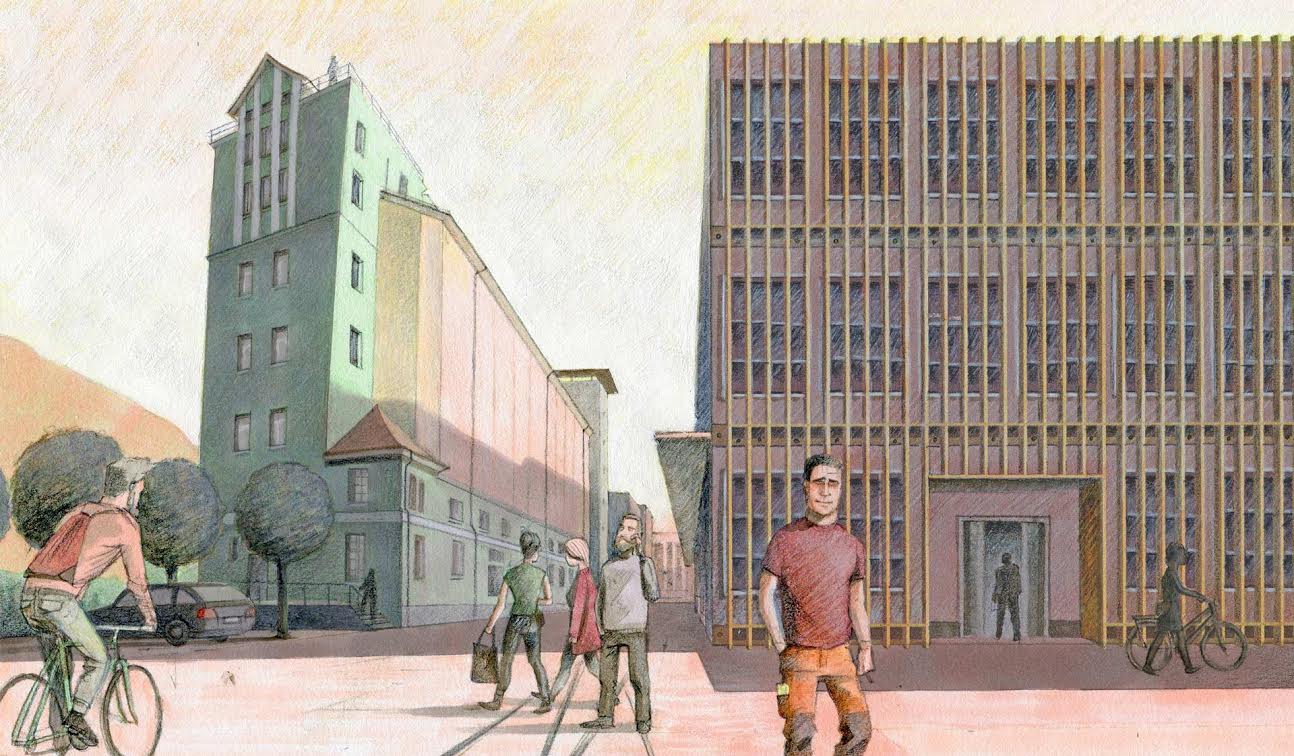
    Werkmatt Uri is one of the last large land reserves in the Uri valley floor. The first industrial uses with a direct railway connection were already established here during the First World War. The listed grain stores designed by architects Eduard Züblin and Robert Maillart in 1912/13 are particularly characteristic. These buildings will be preserved as landmarks and converted into an exhibition centre and art warehouse. The canton is investing in infrastructure to further develop the area between the new Altdorf cantonal railway station and the future Altdorf South motorway junction.

    Optimum location and economic impetus
    Uri is strategically located on the most important European north-south axis with the Gotthard Base Tunnel and the A2 motorway. The immediate proximity to the Altdorf intercity railway station and a modern bus concept promote the accessibility of Werkmatt. The improved accessibility provides impetus for economic and residential projects. With “Vena”, “Cubo” and “Strickermatte”, private investors have realised modern residential developments within walking distance.

    Development with vision
    Kässbohrer Schweiz AG has already recognised the added value of Werkmatt and relocated its headquarters to Altdorf in 2019. The new service building has created 30 qualified jobs in the areas of administration, sales, service, training, final assembly and production of special vehicles, mainly snow groomers. Werkmatt AG is also developing an innovative utilisation concept for building plots 9 and 13. The plans include a multifunctional centre with a business hotel with 80 rooms, co-working spaces, commercial and cultural spaces, restaurants and fitness and recreation areas.

    Targeted planning for sustainable growth
    As the owner, the canton of Uri is striving for a win-win situation with the future owners, users and investors in the area. The plots are to be sold and built on gradually over the next few years. The canton is developing the Werkmatt Uri site in a coordinated manner so that sustainable economic uses are created in the interests of the region as a whole. To this end, it is drawing up guidelines – including those relating to workplace density. The neighbourhood design plan serves as a planning instrument for investors and companies wishing to build on the site, which is binding on the owner and defines the parcel of land. It sets guidelines regarding utilisation, design and infrastructure.

    Success through co-operation
    Werkmatt Uri is an example of coordinated and sustainable site development. Companies benefit from a committed administration, short decision-making processes and needs-orientated solutions. The region expects the project to provide long-term economic impetus and create more than 1,000 jobs.
    Werkmatt Uri is therefore much more than just an industrial area, it is an economic driver and an attractive location for forward-looking companies.

  • Innovation campus in the heart of the Engadin

    Innovation campus in the heart of the Engadin

    The Engadin is known for its cultural diversity and breathtaking nature. At the same time, the region is increasingly focussing on innovation and sustainable development. The InnHub La Punt is a place where research, entrepreneurship and education come together.

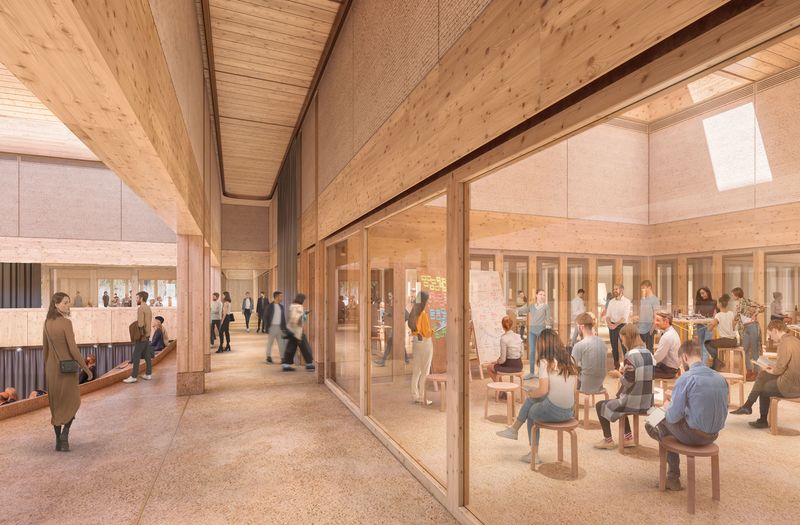
    The centre offers a wide range of uses over an area of 7,700 square metres. These include workshop and classrooms, coworking workspaces, an auditorium with 250 seats, a sports training infrastructure, a spa, a restaurant with bar and lounge, a sports shop, a tourist information centre, 44 hotel rooms and 8 tourist flats. The multifunctional premises create a dynamic environment for innovation and interdisciplinary dialogue.

    Construction begins in spring 2025
    Following a comprehensive planning phase in which the concept was further refined, construction of the InnHub La Punt will begin in spring 2025. The municipality issued the building permit in autumn 2023. The existing buildings will be demolished first, followed by the excavation and construction of the underground car park by summer 2026. The shell will be completed by mid-2027 before the interior work begins. The opening is scheduled for the end of 2028.

    In parallel with the municipality of La Punt Chamues-ch’s future projects, including the road bypass and the renaturation of the Chamuerabach stream, the InnHub will create a new centre that will revitalise the town and provide new impetus.

    Sustainability as a central building block
    A key component of the project is its sustainable approach. The building is being constructed from local wood, granite and lime mortar and is an example of the circular economy and ecologically responsible construction. “The InnHub is a matter close to my heart, as I have lived in the Engadin for years. It is an example of sustainability and innovative construction methods,” emphasised architect Norman Foster in a video message.

    The operation of the campus is also designed to be sustainable. The initiators, including Caspar Copetti, are not focussing on short-term profits, but on long-term positive effects for the region. The InnHub is intended to create new jobs, promote year-round tourism and establish an innovation ecosystem in the Engadin.

    New impetus for the economy and the community
    The InnHub La Punt will not only attract companies, start-ups and skilled workers, but also facilitate strong networking with the local population. The municipality of La Punt Chamues-ch sees the project as an important step for the further development of the region. “The campus will create a cultural and social meeting point in our village. The projects that are being created here will inspire future generations to come to La Punt,” says mayor Peter Tomaschett.

    In addition to the long-term effects for the region, the InnHub offers an InnHub PopUp even before its completion, which can be used as a co-working and event venue for locals, holiday guests and professionals until it opens.

    A milestone for the Engadin
    The InnHub La Punt combines innovation, sustainability and community in a unique way. With a clear focus on responsible development, it will radiate far beyond the Engadin and serve as a model for sustainable innovation centres in the Alpine region. The combination of state-of-the-art architecture, innovative working environments and regional roots makes the InnHub a forward-looking project that will provide new impetus for the Grisons as a business location.

  • Sites in the canton of Zug

    Sites in the canton of Zug

    The cantonal structure plan regulates the main features of the desired spatial developments. It sets out in text and on maps how the cantons and municipalities should develop.

    The need for more affordable living space is recognised by politicians and the canton: In addition to “conventional” flats, flats for families, affordable flats and flats for the elderly are also being built in the various areas.

    A wide variety of site developments are taking place across almost the entire perimeter of the “valley communities”. In addition to the sites, the traffic situation is also being further developed and adapted to the increased utilisation: Examples range from the conversion of bus stops to bypasses to relieve the burden on Cham town centre. This also includes car-sharing concepts, such as at the Papieri site in cooperation with AMAG.

    A lot is also happening in public transport. In future, the Papieri site in Cham is to receive an express bus via the bypass motorway and the Unterfeld Süd site will have a bus stop in the neighbourhood.

    Sustainability plays a decisive role in new projects in particular. The Zug area plays a pioneering role in this respect. The Papieri site in Cham was honoured with the prestigious Watt d’Or award from the Swiss Federal Office of Energy. This emphasises the site’s initiative in the field of renewable energies. A climate-neutral district is being created here that relies entirely on renewable energy sources and covers 75% of its energy requirements on site. The innovative technologies contributing to the high level of energy self-sufficiency include hydroelectric power plants and photovoltaic systems. Geothermal energy is used for heating and cooling.

    The sustainability certificate, awarded by the Swiss Sustainable Building Council to Suurstoffi in Rotkreuz, recognises the sustainable construction methods and holistic planning of the project. The award proves that the highest standards in terms of energy efficiency, mobility and biodiversity have been met. The projects show that Zug not only assumes ecological responsibility, but also serves as a model for forward-looking urban development in Switzerland. By utilising innovative concepts and technologies, the canton of Zug is positioning itself as a pioneer in the sustainable design of urban living spaces.

    The other sites are also impressive. The construction of a high-rise building in timber construction is planned on the Tech Cluster site. The “lighthouse project” called “Project Pi” envisages the construction of an innovative residential tower block. With a height of 80 metres, the plan is to build one of the tallest timber high-rises in Switzerland with affordable flats.

    Baar – Unterfeld Süd
    A mixed-use neighbourhood with around 400 residential units and around 1,000 workplaces is planned for the Unterfeld Süd area. The basic structures were defined by representatives of the population of Baar together with experts under the leadership of the municipality. The development plan for the first of three construction phases was put to the people of Baar for a vote on 22 September 2024. The plan was approved with 74 per cent of votes in favour.

    The realisation of the first stage includes the high-rise building at the Baar Lindenpark light rail station and the neighbouring commercial building. These will be transferred to a joint development plan. The earliest possible start of construction of the first stage is planned for 2025. The remaining building plots will be developed in parallel and realised in subsequent construction phases. According to current planning, Implenia’s project will be completed in 2029, provided the subsequent plans are approved by the relevant authorities and construction proceeds according to plan.

    Hinterberg South (Städtler Allmend)
    The Hinterberg Süd site in the Städtler Allmend employment area in Cham will become a new, lively and easily accessible working and shopping centre for the local population. It offers attractive space for new companies to set up shop and ground-floor uses for the neighbourhood. The upper floors of the office buildings offer flexible spaces that can be customised to the individual needs of future companies.

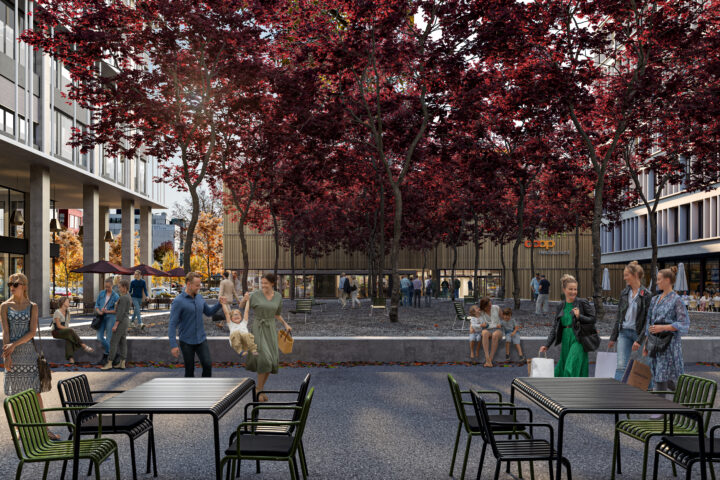
    Publicly accessible uses such as a restaurant, café or bakery are located on the ground floors. They offer workers, shoppers, visitors and passers-by various consumption options and contribute to the revitalisation of the area and the entire neighbourhood. The four buildings surround a public square – the actual centrepiece of the site, which is open to the general public as a place to meet and spend time.

    Bösch Hünenberg
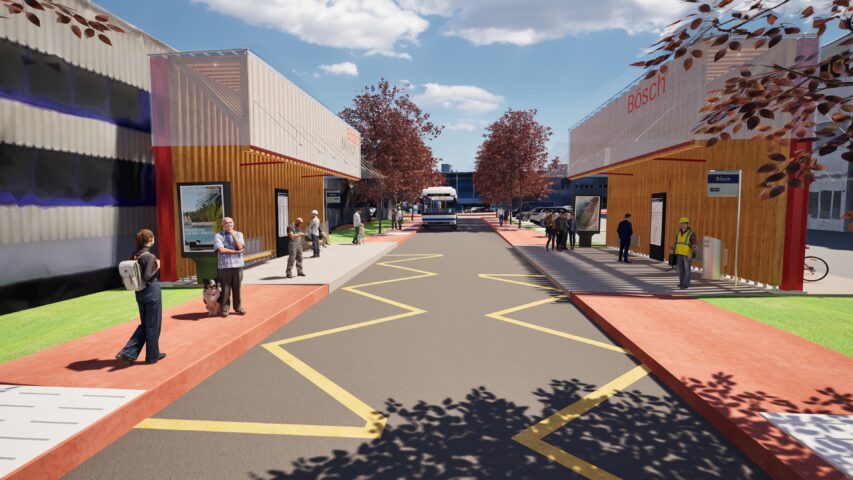
    In order to meet the requirements of a growing service and commercial area, the infrastructure needs to be adapted. The Bösch area should become more attractive for workers and companies and offer space for 6,000 jobs in future. This densification is provided for in the cantonal structure plan. It is binding for the municipality of Hünenberg. The vision is for the Bösch area to develop into a modern and urban place of work that is attractive to investors. To this end, space is to be created through structural densification, which can also lead to an increase in jobs. A holistic landscape design and well-organised mobility will ensure a better quality of life in Bösch. New leisure, supply and catering facilities ideally complement everyday working life in Bösch. On 9 December 2024, the municipal assembly will decide on the road credit of CHF 2.9 million to finance the first stage of the implementation of the operating and design concept in Bösch.

    LG Zug
    Due to its size and prominent location, the LG site is of central importance for the urban perception and urban character of Zug. A lively urban district with a convincing architectural design is to be created on the site of the former industrial area. With the necessary development plan, the planning and building law of the Canton of Zug ensures high-quality development and realisation.

    Papieri Cham
    The Cham Group is developing a new residential and working neighbourhood with industrial charm on the Papieri site. Directly on the River Lorze, the distinctive existing buildings of the former paper factory are being supplemented with striking new buildings and realised in a sustainable way. A new meeting place with supra-regional appeal is being created here, where past and present go hand in hand. A new urban district with around 1,000 flats and 1,000 jobs is being built in several stages over eleven hectares on the site of the former paper factory. It is not being built on a greenfield site, but in the midst of buildings steeped in history: The conversion of characteristic existing buildings preserves the connection to the past – the industrial roots of the neighbourhood remain tangible.

    They are complemented by striking new buildings, including five tower blocks with impressive views. The new neighbourhood directly on the Lorze offers an attractive mix of commercial space, flats, lofts, workplaces, studios, open spaces and public-oriented uses. All of this on a sustainable and well-balanced site that maintains – and continues to write – its own history.

    The Papieri site creates new foundations for an energy-efficient, climate-neutral and sustainable society. It is a pioneering project throughout Switzerland.

    Spinning mill on the Lorze
    Many threads once ran together in the largest spinning mill in Switzerland. The construction of the spinning mill on the River Lorze shaped the development of Baar in the middle of the 19th century. A new, lively neighbourhood with shops, cafés and other local businesses is being created around the historic spinning mill building, which characterises the public pedestrian zone. In addition to family flats and affordable flats, there will also be flats for the elderly. These will be complemented by vegetable gardens, green façades and shady trees.

    Suurstoffi
    The Suurstoffi site was the first site in Switzerland to be awarded the DGNB platinum certificate for sustainable neighbourhoods in planning and construction by the Swiss Sustainable Building Council (SGNI). The DGNB certification confirms that Zug Estates has realised a prime example of sustainable site development with the Suurstoffi site in Rotkreuz. It meets the comprehensive quality requirements of the DGNB certification system, which includes criteria such as energy efficiency, CO2 emissions, life cycle assessment, grey energy, flexibility of use and recyclability of the materials used. The Suurstoffi site is one of the first lighthouse projects of the last 10 years. This also includes the “XUND” health education centre, for which one of the last buildings is currently being completed.

    Tech Cluster
    From June 2018 to May 2019, five renowned Swiss and one Austrian team took part in an overall performance study to explore how affordable living in a high-rise building can be made possible using state-of-the-art construction methods and sustainable materials. At the same time, a study contract was drawn up for an overall urban development concept for the surrounding area of the city of Zug between Baarerstrasse, Göblistrasse, Industriestrasse and Mattenstrasse.

    The Tech Cluster Zug builds on the preliminary investments made by V-Zug and other companies in the Metall Zug Group. Its potential lies in the diverse relationships and synergies between the future users. These will transform the current factory site into an innovative and exciting part of the city of Zug.

  • Zug Economic Area – Facts and Figures Zug

    Zug Economic Area – Facts and Figures Zug

    Located within the Greater Zurich Area (GZA), Zug is one of the world’s leading economic regions. The location boasts an excellent infrastructure, great potential for young talent and political and economic stability.

    Both the municipalities and the canton of Zug are constantly evolving and adapting to the requirements. With innovative projects, such as a bypass to relieve congestion in the centre of Cham, lake water that will regulate the temperature in the houses in residential areas in the future and exciting projects, such as the Association for Decarbonisation or the Climate Charter Zug, the canton is shaping a modern image with ambition.

    Numerous areas of historical significance are being renovated and converted to create attractive mixed-use developments comprising residential, work and commercial space.

    As a result, Zug remains a canton worth living in, which is also reflected in a high level of life satisfaction.

    Zug is not only appreciated by its 133,000 residents, numerous independent ratings and studies also confirm Zug’s outstanding position. For example, Zug has been ranked first among the Swiss cantons in the Credit Suisse and UBS rankings for 24 years. The basic principles of business friendliness, service orientation and a culture of innovation make the canton of Zug an ideal partner for companies, educational institutions and research institutes.

    Testimonials

    Andreas Klopp
    General Manager Roche Diagnostics International AG

    “Rotkreuz is located in the Zurich-Zug life sciences cluster and offers ideal conditions for driving innovation thanks to its excellent infrastructure and high quality of life. For over 50 years, Roche in Rotkreuz has been contributing to the health of patients worldwide with diagnostic solutions.”

    Dr Katja Buller
    Vice President, Head of Corporate Affairs International, Biogen

    “Local and international specialists,
    “Local and international specialists, a multi-layered infrastructure and professional cooperation with the authorities have made the canton of Zug the ideal location for our international headquarters for more than 20 years”

    Katharina Gasser
    President of the Zug Chamber of Commerce

    “Our members appreciate the business-friendly conditions in the dynamic and innovative Canton of Zug. The authorities are service-orientated, make decisions quickly and work efficiently; the unique “spirit of Zug” is palpable.”

    Hanspeter Rhyner
    Chairman of the Executive Board, Zuger Kantonalbank

    “Zuger Kantonalbank combines tradition and modernity. This is precisely the DNA of the attractive location of the Canton of Zug. Digital AND personal –
    this is how we meet the needs of our customers in line with this DNA. And we can fulfil all needs and accompany you through life.”

  • Outstanding projects at the Real Estate Award 2024

    Outstanding projects at the Real Estate Award 2024

    The event begins with a networking aperitif at 5 pm, which offers the opportunity to exchange ideas with leading figures from the industry. The winners in the categories of sustainability, project development/innovation, digital and marketing will then be announced at a gala dinner. The Real Estate Personality of the Year will also be honoured.

    Guest speaker Patrizia Laeri will provide insights into the topics of finance and diversity. Councillor of States and FDP President Thierry Burkart will discuss the current challenges and opportunities in the property sector with Annina Campell.

    Performances by comedian Joël von Mutzenbecher and the rockabilly band ‘the B-Shakers’ round off the evening. The Real Estate Award 2024 offers a varied programme that combines professional exchange with entertainment.

  • Timber construction company introduces new organisational structure

    Timber construction company introduces new organisational structure

    Pirmin Jung Schweiz AG, a timber construction company based in Sursee, wants to revise its organisational structure. According to a press release, the company is aiming for a flexible and agile structure based on the expertise of all employees. According to the press release, decisions will be made directly at the point of decision making, independent of a predetermined hierarchy. A management team of 16 people will take care of strategic decisions. At the same time, the new organisational structure will incorporate and implement ideas from all areas.

    “We are of the opinion that we can successfully master the increasingly complex tasks and issues for us as a company and in the projects if the people with the greatest expertise in the topic work on and decide on the issues in the spirit of Pirmin Jung,” company owner Pirmin Jung is quoted as saying in the press release. “The new organisational form is an agile organism that allows us to react flexibly to challenges and drive innovation. The projects and tasks that we work on as a company are at the heart of our organisation.”

  • Canton of Bern favours solar energy along its roads

    Canton of Bern favours solar energy along its roads

    Two consortia from the cantons of Zurich and Basel were selected from among the applicants, which impressed with their expertise and innovative approaches. The awarding of the projects to the consortium of Elektrizitätswerke des Kantons Zürich (EKZ), Helion AG and mha gmbh as well as the consortium of Industrielle Werke Basel (IWB) and TNC Consulting AG (TNC) marks a decisive step towards promoting renewable energies in the region.

    In particular, the initiative of the EKZ-Helion-mha consortium to erect large-scale solar carports at cantonal motorway service stations represents a double innovation.

    In addition to producing clean energy, these carports help to reduce the use of air conditioning by providing shade. With a planned capacity of almost 8.5 megawatts, they are aiming to realise ten photovoltaic systems and are also exploring the possibility of installing solar panels on noise barriers, retaining walls and a bridge.

    The IWB-TNC consortium is focussing on the installation of almost 1.8 megawatts of photovoltaic systems in the Bernese Oberland region, distributed across various structures such as retaining walls and bridges. The feasibility of these projects is ensured by comprehensive studies.

    The first planning steps for these pioneering solar installations will begin in April 2024, underlining the canton’s commitment to the national Energy Strategy 2050 and to achieving the net-zero target by 2040. This selection process emphasises the Canton of Bern’s desire to take a leading role in the implementation of energy solutions and at the same time promotes the participation of local stakeholders in the energy transition.

  • 4. Competition Gardens & Public Spaces Valais 2024

    4. Competition Gardens & Public Spaces Valais 2024

    The competition is open to innovative and high-quality projects in the field of public spaces and infrastructure that have been realised in the last five years and are open to the public. The prize recognises the work of landscape architects, planners and gardening companies whose projects have strengthened the link between the built and natural environment and enriched the landscape aesthetics of Valais.

    This year’s jury, which is made up of experts from the horticultural sector in western Switzerland, has the task of selecting the most worthy projects by 30 April 2024. The detailed application guidelines can be viewed at www.jardinsuisse-valais.ch

  • New approaches in Swiss environmental and building legislation

    New approaches in Swiss environmental and building legislation

    At a recent meeting, the UREK-N adopted a decisive draft bill by a majority of 14 votes to 8 with one abstention. The draft, which was developed as part of parliamentary initiative 19.409, provides for the right of appeal by associations in the NCHA to be modified so that smaller and medium-sized construction projects, in particular residential buildings with a floor area of less than 400 square metres, are no longer covered by this right. These projects must be located within the building zones in order to be exempt from the regulation. The Commission emphasises that this amendment is in line with the right of appeal enshrined in the Environmental Protection Act (EPA), which only applies to larger projects with environmental impact assessments.

    Despite the approval of the amendment, there was also opposition within the Commission. A minority emphasised the importance of the right of appeal for the protection of historical and natural heritage and spoke out against the changes. Other minorities suggested reducing the reference area to 250 square metres or exempting certain flats from the new regulations.

    In addition to this important legislative amendment, the committee also dealt with the Federal Act on Supervision and Transparency in the Wholesale Energy Markets. The Commission entered into the deliberations without a countermotion, as it recognises the importance of appropriate supervision of these markets, particularly in view of the economic relevance of a secure electricity supply. The need to ensure that Swiss regulations do not deviate unnecessarily from EU requirements was emphasised.

    Furthermore, differences regarding the proposal on the Swiss circular economy, particularly with regard to the relaxation of the municipal waste monopoly, were largely resolved. However, there was still disagreement on the unpackaging of unsold biogenic products.

    In other business, the committee rejected a motion on densification and non-profit housing construction and unanimously submitted a postulate on optimising the use of energy wood. Finally, various umbrella business associations, environmental organisations and industry representatives were consulted on the implementation of the parliamentary initiative “Laying the foundations for a CO2 border adjustment system”.

    The committee meetings took place in Bern under the chairmanship of National Councillor Christian Imark and partly in the presence of Federal Councillor Albert Rösti, and important steps were taken to adapt Swiss environmental and building legislation.

  • Einblick in die Auswahl für zirkuläres Bauen

    Einblick in die Auswahl für zirkuläres Bauen

    Der Schweizerische Ingenieur- und Architektenverein (SIA) hat für seinen erstmalig vergebenen Preis eine Shortlist von neun Projekten und Prozessen veröffentlicht. Emanuel Christ, der Jurypräsident, erläutert den Auswahlprozess und die Kriterien, die für die Nominierungen ausschlaggebend waren.

    In intensiven Diskussionen an zwei Jurytagen wurden 169 Projekte begutachtet und bewertet. Dank einer sorgfältigen Vorbereitung und der Aufteilung der Jury in Arbeitsgruppen konnte jedes Projekt eingehend analysiert werden. Diese Herangehensweise ermöglichte eine effiziente und gründliche Prüfung der Einreichungen.

    Für die Bewertung der Projekte griff die Jury auf die acht Kriterien des Davos Qualitätssystems für Baukultur zurück. Diese umfassenden Kriterien ermöglichten eine multidimensionale Analyse der Projekte und unterstützten die Jury in ihrer interdisziplinären Arbeit. Diese Herangehensweise gewährleistete eine umfassende Betrachtung jedes Projekts, was essenziell für die Bewertung im Bereich Planung und Bau ist.

    Die nominierten Projekte zeichnen sich durch ihre klaren Konzepte, qualitativ hochwertige Umsetzung und überzeugende Präsentation aus. Sie umfassen eine breite Palette von Entwürfen, von kleineren bis zu großangelegten Projekten, die sowohl mit der Landschaft und Natur interagieren als auch klassische Bauprojekte umfassen. Trotz ihrer Vielfalt teilen alle Projekte ein gemeinsames Verständnis für zirkuläres Bauen. Sie reflektieren die Idee, dass Bauen Teil eines ökologischen Kreislaufs ist, unabhängig davon, ob mit neuem oder altem Material gearbeitet wird.

    Christ betont, dass zirkuläres Bauen nicht zu zurückhaltenden Projekten führt, sondern im Gegenteil zu solchen, die einen starken und leidenschaftlichen Gestaltungswillen zeigen. Für ihn persönlich war die Mitwirkung in der Jury eine bereichernde Erfahrung, die ihm neue Einblicke in die aktuelle Baupraxis und die Vielfalt der Planungs- und Bauprojekte in der Schweiz vermittelte.

  • A new chapter is being opened on the former Comadur site

    A new chapter is being opened on the former Comadur site

    High-quality and identity-creating development
    The project vision for the development /
    reuse of the former Comadur site is to develop an urban, mixed-use, identity-creating neighbourhood component with high-quality buildings and open spaces in the short to medium term. Accordingly, the city of Thun and the client (Pension Fund of the Swiss Bar Association (PKSAV)) carried out a multi-stage planning process. The aim was to sound out the potential of the site in a study of design variants, to secure the urban planning qualities as part of a project competition in accordance with SIA Ordinance 142 and to define these under planning law in a zone with planning obligation (ZPP).

    The winning project “Capybara
    The winning project “Capybara” forms the basis for the development of the Comadur site at Bernstrasse 11. It sets new accents in a heterogeneous environment with innovative urban planning and architectural measures. The three characterful buildings – the “Stadthaus”, the “Gartenhaus” and the “Anbau” – merge creatively with the existing structure of the neighbourhood. They form a coherent ensemble that impresses with its density, diversity and clear identities. A central element of the design is the connecting inner courtyard. It not only creates a seamless integration of the new buildings, but also promotes dialogue with the surrounding neighbourhood. The skilful combination of materials, colours and textures creates an interplay between the history of Comadur and the contemporary elements of the project.

    Sustainable design
    The project is of a very high quality in various aspects. In addition to the visible and appealing design, sustainability considerations and the consideration of grey energy as well as a conscious and careful use of materials play an important role. The project offers a balanced mix of aesthetics, sustainability and integration into the existing neighbourhood.

    Diverse and lively “neighbourhood piece
    The focus of the site development is on the realisation of contemporary forms of housing. Around 60 new flats are planned. The residential units are diverse and specifically designed to meet the diverse needs of potential residents. This residential use will be supplemented by additional uses that are adapted to the location and orientated towards the public. In this way, a lively and identity-creating neighbourhood component is being created.

    Conclusion
    The site development at Bernstrasse 11 presents itself as a visionary project that honours the past and at the same time provides forward-looking impetus. The winning project “Capybara” shows how history and the present can be combined in a densely populated area, always focussing on quality and care.

  • Freiburg under the sign of the building sector and energy efficiency

    Freiburg under the sign of the building sector and energy efficiency

    The Fribourg construction sector is part of the bioeconomy, one of the two axes of the canton’s economic strategy. It is proving to be very robust and is prepared for the major upheavals that will result from the challenges of climate change, resource scarcity and digital progress.

    “Whether in the fields of wood construction, metal construction, concrete, plastics, civil engineering or energy efficiency, Fribourg companies enjoy an excellent reputation throughout the country and beyond thanks to their know-how,” says a delighted Olivier Curty, Director of Economic Affairs and Vocational Training for the Canton of Fribourg.

    The players in the sector are supported in their projects and activities in particular by the Building Innovation Cluster, which plays an important role in dynamising the sector, and by the Smart Living Lab, the leading centre of excellence for the future of the built environment. Jerry Krattiger, Director of the Fribourg Economic Development Agency (WIF): “The environment is favourable for the development of partnerships and innovative projects. The framework conditions are excellent, the skills and the will are there… we just have to use them to shape our future!

    Presentation of the magazine
    The 2023 edition of Fribourg Network Fribourg was presented at a panel discussion organised by the WIF in the bluefactory innovation quarter. In the presence of Jacques Boschung, President of Bluefactory Fribourg-Fribourg SA, and Remo Daguati, President of the Swiss Association for Site Management (SVSM), representatives of the Smart Living Lab research and development centre, the companies JPF Holding SA and Lutz Architectes, and the founder of Mobbot shared their experiences and discussed trends, innovation opportunities and challenges in the construction sector.

    Link to the Fribourg Network Fribourg magazine www.fribourgnetwork.ch

  • Jury nominates three projects for the SVIT Award 2023

    Jury nominates three projects for the SVIT Award 2023

    The SVIT AWARD is given to property management companies that have implemented innovative solutions to minor or major challenges in the management of rental properties or condominiums over the last three years.

    The jury assesses the submissions on the basis of three sets of questions:

    • How innovative is the approach?
    • How well can the effect be measured?
    • how easily can the solution approach be transferred and scaled up?

    The selection of the projects for the public vote was not easy. The jury was unanimous in its choice of the projects digital interfaces by Welcome Immobilien, online navigator for housing estates by Previs Immobilien and an app solution for condominiums by Matma Immobilien.

    SVIT members now have until 12 June 2023 to find out about the solutions on the Svit homepage and choose their favourite.

  • “The central location is a big plus”

    “The central location is a big plus”

    Mr. Zettel, what are the goals of the Lucerne Economic Development Agency?

    We pursue three main goals. The first is exciting and good jobs for our population. The second is to generate tax revenue for the services provided by the canton and municipalities. And the third is the positive perception of Lucerne as a business location, both internally and externally.

    What are your responsibilities as Head of Corporate Development?

    As Head of Corporate Development, my main focus is on the existing companies of the Canton of Lucerne. We have just over 30,000 companies and support them in developing positively. Most of our projects with companies revolve around their location. For example, when a company grows, its needs change. In this context, questions about expansions or a change of location may arise. What are currently the biggest challenges facing companies? Issues around limited resources such as building land and commercial space often pose challenges to businesses. Another major issue is currently the shortage of skilled workers and labour. There are currently major uncertainties, such as the Ukraine war or inflation. This also includes issues such as energy prices and supply bottlenecks. These challenges show us once again how dependent we are on what happens outside Switzerland.

    What are currently the most important construction projects in the canton of Lucerne?

    The entire canton of Lucerne has a high level of construction dynamism. A lot is currently going on in the two development focal points of Lucerne North and Lucerne South. The new central cantonal administration is being built in the Smart City Lucerne North. In Lucerne South, many projects are already underway, such as the Nidfeld site or the Pilatus Arena with the Pilatus Tower, Lucerne’s tallest skyscraper. The Horw campus of the Lucerne University of Applied Sciences and Arts will be expanded and renovated by the end of this decade.

    What makes Canton Lucerne an attractive place to live?

    In Canton Lucerne there is something for everyone. We have great places to live and very different regions and landscapes. We have a great city with a wonderful cultural offer. We have lakes, mountains and a tourist offer that is also available to the population. All this makes Lucerne an attractive overall package. Moreover, Lucerne is a manageable place in terms of size. You can integrate well here, we have many clubs and great events. Overall, the quality of life in Lucerne is outstanding.

    What about free and affordable housing in the
    Canton of Lucerne?

    Housing is also an issue in Lucerne. We have a vacancy rate of just under one percent. That is an average value: some communities have practically no vacant flats, in others there are definitely offers. It’s the same with prices: while housing in the city of Lucerne, for example, is relatively expensive, there are also municipalities where there are cheaper offers. At the same time, a lot is being built. That is also the most important thing at the moment: that construction projects are realised and new flats come onto the market quickly.

    Besides the city of Lucerne, which municipalities are particularly popular with companies?

    We have 80 great municipalities in the canton of Lucerne, and each municipality has its own strengths. In terms of the number of companies, the large municipalities in the agglomeration such as Emmen, Kriens, Horw and Ebikon are important locations in addition to the city of Lucerne. Sursee, the second centre of the canton, is also attractive for companies due to its location. But there are also many great companies in regions such as Willisau or Hochdorf, especially in industry. This broad and diverse economic structure is one of Lucerne’s strengths.

    Why should a company come to Lucerne instead of Zurich, Bern or Basel?

    The central location in the middle of Switzerland is a big plus. You can get to Basel or Zurich quickly, but also to Italy or Germany. In addition, we have very attractive corporate taxes, a broad educational landscape and a good skilled workforce.

    Where does Canton Lucerne stand in terms of digitalisation?

    I look at the topic primarily from the perspective of the economic structure. For example, we have many IT service providers who specialise in digitalisation. For most companies, the topic has been around for a long time. But digitisation doesn’t stop there. The transformation into a digital business model is ongoing, and new topics are constantly being added. We also take up these topics. Last year, for example, we co-founded a hub for artificial intelligence. This makes the topic of AI visible and helps companies in its application. We also support companies in networking with suitable partners for digitalisation projects.

    As an economic developer, you have a relatively young profession. What distinguishes this profession for you?

    I come into contact with an incredible number of interesting people – be it from companies, from politics or from the administration. In addition, we are at the source of new ideas and projects. Professionally, this job also has many facets: from business administration to spatial planning and real estate to politics and communication. For me, it is a privilege to be able to do this work.

  • 96. immoTable Lucerne

    96. immoTable Lucerne

    [smartslider3 slider=”14″]

    Monika Schärer welcomed Cantonal Government Councillor Reto Wyss, who informed us about current issues in the Canton of Lucerne. Mr. Zettel, Head of Corporate Development, Lucerne Economic Development, gave an insight into current business and presented current real estate projects. Markus Weber HSLU Co-Director of the Digital Construction course, President of Bauen digital Schweiz showed the potential of BIM, IoT and Lifecycle Data Management. Sabine Ruoss, overall coordinator, and Massimo Guglielmetti, project manager for the Lucerne through station, showed us what is planned and will be built for the through station over the next 20 years. Finally, Clemens Högger from Energie360° showed us a forward-looking and economical energy solution with regard to the energy strategy challenge. At the Apéro Riche, the opportunity to exchange ideas and learn more with the speakers and partners was actively used.

  • A solid 2022 for the Fribourg Cantonal Economic Development Agency

    A solid 2022 for the Fribourg Cantonal Economic Development Agency

    Of the 41 projects supported, 25 are business expansions and 16 are business relocations. Of the 16 relocations, 3 are from Switzerland and 13 from abroad. These include the Japanese company Epson, which has set up in the Marly Innovation Centre, and the Brazilian company Carob House in Fribourg. Among the expansions, the projects of Immomig in Düdingen and Wago Contact in Domdidier are worth mentioning.

    Although the WIF devoted considerable resources to it in 2022, the Rolex project is not included in the figures in the annual report. The project will take shape in 2023 with the finalisation of the spatial planning and construction process and the establishment of temporary production and training facilities. This project of exceptional scope and quality will strengthen Fribourg’s industrial base and accelerate the canton’s competences in the fields of automation, robotisation and, more generally, Industry 4.0.

    Olivier Curty, State Councillor for the Economy and Vocational Training, told the media conference: “Fribourg companies have demonstrated their resilience over the last few years and months, and neither the global pandemic nor the war in Europe can stop them from investing and creating new jobs. The canton of Fribourg is continuing its economic development successfully and vigorously

    WIF Director Jerry Krattiger summarises: “The WIF has had a good year despite the difficult global economic context. After the Council of State defined the bio-economy and Industry 4.0 as the main axes of the cantonal economic development strategy almost three years ago, the Canton of Fribourg has successfully continued its positioning in these areas

    New regional policy with 15 new projects
    Under the 2020-2023 implementation programme of the New Regional Policy (NRP), 15 projects were approved last year, with a contribution of CHF 1.35 million. These projects are divided into the following areas: Community projects (9), programme for mountain regions (3), tourism (2) and new themes (1).

    Work has also started on the NIP implementation programme 2024-2027. Industry and tourism remain the two priority themes. New cross-cutting themes include the local economy, sustainable development and digitalisation. In addition to its usual activities to support the creation, establishment and development of businesses and its activities in the field of NRP, the WIF has finalised the last COVID business support package last year.

  • Together towards the sun

    Together towards the sun

    2021, Bearth & Deplazes Architects were able to accept this award for a multi-purpose building in Fläsch. This is the third time they have been awarded the prestigious prize, which is given for solar buildings that are convincing from an architectural point of view, take into account the careful use of resources and are designed in such a way that they generate more electrical energy than they use themselves

    The company has been dealing with the subject of energy for over 30 years. For them, it is part of designing and building, just like construction. Their buildings clearly reflect that architecture is more than aesthetics for them. That they are concerned with responsibility towards the place, society and the environment.

    They have proven this in Fläsch. The existing multi-purpose building from the 1970s was converted and extended to include a kindergarten and a community hall. The additional rooms nestle up against the existing building to the north and east and are integrated under the extended roof area. Due to seismic safety requirements, the roof had to be replaced, but its original silhouette and ridge point were retained. The orientation of the roof allowed the use of a large-scale PV system, for which the company Reech was commissioned with the planning and technical construction management. In addition to visual aspects, the company’s main focus was on meeting technical requirements. The “Sunskin Roof” in-roof system from Eternit, developed in Switzerland and manufactured in Austria, not only convinced the PV specialists with its energy efficiency, performance and quality. “The resistant double-glass solar modules can be installed even at flat angles of inclination. In addition, they can be walked on, which brings great advantages when maintaining the system,” explains Tamás Szacsvay, Head of Technology & Engineering and Partner at Reech. He also appreciates the good technical support from Eternit and the comprehensive documentation from which all connection details can be taken directly.

    The installation of the handy modules is also quick and easy, as the flexible installation allows work to be carried out from different sides at the same time

    Eternit (Schweiz) AG works closely with architects and technicians when developing new products. This pays off. In this way, constructive, functional and aesthetic aspects flow into the planning process at an early stage. Since 2010, the company has been applying its know-how specifically to the development of frameless photovoltaic systems that are fully integrated both on the roof and on the façade and replace the conventional building envelope. Thanks to well-designed detailed solutions, they also meet the high aesthetic requirements of architects

    The large-scale Eternit solar roof in Fläsch supplies 179,700 kWh/a, 175% more energy than is required for the building’s own needs. The surplus energy of 114,200 kWh/a is used by the neighbouring clinic, which can cover a third of its energy needs with it.
    Thus, through their clever design, the architects have succeeded in strengthening the local ensemble of school building, clinic and multi-purpose building, while integrating a contemporary solution for energy generation and use that is convincing in terms of design and respects the special nature of this location

    “Of course we have to achieve the energy turnaround,” says Daniel Ladner, who, along with Valentin Bearth and Andrea Deplazes, is the third office partner and overall project manager for the construction in Fläsch. “But not at the expense of the townscape. That’s why the design with energy must always be demanded and coordinated with the operator.”

  • The industry is hungry for change

    The industry is hungry for change

    The Branch was founded in 2020. What exactly is the association and what does it do?
    W.S. Seidel: The Branch is a non-profit association that develops new processes and solutions for the further development and increased productivity of the construction and real estate industry and thus promotes the transformation of the industry. The association is broadly based: on the one hand, among its members – organisations from the entire sector, private and public building owners, entrepreneurs, planners, logistics experts and IT specialists. On the other hand, at the level of federal policy: The Branch aims to contribute to the implementation of the goals set by the Federal Council in its 2030 Agenda for Sustainable Development and in its 2050 Energy Strategy.

    What are the goals of The Branch?
    Y.Körber: The Branch is committed to process-related and integrated cooperation within the construction industry. The industry today is very discipline-based, sometimes almost with blinkers. People think mainly in phases, and there is a conspicuous separation between planning and execution. However, cross-disciplinary cooperation would be enormously important. By this we mean, for example, that the different players work together much more closely from the beginning, and that the execution is already taken into account much earlier in the planning. We are working intensively to establish integrated models in the market and to develop basic principles, solutions and answers. Ultimately, this should also lead to more productivity and innovation as well as better results.

    St. Zanetti: We want to use concrete projects to show that new models work. We want to build up a rich inventory of tried and tested instruments. In addition, we organise events where we discuss practice-related questions with the participants.

    How does the cooperation within the association work?
    St. Zanetti: The association is currently organised in eight working groups, which are composed dynamically and deal with different assignments in different subject areas. One of the working groups, for example, deals with the question of how to improve the handling of data in construction projects. We are currently in the process of creating templates, for example for the legally compliant exchange of data. Such templates can save a lot of effort because not every company has to reinvent the wheel.

    How will the success of The Branch be measured in the long term?
    Y. Körber: In the changes that take place in the construction industry.Körber: By the changes we can create in the industry: more innovation, more sustainability, a very concrete change in culture. We can also see that our idea is well received from the growth of the association – in the first three years we have gained over 500 members in German-speaking and French-speaking Switzerland and our board of directors comprises almost 20 people. This also shows that the industry is hungry for change.

    The topic of grey energy and the circular economy is currently very present. What role does it play at The Branch?
    W.S. Seidel: This is one of our core topics. Finding a better way of dealing with grey energy and making building projects more sustainable is only possible through innovation. And innovation needs collective know-how – and thus the cooperation of different disciplines at an early stage.

    St. Zanetti: In the end, you will only be able to achieve a sustainable real estate industry if you think in integrated cycles. Because only then will we know what has happened, what has been built and what emissions are produced. The sustainability goals of the Federal Council can also only be achieved with an integrated view.

    What significance does digitalisation have for The Branch?
    St. Zanetti: Only when we are on the move in an integrated way can we as an industry optimally use and exploit technologies. Digitalisation then in turn supports integrated cooperation. When using technologies, the compatibility of different software and technologies is central. For example, we are dealing with the question of how the interfaces of the systems of different players and in different phases look and how companies must select their software so that data continuity is guaranteed. We also want to set standards for the industry in this area.
    The criticism of proptech companies is often that they do not know the needs of the industry and only provide individual pieces of the puzzle.

    Y. Körber: One of the big challenges for young proptech companies is precisely this fragmented and non-integrated process view in the construction industry. This makes it difficult for start-ups to develop scalable solutions. They develop a solution for one project – and everything is supposed to look different again for the next one. The work of The Branch will also lead to standardisation in this area and make it easier for young companies to develop suitable solutions.

    One question in conclusion: Why are you personally on the board?
    St.Zanetti: I find it exciting to advance topics in a pragmatic format with people from the most diverse companies using very concrete practical examples.

    Y.Körber: I am fascinated by the fact that The Branch shapes innovation and makes it accessible to everyone. The real estate industry is an important pillar of the Swiss economy – our approach therefore serves not only at industry level, but also at national level. That’s what I like to be involved in.

    W.S.Seidel: I am on the board in order to further develop the conflict-laden situation between the various players in the construction industry, as a result of which a lot of added value is lost, into a proactive production and cooperation-promoting culture in the long term, from which everyone benefits.

    Wolf S. Seidel is a lawyer and a proven expert in construction, planning and real estate law. The practical, legal design of integrated project development models is a focus of his current studies and work. He is involved in various committees and organisations that make collaborative and process-optimised forms of realisation available in practice, particularly for Swiss building owners – both public and private.

    Yvette Körber is co-founder of several companies, including Amberg Loglay AG. She has been working successfully in the construction industry for several years and helps the industry to become more efficient with smart and digital construction logistics. She is involved in “The Branch” with the Design Build and Ordering Competence groups.

    Stefan Zanetti has spun off several spin-offs from ETH Zurich; most recently Allthings Technologies AG, an integration and orchestration platform for the real estate industry that seamlessly links numerous systems. He is involved in various committees for a permeable and seamlessly networkable software landscape in the real estate industry in Switzerland and Europe, and is also a regular lecturer on various CAS and MAS training courses.

  • SVSM Award 2022: projects are nominated

    SVSM Award 2022: projects are nominated

    The Swiss Association for Location Management SVSM has been presenting the SVSM Awards annually since 2007. These are awards for particularly innovative projects in the areas of location marketing, location development and business promotion. 14 applications were received for this year's awards – from municipalities, cities and organizations from Lake Constance to Upper Valais. A jury evaluated these based on defined criteria and nominated the following six projects for the 2022 awards:

    • “Big Air Chur” city event – submitted by the city of Chur's business contact point

    • Conversion of the old spinning mill in Lichtensteig – submitted by the Stadtufer cooperative

    • "valais4you" project to promote the immigration of skilled workers –

    submitted by the regional and economic center of Upper Valais

    • Joint project "BIGNIK" to strengthen identification –

    submitted by REGIO Appenzell AR-St.Gallen-Bodensee

    • “Werkstadt Zürisee” to develop the Rütihof workplace area –

    submitted by the city of Wädenswil

    • Launch of the integrated location promotion for the Zurich Oberland –

    Submitted by the Zurich Oberland Promotion Association

    With the nomination, however, the applicants are not yet guaranteed an award: At the end of August, all nominees have the opportunity to present their projects to the jury. The jury consists of the following experts: Katharina Hopp, jury president and board member SVSM; ambassador dr Eric Jakob, Head of the Directorate for Business Promotion SECO; Pascal Jenny, President of Arosa Tourism; Karin Jung, Head of Office for Economy and Labor Canton of St.Gallen; Prof. Dr. Markus Schmidiger, Head of the Real Estate Competence Center

    University of Lucerne; Sonja Wollkopf-Walt, CEO Greater Zurich Area.

    The awards will be presented on Wednesday, November 2, 2022, as part of the hybrid conference "SVSM Dialogue Economic Promotion" in the Capitol cinema in Olten. Incidentally, the location manager of the year is also honored at this event.

  • Women's power for the energy transition

    Women's power for the energy transition

    Im Energiesektor ist der Frauenanteil seit jeher gering, in Führungspositionen erst recht. Die Bedingungen sind für Frauen schwieriger als für Männer. Das beginnt schon bei der Ausbildung, denn Frauen trauen sich immer noch zu selten, mathematisch-naturwissenschaftliche oder technische Berufe zu ergreifen. Dabei bringen sie nicht weniger mathematisches oder technisches Verständnis mit, sind aber gleichzeitig stark am Gemeinwohl und an Innovationen interessiert.  

    Klimabewegung in weiblicher Hand 
    Eine gute Nachricht vorweg: Der Frauenanteil im Bereich der erneuerbaren Energien wächst stärker als im konventionellen Energiesektor. Ein möglicher Grund könnte das steigende Bewusstsein für den Klimawandel sein, denn schlussendlich ist weltweit die Klimabewegung weitgehend weiblich. Zudem geben Frauen als Grund für ihre Berufswahl häufig an, mit ihrer Tätigkeit etwas Sinnvolles tun zu wollen. Frauenpower ist also erwünscht: Denn es ist längst erwiesen, dass Unternehmen von einer vielfältigeren Belegschaft und einem gemischten Führungsteam nachhaltig profitieren.

    Doch wie sieht es eigentlich beim Energielösungsunternehmen Helion aus, dass in einer typischerweise Männer dominierten Branche tätig ist. Oder ist dem überhaupt so? Und wo genau sind die Frauen im Unternehmen zu finden? Wir haben nachgefragt: Derzeit machen Frauen nur 12 Prozent der Belegschaft aus und sind vor allem in den Bereichen Marketing, Öffentlichkeitsarbeit und Personalwesen anzutreffen. Aber nicht nur! Weitere Infos auf www.helion.ch News.

  • «Set planning framework conditions with foresight»

    «Set planning framework conditions with foresight»

    Zur Person
    Balz Halter ist Hauptaktionär und Verwaltungsratspräsident der Halter AG. Die Unternehmensgruppe der Schweizer Bau- und Immobilienwirtschaft beschäftigt rund 320 Mitarbeitende an den Standorten Schlieren, Bern, Basel, Luzern, Lausanne, Genf und St. Gallen. Der Ingenieur ETH und Jurist ist bekannt für Unternehmergeist und Innovationskraft. So hat sein Unternehmen «The Branch», ein Do-Tank und eine Kollaborationsplattform für eine innovative und integrierte Immobilienwelt, initiiert.

    Herr Halter, Ihr Unternehmen ist seit über 100 Jahren am Markt tätig. Was hat sich seither in der Stadtplanung verändert und was ist gleichgeblieben?
    Unverändert ist sicher immer noch die Anziehungskraft von Wirtschaftsmetropolen wie Zürich. Den Drang in die Stadt gab es schon vor 100 Jahren und er ist heute nicht geringer, wahrscheinlich sogar grösser. Es ist immer noch der gleiche Kampf um günstigen Wohnraum. Das wird ein ewiges Thema in allen Städten bleiben. Anders als damals macht man sich heute kaum Gedanken zu einer übergeordneten Stadtplanung und der Frage, wie sich Stadt über ihre politischen Grenzen hinaus entwickeln soll. Mit Aufkommen des Individualverkehrs und Ausbau der S-Bahnen wurde primär in Infrastrukturen gedacht und geplant. Entstanden ist die konturlose Agglomeration, die weder Dorf noch Stadt ist und ihre Identität sucht. Den Herausforderungen des Wachstums und die damit verbundene Not an zahlbaren Wohnraum begegneten unsere Ahnen vor 100 Jahren mit dem internationalen Städtebauwettbewerb Gross-Zürich, der sich weit über die damaligen Stadtgrenzen Zürichs erstreckte. Es wäre höchste Zeit, wieder einen derartigen Wettbewerb angepasst auf die aktuellen Anforderungen und Herausforderungen zu veranstalten.

    Gibt es hier vielleicht einen Wechsel durch die aufkommende Elektromobilität?
    Wir wissen, dass sich etwas verändern wird, aber wir sehen noch zu wenig klar, was da auf uns zukommt. Wie und wann sich Konzepte des Selbstfahrens, motorisierter Individualverkehr im Sharing-Modell kommen wird, wissen wir noch nicht. Wie dieser im Zusammenspiel mit öffentlichen Verkehrsträgern wie Tram, Bus und Bahn funktionieren oder diese sogar teilweise ersetzen werden, können wir noch nicht abschätzen. Es ist jedenfalls anzunehmen, dass diese Entwicklungen Auswirkungen auf die Stadtplanung haben werden, insbesondere auf den öffentlichen Raum. Möglicherweise werden weniger Parkplätze als Umschlagplätze gefragt sein.

    Im Wandel der Mobilität, von der Pferdekutsche bis zum Automobil und vielleicht sogar bis zur künftigen Drohne als individuelles Verkehrsmittel, muss man wie früher auch schon die Strukturen grosszügig planen, dann kann sich Vieles ergeben. Wir sehen gerade vor der Tür in Schlieren mit der Limmattalbahn oder auch im Glatttal die Wiedergeburt der Strassenbahn. Das ist möglich, wenn öffentliche Räume zur Verfügung stehen. Deshalb wäre es falsch, grundsätzlich von einem Paradigmenwechsel auszugehen.

    Faktor Flugzeug und Flughafen – wie strahlt das auf die Region Zürich und die Immobilienprojekte aus?
    Der Flughafen ist ein Treiber für Arbeitsplätze, Wohlstand und Prosperität. Wir verdanken wohl dem Airport Zürich auch, dass Zürich die Wirtschaftsmetropole in der Schweiz ist. Es war damals ein strategischer Entscheid, den Landesflughafen im Gebiet des damaligen Waffenplatzes Kloten-Bülach anzusiedeln. Davon profitieren wir alle heute in hohem Mass. Wir müssen diesen Vorteil weiter nutzen und dem Flughafen mit seiner Hub-Funktion Sorge tragen, so dass er direkte Verbindungen in alle Welt auch nach Corona bieten wird. Das Reisen wird wieder zunehmen, wenn auch nicht in dem rasanten Tempo, wie wir es zuvor erlebt haben. Der Flughafen Zürich hat eine enorm grosse Bedeutung und ich hoffe, dass das auch so bleibt.

    Braucht es einen Flughafenausbau, und falls ja, wie und wann?
    Im Wettbewerb der Volkswirtschaften ist die Schweiz als Binnenland und Exportnation auf diese Stärke angewiesen. Wir müssen den Flughafen als langfristiges Projekt verstehen, dass sich wandelnden Bedürfnissen anpassen kann und muss. Deshalb müssen wir planerisch und regulatorisch die Basis schaffen, dass ein weiterer Ausbau möglich bleiben wird. Ob das dann wirklich geschieht, steht auf einem anderen Blatt. Das können und müssen wir nicht heute oder morgen entscheiden. Aber die Rahmenbedingungen müssen mit Weitsicht gesetzt werden.

    Im Moment sind Lärm und Nachhaltigkeit sowie fossile Brennstoffe grosse Themen. Dank Fortschritt bei neuen Antriebsmodellen und bei der Energiegewinnung wird es auch in der Flugindustrie zu Veränderungen kommen. Es wird andere Kraftstoffe geben, die nachhaltiger sind. Die Lärmbelastung durch den Luftverkehr wird von Jahr zu Jahr weiter sinken. Auch deshalb können und sollten wir Weichen stellen, um einen Airport-Ausbau zu ermöglichen und Wachstum zuzulassen.

    In der Flughafenregion sind Sie zuhause und haben bereits eine Vielzahl an Projektentwicklungen mit Ihrer AG realisiert. Die jüngste in dieser Reihe ist eine Neuüberbauung in Wetzikon in unmittelbarer Nähe zum Bahnhof. Was ist hier der aktuelle Stand und was entsteht dort genau?
    Das Zentrum Metropol, so der Name des Projektes, ist in meinen Augen ein wegweisendes Vorhaben, das als Modell für Zentrumsüberbauungen in Subzentren dienen könnte. Aus der Sicht des Stadtentwicklers ist es deshalb spannend, weil wir es mit der Um- und Neunutzung eines Einkaufszentrums zu tun haben. Shoppingcenter kennt man aus den 1960er und 1970er Jahren und mit dem Projekt Metropol erfolgt in Wetzikon eine Neuinterpretation dieses Modells. Geplant ist ein neuartiges Einkaufskonzept, das auch nach aussen strahlt. Wir bauen einen Stadtbaustein, der die verschiedenen öffentlichen Räume vernetzt und das Leben dort unterstützt. Wir interpretieren Stadt quasi neu. Es wird nicht mehr ein in sich geschlossenes System sein, sondern ein offener, zugänglicher und vielfältiger Ort für alle. Die Nutzungen werden gemischt sein: neben Retail- entstehen Dienstleistungsflächen, Wohnungen sowie Angebote für Coworking und neue Formen des Zusammenarbeitens. Wir streben einen guten Mix an, so dass der Ort lebt, nicht nur zu Büro- oder Geschäftszeiten. Wetzikon soll an Attraktivität gewinnen, gegenüber den grossen Zentren Zürich und Winterthur, so dass die Leute in ihrer Stadt bleiben.

    Stichwort «Digitales Planen und Bauen»: Mit Raumgleiter besitzt Halter hier eine wegweisende und innovative Schwestergesellschaft. Was wird heutzutage noch analog gemacht und was bereits alles digital?
    Raumgleiter ist ein Pionier im Bereich Virtualisierung, digitaler Planungs- und Bauprozesse auf der Basis von 3D-Modellen, respektive des digitalen Zwillings eines Gebäudes. An diesen Themen arbeiten wir bei Raumgleiter, aber eigentlich in allen Unternehmen unserer Gruppe. Doch: Immobilien sind und bleiben real. Deshalb ist deren Realisierung und auch vieles im Betrieb analog und wird es auch in Zukunft bleiben. Die Digitalisierung hilft uns jedoch, die heute sehr komplexen, hoch fragmentierten Bau- und Betriebsprozesse neu zu gestalten. Das Ziel muss sein, dass Gebäude effizienter und nachhaltiger erstellt und betrieben werden können, in hoher Qualität und ausgerichtet auf die tatsächlichen Bedürfnisse ihrer Nutzer. Wir stehen noch am Anfang: die Digitalisierung bietet unserer Industrie jedoch ein enormes Potenzial.

    Welche Rolle spielt dabei der von Ihnen mitinitiierte Do-Tank «The Branch»?
    Im Branch kommen viele verschiedene Beteiligte aus der Bau- und Immobilienwirtschaft zusammen: Unternehmer, Dienstleister, Bauherren, Investoren und finanzierende Institute. Wir als Halter-Gruppe sind auf Planer und Unternehmer angewiesen, wenn es um die Entwicklung und Realisierung von Gebäuden geht. Deshalb müssen wir Partner haben, die denken wie wir und die bereit sind, neue Prozesse, Produkte und Tools zu entwickeln und auszuprobieren. Deshalb laden wir Gleichgesinnte aus der Branche ein, auf unserem Weg in die Digitalisierung mitzumachen und durch innovative Konzepte neue Geschäftsmodelle, Berufsbilder und Plattformen zu schaffen und zu gestalten. Wir sind ein Do-Tank. Es geht nicht nur darum nachzudenken, sondern konkret zu handeln. Das können gemeinsame Pilotprojekte sein oder sogar gemeinsame Unternehmungen. Diese Initiative ist auf sehr offene Ohren gestossen. Wir haben enormen Zulauf von Bauunternehmern, Zulieferern, institutionellen und privaten Investoren und Planern. Wir sind auf einem sehr guten Weg, ein neues Verständnis und neue Denkmodelle in unsere Industrie hineinzubringen. Ziel ist es, über die Innovation hinaus unsere Wirkung zu verbessern, insbesondere auch bezüglich Nachhaltigkeitsaspekten und einer zirkulären Wirtschaft.

    Vieles in der Digitalisierung hängt scheinbar von gemeinsamen Standards ab. Sollten diese national oder besser international sein?
    Ich glaube, man überschätzt die Möglichkeiten einer Standardisierung, eines technokratischen Ansatzes in einer Zeit der sich rasch wandelnden technischen Möglichkeiten. Es ist verführerisch zu sagen, wir handeln alle gleich und wir denken alle gleich. Aber die Bauindustrie ist extrem regional und wenn man diese international und global betrachtet, findet man so viele unterschiedliche Kulturen, Usancen, aber auch Normen und Standards. Man kann sehr viel Energien verschwenden, wenn man versucht, den einen gemeinsamen Standard zu bauen. Man muss sich vielmehr an der Denkweise der Softwareindustrie orientieren. Dort ist nicht die Frage, ob alles nach dem gleichen Modell funktioniert, sondern wie kann man das «Handover» zwischen den verschiedenen Lösungen mit den richtigen Programmierschnitt- stellen hinbekommen. Am Ende werden sich aus diesen technischen Innovationen auch gewisse Industriestandards formieren. Diese sind dann nicht kraft Definition entstanden, sondern aus Bewährtem im Arbeitsalltag.

    Wie schaut Raumplanung und Stadtentwicklung in 20, 50 oder gar 100 Jahren dann aus?
    Ich bin kein «Digital Native» und keiner, der sich in den «Metaverses» herumtreibt. Aber auch zukünftige Generationen werden reale Geschöpfe bleiben und in der analogen Welt leben. Daran wird sich nichts ändern. Deshalb lohnt sich ein Blick zurück und zu schauen, wie Städte vor 100 Jahren gebaut wurden. Sie sind damals menschengerecht geplant und realisiert worden. Wir leben noch heute in diesen Städten und schätzen gerade diese bewährten Stadtstrukturen und Quartiere sehr. Natürlich verändern sich Möglichkeiten und Bedürfnisse. Die Grundstrukturen funktionieren aber noch, die wesentlichen Elemente, die Stadt ausmachen, bleiben die gleichen. Das ist vor allem am öffentlichen Raum abzulesen, den man früher mit Grosszügigkeit und Weitsichtigkeit, aber auch zuweilen mit einer gewissen ‘Verengtheit’ geplant hat. Das sind heute spezifische Qualitäten, die wir sehr schätzen.

    Wenn man Bilder vom Zürcher Bellevue vor 100 Jahren anschaut: Das war ein riesiger Platz, wo nicht viel passierte. Irgendwann kam das Tram, die Pferdekutschen verschwanden und dann sind die Autos, Zweiräder und Busse dazugekommen. Das konnte alles aufgenommen werden und funktionierte. Man muss offen sein für künftige neue Bedürfnisse und auch neue technologische Möglichkeiten. Grosszügige öffentliche Räumen schaffen Identität, Flexibilität und die Chance neue Entwicklungen zuzulassen. Das ist eine Qualität, die auch den Menschen gerecht wird und die die Attraktivität der Stadt ausmacht. Wenn wir an den bewährten Grundelementen weiterarbeiten, wird die Stadt in 100 Jahren zwar grösser und vielzähliger, aber nicht deutlich anders ausschauen. Gewisse Flächen und Räume werden anders bespielt werden als heute. Aber die Anziehungskraft von Städten wird bleiben.

  • Bouygues ES builds digitally and with robots

    Bouygues ES builds digitally and with robots

    Bouygues Energies & Services uses work robots and a version of the digital planning method Building Information Modeling (BIM) on a construction site in Zuchwil, BIM-to-field. According to the press release , both will be used as part of the new RiverNest building in Zuchwil. The center of excellence for renewable energy, which will also be the headquarters of the Helion business unit of Bouygues ES, is currently being built as a timber structure on the site on the Aare.

    On the basis of the coordination and execution plans, the basics for the prefabrication of the pipeline construction and the fastening points were modeled. A logistics concept was also drawn up in order to order all materials for the construction of the systems in the desired quantity and in the required dimensions. According to the press release, planning risks can be minimized and sources of error avoided in this way.

    The Jaibot , a semi-autonomous drilling robot developed by Hilti , was also used for the first time in timber construction at the construction site in Zuchwil. Based on the digital planning data, the Jaibot worked its way through the premises and drilled all the holes required for mounting the suspensions. In doing so, he operated independently within a specified radius and also marked the drilled holes for the respective trade, according to the statement. The robot works much faster than a worker and avoids misinterpretation of the planning data.

    This "does not mean that we no longer need the fitter on the construction site," says Yves Kessler, HVAC Division Manager at Bouygues ES in the Jürasüdfuss region. But he no longer has to be used for "low-quality work" such as drilling holes on suitable construction sites.

  • Location promotion in Switzerland – hybrid conference and awards

    Location promotion in Switzerland – hybrid conference and awards

    With the “SVSM Dialogue” series of events, the Swiss Association for Location Management SVSM imparts specialist knowledge and connects location managers, business developers, real estate experts, spatial planners and other interested parties. At the upcoming spring event, which will take place on March 31, 2022 from 3 p.m. to 6.30 p.m., practical presentations from Upper Valais, the city of Baden and the Wil region will provide valuable technical input for day-to-day work. At the “SVSM Dialogue on Location Management”, three exciting speakers will use case studies to show practical solutions and strategies and discuss current challenges: Thomas Lütolf, Head of Location Promotion City of Baden, will present the regional economic vision of the Baden North district. Anne Rombach-Jung, managing director of REGIO WIL, talks about the future of WILWEST and Esther Schlumpf, project manager at the Upper Valais regional and economic center, deals with the question of whether governance can be a success factor for regional development.

    Be there – on site or via live streaming
    The “SVSM Dialogue Site Management” is held as a hybrid event: The participants either attend the event on site in the unique ambience of the garden hall of the Villa Boveri in Baden or join the event virtually – the entire event is streamed live and offers thanks to a special Event platform also gives virtual participants the opportunity to interact. After registering online, all participants will receive a personal participation link with which they can log into the event via a browser. The event is free for members of the SVSM. Non-members pay a fee of CHF 50. If a membership is registered during or after the event, this amount will be refunded.

    Registration and detailed program:
    https://svsm-standortmanagement.ch/anlaesse

    SVSM Awards for innovative projects
    In addition to the hybrid specialist conferences, the “SVSM Awards” are another focus of the SVSM. These will be awarded again in 2022 after a two-year break due to the pandemic. The awards are aimed at small and large projects – from local to national. The “SVSM Awards” want to make the variety and quality as well as the innovative strength of projects from all over the country visible and thus strengthen the position of the corresponding organizations and initiatives. The “SVSM Awards” are both an incentive and a reward for those involved in the area of location and business development. Projects with a particularly high degree of innovative strength are awarded. Possible examples are location strategies, area developments and corresponding positioning, projects to promote innovation and business clusters, projects to establish or strengthen location brands, promotional activities and campaigns, events that strengthen a location, or organizational development and cooperation models. Applications for the awards are made using an online form. A jury of experts selects the nominated projects from all submissions. The nominees then have the opportunity to present their project to the jury in a virtual session. The announcement of the winning projects and the presentation of the awards will take place as part of the “SVSM Dialogue Economic Promotion” on November 2, 2022.

    Further information and online application:
    https://svsm-standortmanagement.ch/awards

    The umbrella organization for location promotions
    The Swiss Association for Location Management SVSM is a professional association founded in 1998. It enables the interdisciplinary exchange of information and experience, links teaching, research and practice, promotes professionalization in site management and is the contact for questions about site management. The SVSM currently has around 80 members from the areas of location and business development, c, real estate as well as training and further education. Twice a year, the SVSM organizes the hybrid conference “SVSM Dialog”; in spring with a focus on topics related to location promotion, in autumn with a focus on economic development. After a break due to the pandemic, the trade association is again presenting the “SVSM Awards” this year for innovative projects in the area of location management and business development. At the beginning of October, the SVSM – also after a two-year break – once again organizes the popular guided visit to Europe’s largest trade fair for locations and real estate, the Expo Real in Munich.

    Further information on the SVSM:
    https://svsm-standortmanagement.ch

  • Halter AG realizes the VIVO Aesch project

    Halter AG realizes the VIVO Aesch project

    The Halter AG construction group is teaming up with the UBS Sima real estate fund as an investor and future builder to implement the VIVO Aesch project. According to the press release , the legally binding building permit for a new development with residential, commercial and commercial use at the northern entrance to the municipality of Aesch is available. The 15,188 square meter area was used by the previous landowner Victus Real Estate AG as a material storage and transshipment point.

    The new mixed-use development is to be built by 2024, with around 85 percent of the main area being intended for residential use. According to a press release, after the development phase was completed in July, Halter AG was able to win an investor in Balintra for VIVO Aesch. Balintra AG in Basel is a real estate company owned by the UBS Sima real estate fund.

    The new property owner will transfer the project with an investment volume of around 150 million Swiss francs as builder together with Halter as developer and overall provider into the first construction phase from this autumn.

    According to Halter, the project comprises four building units. The 40 meter high VIVOTower at the motorway turn marks the entrance to the municipality of Aesch. On the lower floors, the tower offers space for commercial use and the TowerCafe. In addition, 36 apartments and 80 rental apartments are planned.

    The VIVOHof is another building with mixed use, with areas for small businesses and 36 rental apartments on the upper floors. The VIVOKamm comprises 57 rental apartments with south-facing terraces as well as a common room with access to the neighborhood square. VIVOQube offers a further 55 rental apartments on six floors, mostly maisonette apartments.

    According to Halter AG, the start of marketing for the commercial space is in spring 2022, and for the apartments in spring 2023. Completion is planned for the third quarter of 2024.

  • Hilcona creates a meadow on the roof

    Hilcona creates a meadow on the roof

    Hilcona has created a 1200 square meter roof meadow on the first completed new building at the company’s headquarters in Schaan. According to a press release, the roofs of the five-year expansion will also be planted in an “ecologically valuable” way. “The green areas provide more infiltration areas than concrete-sealed areas, relieve the sewage system and offer essential protection against heavy rain events,” says the Head of Technical Service, Peter Ritzer, in explanation.

    As Hilcona further explains, green roofs are able to hold back and store water. Therefore, when building the new company building, care was taken to seal as little area as possible. They also absorb pollutants such as CO2 and clean water and air. On the other hand, the water on sealed surfaces such as conventional roofs, tar and concrete surfaces immediately drains into the sewer system and onto open floors. That causes floods and floods. The green roofs could cushion this.

    In addition, they heat up less than gravel roofs, for example. They are also more durable and easy to care for. “With the roof meadow we want to give back as much as possible to nature,” says Ritzer.

  • Emmi lays the foundation stone for a new cheese dairy

    Emmi lays the foundation stone for a new cheese dairy

    Emmi is building a modern cheese factory at its location in Emmen for 50 million francs. It will replace the existing cheese dairy building, which is over 40 years old. As stated in a press release , this new building is one of the most important investment projects in Emmi's history. On Thursday, the milk processor celebrated the start of the new project phase with the laying of the foundation stone: the building construction is being tackled. In addition to representatives from Emmi and the project partners, Council of States Damian Müller and Lucerne Councilor Fabian Peter were also present.

    Preparatory work in the area began in November. The groundbreaking took place in January. The building should be ready by the end of the year. Commissioning – initially parallel to the existing cheese dairy – is planned for the end of 2022. The new dairy offers "space for highly professional and resource-saving cheese production," the message continues. In addition, it creates additional capacities in line with the long-term growth plans.

    The Emmi Group has 25 production facilities in Switzerland. The company also has 14 subsidiaries abroad. It is also represented with production facilities in eight of them. Emmi exports its products from Switzerland to around 60 countries. "With regional milk from Central Switzerland, we will be producing even more high-quality cheeses such as our Lucerne cream cheese for the whole world in the future," said CEO Marc Heim.

    "Emmi's investments show great confidence in the regional economy and in the canton of Lucerne as a location," government councilor Peter is quoted as saying. “As an important employer, she also serves as a role model in many ways. We are proud to have Emmi in our region. "

  • Implenia hands over the Dialogplatz in Winterthur

    Implenia hands over the Dialogplatz in Winterthur

    Implenia ceremoniously handed over the dialogue space, which was completed in spring, to the city of Winterthur on June 8th, the real estate company informed in a message . The name of the approximately 5,800 square meter open space in the Lokstadt district of Winterthur goes back to a wage dispute at Sulzer that was settled in 1937. Implenia writes that in the future, the dialogue space should be a central place for meeting and exchanging ideas. "We are very pleased to be able to present the residents of Lokstadt and all Winterthur residents with a great town square and meeting place that can be used in many ways", Adrian Wyss, Head of Implenia's Real Estate Division, is quoted in the press release.

    Implenia developed the dialogue space, which is part of the 21,000 square meter open space in the Lokstadt district, in collaboration with the city of Winterthur. In the course of the takeover, the city will gradually be responsible for the operation and maintenance of the square. Implenia is contributing 6 million francs for future maintenance and renovation costs.

    The square, which is located in a new pedestrian zone, offers a variety of opportunities to stay, meet and play, is further explained in the communication. Specifically, Implenia lists a playground, shady trees, a system for roller sports equipment (pump track), a drinking fountain, seating and a catering area.