Tag: Qualität

  • Five companies are in the final of the Prix SVC Zurich Economic Area

    Five companies are in the final of the Prix SVC Zurich Economic Area

    The finalists for the Prix SVC Zurich Economic Area 2024 have been announced. An independent jury of experts with strong regional roots has decided in favour of Hauenstein AG, Hawa Sliding Solutions AG, Luzi AG, RepRisk AG and Schneider Umweltservices AG, the SVC announced in a press release.

    “I am very much looking forward to the Prix SVC and believe the decision as to who will win the prize has never been as challenging as this year,” said jury president Christopher Blaufelder, Partner at McKinsey & Company Switzerland, in the press release. “We have consistently high-quality companies from a wide range of industries in the final selection.” According to Blaufelder, all of them are characterised by a focus on quality and innovation.

    Hauenstein AG from Rafz ZH relies on the sustainable in-house production of native, hardy plants in its tree nursery and garden centres. Hawa Sliding Solutions AG from Mettmenstetten ZH specialises in sliding solutions for rooms, furniture and façades. Globally active Luzi AG from Dietlikon ZH develops and produces fragrance creations.

    RepRisk AG from Zurich specialises in the identification of business and ESG risks. Schneider Umweltservice AG from Meilen ZH specialises in innovative and environmentally friendly solutions for reuse and recycling.

    The Swiss Venture Club is one of the largest entrepreneurial networks in Switzerland. It awards the Prix SVC in eight regions every two years. The prize honours innovative companies in the region for outstanding achievements that enable sustainable economic success to be realised.

  • Load-bearing capacity and usability of timber buildings

    Load-bearing capacity and usability of timber buildings

    Wooden buildings have already proven their load-bearing capacity in the past: The palace of Knossos on Crete, built around 1700 BC, was constructed with wooden pillars and cedar timbers built horizontally into the walls. It survived a severe earthquake around 1400 BC virtually undamaged. The columns and beams of Greek temples and the framework of the mud-brick walls were made of wood until 600 BC.

    Compliance with the SIA structural standards
    Modern timber constructions guarantee structural safety and serviceability by complying with the SIA structural standards. Specialist planners and timber construction companies vouch for this. Unusual events such as fire and earthquakes are also investigated through analyses in various design situations. The variety of construction timber, wood-based materials and fasteners in combination with modern planning and production tools enables the designer to design an optimised load-bearing structure for every new construction project.

    Research and predictability
    The flammability of wood is widespread, but its behaviour in the event of fire is well researched and predictable. The similar strength properties at high temperatures as well as the low thermal conductivity due to the insulating carbon layer and the escaping water vapour make this building material stand out. The efficient fire safety of timber constructions is confirmed by extensive fire tests. With appropriate dimensioning or in combination with other materials, fire resistances of up to 240 minutes can be easily achieved. In contrast to steel and reinforced concrete constructions, timber constructions remain stable even at extremely high temperatures.

    Fire protection standards for timber components in Switzerland
    Fire-resistant timber components that are protected with non-combustible panels are considered non-combustible according to Swiss fire protection regulations. This shows the recognition of the fire protection authorities for the results of extensive studies, which prove that the combustibility of a building material is not the decisive criterion, but rather that the correct fire protection design of a construction has a greater influence on the fire behaviour. Current regulations permit the use of wood in various construction applications without restrictions and even in high-rise buildings under certain conditions. Timber therefore has a wide range of applications in all building categories and uses.

    Safe timber surfaces in interior spaces
    The requirements for structures in safety-sensitive areas such as vertical escape routes are met by suitable timber components with non-combustible fire protection cladding. Visible wooden surfaces are permitted in interior rooms, with the exception of escape routes.

    Compliance with quality requirements
    Thanks to the “Fire safety and wood” research and development project, which has been running since 2001, comprehensive technical and methodological principles and safe designs for timber components have been developed. An industry-specific quality assurance system defines the fire safety-related quality standards for wood in construction. In Switzerland, high-quality timber buildings are erected in strict compliance with quality requirements. The Lignum documentation on fire protection serves as a guideline and shows the many different ways in which wood can be used to ensure the correct realisation of timber components in small, large or tall buildings. It corresponds to the current state of the art in fire protection in accordance with Swiss regulations.

  • Modernisation and expansion of the south station

    Modernisation and expansion of the south station

    In a densely built-up district such as District 2, the emergency services currently only reach the scene within the critical ten-minute mark in around 60% of cases. The planned expansion and redesign of the southern fire and ambulance station addresses this problem with a comprehensive approach aimed at shortening response times and increasing the efficiency of the services. At the same time, the project aims to enhance the urban development of the area, which is in line with the redesign of the urban space through the demolition of Weststrasse and the new construction of the “Hohe Haus West”.

    The winning project from the architectural competition, “FUCHS”, creates a seamless integration into the existing structure of the fire station. The extension blends in harmoniously with the existing building in terms of both height and alignment and harmoniously completes the perimeter of the block. Particularly noteworthy are the courtyard-side extensions with shed roofs and photovoltaics as well as a setback from the first floor, which give the new building a striking independence. These architectural features make it possible to master the balancing act between preserving the historical heritage and fulfilling state-of-the-art operational requirements.

    The “FUCHS” project not only impresses with its aesthetic and functional integration into the existing building fabric, but also sets new ecological standards. Thanks to the environmentally friendly energy supply, which is based 100 per cent on renewable energies, and the generously dimensioned photovoltaic system on the shed roofs, a contribution is being made to climate protection. In addition, the design optimises the operational processes of Schutz & Rettung Zürich and creates a coherent unit of high spatial quality.

    The project impressively illustrates how the challenges of modern emergency care can be mastered in a historical context through creative and innovative solutions. The careful balancing of the needs of the emergency services and the requirements of heritage conservation has resulted in a project that breaks new ground both functionally and aesthetically. The result is a sustainable infrastructure that meets the requirements of modern emergency services and at the same time makes a valuable contribution to the urban quality of the location.

  • Swiss Chamber of Real Estate Agents strengthens quality standards

    Swiss Chamber of Real Estate Agents strengthens quality standards

    The Swiss Chamber of Real Estate Agents remains on course for success, as was announced at this year’s General Meeting in Zurich. The Board of Directors proudly announced an increase in the number of members to a total of 125. This growth underlines the members’ commitment to the SMK’s high quality standards.

    To become a member and receive the coveted quality label, estate agents must undergo strict quality management procedures and demonstrate their expertise in regular audits.

    As part of the Swiss Real Estate Association, the SMK brings together professional and independent estate agents who are committed to quality, continuous training and fairness in their advice. By establishing quality standards, the SMK actively campaigns against dubious business practices in the property sector.

    Ruedi Tanner, President of SMK, emphasises the importance of quality standards and the added value of the SMK quality label for members: “Our members are characterised by their comprehensive expertise and their commitment to the highest standards. The SMK quality label provides orientation in the market and enables our members to clearly differentiate themselves. At the same time, they can strengthen the trust of their customers with their certificate. The continuous growth in our membership is a direct result of our quality strategy.”

    The Board of Directors, consisting of experienced personalities from the property sector, was confirmed at the Annual General Meeting and continues to promote quality and professionalism in the estate agent sector.

  • Winterthur sets priorities for an attractive interplay of living and working

    Winterthur sets priorities for an attractive interplay of living and working

    Word has spread about the high quality of life in the city of Winterthur. More and more people live, work and study here. The city in the Zurich economic region currently has over 120,000 inhabitants, around 75,000 employees, almost 11,000 university students and around 11,000 students at vocational schools. The municipal forecast predicts a population growth to around 135,000 people by 2040. Winterthur wants to use this growth as an opportunity to develop existing urban qualities by setting spatial priorities.

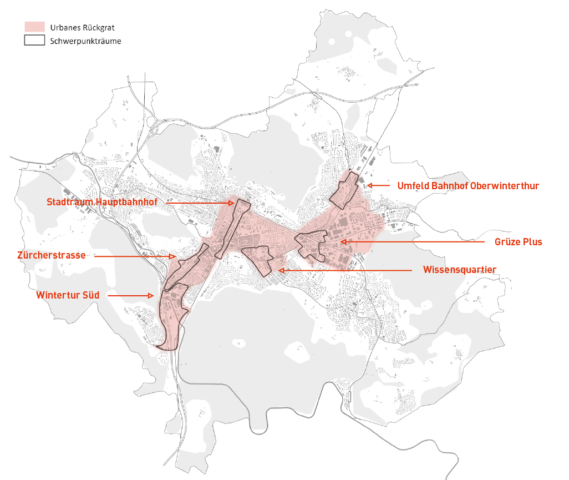
    The majority of this development is to be driven and directed within Winterthur’s already very dynamic urban backbone (see diagram), complementing the existing settlement structure. The city is to be densified along the main traffic axes from Töss in the southwest to Oberwinterthur in the northeast and the diversity of uses is to be increased.

    Densification along the urban spine
    From an urban planning perspective, there are six areas with enormous growth and densification potential. The city concentrates on six priority areas along the urban spine (cf. diagram): Winterthur South, Zürcherstrasse, Main Station Urban Area, Knowledge Quarter, Grüze Plus and the surroundings of Oberwinterthur railway station. Here, more living space, new jobs, and additional recreational and cultural spaces are to be created. Attention will be paid to a high quality of supply that enables short distances and thus also contributes to net zero by 2040.

    Careful development of the neighbourhoods
    The existing neighbourhoods will not be forgotten – on the contrary. The spatial focus on high-quality inner development along the urban spine relieves them of the pressure of densification. Selective densification remains possible in suitable locations, so that the residential offer there can also be developed in a diverse manner and the qualities of the outdoor spaces can be improved. The objective set out in the “Spatial Development Perspective Winterthur 2040” to promote so-called “5-minute neighbourhoods” is an important concern of the city and contributes to a sustainable interplay of living, working and open space and thus to maintaining the high quality of life so highly valued today.

    Office for Urban Development, Winterthur
  • A lighthouse project for Wil

    A lighthouse project for Wil

    The development on Untere Bahnhofstrasse 1-11 is the result of a study commission to meet the high architectural and site planning requirements at this location, which is important in terms of traffic engineering and construction. The location between the railway tracks and Unterer Bahnhofstrasse placed high demands on the organization and floor plans in terms of emissions, living hygiene and quality of living: "In Eastern Switzerland, the first development of this size is being built here, which will be certified for a 2000 watt area," says the project manager Stefan Schreiber from real estate developer Mettler2Invest AG. "The new building eliminates a problem at the train station that has been referred to as a 'scand stain' in the local press for years."

    A new, covered two-wheeler parking facility for over 600 bicycles is being built in the basement. This is operated by the city of Wil and is directly connected to the SBB pedestrian underpass. With 100 units from 1½ to 5½ rooms, the complex offers a wide range of living space, suitable for single households, couples, families and senior citizens. 4100 m2 of space is available for office, service and retail use. The central location directly on the station square and on platform 1 of the SBB offers tenants and customers very good public access. The building is architecturally and economically a lighthouse project for Wil.

  • EWA – energieUri receives quality label

    EWA – energieUri receives quality label

    The association has developed the quality label vsas-certified.swiss in order to promote the profitability, product quality, specialist knowledge and safety of its member companies, writes the Association of Switchgear and Automatic Systems Switzerland ( VSAS ) on its Internet portal. EWA – energieUri has successfully passed the extensive audit to award the certification. This means that the Uri energy supplier is the first company in Switzerland to be awarded certification, writes EWA – energieUri in a press release.

    "We build switchgears of all sizes for customers all over Switzerland", Kilian Huwyler, Head of Switchgear Construction and Automation at EWA, is quoted in the press release. "The spectrum ranges from house panels to complex switchgear for industry." This year, the Uri-based energy service provider looks back on the company's 125th anniversary.