Tag: Quantenphysik

  • Listen to how quantum atoms talk to each other

    Listen to how quantum atoms talk to each other

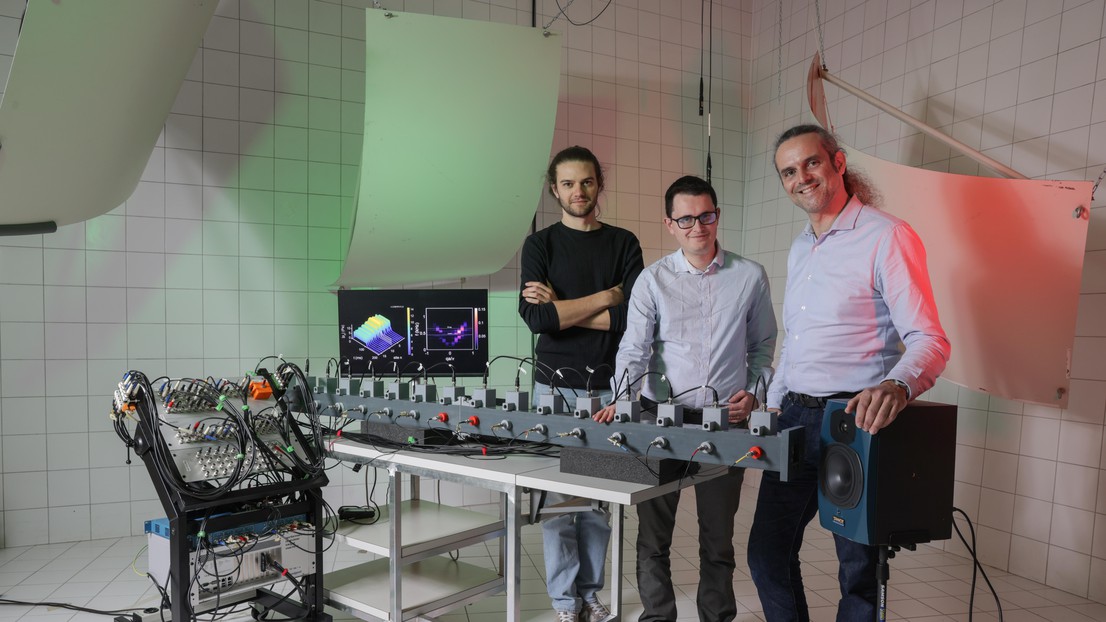
    A scientific milestone is currently being created in the laboratories of the EPFL in Lausanne. An acoustic system that makes it possible to simulate quantum phenomena on an audible, macroscopic level. It was developed by PhD student Mathieu Padlewski together with researchers Hervé Lissek and Romain Fleury. The aim is to make the highly complex states of condensed matter accessible, not via electrons, but via sound waves.

    Metamaterial as a research platform
    The system is based on a so-called acoustic metamaterial, an artificial structure made up of 16 interconnected cubes. The researchers use integrated loudspeakers and microphones to generate and measure specific sound waves. These “acoustic atoms” can be flexibly configured to model a wide variety of physical phenomena, including those that lie beyond the realm of classical solid-state physics.

    Schrödinger’s cat becomes audible
    In contrast to real quantum waves, which are destroyed by every measurement, acoustic waves can be observed and analyzed directly. This allows the quantum concept of superposition, symbolized by Schrödinger’s cat, to be experienced in sound. Just as a voice consists simultaneously of fundamental frequency and harmonics, the EPFL system can make many “acoustic states” audible and measurable at the same time.

    From physics to application
    The potential fields of application range from the development of new types of energy control systems to medical diagnostics. The metamaterial could be tuned to specific frequencies, similar to the human inner ear. A possible way to research hearing disorders such as tinnitus. Even more ambitious is the long-term goal of an “acoustic analog computer”, which, inspired by quantum computing, could process information in superimposed states without risking its decay.

    Switzerland as a location for innovation
    This research highlights Switzerland’s role as a leading location for disruptive science. The combination of basic physics, technology and application visions impressively demonstrates the potential of interdisciplinary research. For investors, developers and innovation promoters, there are new opportunities to establish acoustic technologies as scalable alternatives in the fields of computing, sensor technology and materials technology.

  • Quantum entanglement – the ultra-fast dance of particles

    Quantum entanglement – the ultra-fast dance of particles

    Quantum entanglement occurs when two or more particles remain in a state in which the state of one particle is inextricably linked to that of the other. This connection remains even over large distances, so that a change to one particle has an immediate effect on the other. Albert Einstein described this effect as “spooky action at a distance.” This fundamental property of quantum physics is an important building block for many pioneering applications.

    The role of time in quantum entanglement
    Although quantum entanglement is extremely fast, it is not instantaneous. Using high-precision measurement methods, TU Wien has established that the formation of entanglement takes place over a period of attoseconds. The research shows that although quantum processes have an immediate effect, they can be measured over time. A laser pulse releases an electron from an atom, causing another electron to be put into a higher energy state – these two electrons are then entangled.

    Measuring attoseconds – a glimpse into the unimaginable
    The time span in which quantum entanglement takes place is so short that it is measured in attoseconds – a billionth of a billionth of a second. These measurements were carried out using advanced simulations and ultrashort laser pulses and revealed that the “birth time” of electron entanglement is 232 attoseconds. This advance allows researchers to directly observe the dynamics of these ultrashort processes and recreate them in experiments.

    Simulations at the attosecond level – a breakthrough in quantum research
    By combining simulations and experiments, researchers at TU Wien were able to precisely reproduce the process of quantum entanglement. The results, published in “Physical Review Letters”, are considered a milestone and create new perspectives for applications in quantum cryptography and quantum computers, in which entanglement plays a central role. The possibility of analysing quantum processes in attoseconds opens up new avenues for the further development of quantum technological systems.

    The understanding of time in quantum physics
    Current research shows that the classical understanding of time is not sufficient to describe quantum effects. In the quantum world, states arise and disappear in tiny time spans that are almost incomprehensible to us. “The electron doesn’t just jump out of the atom, it’s a wave that slowly sloshes out of the atom,” explains Prof Iva Březinová from TU Wien.

    Applications of quantum entanglement – a technology for the future
    Quantum entanglement is much more than a fascinating phenomenon; it forms the basis for revolutionary technologies such as quantum cryptography, which enables extremely secure communication systems, and quantum computers, which perform potentially complex calculations faster and more efficiently than classical computers. By deciphering the ultrafast processes of quantum entanglement, researchers gain insights that make it possible to design these technologies securely and efficiently.

    Research into quantum entanglement on the attosecond scale represents a breakthrough in our understanding of quantum physics and offers enormous potential for the technologies of the future. The precise understanding of these processes allows applications such as quantum cryptography and quantum computing to be further developed, fundamentally changing the world of information processing and security.