Tag: Quartier

  • Lighthouse Papieri Cham

    Lighthouse Papieri Cham

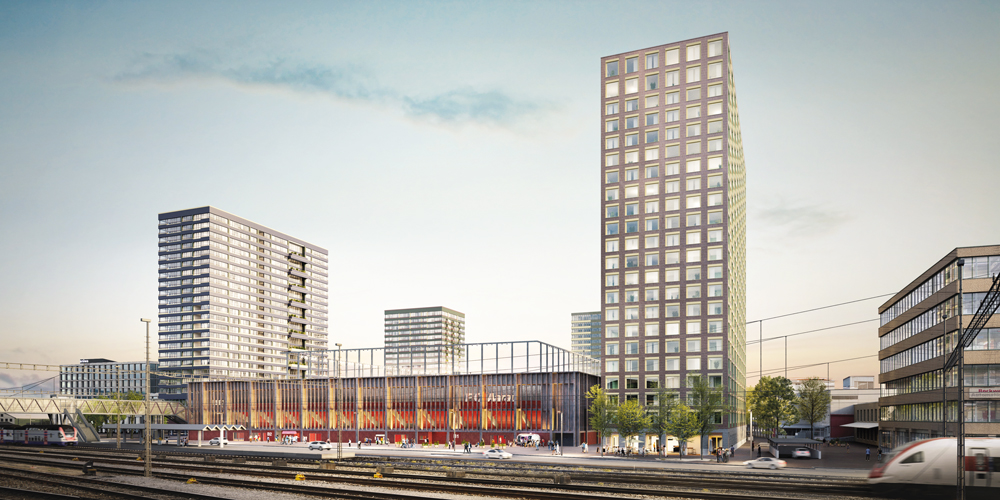
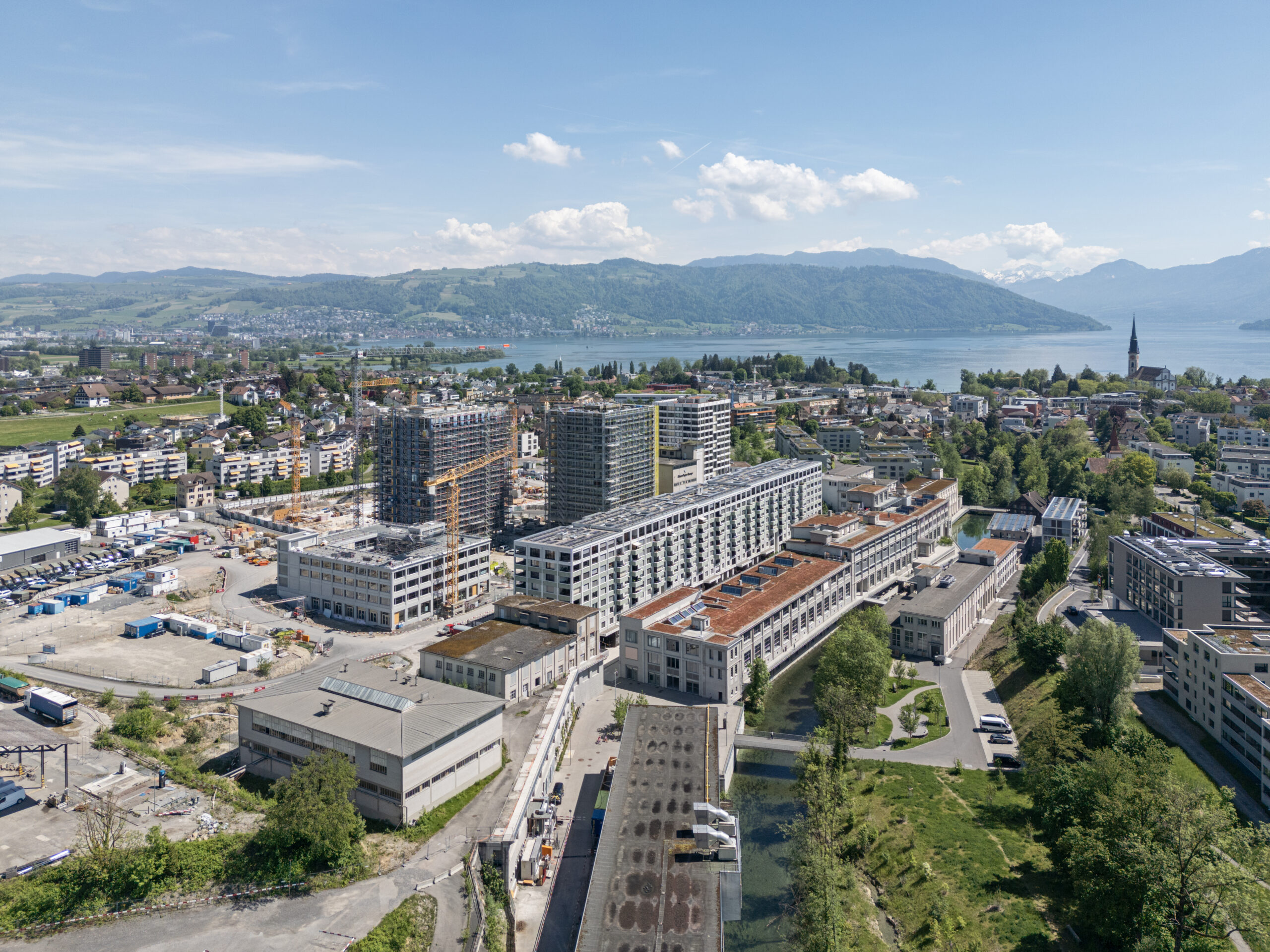
    People today are looking for the “as well as” – in the case of Papieri, it is the interplay of an urban lifestyle in close proximity to nature. On the one hand, the new district offers all the extras of a lively neighbourhood with practical services for everyday life, such as a wide range of shopping and dining options, childcare and cultural and sporting activities
    And catering facilities, childcare and cultural and sporting activities. On the other hand, you can find peace and quiet by the River Lorze or in one of the neighbouring recreational areas.

    Next Level Spaces
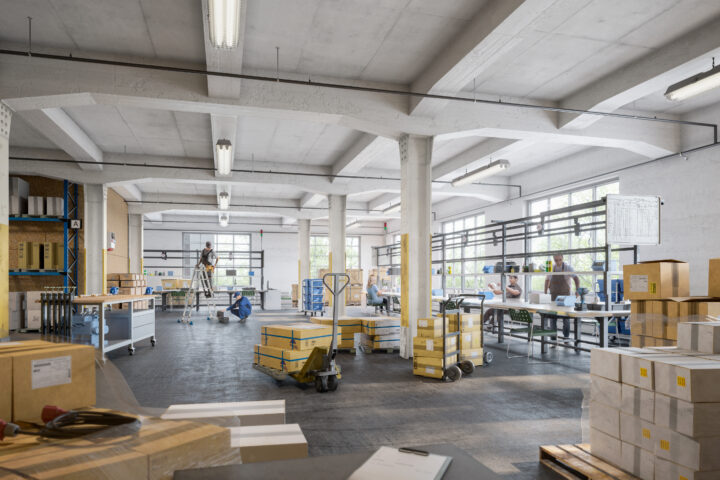
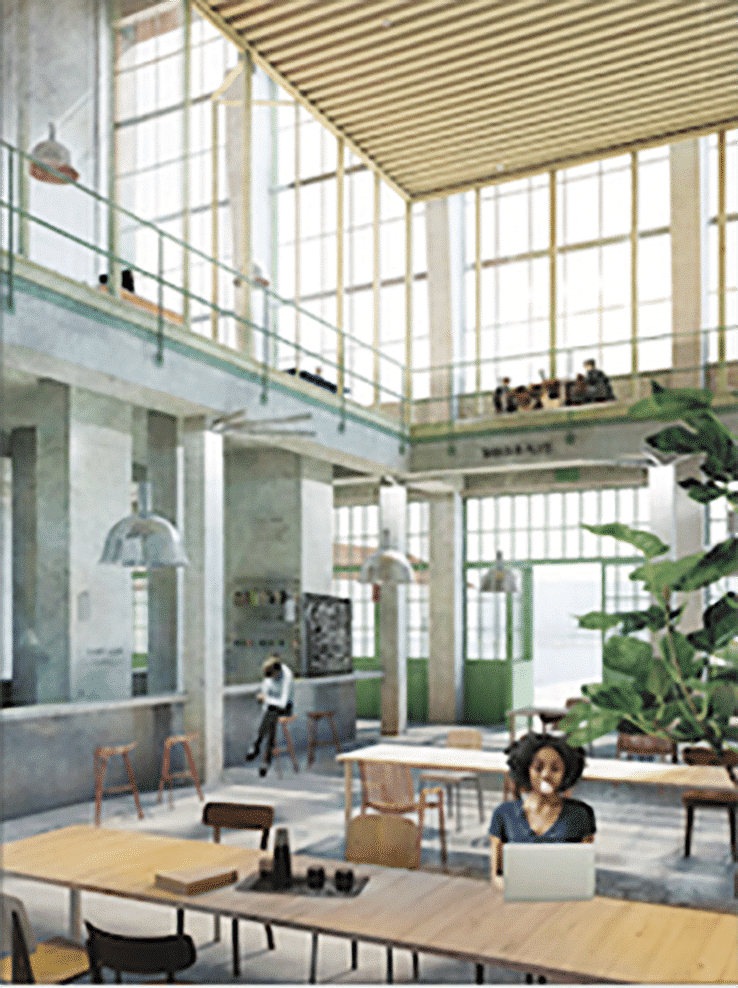
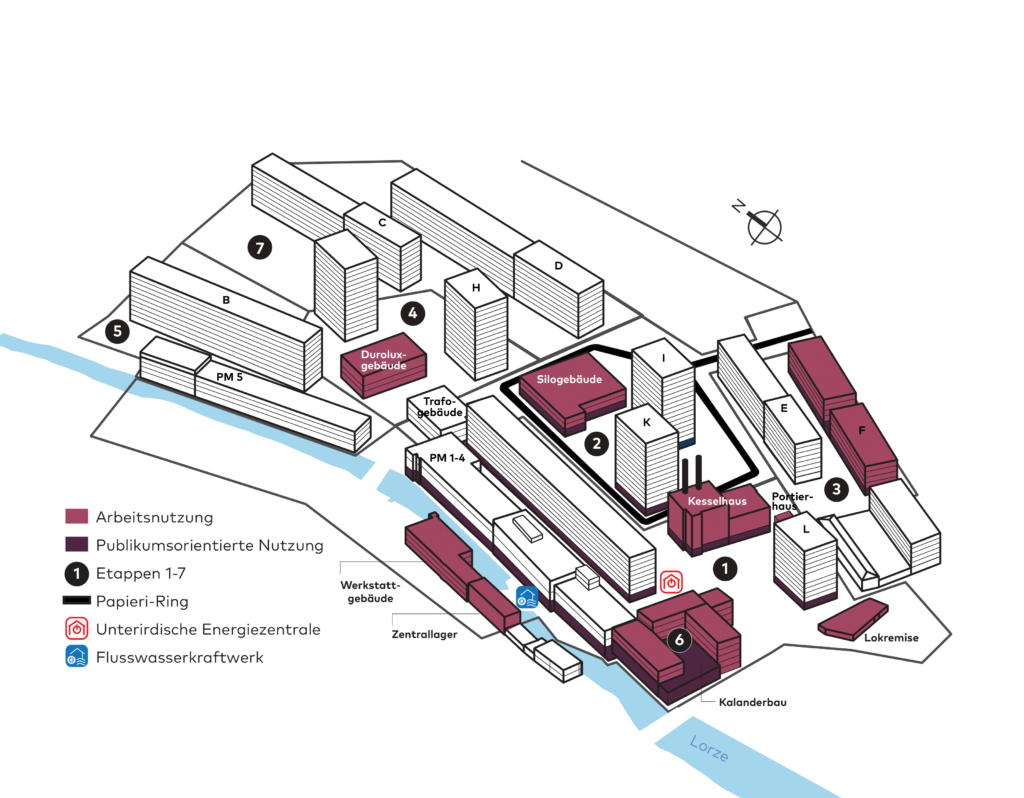
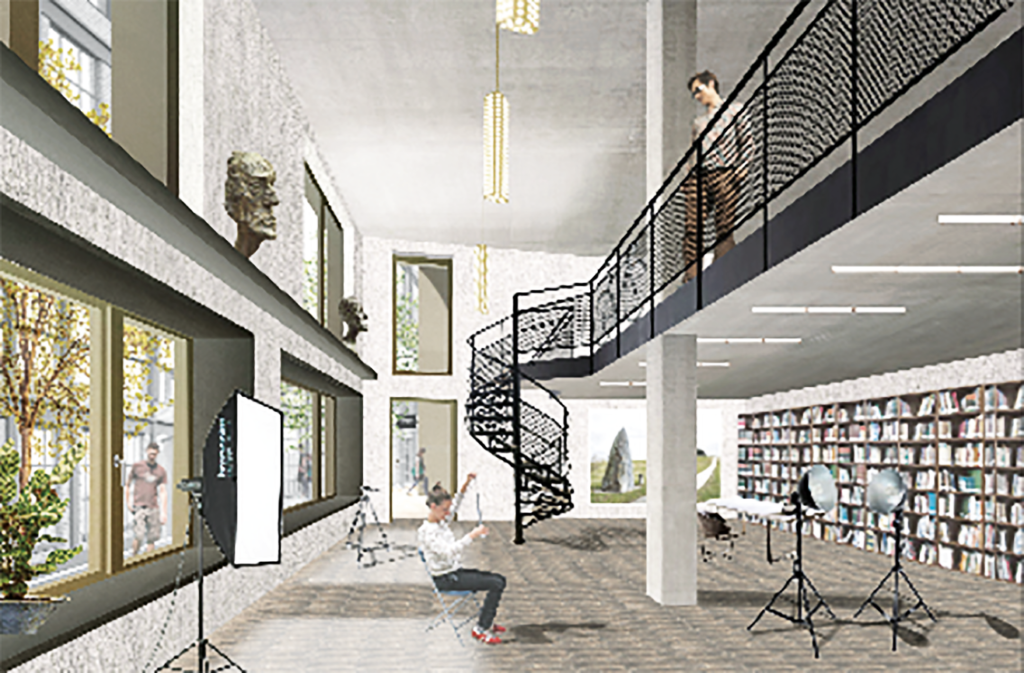
    In the third construction phase, a total of 10,000 m² of office, commercial and retail space will be created with the “Next Level Spaces”. Where and how people work has changed dramatically in recent years. Attractive and adaptable work concepts are needed to inspire employees. This leads to new requirements for buildings, such as a high degree of flexibility in order to fulfil a wide range of needs, from office layout to building services.

    The spaces in the “Next Level Spaces” can be flexibly designed and are over 6 metres high with a payload of up to one tonne per m², and intermediate floors can be installed as required. The user decides where intermediate floors are needed and can also create additional space at a later date. The “Next Level Spaces” offer future-orientated companies a wow location for offices, trade and Industry 4.0.

    Landmark boiler house
    The landmark at the heart of the site – the listed boiler house – will also be converted in the third construction phase. Where steam boilers used to be fired up, guests can expect a culinary treat in future. In spring 2026, the Segmüller Collection will expand its portfolio of unique gastronomy concepts such as Carlton, Loft Five, Roof Garden and Sablier in Zurich to Papieri-Platz in Cham and open a new grill restaurant with bar and lounge on the ground floor of the Kesselhaus. Industrial charm meets modern lifestyle, archaic fire cuisine meets refined elegance – a place that promises enjoyment for every taste. In the western section above, unique office space awaits new users in the former monument, while a fitness centre in the eastern section offers space for physical exercise.

    Sustainability
    Awarded the “Watt d’Or” by the Swiss Federal Office of Energy, the energy system of the Papieri site enables completely CO2-free operation and ultimately generates around 75% of the energy on site. In addition, the “Next Level Spaces” commercial building is certified with the internationally renowned “Leed Platinum” sustainability label. Resource-conserving construction is also already common practice at Papieri. For example, with the conversion of listed buildings such as the boiler house or an innovative timber-hybrid residential tower block. However, the most important contribution to sustainability is a long service life. Great attention is paid to this factor during development. Buildings must be flexible in order to meet the as yet unknown needs of a changing society in the future. An office building that can be converted into flats, for example, prevents premature demolition and thus contributes to sustainability. This is why Papieri constructs high-quality, adaptable buildings that will still be in favour for various uses decades from now.

  • Mobimo expands Aeschbach neighbourhood in Aarau

    Mobimo expands Aeschbach neighbourhood in Aarau

    Mobimo has laid the foundation stone for the Hofhaus and Hallenhaus buildings in Aarau’s Aeschbach neighbourhood with representatives from the authorities and its project partners, according to a press release. As part of the overall Torfeld Süd development area, the next stage in the expansion of the neighbourhood, which was revitalised in 2019, is thus being realised.

    Based on plans by Baumberger Stegmeier Architekten from Zurich, 126 rental flats with 1.5 to 5.5 rooms will be built there. The courtyard house is being realised as a timber construction with a garden courtyard in a future-oriented, ecological design. According to Mobimo, the hall building stands out positively in terms of sustainability and grey energy because as much of the existing façade of the former Hall 5 has been retained as possible. It will serve as the ground floor for the extension of the historic building.

    Completion is planned for autumn 2026, with occupancy scheduled for the second quarter of 2026. Marketing will begin in the third quarter of 2025. The Aeschbachquartier will then have a total of around 260 rental and owner-occupied flats. It will also offer around 4600 square metres of commercial space for 1400 people working there.

  • Maaglive a green heart for Zurich West

    Maaglive a green heart for Zurich West

    In the heart of Maaglive, on the former Maag site, a multifaceted centre is expected to be created by the end of 2028. Consisting of the historic K building, a modern residential tower, a cultural pavilion and lively open green outdoor spaces, a new neighbourhood life will be created here.

    Maaglive focuses on neighbourhood revitalisation and new standards in urban development. The existing K building is and will remain a meeting point with catering and cultural facilities and co-working areas, while the cultural pavilion offers space for art and encounters. The residential tower complements the offer with living, working and catering space.

    The infrastructure on the neighbourhood square is tailored to the needs of residents, visitors and children and ensures a lively atmosphere. Events that attract residents and visitors alike will also take place here. The neighbourhood square is therefore a lively meeting place for the community. This green and traffic-free public area invites people to sit down, meet and play, surrounded by native trees. It connects the neighbourhood with the surrounding network of footpaths and cycle paths and serves as a natural extension of the urban living space, helping to reduce heat in the surrounding area.

    Maaglive combines sustainability with urban living. Thanks to flexible construction methods and the use of renewable energy sources, the new buildings fulfil the highest energy standards. The use of hybrid timber construction methods in the residential building emphasises the commitment to environmentally friendly design and positions Maaglive as a pioneer in sustainable urban development.

  • Future-oriented neighbourhood management: cultivating an active living space

    Future-oriented neighbourhood management: cultivating an active living space

    It is essential to involve all relevant actors in the neighbourhood design process to promote social sustainability. This includes both residential and commercial tenants. The creation of activity and meeting zones not only strengthens social cohesion but also provides a platform for business synergies.

    Added value through neighbourhood activation
    The active management of a community increases the attractiveness and value of the neighbourhood, which has a positive effect on the marketing of vacant spaces. At the same time, sustainable social hubs are created that strengthen the sense of community.

    Pioneers in nationwide implementation
    Initial projects in various neighbourhoods in Switzerland show the success of this approach. For example, a pop-up event was launched in Winterthur that combined gastronomy and culture for six weeks. Due to the great popularity, this concept will be further expanded and also implemented in Zurich for the coming winter.

    A young but promising discipline
    Although community management is still quite new as a field, it is seen by experts as a promising and as yet untapped area. “We see great potential in this approach and want to develop and promote it,” say industry experts. I hope this paraphrase meets your needs and offers a new perspective on the subject.

  • In the middle lies KIM

    In the middle lies KIM

    Neuhegi, the former Sulzer site in Oberwinterthur, has changed in recent years from an industrial district to a dynamic development area. It is a varied mix of flats, businesses, shopping facilities, schools, a wide range of leisure activities, meeting zones and a local recreation area that includes the Eulachpark.

    With KIM Winterthur, a lively and multi-layered quarter with commercial and residential buildings of different sizes is being created directly at Winterthur-Neuhegi railway station. Each of them is modern, but has its own character. The overall composition consists of a total of seven buildings, variedly planted inner courtyards and a landscaped park.

    On the one hand, KIM is intended to become a hub for fresh entrepreneurial spirit and innovation. It wants to bring people, companies and educational institutions together in an inspiring way. The commercial spaces can be used in a variety of ways and are intended to appeal to companies of different sizes and from a wide range of industries.

    On the other hand, KIM in Neuhegi will create several hundred modern rental flats, many of which have already been occupied. The 1.5 to 5.5 room flats have floor plans between 41 and 135 square metres. Living comfort is also reflected in the above-average heights of up to 4.7 m on the ground floor and 2.6 m on the upper floors. All buildings comply with the Minergie-P standard and are built in solid construction on the one hand and in ecological wood-concrete hybrid construction on the other.

    The Vivale Neuhegi senior citizens’ centre, which opened in 2020, is also part of the quarter. It fits in with the philosophy of KIM, which aims to promote heterogeneous coexistence.

    The KIM buildings are surrounded by green retreats. The area is broken up by trees, bushes, green spaces and paths. Car-free promenades and a network of paths for walkers and cyclists invite people to linger in the fresh air on the site and in the nearby Eulachpark. Together, they form an essential part of the public green belt. in 2018, construction began on Ida Park and Sulzer Park. These connect the Neuhegi school building via Sulzerallee with the Hegi railway station as a public park strip. Half of the design of this park strip was determined by the residents.

    In summer 2019, construction began on the northern half of the plot for the u-
    shaped residential building “Haus Furrer” with a public-oriented use on the ground floor. At the end of 2019, construction work began directly next to it on the second residential building, “Haus Bill”. The two buildings were completed at the end of 2021 and in mid-2022. With the residents, KIM’s public-oriented commercial sector received many potential new customers. The two southern commercial buildings are to be home to established companies and start-ups from the high-tech sector, among others, on 18,600 square metres. The start of construction has not yet been determined.

    KIM Winterthur is a joint project. The investors and real estate developers involved are Ina Invest, Steiner, Swiss Life and Mobiliar, as well as Reliva, which manages the Vivale Neuhegi senior citizens’ centre.

  • Walo realises environment project in the Westfeld Basel neighbourhood

    Walo realises environment project in the Westfeld Basel neighbourhood

    The Dietiker construction company Walo Bertschinger has completed the work on the landscaping of the new Westfeld neighbourhood in Basel. According to a media release on LinkedIn, this environmental project includes the entire outdoor space, plus a narrow Allmend area along Hegenheimerstrasse and part of the area surrounding the Felix Platter Hospital.

    The surrounding project realised by Walo consists largely of publicly accessible areas. Beyond the site, the works complement the open space and footpath offer to connect and revitalise the neighbourhood. The work includes 23,000 square metres of terrain modelling, 8,000 square metres of paving, a fountain and seven tree troughs made of natural stone, the furnishing and all the work on the 2900-metre-long utility lines.

    The forum now stretches between the newly built Felix Platter Hospital and the new Westfeld building and flows into the neighbourhood square in front of the converted hospital building. There is a “carpet” of natural stone slabs there. In contrast to the stone forum and the neighbourhood square, the neighbourhood garden, which has also been laid out, is mainly green and covered with trees.

    Since 2015, a showcase project for a trend-setting residential building culture has been created around the old hospital, which has now been converted into residential space, according to Walo’s statement. More than 500 cooperative flats have been built on the approximately 35,000-square-metre plot, of which around 400 are on the part of the site earmarked for new buildings and around 130 in the converted hospital building. There is also space for neighbourhood uses, services and small businesses. The building cooperative wohnen&mehr has published a video clip on the project.

  • Transfer of ownership of the Schützengütli site for residential development takes place

    Transfer of ownership of the Schützengütli site for residential development takes place

    In February 2022, Halter AG acquired the Schützengütli site in Bischofszell with two areas of around 6500 and 1000 square metres. The property, which had served the Schiffli embroidery factory from 1907 and later the glass rectifier construction, passed into the ownership of the Laumann & Co. malt factory and fruit pressing plant in 1946. Essences and syrups were produced here until a few years ago. On 10 February 2023, the revised building and zoning plan of the city of Bischofszell came into force, allowing residential use with a design plan obligation on the site.

    For a lively and attractive Bischofszell
    “With this site development in an intact neighbourhood, we will create attractive living space in a very well-developed location right next to the railway station,” says Rolf Zäch, project manager at Halter Entwicklungen, with conviction. “The development of the site makes a valuable contribution to an attractive Bischofszell.” Thomas Weingart, mayor of Bischofszell, is also pleased about the upcoming development: “The centre of our town continues to develop positively. The town council is pleased about that. We are particularly honoured that Halter AG, a well-known company, will be active in Bischofszell and can contribute its great experience in urban development.”

    Harmonious integration into the neighbourhood and the city
    Around 50 owner-occupied flats are planned, for which the existing buildings will be removed except for individual elements. In a two-stage study contract, the aim is to achieve a high-quality site development that offers future residents a high quality of living and blends harmoniously into the surrounding neighbourhood. Taking economic criteria into account, an urban planning concept for the site will be developed, which will be followed by the architectural design in a second step. The study commissioning process already initiated by Halter Entwicklungen will start this spring.

  • The transformation of the Papieri site

    The transformation of the Papieri site

    The Papieri site in Biberist, Solothurn, can look back on a long industrial history: Its existence began in 1862 as the site of the “Papieri” paper mill. After almost 150 years, the factory ceased operations in 2011, most recently owned by the international paper group SAPPI. Subsequently, HIAG from Zurich acquired the 60,000 square metre site – with the aim of creating a lively and diverse quarter.

    However, the industrial spirit that is strongly anchored here is not to be lost: The “Papieri” is to continue to be used for commercial and industrial purposes. The location and general conditions of the area are still ideally suited for this. The site can be reached in a few steps from Biberist Ost railway station. In addition, it is served by the bus stops Biberist Emmenbrücke and Biberist Derendingenstrasse (BSU). Attractive pedestrian and bicycle connections are also planned for the medium term.
    HIAG has worked out a sustainable development strategy in close consultation with the canton, municipalities and other stakeholders. As early as 2013, an urban planning study was carried out in collaboration with five architectural firms. The findings of this study commission formed the basis for the master plan, which was completed in 2015 in consultation with the municipality of Biberist. The partial zone plan revision is currently underway. This is currently undergoing a cantonal preliminary examination.

    The long-term planning envisages a division of the site into two parts: The “West” area near the Biberist East railway station comprises about one third of the total area and is to become an area open to the public with quiet commerce, services, leisure, culture and housing. No concrete residential projects are planned yet. But: “The future usage regulations allow for a residential share in the western area,” says Dominik Ulrich, project developer of HIAG Immobilien Schweiz AG. The eastern area towards Derendingen, on the other hand, will be transformed into a workplace area for the manufacturing industry.

    nightnurse.ch

    Access to the publicly accessible western area of the site is already from the southwest. In future, the triangular Papier-Platz will mark the beginning of the site. The square is enclosed by the striking existing building at Fabrikstrasse 1, which will be made fit for the planned transitional uses by mid-2023: On the ground floor, spaces between 160 and 1000 square metres will be rented to commercial and service providers. The rooms on the upper floors are ideally suited for commercial and storage space as well as studios. Offices are also available in the neighbouring building. “The transitional use of Building 1 is planned for up to ten years. The goal is to establish uses that will last in the long term,” explains Ulrich. The dismantling of the machinery was a prerequisite for opening up the area. The machines were successfully sold in recent years and transferred to new owners.

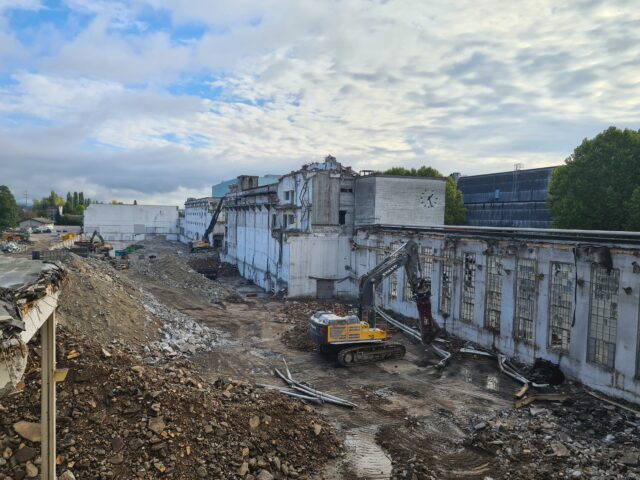
    The centre of the area, and thus the centre, is the square by the canal: Demolition work is currently underway here to create open spaces and breakthroughs in the hall structures. So far, 17,000 tonnes of material have already been removed. HIAG attaches great importance to sustainability: 14,000 tonnes of it will be processed into granulate on site and reused. The deconstruction work is scheduled to be completed by the end of this year. From mid-2023, the construction of a new modern building is planned, which will offer around 15,000 square metres of usable space for trade, production and offices. The first tenants are expected to move in by the end of 2024. According to Ulrich, concrete negotiations are currently underway with prospective tenants.

    Demolition work is currently underway in the middle of the site.
  • Lymhof: Versatile, lively district planned in Schlieren

    Lymhof: Versatile, lively district planned in Schlieren

    The Lymhof district at the Rietpark will be built near Schlieren railway station, where the Vitis sports centre stands today. The name recalls the past of the former factory site, where Geistlich glue and fertiliser were produced in the 20th century in the so-called “Lymi”. The area of the Lymhof itself was then used for farming.

    With its location near the Schlieren West railway station subway, which is extended under Wiesenstrasse, one can get from the railway station or from the centre of Schlieren beyond the tracks through Lymhof-Gasse directly into the neighbourhood at Rietpark. The Lymhof is to become a colourful, lively part of the neighbourhood, where commuters can grab a quick coffee and croissant on their way to the train in the morning and meet for an aperitif on the terrace in the evening.

    To ensure that this vision also works in reality, Geistlich Immobilia is developing the uses for the special buildings of the guesthouse and hall, as well as the ground floors, in collaboration with experts and in a participatory process – through discussions and exchanges with interested residents and potential future users.

    The project comprises around 350 flats for a diverse range of residents from students to senior citizens, a guesthouse with hotel rooms and a bistro, a hall building, small commercial spaces and studios where people can both live and work.

    The world’s first vertical farm is planned in the hall building, which will be integrated into a residential quarter. Site owner Geistlich Immobilia signed an agreement to this effect with the start-up company Yasai in October 2022. From 2026, herbs, lettuces and much more will be grown in the eight-metre-high hall in a resource-friendly and pesticide-free way and sold directly on site. The urban farming company already operates a pilot farm in Niederhasli.

    Sustainability characterises the project in its planning, construction and operation. Around 900 bicycle parking spaces, a car and e-bike sharing service and charging stations for electric vehicles are planned for the Lymhof. The buildings will be heated with geothermal energy, solar panels will produce electricity and green roofs and outdoor spaces will promote biodiversity. A large part of the buildings will be made of wood and environmentally friendly materials will be used for the interior fittings.

    A study commission was organised for the project planning. In summer 2020, the interdisciplinary jury, in which the city of Schlieren was also represented, decided in favour of the project by the Zurich firm Clou Architekten and the landscape architects from Atelier Oriri. “We were convinced by the diversity and playfulness of the project with its different building sections, which are connected to each other but still allow for independent characters in terms of design and uses,” explains Martin Geistlich, managing director of the landowner Geistlich Immobilia.

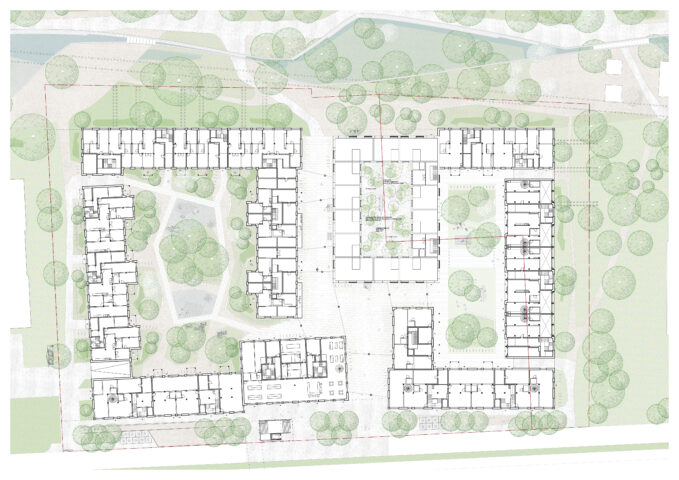
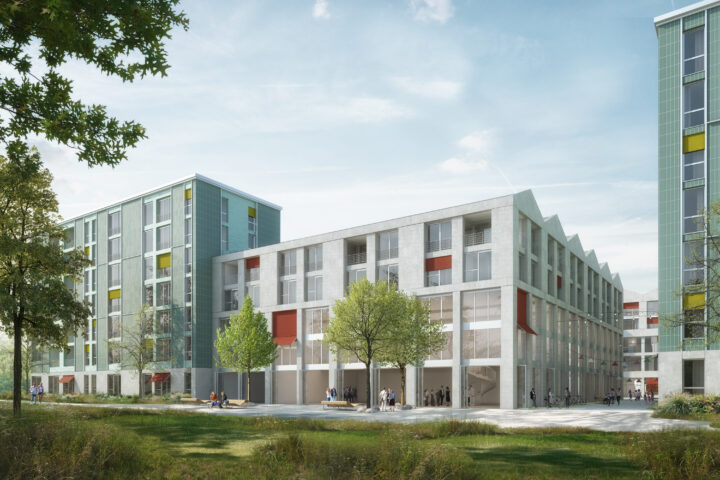
    The building sections of different heights are grouped around two large green inner courtyards. Their façades are clad with ceramic tiles in different colours and concrete elements. The exterior design creates diverse meeting places and landscaped areas with large trees and native plant species, which are intended to cool the courtyards and create habitats for small animals.

    The Lymhof is scheduled to be built from 2024 and ready for occupation from 2026.

    The building sections of different heights are grouped around two large green inner courtyards.
  • FHNW inaugurates pavilion made from recycled components

    FHNW inaugurates pavilion made from recycled components

    As part of the annual theme Constructive Futures – beyond Concrete, the University of Applied Sciences for Architecture, Civil Engineering and Geomatics held a competition among the students of the third year of their bachelor's degree in architecture. The task was to reuse the components of a storey-high wooden ramp that was temporarily attached to the Swiss Architecture Museum. A place to stay protected from wind and sun was to be created in the park of the FHNW campus in Muttenz.

    The Silvestris project, which won the competition, was deepened and implemented in an interdisciplinary elective course last spring semester, explains the FHNW in a statement . "Various structural and static challenges" had to be mastered. The project also showed the limits of the recyclability of the components. Specifically, the waste wood of the ramp did not have the necessary strength for the structurally relevant components of the planned pavilion. Here, construction wood not originating from the ramp had to be used.

    The now completed "Arena Circular" is intended to serve as a place for teaching, performances and as a place for use and participation by members of the university and residents of the quarter. On September 27th, the FHNW invites all interested parties to the inauguration in the park of the FHNW campus in Muttenz. Registration is not required.

  • Lonza is expanding in Basel

    Lonza is expanding in Basel

    Lonza AG is expanding its operational headquarters in Basel, which has been located on the Lindenhof site since 1962, the cantonal administration of Basel-Stadt informs in a press release . Two more high-rise buildings are to be built in the vicinity of the existing Lonza high-rise building, which is under a preservation order. In addition to commercial and service areas that are required by Lonza, apartments "for different needs" are also planned, according to the statement.

    The extension buildings are intended to “develop the area into a green, mixed-use and publicly accessible district component of the St. Alban district,” writes the canton administration. The edge of the park is to be preserved and planted with more trees. Grounds previously sealed by parking lots and tennis courts will be "upgraded and greened in terms of biodiversity and climate compatibility".

    The plan requirement for the necessary change to a development plan from 1991 that was never implemented can be viewed at the cantonal building and transport department until September 30th. On September 6, Lonza also wants to provide information about the project itself from 6 p.m. in the Hotel Victoria.

  • Station area Wettingen becomes a residential area

    Station area Wettingen becomes a residential area

    Under the aspect of living and working directly on the track, the SBB has announced an architectural competition for the design of their area at the railway station in Wettingen . According to the press release, the results are now available. They can be viewed in an exhibition in the foyer of the Tägi Wettingen until Tuesday, March 8th.

    The winning project is called Stadtlaube and, according to the SBB announcement at Wettingen station, envisages two long, five-storey residential buildings with service, retail and catering areas on the lower floors and a four-storey service building with public-oriented uses. The historical railway buildings are preserved.

    The two buildings to the west of the station form a boundary opposite the track field and thus create living and recreation space in a central location, according to the project announcement. The entrance areas and partly open-plan staircases are intended to provide a view of the railway tracks. There will be small squares and a play street in front of the house entrances. Flexible 2.5 to 4.5 room apartments with private outdoor areas and communal roof terraces are planned.

    A four-storey service building with shops and restaurants is planned to the east of the residential buildings and embedded in the historic station buildings. According to the announcement, the protected individual objects Lokremise, goods shed, station building and turntable will be preserved.

    The winning team of the architectural competition consists of Burkard Meyer Architects from Baden AG, ASP Landscape Architects from Zurich, MWV Civil Engineers from Baden, Leimgruber Fischer Schaub from Ennetbaden AG, Mühlebach Partner from Winterthur and Scherler AG from Lucerne.

  • FC Aarau's new home

    FC Aarau's new home

    How do you combine a football stadium with an attractive residential area? – "It's not always easy, but it offers great opportunities," says Ariel Arthur Dunkel, project manager for real estate development at HRS Real Estate AG. «The focus here is on the question of use and the possibilities of appropriating the diverse open spaces. The district thrives on the tension between everyday life and a festive atmosphere.» The planning is already very advanced, but it has not yet been possible to submit a building application: “We are waiting for the partial change in the usage plan of the city of Aarau, against which a complaint has been lodged, to take legal effect. Then comes the approval process for the design plan that we developed for the area together with the city of Aarau. Then comes the building permit process. Until then, the planning rests.”

    There aren't many vacant areas that are so well developed. The eastern part of Torfeld Süd is, so to speak, a missing part of the city that is now being supplemented. To the south and west, Torfeld Süd borders on lively quarters. The networking of the non-motorized traffic development and the open and green spaces is an important topic in the planning. «The project is very visible. And that's why we want it to be seen as an example of good development – in terms of architecture, the revitalization of the building base, the attractive open spaces, the high standards of sustainability and the mix of uses that people with everything important in a small radius provided."

    Ariel Dunkel would like to start building tomorrow: “However, it is understandable that numerous interests have to be coordinated with a project of this size and scope. This will need time. The difficult thing here is that the population, who always clearly supported the stadium project in the votes, now have to be so patient because of the appeals process. There is also intensive dialogue with politicians, who rightly have high expectations of the project. Personally, I am convinced that the project will create significant added value not only for the area itself, but also for the surrounding area.» The construction project was also affected by the corona pandemic. Many households would like more space so that they can work comfortably from home in the long term: “We also have studios and small apartments that can be rented. In principle, we are working from a very solid starting position due to the good development and the comprehensive supply of quarters and can easily react to changes," concludes Dunkel.

    In a project of this size, numerous interests have to be coordinated.
  • Six “courtyards” promise urban and natural flair in Adliswil

    Six “courtyards” promise urban and natural flair in Adliswil

    Six buildings in a park-like setting with natural names such as “Libellenhof”, “Eulenhof” or “Froschhof”. Around 10,000 square meters of space for commercial and office space and space for 331 rental apartments. Energy efficient building standard. A park-like environment, car-free zones, beautiful courtyards, meeting places and playgrounds. Urban flair through bistros, shops, a fitness center, a supermarket, a daycare center and medical practices. Relaxation, liveliness and an inspiring environment. That is what the Quartier Höfe Adliswil should be when it is completed in 2024.

    The Libellenhof and Hummelhof buildings should be ready for occupancy as early as 2022. The Libellenhof is located in the west of the area. The L-shaped structure is the gateway to the Höfe district. On the ground floor there is a supermarket, a daycare center and other services. Office space and apartments are available on the upper floors. The 56 apartments in the Libellenhof have spacious floor plans, the atrium apartments are loft-style and have roof terraces. The Hummelhof is on the east side of the quarter. Commercial space is planned on the ground floor, office space and 53 apartments on the upper floors.

    In the course of 2023, the Amselhof and the Schwalbenhof right next to it should be ready for occupancy. The Amselhof forms the south-eastern boundary of the quarter. The trapezoidal structure has a large inner courtyard. Commercial space is planned on the ground floor, office space and 68 apartments on the upper floors. The Schwalbenhof wants to appeal to tenants – double earners with or without children, singles, expats – who are looking for exclusive quality of living.

    The Froschhof and the Eulenhof are to be built by 2024. The Froschhof is also mainly intended for living. The smaller Eulenhof with only 16 apartments offers tenants a lot of privacy.

  • Regensdorf receives a city quarter on top of an art museum

    Regensdorf receives a city quarter on top of an art museum

    A city quarter on top of an art museum? This is not a typo, but a reality: In Regensdorf, the investment foundations Turidomus, Adimora and Pensimo have planned a new type of living and working concept. Zwhatt is the name – and it stands for social, cultural, ecological and architectural diversity. The cemented art museum of the Fondation Riklin is located in the foundation of the city quarter, which is being built on 3.6 hectares directly at the Regensdorf-Watt train station.

    On behalf of the aforementioned investment foundations, Pensimo Management AG is realizing around 600 rental apartments and commercial space around central Zwhattplatz in two construction phases. The first construction phase envisages around 400 apartments, 12,000 square meters of commercial space and 330 underground parking spaces. The rental of the first apartments is scheduled to begin in autumn 2021.

    A total of seven buildings are planned, two of which are high-rise buildings. The Riklin Foundation was set up in January by the St. Gallen conceptual artists Frank and Patrik Riklin. In Zwhatt, art is becoming the DNA of a new city quarter – it is supposed to lay a new foundation for social cohesion.

    Pilot project for climate-adapted area development
    Residents from Regensdorf, Adlikon and Watt gave the two artists everyday items such as suitcases, lamps and rocking horses. These were then reassembled with other suitcases, lamps and rocking horses, or rather “latticed”. The works of art created in this way were sunk into the foundation of the museum. Later they will be brought back to life using augmented reality.

    The new city quarter should meet the need for mobility, flexibility and freedom as well as the desire for community and home. Different lifestyles, family models and types of consumption are expressly encouraged. Zwhatt stands for the encounter with diversity. And this motto does not stop at the architecture either: the interpretation limits of the design plan were explored using a so-called Charrette process. 100 architects, urban planners and experts took part in the preselection in 2018. In the end, five teams were selected to help shape the project. The architects of the first construction phase were also evaluated using unusual methods such as the sufficiency pitch.

    Zwhatt is a pilot project for the federal government’s climate-adapted area development. The district draws its energy from the groundwater and the electricity from its own photovoltaic systems. In the case of high-rise buildings, panels are also integrated into the facades. The mobility concept provides for a small number of parking spaces and thus low-car living. The desired mobility is made possible by sharing offers for electric cars and e-bikes. Co-working spaces, shops and restaurants directly on the site support this concept. The first occupancy is planned for 2023.

  • Swiss Prime Quartier Riverside is ready for occupancy

    Swiss Prime Quartier Riverside is ready for occupancy

    In Zuchwil, the new residential and work area Riverside is now ready for occupancy. According to a press release , the first tenants will move into the Widi Huus and Sulzer Huus in October. The project of the Swiss Prime Investment Foundation is characterized by modern energy supply and traffic management as well as recreational opportunities. It was also developed by the Swiss Prime Investment Foundation in Olten as a “living space”. As a location in the country with all the amenities of an urban place. The new Riverside district combines living and working. The Aare in turn connects nature with the city. The quarter has direct access to the river.

    According to Jérôme Baumann, President of the Board of Trustees of the Swiss Prime Investment Foundation, “120 apartments have already been rented. Only a few are available. ”The apartments offer a lot of quality of life. The Solothurn architect Benedikt Graf from gsj architects and agps architecture was quoted as saying that the choice of materials was "extremely careful". The heat generation for heating and water takes place sustainably via a groundwater heat pump. Natural cooling is in operation in summer.

    All apartments are designed according to the guidelines of Procap Switzerland and are wheelchair accessible. There are individual charging stations for e-vehicles at the visitor parking spaces. The parking spaces in the underground car park can also be equipped with a charging station. All five houses of the first stage should be occupied by autumn 2022.

  • Halter AG lays the foundation stone for a new quarter

    Halter AG lays the foundation stone for a new quarter

    A new quarter is to create the connection between Suhr Süd and the center. In addition to a twelve-story high-rise, three four- to six-story buildings are being built. Schlieremer Halter AG is responsible for project development and implementation, according to a media release . The foundation stone was laid on Wednesday.

    The quarter is being built on an area formerly used by Ferroflex AG. There will be areas for living, services and commerce. Public open spaces with paths and squares, a children's play area and a barbecue area are planned between the buildings. In the high-rise and in the so-called garden house, 59 apartments with 2.5 to 5.5 rooms will be built as residential property. 143 rental apartments are being built in the other two buildings.

    The development project will be implemented according to the objectives of the 2000 Watt Society. District heating from the Buchs AG waste incineration plant is used to generate heat. Solar systems will provide some of the electrical energy required.

  • Renewal of the Läbespark retirement home

    Renewal of the Läbespark retirement home

    The four existing main buildings and other auxiliary buildings in the Läbespark retirement home in Biberist are getting on in years: they were built between 1969 and 1995. In order to improve the quality of life for around 100 residents, the cooperative had a refurbishment project drawn up. Phalt Architekten AG, Wam Planer und Ingenieure AG and Neuland ArchitekturLandschaft GmbH were commissioned for this. A committee consisting of representatives of the Biberist community, the responsible cooperative and various experts accompanied the process.

    The alignment project forms the basis for the design plan process and the further project elaboration. The oldest house at Blümlisalpstrasse 12 will be replaced by a new building. The height of this is based on the existing building. Compact small apartments based on the Bonacasa building standard are planned. The 1.5 to 3.5 room apartments will have a wet room with a laundry tower and a loggia facing the park-like inner courtyard. A reduit complements the larger apartments. «The existing restaurant / café Pintli will move into the new building. To do this, we are revitalizing the premises of the former Pintli with commercial and service uses, ”says Ronny Fluri from Bonainvest AG, which takes on the building owner function for the cooperative. A common room is also planned, which should also promote social contact among the residents. The new building will have a parking garage.

    So the previous parking lot can give way to a piazza. “We are thus creating another meeting zone and upgrading the area. Our green park with a small pond will have a herb garden, more seating and various exercise elements that are intended to provide incentives for the residents, ”explains Fluri. The surrounding quarter will be better networked by footpaths. But there is still one problem to be solved: “The building that is being replaced has heating for two more houses. We would like to work with geothermal probes in the future. However, various investigations are still ongoing, ”says Fluri. When this has happened, the other buildings can at least be refurbished in terms of energy. There is still some time until construction begins: work is scheduled to start in 2023. The new building should be ready for occupancy at the end of 2024.

  • From the metal factory to the mixed neighborhood

    From the metal factory to the mixed neighborhood

    The Wydeneck was a closed area for over 100 years and was used exclusively by the "Schweizerische Metallwerke AG Dornach" for metal processing. Swissmetal still produces today and uses around half of the area. Small craft businesses and manufacturing SMEs also work.

    In 2015, Hiag acquired the area in Dornach and began planning its future use. In close cooperation with the canton and municipality, the owner developed a coherent basis for the transformation of Wydeneck. The leading office for the test planning process was the Zurich urban planning office Feddersen & Klostermann in collaboration with Brühlmann Loetscher. 90 interested residents brought their wishes and suggestions into the planning process during a two-day participation process. On this basis, the master plan was drawn up and approved by the municipal council in 2018. In this context, the new name was also announced: Wydeneck – Metalli im Wandel.

    The area-specific sub-zone plan revision and the development of a sustainable mobility concept are currently on the agenda. Central topics are the development of the quarter with a bus line, its own S-Bahn stop and the integration of the feeder to the A18 motorway. Building land is to be re-zoned along the Birs and the river basin is to be revitalized.

    The opening of the aeral will initially take place through transitional uses. This creates space for business, leisure and culture. The offers are intended to attract customers and visitors. With the start of the first construction phase, these uses will be successively replaced or relocated. Several hundred apartments as well as commercial and service-oriented offers will be built in the next 20 to 25 years. Some of the existing historical buildings will be renovated and will remain as a contemporary witness of industrial history.

    The Wydeneck is to become a lively, mixed and urban district. Around 1,800 residents and a wide range of commercial and service offerings with up to 400 jobs are planned. The publicly accessible riverside park and the preservation of the historical substance also ensure the special flair.

  • Spinning mill, girls' home and soon residential area

    Spinning mill, girls' home and soon residential area

    The Emmenhof is located in the center of Derendingen and looks back on a varied history: It began 150 years ago with the establishment of a cotton spinning mill. In 1897 a girls' home was also built. In 1932 there was another change of ownership: when Scolari AG moved in, the Emmenhof served as a pasta production facility until 1973. From then on, various SMEs settled on the 50,000 m² area. Even today there are around 100 companies that have their offices or warehouse here. The area, which has so far only been built on in the southern part, is characterized by its own hydropower plant, the striking factory and the former manufacturer's villa.

    Emmenhof Immobilien AG has planned a fundamental transformation of the area: by 2030, a new quarter with residential offers, leisure facilities, various office and commercial space as well as a catering concept is to be built here. In addition to the preservation of some detached historical buildings, several new buildings are planned. A total of 270 apartments are planned, the construction of which is based on the history of the area.
    Access to the new quarter is marked on the south side by the “Wollturm” with ten floors, an underground car park entrance and a visitor parking lot in front of it. This entrance is followed by the “cotton yard”, which is framed by two buildings and closed off by the historic factory building. The “Garnwerk”, “Turbinenhaus” and “Därberei” buildings are being built in the north of the site. Generous green areas and direct access to the Emmen Canal and the Schluchtbach give the quarter a natural character.

    The development of the area is planned in six stages. The first stage has already been completed and includes the “Spindelgut” project in the southwest. The new building, designed by the architects Liechti Graf Zumsteg, consists of three wings with 14 apartments.

    Emmenhof Energie AG is the area's electricity producer. This enables tenants and owners to obtain sustainable energy: from photovoltaic systems that are installed on the roofs of the new buildings and from hydropower. Hot water and heating get into the houses by means of district heating.

  • Innovative quarter on the Henz site

    Innovative quarter on the Henz site

    At the Suhr Süd train station, an innovative quarter is being created that combines living and working. To this end, the Henz area – the former location of the steel trading company of the same name – is being completely converted. Condominiums and rental apartments are being built here, some of which can be moved around at the push of a button. The four to twelve storey buildings are characterized, among other things, by their open courtyards. The new quarter connects to the urban train station quarter in the north. In the south, according to the SSA Architekten AG commissioned with the project, the “scale transition to the Helgenfeld and Frohdörfli developments” is successful.
    59 condominiums and 143 rental apartments as well as studios and movements – these are furnished apartments with movable modules – as well as commercial, restaurant and service areas are to offer residents a meeting point for young and old after completion in autumn 2023. A 40 meter high building with 12 floors will be particularly striking. Here, on areas of 72 to 119 square meters, 2.5 to 5.5 room apartments with loggias are being built that are for sale. A restaurant and at least two should be on the ground floor
    Service companies settled
    will.

    The garden house has four floors. The condominiums are designed as 2.5 to 5.5 room apartments. With living areas of 68 to 129 m2, loggias, terraces or garden seats, the larger apartments are particularly suitable for families. The so-called courtyard building provides for 15 condominiums. Two more buildings with rental apartments and studios are being built along Gränicherstrasse and Bernstrasse West.

    A public square with a café and playground as well as various open spaces connect the area with the surrounding quarters via a network of paths. The property on the southwest corner of the area offers additional outside space. On the other side of the street, a green area belonging to the Henz area with a playground and pavilion is being built. Various commercial and service areas are planned on the ground floors of the building. These uses are intended to enliven and enrich the quarter. The studio areas allow flexible use of living and working.

    The sustainable energy strategy includes the supply of district heating from the Buchs waste incineration plant. The energy for the gentle cooling of the apartments in the high-rise is generated by solar energy. Photovoltaic systems on the site generate part of the household electricity. The parking garage is equipped with a charging infrastructure for e-bikes and electric cars.

    Condominiums can be configured online by their future residents. Visiting your own four walls in the future is already possible thanks to virtual reality (VR). Halter AG is continuously registering bookings for this offer: "Customers are thrilled with how well they can imagine the premises and, in particular, the view and the ceiling height of 2.60 to 2.80 meters," says Agathe Siffrin from Primus Property AG who takes care of sales for Halter AG. “The combination of VR, configurator and showroom is the optimal solution for showing apartments that will only be ready for occupancy in around two years”, she continues. As of today, over 50 percent of the condominiums are already reserved. The rental starts next year. Interested parties can register for the one to two-hour VR and advisory tour free of charge via the website.

  • From paper to quarters

    From paper to quarters

    “The construction progress of the five buildings of the first construction phase is on schedule despite the pandemic,” says the person responsible for communication, Kathrin Sonderegger. In the southernmost high-rise building with condominiums (Papieri-Suites), the shell is already up to the fifth floor. In the former PM1-4 paper machine halls, new staircases, floor ceilings and apartment partition walls are being installed, as well as the renovation of the facade for the spacious loft apartments and studios (Papieri-Lofts). The new building with 160 rental apartments running parallel to this – 30 of them in the inexpensive range – is also well advanced in terms of shell construction. The Maschinengasse that is emerging between the two buildings is also slowly becoming recognizable. This will be animated at the end of 2022 by the various users of the one or two-story adjoining studios. Underground car parks 1 and 2 are currently under construction, and their parking spaces can be equipped with charging stations for electric cars in a future-proof manner.

    Planning of the second construction phase is well advanced
    The newly renovated and listed Lokremise was handed over to its new owner at the end of the year. Sonderegger says: "After the renovation of the workshop building, the second commercial conversion of a historic building on the site became a reality." At the end of the year, the construction of the new Ringstrasse (Papieri-Ring) began, which is part of the main development of the area and encircles the buildings of the second construction phase. As part of the second construction phase, in addition to the commercially used replacement building for the silo building, two high-rise residential buildings with 61 owner-occupied and 36 rental apartments will be built. Commercial space and a day-care center are planned on the ground floors. 64 micro-apartments complete the housing offer.

    CO2-neutral energy system
    Those responsible for the site development pursue the goals of the 2000 Watt Society. It is worth mentioning the sustainable energy supply of the Papieri area with a self-sufficient, CO2-neutral heating and cooling supply. A significant amount of electricity is generated by the company's own river power plant and photovoltaic systems on the building roofs. The construction of the energy center has been completed and the installation of the technical systems is in full swing. Also as part of the energy system, around 100 geothermal probes have already been drilled and installed to a depth of 320 meters. The energy system will be put into operation in autumn 2021, so that the existing houses and the buildings under construction can already be supplied with sustainable heat this winter. “In addition to the building permit, the canton's concession for the operation of the run-of-river power plant is available, the renovation of which will start in early summer 2021. The area of the former wastewater treatment plant (ARA) will be completely renatured, landscaped and supplemented with a small river arm ”, says Sonderegger.

    Huge interest
    The Cham Group is already seeing a great deal of interest from the population: "The residents find out what is happening on the site and we try to get updates accordingly," says Sonderegger. Unfortunately, the corona pandemic is currently making events such as the open construction site day in 2019 for residents and interested parties impossible. The reactions at the time were overwhelming. “The same thing can also be seen in sales: there is great confidence in our site development and the quarter that is being created here. The first apartments that came on the market at the end of 2019 were reserved within a week. Over 3000 people have subscribed to our newsletter. » One reason for the trust is that the Cham Group will be there as the owner and builder. The team has its offices on the site and is on the pulse of what's happening. Suggestions can be reacted to, feedback and inputs flow directly, and any reservations are defused.

    On June 4, 2020, when the foundation stone was laid, a time capsule was filled with objects typical of the time and built into the foundation of the first construction phase. It should document the building project for future generations. What was the most special item? Sonderegger explains with a laugh: “In view of the fact that we can't even have lunch in a restaurant at the moment, and many people miss this time together in the team, the current menu cards from the surrounding restaurants are items of particular relevance. Who knows whether meat will still be eaten in 100 years' time – then minced meat tats might be part of a forgotten meal. "

  • Suurstoffi: Area development with a model character

    Suurstoffi: Area development with a model character

    «The Suurstoffi offers everything we need for our work. We can no longer be taken away so quickly here, ”says Sanofi Aventis CEO Andrea Meyer. A nice compliment for Zug Estates, which in the last ten years has developed a district in Rotkreuz that impresses with its architecture, greenery and energy efficiency. The once unattractive area has been revitalized. "The Rotkreuz community has an excellent macro location and is easily accessible by public transport," says Martin Jöri, Head of Strategic Site Management at Zug Estates. “The area is right next to the train station, but can also be easily reached by motorized private transport. The quarter is a kind of village within the village, and the campus concept is omnipresent. "

    A healthy mix
    All in all, Jöri appreciates the mix of living, business, research, school and gastronomy. He also likes the typical district infrastructure with a hairdresser or doctor. According to the latest construction status, the area is practically completed: “A construction site with two office buildings (Suurstoffi p. 18/19) has not yet been developed – but the building permit is available. The construction will be triggered in accordance with demand if sufficient occupancy has been achieved beforehand. " Looking back, Jöri regards the high construction speed with the aim of on-time commissioning as the greatest hurdle that had to be overcome.

    “Zero-Zero” goal
    The Suurstoffi is breaking new ground with an exemplary energy concept. On the site, solar use, several dynamic underground storage facilities and an anergy network form the basis for achieving the “zero-zero” goal. That means: the around 165,000 square meter Suurstoffi area is CO2-neutral. The energy for heating and cooling is generated by underground storage and building waste heat, electricity is provided by various solar power systems. The aim is complete self-sufficiency with primary energy for heating and water treatment. It was precisely this ambitious energy concept that particularly appealed to Jöri about the building: “It is a future-oriented vision of a CO2-free quarter with as much energy as possible, which is provided from our own production. But the architecture is also great. There is no uniformity here. Each construction site has a varied design. We also attached great importance to a green and high-quality outdoor space. "

  • Unique office and commercial space on the Papieri site

    Unique office and commercial space on the Papieri site

    Tailor-made office space and studios for every business idea
    Spread over the entire area, an extraordinary variety of areas will emerge over the next few years, which are suitable for the most varied of uses and sizes of businesses. Do you want 5m high rooms with industrial charm or something more modern in a contemporary new building with a representative appearance? Do you only need a small retreat to fine-tune your latest ideas, or as an anchor tenant would you like to play a key role in the planning process for your new headquarters? Everything is possible on the Papieri site and, thanks to the state-of-the-art infrastructure with fiber optic connections, you don't have to compromise anywhere. Areas from 50 m2 to 5,000 m2. Move-in from the end of 2022.

    Kesselhaus bistro with coworking.

    Lively ground floors for small businesses and services
    Lively ground floors are an important quality feature of any functioning quarter. Whether gastronomy, graphics office or physiotherapy, whether yoga room, flower shop or showroom: Innovative ideas with added value for residents and visitors are very welcome on the Papieri area. Areas from 100 to 1,000 m2. Move-in from the end of 2022.

    Sustainability is a top priority
    Thanks to our own hydropower plant on the Lorze and large-area photovoltaic systems on the roofs, all buildings are cooled and heated 100% CO2-neutrally. In addition, around a third of the electricity consumed is produced on site. All parking spaces are prepared for electromobility and are equipped as required. In addition, there are several quick charging stations available on the site. Don't own a car? Car and bike sharing offers ensure that you are still mobile.

    Maisonette studios in the new building.

    Become part of a lively neighborhood
    As a tenant, you can benefit from the attractive framework conditions on the Papieri site. Do you need a room for a new employee for a few months? Book a micro apartment directly on the area! Fancy a business lunch? The future Kesselhaus bistro is only a stone's throw away. Or do you feel like jogging or jumping into the cool water to clear your head? The attractive location of the Papieri area directly on the Lorze, not far from Lake Zug and the idyllic Villette Park, offers you countless opportunities to switch off and recharge your batteries and then start over.

    Get in contact with us and convince yourself of all the possibilities that are open to you here. Grow with us!