Tag: Quartierentwicklung

  • The Sonnenhof is to reinvent Bülach’s centre

    The Sonnenhof is to reinvent Bülach’s centre

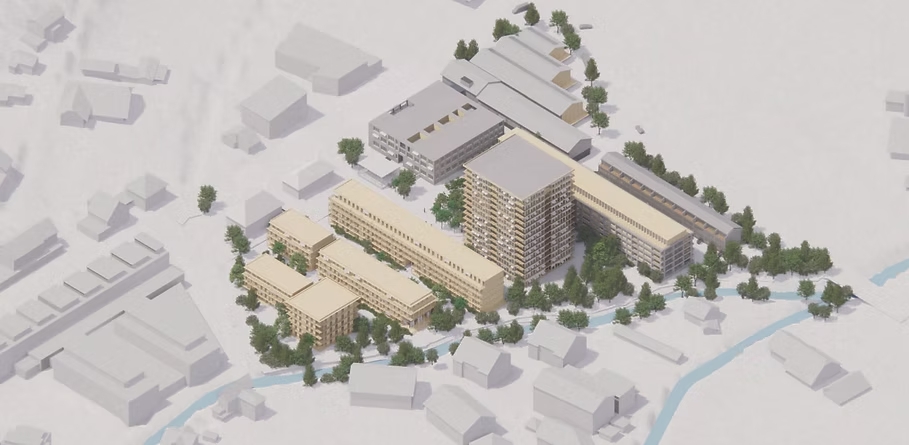
    The Sonnenhof site is centrally located between Bahnhofstrasse and Schaffhauserstrasse and covers a good 20,000 square metres. Today, the site is dominated by a shopping centre from the 1970s, other commercial and residential buildings and a large sealed car park. It is precisely this structure that is now to be fundamentally changed.

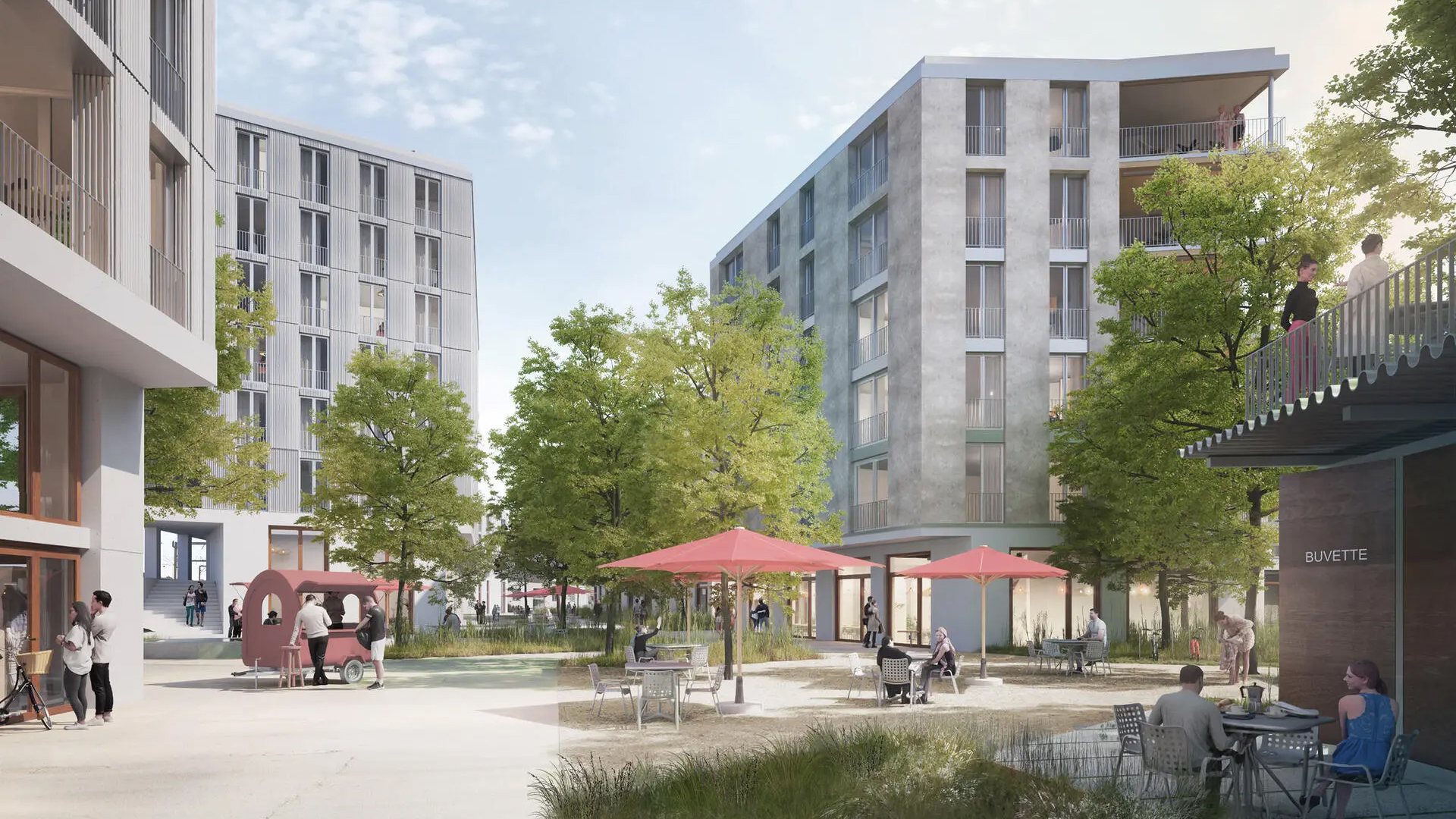
    The plan is to create a new, mixed-use district with a public passageway, green courtyards and squares, businesses, restaurants and a cultural and meeting centre. The existing shopping centre will not disappear, but will be modernised and integrated into the new structure.

    Urban densification
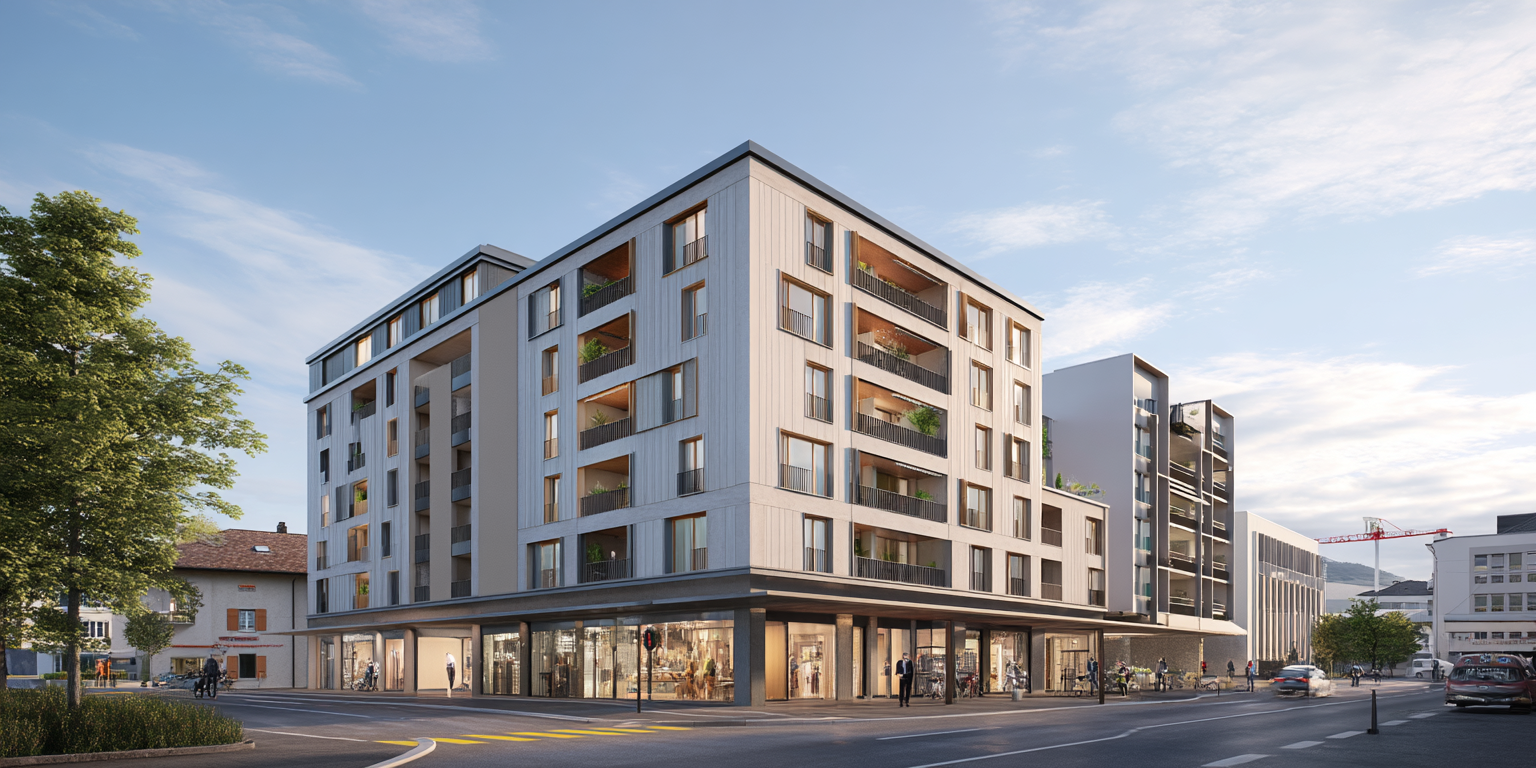
    At the heart of the project are around 240 rental flats in various price categories and with different floor plans. In addition, there are around 12,000 square metres for commercial, cultural and public uses on the ground floors and in the passages.

    In terms of urban planning, the project focuses on density and orientation. Four taller buildings will mark the site and give it a clearly recognisable address. The design plan allows for a maximum building height of 55 metres on the north-eastern corner. This shows how clearly the Sonnenhof will stand out from the previous scale.

    Open space instead of tarmac
    The message is particularly strong in the outdoor space. Where heat-retaining pavement dominates today, unsealed surfaces, trees, courtyards and climate-resistant planting will improve the microclimate in future. Rainwater will be able to seep away and evaporate, roofs will be greened and supplemented with photovoltaics.

    The project also aims to reorganise traffic flows. Most of the above-ground parking spaces will be moved to the underground car park, while paths and squares will be designed primarily for pedestrians and cyclists. Nevertheless, around 450 car parking spaces will remain on the entire site.

    Culture as part of the development
    The combination of property development and public use is striking. The planned KUBEZ cultural and meeting centre at Sonnenhof will not only be built, but will also create a regional meeting place for culture, education and leisure. The project is being developed in collaboration with the town of Bülach and neighbouring municipalities.

    This is what makes the Sonnenhof more than just a classic development. The site should not only provide living space, but also create a new centre that expands the everyday life of the town and strengthens the connection between the railway station, town centre and neighbourhood.

    A long road to the new centre
    Sonnenhof is still a planning project. the private design plan is due to be submitted in 2026, with approval scheduled for 2027. The first stage could start in 2029 and be completed in 2031, with overall completion scheduled for 2034 according to the project status.

    This shows the true scale of such projects. The transformation of a central site requires not only capital and design power, but above all time, procedures and political coordination. If Sonnenhof succeeds, Bülach will not simply gain new flats. The town will gain a new piece of urbanity.

  • Residential complex to be sustainably renovated and extended

    Residential complex to be sustainably renovated and extended

    The Schlieren-based real estate and construction company Halter is transforming the Clochettes site in the Champel district of Geneva. As part of the project, Halter was commissioned by Baloise to carry out the energy-efficient renovation, conversion and addition of storeys to three residential buildings from the 1970s. According to the press release, a total of 70 existing apartments will be modernized by January 2029 and 15 new apartments will be created by adding two more floors. The work will start in May and will take place while the apartments are occupied.

    As part of the refurbishment, Halter will replace the technical systems and refurbish the façades. Heat recovery and the installation of photovoltaic systems are also planned, according to the project description. The aim is to obtain a Minergie renovation label.

    The architectural design by the Grenier Coretra architecture firm maintains continuity with the existing buildings and harmonizes with the neighbouring residential complex. The new apartments will offer a variety of floor plans and room concepts tailored to modern living.

    New areas for residents and neighborhood-related uses will be created on the first floor of the buildings. The outdoor areas will also be enhanced with wooded areas to promote quality of life and biodiversity.

  • Ground-breaking ceremony marks the start of a new residential development in Baden

    Ground-breaking ceremony marks the start of a new residential development in Baden

    The first five foundation stones were laid on the Brisgi site, marking the official start of the approximately three-year construction phase. According to a statement from the City of Baden, the site will see the creation of around 220 units of sustainable and affordable housing. The symbolic laying of the foundation stones was carried out by Baden’s Mayor Markus Schneider, representatives of the non-profit developers – the Baden Housing Foundation, Logis Suisse AG and the Graphis Building and Housing Cooperative – as well as members of the local community.

    “These five stones come from the excavation and represent the core values of the future Brisgi site: together we are shaping the future with sustainable and affordable housing,” explains the City of Baden in the statement.

    By 2028, affordable flats and flexible housing options for single people, couples and families are to be built on the site. In addition, community life will be enhanced by studios, green spaces, a neighbourhood square and a playground.

    The project will be built in accordance with the Swiss Sustainable Building Standard (SNBS). “The site focuses on hybrid construction, renewable energy, biodiversity and minimal soil sealing,” the press release states. “In this way, the project demonstrates that high-quality construction, sustainability and affordable housing go hand in hand.”

  • Laufenburg builds windmills at the train station

    Laufenburg builds windmills at the train station

    The Schützegärte site is located in a sensitive urban location. Three streets surround it, and building typologies from different decades clash all around. It is precisely this chaos that is the theme. AWW Architekten AG makes the “contrasting and bilateral” the basis of the concept. The architecture emerges from the tension of the location, not against it.

    Offset, rotated, anchored
    Two identical, four-storey buildings form the ensemble. They are not parallel, but offset and rotated in relation to each other on the slightly sloping terrain. This positioning is not an aesthetic conceit, but a precise reaction to the formation of edges and the flow of space in relation to the neighboring buildings. An ensemble that blends in while remaining independent. The total floor area is around 4,600 square meters, the building volume around 13,800 cubic meters.

    Windmill as a residential model
    The architectural concept is based on a compact four-span “windmill” building shape with a central staircase core. The projecting wings characterize the façade and make reference to typical bay window shapes in the district. Each apartment is oriented on three sides. At the heart of the building are the “four-season rooms” with spacious rooms that can be used as conservatories, studios or living and dining areas. Together with loggias, this creates a flexible range of spaces for a wide variety of lifestyles.

    Green, communal, grounded
    The open space between the houses is deliberately kept low-threshold. Accessible from inside and from the street. A green layer of native shrubs and perennials protects the first floor apartments and gives the development character. At one corner, the area opens up to a meadow-like situation with fruit trees, a reference to the local tradition of orchards close to settlements. The project considers housing and community as a unit.

    Next steps open
    The town of Laufenburg was not involved in the planning process. Town clerk Marco Waser confirms that the building authorities only clarified the building regulations in advance. The town has not yet made an assessment. The landowner Erne Immo AG has not yet commented on the time horizon for implementation.

  • Five stones, 220 apartments, one future

    Five stones, 220 apartments, one future

    The Brisgi has roots. In the 1940s, the site was home to a shanty town for up to 1500 employees of the former BBC industrial group. Many of them were guest workers with their families. In the 1960s, a high-rise building and two apartment blocks followed, which still stand today and are carefully embedded in the new development. What was once a workers’ housing estate is now becoming a modern urban building block.

    Three sponsors, one goal
    The project is backed by three non-profit organizations that are jointly developing the 6.5-hectare site: Wohnbaustiftung Baden, Logis Suisse AG and Graphis Bau- und Wohngenossenschaft. Each will take over one of the three buildings and design them independently. The rents are calculated to cover costs. Profit is not the goal, but affordable living is.

    Wood, concrete and sun
    Nine five- to six-storey buildings, pergolas, green inner courtyards and a central square will characterize the future Brisgi. The hybrid construction method combines wood and concrete. Concrete only where it is really needed. Solar panels will produce electricity on around half of the roofs and the site will be connected to the district heating network of Regionalwerke Baden. The aim is to achieve the gold certificate of the Swiss Sustainable Building Standard.

    Values carved in stone
    Five stones, found during the excavation of the building pit and engraved by a stonemason, represent the self-image of the development. Common ground, the future, sustainability, affordability and living. City President Markus Schneider, who carried the stone with the inscription “Future”, summed up the 14 years of planning work: “Now the lively Kappi is becoming even livelier. A neighborhood within a neighborhood is being created here.” The five stones will be clearly visible in the development in future.

    Milestones on schedule
    After years of objections and a planning process since 2012, things are now picking up speed. The building permit for all three courtyard buildings was granted in April 2025 and construction started on schedule in the fall of 2025. Letting will start in the second half of 2027, with occupancy scheduled for the first half of 2028. The design architects are the Baden-based firm Meier Leder Architekten together with the Zurich firm Müller Sigrist, whose “Kandalama” project was chosen as the winning project in 2016.

  • Ein Quartier ohne Einsprache

    Ein Quartier ohne Einsprache

    Der Luzerner Regierungsrat genehmigte den Bebauungsplan Schützenmatt im Januar 2026. Der Emmer Einwohnerrat hatte ihn bereits am 1. Juli 2025 in zweiter Lesung einstimmig verabschiedet. Nach Ablauf der Beschwerdefrist liegt nun Rechtskraft vor, kein einziger Rekurs wurde eingereicht. Das ist bei einem Projekt dieser Grössenordnung keine Selbstverständlichkeit, sondern ein Zeichen breiter Akzeptanz.

    250 Wohnungen, 4000 Quadratmeter Leben
    Auf dem Areal entstehen rund 250 Wohnungen in verschiedenen Grössen sowie Gewerbe-, Gastronomie- und Dienstleistungsflächen von insgesamt rund 4000 Quadratmetern. Der Wohnungsmix reicht von kleineren Einheiten über Familienwohnungen bis zu Alterswohnungen . Bewusst konzipiert für alle Lebensphasen und verschiedene Einkommensstufen. Ein Teil der Wohnungen muss als preisgünstiger Wohnraum realisiert werden.

    Weniger Auto, mehr Velo
    Das Mobilitätskonzept setzt klare Prioritäten sodass Fuss, Velo und öffentlicher Verkehr Vorrang haben. Geplant sind über 970 Veloabstellplätze, darunter eine gedeckte, öffentlich zugängliche Velostation mit mindestens 300 Plätzen direkt an der Bahnhofunterführung. Für Autos stehen maximal 120 Parkplätze in der Tiefgarage bereit. Die Velohauptroute entlang der Gleise wird kreuzungsfrei geführt. Somit entfallen Konflikte mit dem Fussgängerverkehr.

    Die Stadt als Schwamm
    Das städtebauliche Konzept stammt von Fischer Architekten, deren Wettbewerbsbeitrag mit dem ersten Preis ausgezeichnet wurde. Im Zentrum steht das Schwammstadtprinzip. Sickerfähige Beläge, Bäume auf natürlichem Boden und begrünte Dachflächen speichern Regenwasser und geben es kontrolliert wieder ab. Mindestens 60 Prozent der Dachflächen werden intensiv begrünt. Das verbessert das Mikroklima und macht das Quartier klimaresilient.

    Ab 2027 wird gebaut
    Mit der Rechtskraft liegt die Umsetzung nun bei den Grundeigentümerschaften. Die Realisierung ist in vier Etappen geplant, ein Bezug der ersten Wohnungen ist ab rund 2030 realistisch. Christine Bopp, Leiterin Planung der Gemeinde Emmen, spricht von einem abgeschlossenen langen Planungsprozess, der nun Planungssicherheit für alle Beteiligten schafft. Emmenbrücke bekommt sein neues Herz und baut es mit Bedacht.

  • Urban change on the Wellis site

    Urban change on the Wellis site

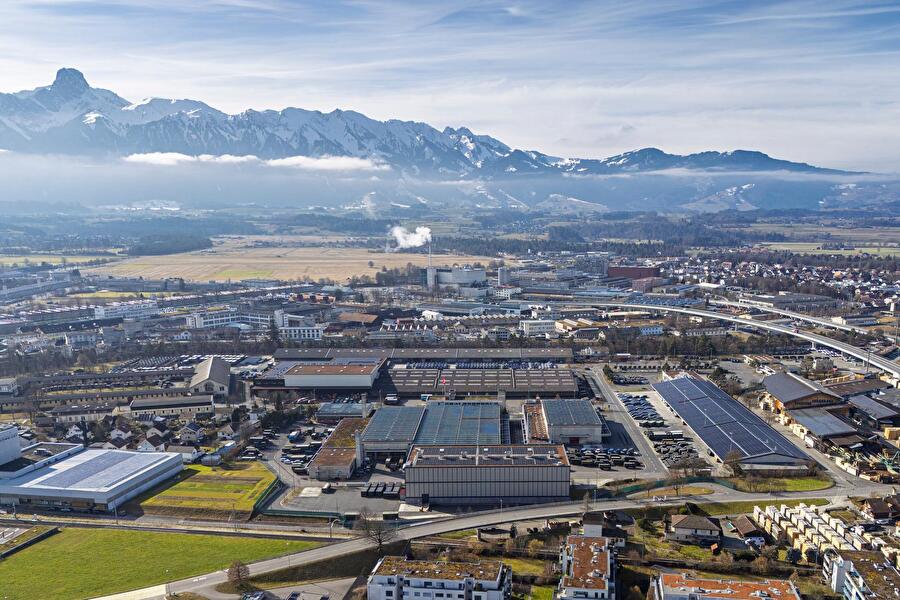
    One of the region’s most exciting transformation areas is located between the railroad station and the old town. Halls, warehouses and work yards are being transformed into an urban quarter with its own character. The area thus plays a key role as the gateway to Willisau.

    The area is roughly the same size as the historic old town. The previously closed production site is being transformed into an open piece of town. Paths, squares and open spaces will connect the station, the old town and the district. The previous barrier will become an urban interface.

    Mixture instead of monofunction
    The development clearly focuses on a mixture of uses. Several hundred apartments of different sizes and typologies are planned, supplemented by areas for commerce, services and local amenities. Living, working, shopping and leisure are moving closer together.

    It creates frequency throughout the day, increases the utilization of the infrastructure and reduces dependency on a single type of use. At the same time, it opens up scope for new forms of work, small-scale service providers and local suppliers.

    Identity from the industrial past
    The Wellisareal remains recognizable as a place. Parts of the existing building fabric will be preserved and used for new purposes. The industrial character not only provides history, but also identity. It clearly distinguishes the district from green meadow developments on the outskirts of the town.

    New buildings complement the existing buildings without covering them up. A high point marks the area in the silhouette of Willisau. The decisive factor here is not the height alone, but the effect in the urban space. This creates an image that remains anchored in the perception of residents, visitors and investors.

    Open space as a location factor
    The project consistently combines density with open space. Generous green spaces, trees, squares and paths structure the quarter and ensure a quality of stay. Instead of the inner courtyard as a residual area, the open space is at the center of the concept.

    For future users, this is more than just a matter of comfort. Shaded recreational areas, well thought-out outdoor spaces and differentiated microclimates are becoming hard location factors. They influence rentability, image and long-term value development. A robust open space concept also supports the adaptability of the neighborhood over its life cycle.

    Rebalancing mobility
    The location directly next to the train station and close to the old town allows for a low-traffic approach. Priority is given to pedestrians and cyclists, with public transport services within walking distance. The project deliberately reduces the number of parking spaces and focuses on alternative forms of mobility.

    For local authorities and investors, this means less land consumption for cars, more space for value creation and quality of life. At the same time, there is increasing pressure to think of mobility as an integrated offer. From sharing solutions to logistics and neighborhood services.

  • Foundation stone laid for mixed-use building in Frenkendorf

    Foundation stone laid for mixed-use building in Frenkendorf

    According to a statement, Halter AG has laid the foundation stone for the Park3project. Also involved were the client Zurimo “B” Immobilien AG, represented by UBS Fund Management (Switzerland) AG, representatives of Reuter Architekten, the municipality of Frenkendorf and the planning, marketing and implementation teams involved.

    The mixed-use residential and commercial building will be a five-storey structure with an attic, combining living, working and commercial space under one roof. The plot size is 2,607 square metres and the construction costs amount to 14 million Swiss francs. Flexible commercial space will be created on the ground floor, with modern office units on the first floor. The upper floors will feature 22 apartments with 2.5 and 3.5-room floor plans. The project is being developed in an area with good infrastructure connections, which is increasingly gaining urban quality as part of urban development. The site is currently used primarily for commercial purposes.

    The building plans for the project, a UBS annual report and the current issue of the Halter Group’s KOMPLEX magazine were placed in the foundation stone as contemporary documents and permanently anchored in the foundations.

    The focus is now on the construction of the shell, which is scheduled for completion by the summer. The project is scheduled for completion in spring 2027.

    Halter AG is a real estate and construction company operating throughout Switzerland. The company handles a construction volume of around CHF 800 million per year at seven locations and currently has around 320 projects in development and execution.

  • Thun North forms a new urban neighbourhood

    Thun North forms a new urban neighbourhood

    The cantonal development centre Thun North is considered the most important business location in the Bernese Oberland and is one of the four premium locations in the canton of Bern. The area between Selve and Lerchenfeld, which is still heavily characterised by military use, is to be gradually opened up for new uses. This will create space for working, living and mobility, linked by a new public access route.

    Workshop process as a milestone
    In 2025, the city of Thun conducted a workshop process together with Armasuisse Immobilien, Ruag Real Estate AG and BLS. It marked an important milestone in the transformation of the area. The task was to identify ways in which the site could develop into a modern, networked urban district. In addition to the future Thun Nord S-Bahn station, the creation of a lively urban environment is at the centre of the project.

    Open spaces as a basic framework
    The planning considerations focus on open spaces as a connecting element between the closed military areas to the south of the site. The three interdisciplinary teams developed several approaches in dialogue with experts, owners and interest groups. Despite different concepts, a common core emerged. The open space, Aare, Alpenbrücke and Allmendstrasse form the supporting framework to which future neighbourhood structures will connect. The new railway station also makes reference to the existing buildings. The striking shed roof hall will serve as the backbone and identity carrier.

    From idea to realisation
    The next phase is now starting. In a so-called synthesis, the city, owners and project partners are working on further refining the open space and neighbourhood structure. This forms the basis for the next, harmonised plans, such as infrastructure projects or the necessary planning instruments. Thun North is thus taking shape as a forward-looking neighbourhood that combines economic strength and spatial quality.

  • How Basel-Landschaft creates spaces for innovation and living

    How Basel-Landschaft creates spaces for innovation and living

    Basel-Landschaft is building for the future. Former industrial sites are being transformed into innovative campuses, flexible business parks and urban neighbourhoods. The Dreispitz combines art, education and high-tech on the cantonal border and creates space for 4,000 jobs, research and sustainable architecture at the highest level. Uptown Basel in Arlesheim is positioning itself as a hotspot for Industry 4.0 and MedTech with quantum computing pioneers and ecological lighthouse character. New districts in Muttenz, BusinessCity and AM SCHÄNZLI combine living and working spaces, green open spaces and climate-friendly mobility, further raising the location’s profile as a centre of knowledge and innovation.

    In Pratteln, modern urban living spaces are being created with Bredella, the Campus der Wirtschaft and Zentrale Pratteln, which focus on sustainable development, smart infrastructure and flexible utilisation concepts. In Allschwil, Bachgraben is developing into a leading life sciences location with the Switzerland Innovation Park Basel Area, where biotech, medtech and pharmaceutical companies are driving forward cutting-edge research and high-tech innovations. The Laufen Industrial Park and Ziegelei Ost in Allschwil create impetus for regional production, craftsmanship and community, focussing on the circular economy and CO² reduction. GETEC PARK is a growth driver for chemistry and life sciences, driven by decarbonisation and ESG standards.

    Basel-Land demonstrates how diversity, sustainability and innovation are driving transformation.

    Dreispitz
    Dreispitz in Münchenstein (Basel-Landschaft) is one of the most diverse areas in the Basel region. Art, education and business come together here. Over 380 companies and around 4,000 jobs characterise the Dreispitz business park, flanked by universities such as the FHNW and creative clusters. The intercantonal area offers space for innovative companies, start-ups, culture and modern educational institutions. A vital future location for the entire region.
    www.dreispitz.ch

    uptownBasel
    uptownBasel is building the future. A state-of-the-art innovation campus for the jobs of the coming decades has been under construction since 2019. The world-famous dental implant manufacturer Straumann is relocating a total of 1,000 jobs to the future-oriented development site by 2028. Arlesheim will thus become the most important hotspot for medical technology in Switzerland. The campus, which is being realised at a rapid pace by the Staehelin family and Fankhauser Arealentwicklungen, is characterised by several buildings already under construction with sustainable architecture at the highest level. The Roofdeck has now attracted worldwide attention and, together with the seminar and event rooms, serves to make the site a state-of-the-art centrepiece for the industrial location of Baselland.
    uptownbasel.ch

    Laufen Industrial Park
    The Laufen Industrial Park is located on the former Keramik Laufen AG tile factory on the south-eastern edge of the city and has been owned by the Abendrot Foundation since 2017. Following the major fire in 2020, which destroyed around 80% of the substance, the industrial site will be rebuilt as a single-storey timber system building from 2025 to 2027. The aim is to provide modern, affordable accommodation for small regional businesses, tradespeople and creative professionals, with flexible rental space and customised expansion options. A network of commercial lanes ensures good access and lighting and promotes networking between users. Densification and multi-storey extensions are possible in order to respond flexibly to regional demand. The focus is on sustainability. Re-use of building components, wood instead of concrete and renewable energy characterise the concept. An area association is intended to strengthen cohesion. Overall, a regionally relevant, versatile and sustainable commercial centre is being created.
    www.abendrot.ch

    AM SCHÄNZLI
    The new AM SCHÄNZLI neighbourhood in Muttenz marks an urban reinterpretation of living, working and leisure at the gateway to Basel. Three high-rise buildings with 385 flats and 14,000 m² of commercial space will be built on the 74,000 m² “Hagnau Ost” site by 2029. A central square and intensive greening will lend urban density and quality of life directly on the Birs recreational area. The focus is on resource-conserving construction, energy efficiency (SNBS Gold), photovoltaics and optimised mobility for pedestrians and cyclists. AM SCHÄNZLI stands for modern site development and sustainable integration of city and nature.
    am-schaenzli.ch

    BaseLink site
    The Bachgraben site in Allschwil has developed into Basel’s innovation engine. The site combines international life science companies, cutting-edge research and sustainable urban development. Projects such as the BaseLink site and new public transport and cycling initiatives are creating attractive workplaces and an urban environment. Close cooperation between the canton, the municipality and the business community is creating momentum and making the area a showcase project in the tri-national region.
    sip-baselarea.com/maincampus/

    Campus of the economy
    The new Campus der Wirtschaft is located directly next to the railway station in Pratteln and is developing into one of the most important event and work locations in the Basel region. By 2028, the H² building will be a state-of-the-art centrepiece. Six storeys will offer over 10,000 m² of flexible laboratory, event and office space, supplemented by a congress hall for up to 1,900 people and a total of more than 6,000 m² of event space. The campus is aimed at companies from industry, research and services, with sustainable architecture, optimal accessibility, infrastructure from a single source and synergies with the Bredella neighbourhood. The development strengthens the region’s competitiveness and positions Pratteln as an international centre for innovation, exchange and major events.
    h2-pratteln.ch

    GETEC PARK.MUTTENZ
    GETEC PARK.MUTTENZ is the leading industrial cluster in north-west Switzerland for chemicals, pharmaceuticals and life sciences. State-of-the-art infrastructure, safe laboratory and logistics areas as well as sustainable energy and resource concepts are concentrated on 50 hectares. The park, created from Infrapark Baselland and Schweizerhalle, is home to global corporations and numerous SMEs. Innovative solutions such as Waste2Value and ESG-based processes make GETEC the growth engine of the industry.
    www.getec.swiss

    Pratteln headquarters
    The Zentrale Pratteln project is transforming the former Coop site north of the railway station into a lively, environmentally and socially oriented neighbourhood. By 2026, around 480 cooperative flats for 1,200 people will be built, supplemented by a new school, around 15,000 m² of commercial space and a variety of open spaces. Construction and planning consistently focus on preserving existing buildings, reusing building components and sustainable energy supply. Historic industrial buildings such as the sugar silo will be retained. The cooperation between six property developers and the innovative utilisation concept make Zentrale Pratteln a showcase project for non-profit and sustainable neighbourhood development in the Basel region.
    centralpratteln.ch

    Bredella in Pratteln
    Bredella in Pratteln stands for the large-scale transformation of a central industrial site into an innovative urban neighbourhood. In the immediate vicinity of the railway station, 87,000 m² of diverse living, working and leisure facilities are being created, interspersed with green squares and renovated industrial buildings. The masterplan and neighbourhood plans focus on gradual development, sustainable mobility and a high quality of stay. With perimeter blocks, high-rise buildings, commercial and studio spaces, car-free areas and lively ground floors, a model for urban living in the Basel region is being created. Bredella boldly combines modernity, history and sustainable development.
    bredella.ch

    Brickworks East
    Ziegelei Ost in Allschwil is undergoing a comprehensive transformation into a lively, mixed neighbourhood. Historic buildings are being carefully preserved and combined with new uses for living, working and recreation. Large green areas, diverse public spaces and a finely meshed network of paths connecting three central squares – Kulturplatz, Quartierplatz and Lettenwiese – are characteristic of the area. The industrial tradition remains tangible through the preservation of the brickworks and their integration into modern structures. The project emphasises circularity, the reuse of building components and flexible new buildings in order to ensure climate protection, sustainability and a high quality of life.
    www.ziegelei-ost.ch

  • Green living in Basel Dreispitz Nord

    Green living in Basel Dreispitz Nord

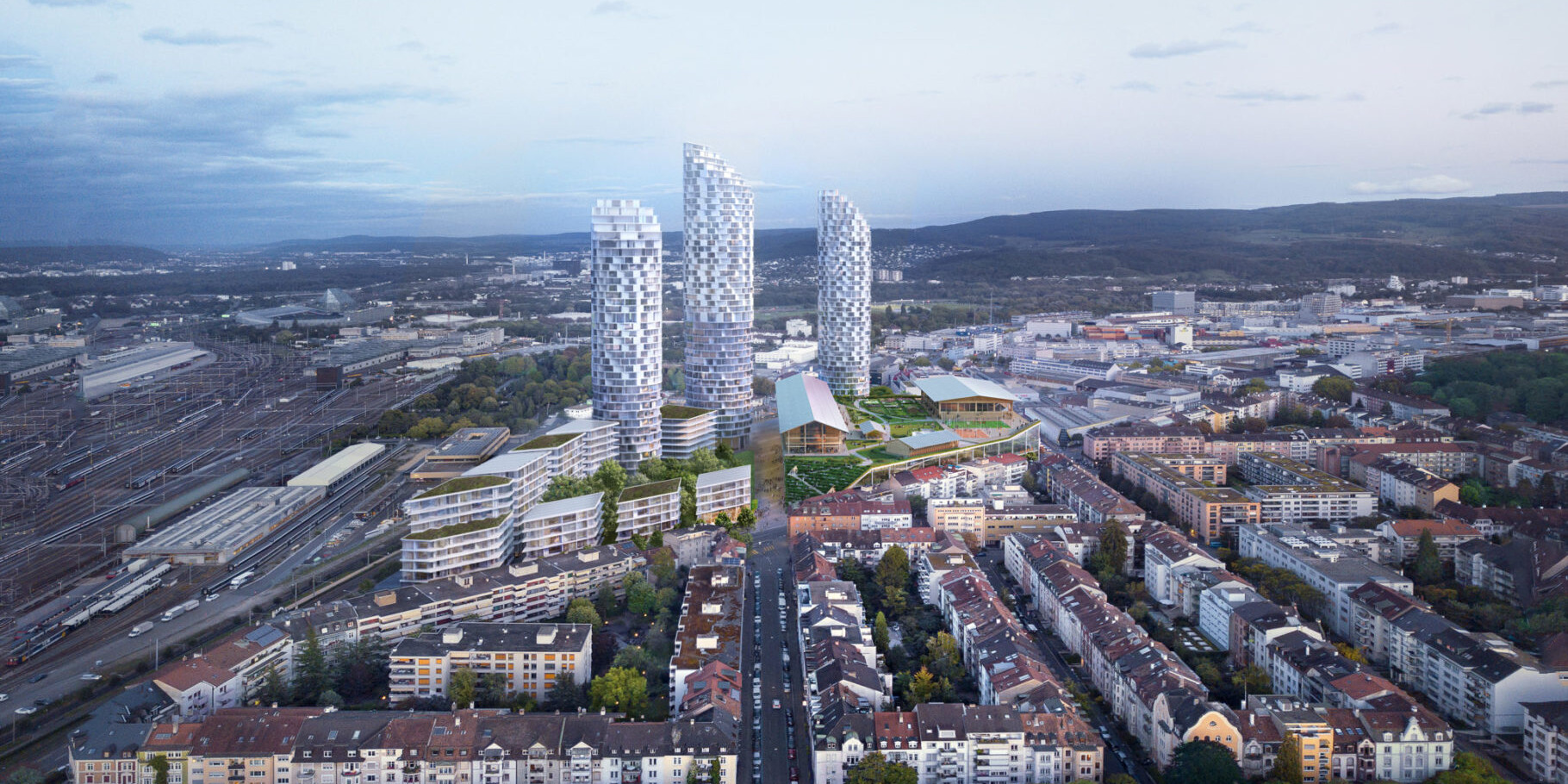
    Dreispitz Nord is transforming a formerly single-use area covering around eight football pitches into an inclusive district. Around 800 flats are being built, a third of which will be affordable and non-profit housing. Three striking round high-rise buildings will offer attractive flats as well as office space, a library and a fitness centre. The focus is on a neighbourhood where everything is within easy reach. Living, working, shopping and leisure activities merge into an urban whole. Pedestrians and cyclists have priority, and the public space is almost completely car-free. A total of 4,000 bicycle parking spaces are planned, and car parking facilities are bundled together and separated from the residential area to minimise traffic in the neighbourhood.

    A green place for urban climate and community
    Two newly planned city parks with large shade trees will transform the area into Basel’s green lungs and improve the microclimate in the long term. Permeable soils and planted roofs fulfil the principles of the sponge city and help to mitigate heat effects. The secondary school for around 600 pupils will be built on the roof of the modernised MParc, opening up new dimensions in terms of land use. The facilities will be complemented by basketball and sports fields, a triple gym and a youth club, which can also be used outside school hours. Direct access from Gundeldingen via a green ramp seamlessly connects Dreispitz Nord with the neighbouring district and creates public spaces that foster a sense of identity.

    Partnership-based planning with vision
    The Christoph Merian Foundation as the landowner, the Migros Basel cooperative as the building leaseholder and the canton of Basel-Stadt as the planning authority are jointly driving the project forward. After an intensive public consultation period with seven objections, all of which were rejected, the cantonal government confirmed the development plan on 14 October 2025 and forwarded it to the cantonal parliament for consideration. In addition to the development plan, adjustments to the zoning plan, noise sensitivity levels and building regulations are also planned. The environmental impact assessment confirms that all requirements have been met.

    Sustainability and social balance
    Dreispitz Nord is a prime example of sustainable neighbourhood development. Instead of grey parking spaces, green open spaces are being created, and the diversity of housing promotes social mixing. The existing building is being integrated into the new complex in a resource-efficient manner. Wide distances between the high-rise buildings ensure good ventilation, shade providers reduce heat stress and permeable surfaces strengthen climate adaptation. With 1,400 new residents, representing 7 per cent of the total population of Gundeldingen, and 1,600 jobs, the district will become a significant economic driver.

    Urban life and economy in harmony
    The new quarter integrates today’s modernised retail spaces, complemented by cafés, restaurants and small shops, which are also easily accessible via the extended tram stop. The interconnection of living, working, shopping and leisure creates an inspiring atmosphere and promotes sustainable mobility over short distances.

    Dreispitz Nord is characterised by its urban compactness, ecological sensitivity and social diversity. The project is a prime example of how comprehensive urban development can harmonise innovation, sustainability and quality of life, strengthening Basel as an attractive city for today and tomorrow.

  • From freight station to urban district

    From freight station to urban district

    The transformation will begin in 2027 with the first phase of development in the western part of the site. Around 600 flats will be built, a third of which will be affordable cooperative flats. The aim is to attract a diverse population and combine urban density with social diversity. The Urban Hub will become the lively centre of the neighbourhood. It will combine gastronomy, sport, culture and services and act as a link between residential buildings and commercial areas.

    The second phase of development will begin in the east of the site in 2031. Modern service and commercial buildings will create around 1,000 jobs and unlock the site’s potential for business, innovation and city logistics. Its central location at the railway station and its connection to the regional transport network reinforce its function as an urban hub in Basel.

    Focus on architecture, sustainability and flexible use
    The master plan consistently follows the principles of ecological and sustainable urban development. The new perimeter block development is based on the sponge city principle and integrates historic railway buildings into the courtyard concept. This ensures a pleasant microclimate, promotes biodiversity and improves rainwater management. Buildings such as Janus and Binaria impress with reused components, modular wood and metal elements, green and accessible roofs, and photovoltaic surfaces. The flexible construction guarantees reparability, ease of maintenance and subsequent conversion.

    Cultural and social start-up initiatives strengthen neighbourhood identity
    Even before construction begins, the area is being actively revitalised through innovative temporary uses. SBB is opening historic warehouses for culture, gastronomy and sport. One example is pickleball, which offers 2,000 square metres of space and attracts new players. Rental space for creative and social initiatives is also available. These pioneering uses create proximity to the neighbourhood population and promote creative participation. In particular, the broad participation process, in which the public, associations and organisations are involved from the outset, guarantees acceptance and innovation.

    Mobility, smart city and quality of life as a guiding principle
    People are at the centre, with technology and sustainability as the supporting pillars. A city logistics hub in the eastern area ensures resource-efficient goods distribution in Basel and the surrounding area. Modern mobility services and integration with public transport are an integral part of the neighbourhood strategy. The SBB’s scientifically supported quality of life model, developed in collaboration with the University of Basel, makes Wolf Basel a laboratory for innovative solutions in energy, circular economy and social cohesion.

    Wolf Basel is creating an inspiring neighbourhood that combines urban densification, sustainability, smart networking and social diversity. In this way, Basel is growing not only spatially, but also socially and technologically into the future.

  • The Sursee hospital site – new prospects from 2034

    The Sursee hospital site – new prospects from 2034

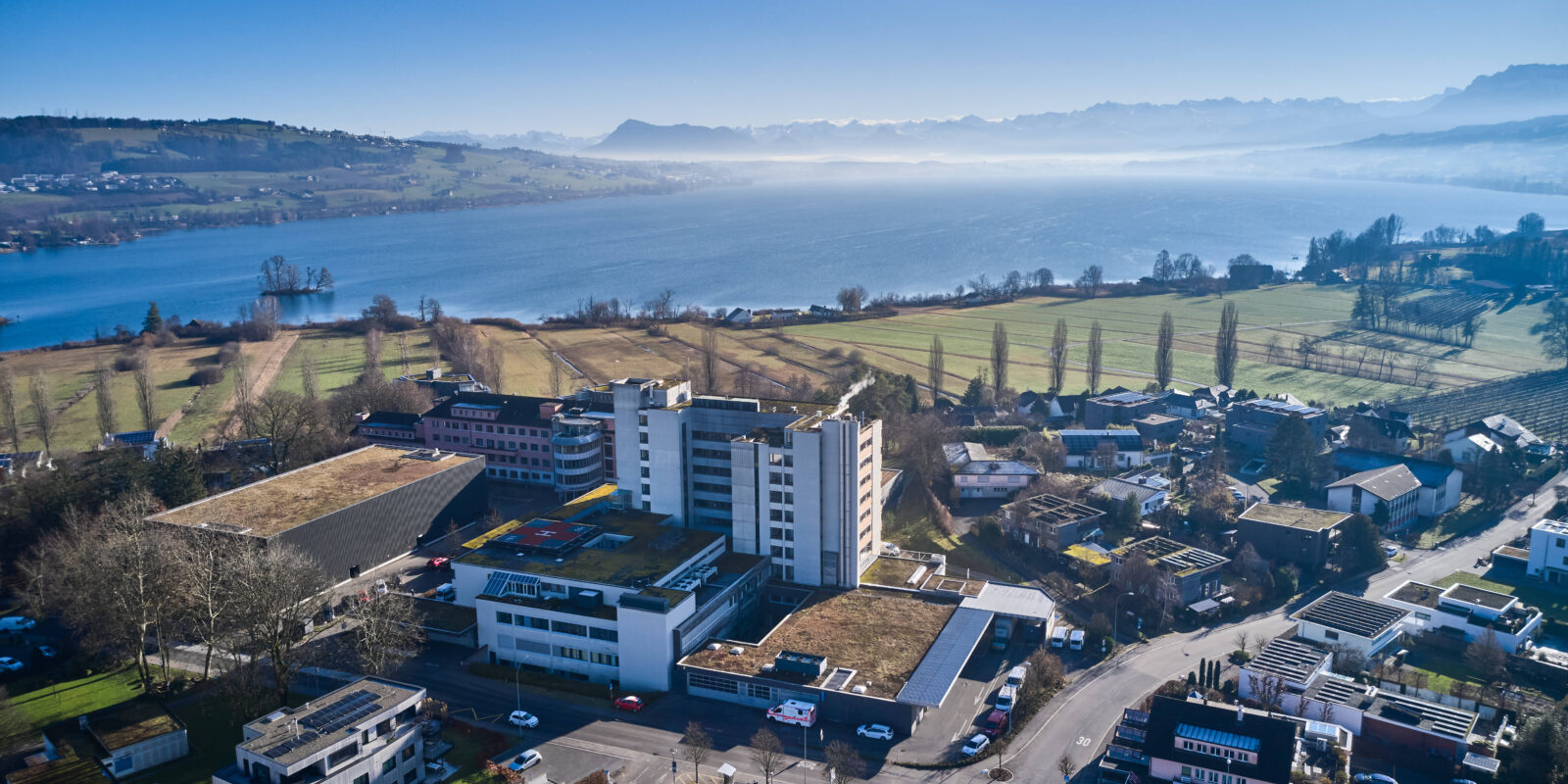
    The new construction of the LUKS Sursee and the Seeblick care center on Schwyzermatt in Schenkon will free up an area of around 47,000 square meters on Spitalstrasse in Sursee. About seven football pitches, centrally located, well developed and with views as far as the Alps. Where hospital buildings still stand today, a new urban building block can be created from 2034 that will shape Sursee in the long term. The canton of Lucerne is the main owner of the site, while adjacent areas also belong to the canton and partly to the city and will be included in the planning.

    The almost 50-year-old LUKS Sursee no longer meets the requirements of a modern hospital operation. The government council’s decision to build a new hospital and care center in Schenkon by 2033 will shift the healthcare infrastructure and open up a rare urban development potential in Sursee.

    Living, living, meeting
    The canton of Lucerne and the city of Sursee are pursuing a common goal: a mixed-use, lively district that combines living, services and quality of life. A test plan from 2026 will examine which uses and development structures are possible and sensible on the site. The results will form the basis for rezoning, architectural competitions and the first construction phases, which are to start after the hospital and nursing home have moved away, with the aim of avoiding vacancies as far as possible.

    It is already clear that the area is particularly suitable for residential use, for families, couples, singles and senior citizens. In addition, services, shopping facilities and restaurants are conceivable to fill the district with life. The aim is to create a socially mixed environment with a mix of upmarket and affordable housing that strengthens Sursee as a place to live and at the same time creates new opportunities for different phases of life.

    Sursee is growing
    Sursee is growing dynamically and, with a vacancy rate of 0.26 percent, has an extremely tight housing market. The new offer on the hospital site should help to alleviate the pressure and create additional residential quality in a central location. Its proximity to the old town, the existing transport links and the view of the lake make the site a key location for future urban development.

    It is an opportunity to create a new, identity-forming district. The site can provide impetus for the economic development of the region, create new jobs in the service sector and further raise Sursee’s profile as a regional center.

    District development as a joint task
    The planning of the hospital site is deliberately designed as an open process. Workshops with the local population and various interest groups are planned from spring 2026. Needs, ideas and expectations are to be incorporated at an early stage so that a district is created that is not only convincing from a planning perspective, but is also supported by the population.

    The municipal assembly will decide on the necessary changes to the sub-zone plan. This makes it clear that the future of the hospital site will not be designed in secret, but in a transparent process that combines specialist planning and local perspectives.

    A new urban building block with a history and a future
    In the long term, a diverse residential and living space with green areas, play areas and recreational spaces could be created where a hospital still operates today. Outdoor meeting places, short distances and good connections to the existing urban structure should make the area an integral part of Sursee.

    The canton of Lucerne wants to make targeted use of the potential of the privileged location with its lake view and historical use. From 2034, there will be an opportunity to create a district that respects the history of the site and at the same time provides answers to the housing and living needs of the coming decades. A new chapter for the hospital site and for Sursee.

  • Bassersdorf plans the next growth step

    Bassersdorf plans the next growth step

    Today, around 90 people work at the Pöschen, Gmeindwisen site on over 90,000 square meters. Over the next 20 years, 600 to 800 new jobs are to be created there and living space for around 1,200 people.
    With the further conversion of all plots, additional space for 100 to 200 more jobs and around 300 more residents is planned. The basis for this is the rezoning to a five-storey residential and commercial zone with a design plan obligation, which has been legally binding since February 2024. The development will take place in stages over several decades, with existing businesses retaining their place.

    Traffic, public transport and “low-car” concept
    The focus of the dialog with the population was on traffic. Questions were asked about parking, access and the future of the bus station. The planning team emphasized the clear focus on public transport. The district is not intended to accommodate through traffic, residents’ cars will be parked in underground garages and no new park-and-ride areas are planned. Despite the development of the area, the planned bypass will remain possible. Those responsible expect to attract a younger, more public transport-oriented population.

    Green spaces, neighborhood life and phasing
    The approximately 50 attendees were particularly positive about the generous green and open spaces, squares and connecting paths. The winning project structures the area into clearly recognizable neighbourhoods, with a noise-shielding block along Zürichstrasse, workplace-oriented uses towards the tracks and diverse residential areas in between. This structure facilitates implementation in stages. Complete realization is expected in ten to fifteen years.

    Political backing and participation
    Mayor Christian Pfaller and the landowners reaffirmed their support for the winning project and the long-term development of a diverse, sustainable district. As the municipality does not own any land itself, it is reliant on a cooperative approach with the owners. A school building is not required. Kindergarten and daycare facilities are planned, which the municipality intends to buy into. With the 2022 building and zoning regulations, the electorate approved the transformation to a mixed zone in principle, but at the same time anchored a design plan obligation. The current consultation event is part of this communication process. The feedback will now be incorporated into the indicative project, which will form the basis for the public design plan, which is expected to be discussed again next year.

  • Future neighbourhood with residential and commercial space in Döttingen

    Future neighbourhood with residential and commercial space in Döttingen

    The results of the study contract for the Gewerbestrasse site development in Döttingen will be exhibited in Döttingen on 18 and 19 October. The winning entry was submitted by fsp Architekten from Spreitenbach, together with LAND Suisse from Lugano and ASTOC Architects and Planners from Cologne. In the DOT project, a new neighbourhood is being created on the Birchmeier Hess Immobilien site. An area of 75,000 square metres will be home to 550 flats, while 15,000 square metres are earmarked for commercial use, as detailed in a press release.

    “With the transformation of the site, industry will become a neighbourhood. Halls become home, traces become identity. The industrial heritage is being transformed – sustainable, future-proof, mixed,” says Ivo Lenherr from fsp Architekten about the DOT project. The jury’s unanimous vote in favour of the winning project was based, among other things, on the “sophisticated urban planning strategy in dealing with the specifications of the landowner, the current building stock and the approved structure plan”. The project represents “a considerate approach to the neighbourhood and public needs and promises a harmonious and rich living and working environment for future users.”

  • How the Wolf site in Basel is becoming a residential neighbourhood

    How the Wolf site in Basel is becoming a residential neighbourhood

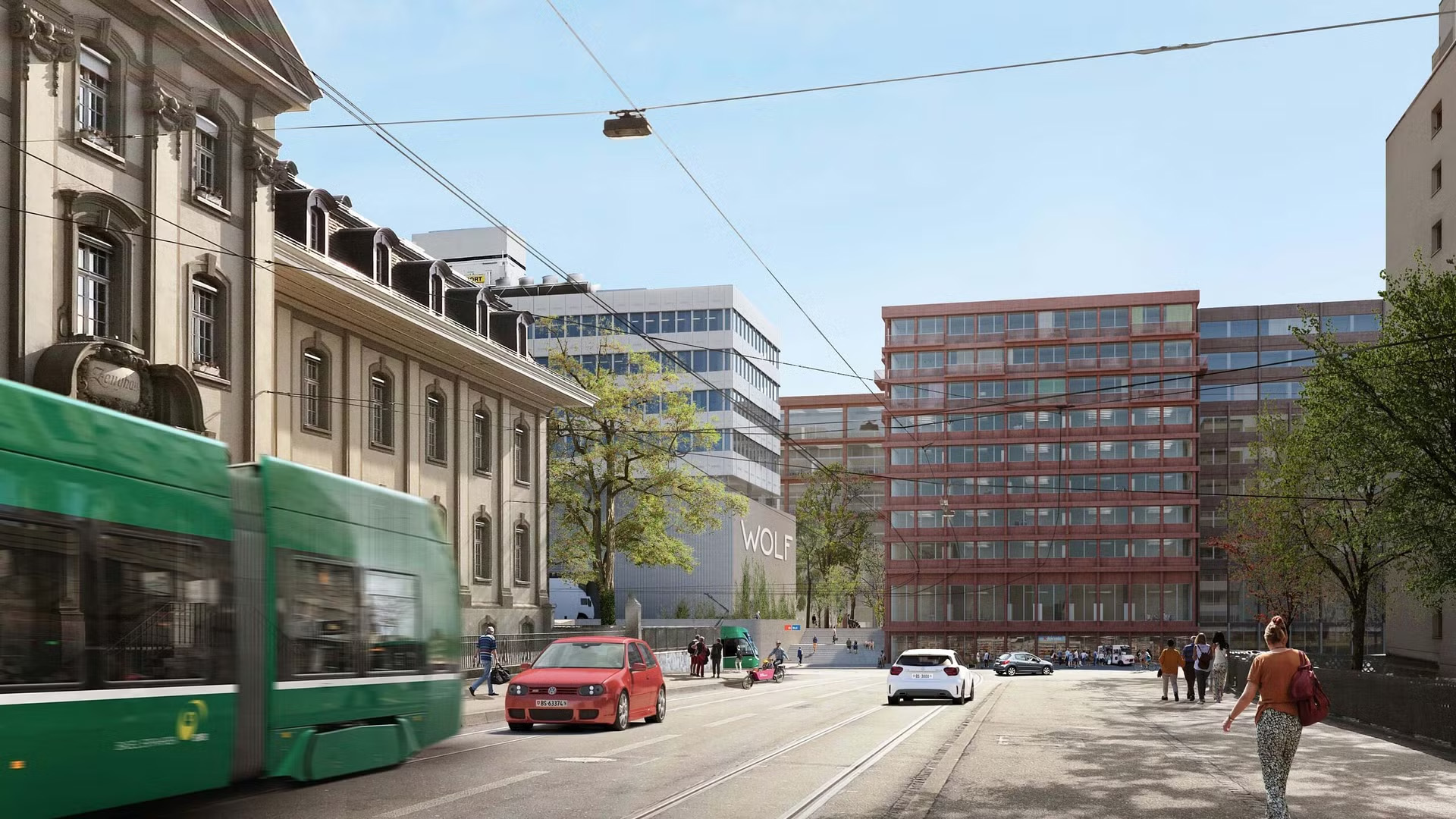
    The relocation of freight handling to the harbour area freed up a 16-hectare site near Basel SBB station. SBB has been pursuing the vision of a mixed neighbourhood here for years, combining living, working and leisure. The urban development plan is based on a design by Christ & Gantenbein and EM2N. The central element is a large courtyard that stretches from east to west, shields against noise and links public and private uses as a green boulevard.

    Two faces “Janusproject
    The Paris-based firm Experience, together with M-AP Architects from Lausanne, won the competition for the MF02 construction site. Their “Janus” project responds to the contrasts between the railway side and the inner courtyard with two architectural languages.

    A horizontal ribbon façade with striking concrete frames stretches towards the track side, conveying a powerful image to passing trains. Towards the courtyard, a finely structured façade with staggered balconies and greenish decorated surfaces appears.
    The construction method follows a hybrid approach of concrete skeleton and timber construction. The floor plans are compactly organised, with a clear separation between bedrooms, wet rooms and spacious living areas. Only the lack of privacy in the ground-floor flats was criticised.

    Noise protection as a design element “Binariaproject
    The “Binaria” project by Basel-based ARGE Parabase and Confirm won the competition for the MF03 construction site. It counters the street noise with a robust north façade made of reused trapezoidal sheet metal and protruding acoustic elements. In contrast, a transparent, green glass façade with balconies and plant troughs opens up to the courtyard side.
    The multi-storey passageway connecting the courtyard and the street is particularly striking. The circular ventilation grille made of sound-absorbing panels makes a strong architectural statement here. Inside, linear floor plans allow for flexible living concepts from 2.5 to 5.5-room flats. Sustainability is characterised by reused beams, recycled concrete and re-used wood.

    Pilot character with high standards
    Both winning projects pursue innovative approaches to noise protection, the flexibility of the flat layouts and the use of recycled materials. The roofs are used for photovoltaics and rainwater management, the façades are partially planted or fitted with integrated solar technology. Energy is generated from renewable sources, while shading and evaporation provide thermal insulation in summer. Special attention is paid to reversible construction. Constructions are to be screwed together instead of glued in order to facilitate subsequent reutilisation or material cycles.

    Milestones and prospects
    The new buildings in the west of the site will be realised in the first stage, with construction scheduled to begin in 2028. A second stage with a city logistics hub and additional uses will follow from 2031. Even before completion, SBB will open the site for interim use. The listed 2,000 m² railway hall will be used for sports activities, for example. The Wolf site will thus become a pilot project for urban housing construction that answers questions about noise protection, sustainability and socially mixed housing on a large scale. For Basel, this is not just an urban planning experiment, but a decisive step towards more affordable living space and a higher quality of urban life.

  • Gartenstadt Bergacker living with a future

    Gartenstadt Bergacker living with a future

    The approximately 70-year-old buildings on the Bergacker estate are no longer up to date and are in need of renovation. It is not feasible to renovate them while they are occupied, which is why the owners, Swiss Life for the western part of the site and Habitat 8000 for the eastern area, have decided in favour of a comprehensive replacement building.

    Test planning was carried out back in 2019 to develop a sustainable urban planning solution. The result is a concept based on four-storey terraced buildings that are arranged along the slope and create generous, green open spaces. These “garden courtyards”, developed by EMI Architekten and Maurus Schifferli Landschaftsarchitekt, tie in with the original garden city idea and promote the quality of life.

    Sustainability as a guiding principle
    The entire construction project is designed in accordance with the highest sustainability standards and aims to achieve the “Gold” certificate of the Swiss Sustainable Building Standard. Energy is supplied by geothermal probe heat pumps and photovoltaic systems, making the neighbourhood largely self-sufficient in renewable energy. Green roofs and climate-resistant outdoor spaces with wildflower meadows and shady trees promote biodiversity. At the same time, a large proportion of the garden courtyards remain unsealed in order to improve natural water management.
    In addition to ecological sustainability, the social component also plays a central role. The new building will create a total of 270 flats with 1.5 to 5.5 rooms, which are aimed at a broad public, from singles and families to older people. The focus is on affordable living space that is suitable for all stages of life.

    Living quality through intelligent architecture
    The new buildings make optimum use of the hillside location to offer maximum living comfort. A noise-reduced mezzanine floor has been created on the street side, while the rooms on the garden side have generous ceiling heights and offer direct access to the green open spaces. The floor plans are designed in such a way that morning sun in the kitchens and evening sun in the living rooms ensure a pleasant indoor climate. Each flat has two outdoor areas in the form of a loggia, a balcony or a terrace with a private garden.

    Particular emphasis is placed on communal areas. In a participatory process, tenants expressed a desire for seating, playgrounds, barbecue areas and urban gardens, which are now being integrated into the planning.

    Staggered implementation for a smooth transition
    To ensure an orderly transition for residents, the new building will be realised in several stages. The construction project planning should be completed by the end of 2025 before the first construction phase starts in 2026. The first new buildings are expected to be occupied in 2028, while the other construction phases should be completed by 2030.

    Swiss Life tenants will be actively supported throughout the entire process. They will receive help in finding accommodation, have priority when re-letting within the neighbourhood and benefit from flexible notice periods.

    A showcase project for sustainable living
    Gartenstadt Bergacker is becoming a forward-looking neighbourhood that combines sustainable construction with a high quality of living and a social mix. Conscious planning and the involvement of the tenants will create an environment worth living in that fulfils ecological, economic and social requirements in equal measure. The project sends out a strong signal for the future of sustainable living in the city of Zurich.

  • Innovation Park Ticino strategic project for the future

    Innovation Park Ticino strategic project for the future

    The Switzerland Innovation Park Ticino will be located on a 25,000 square meter site in the middle of the new quarter. The proximity to Bellinzona railroad station and excellent connections to the economic centers of Zurich and Milan make the location particularly attractive. The historic “cathedral” of the former workshops in the center of the quarter will be preserved and integrated into the modern cityscape as a landmark of the industrial past.

    Promoting research and development
    The innovation park will become a hub for cutting-edge research projects and business collaborations. Competence centers for drone technology, life sciences and lifestyle tech are planned. These are intended to strengthen the region’s innovative power and intensify cooperation between start-ups, established companies and academic institutions. The Life Sciences Competence Center, for example, will open up new avenues in biotechnology and work on animal-free drug testing.

    A strategic joint project
    Funding is provided by a broad partnership of public and private stakeholders, including the canton, BancaStato, industry and business associations as well as renowned universities such as the Università della Svizzera italiana (USI) and the SUPSI University of Applied Sciences. Switzerland Innovation Park Ticino SA was founded as a non-profit organization and will manage the development of the park.

    Stimulus for the economic development of Ticino
    With the official recognition by the national innovation network Switzerland Innovation, Ticino will be closely networked with the Innovation Park Zurich. This collaboration is intended to create synergies between the two regions and promote the exchange of knowledge between research and industry. The link to the MIND Milano Innovation District underlines the international focus of the project and strengthens Ticino’s competitiveness as a high-tech location.

    State Councillors Christian Vitta and Marina Carobbio Guscetti emphasize the strategic importance of the innovation park for Ticino. For Ticino as a business location, the innovation park is a strategic project for the economic development of the canton. The aim is to establish the region as an innovation hub, create highly qualified jobs and attract investment. The Switzerland Innovation Park Ticino will thus become a key driver of economic and technological development in the region and consolidate Ticino’s position as a major player in the Swiss innovation ecosystem.

  • Westspitz neighbourhood in Dietikon enters the planning phase

    Westspitz neighbourhood in Dietikon enters the planning phase

    The Basel-based insurer Baloise has completed the study contract for the urban development of the Dreispitz site in Dietikon, according to a statement from the city of Dietikon. The Westspitz neighbourhood is to be built there. The design plan process will begin in summer 2025 and run until the end of 2027, with the building permit procedure and project planning scheduled for 2028/2029. The construction phase is set to last from 2030 to 2032, with completion and occupation scheduled for 2032/2033.

    According to the press release, the consortium Penzel Valier in Zurich and ROBERTNEUN, based in Berlin, was unanimously recommended by an independent jury as the winning project for further development. The jury was appointed by Baloise as the owner and leaseholder of the site. The project, known as Westspitz Dietikon, meets the urban planning requirements of the city of Dietikon, supports its development strategy and provides new impetus for an urban, sustainable neighbourhood, it added.

    Westspitz Dietikon is located at the intersection of Badenerstrasse and Überlandstrasse. In the coming years, Westspitz is set to grow into a lively, mixed and well-connected neighbourhood. The neighbourhood consists of 80 to 90 percent residential space. Compact residential units for smaller households and larger flats for families are planned, as well as communal areas and noise-protected outdoor spaces. The ground floor zones along Badenerstrasse are to be enlivened by small-scale commercial spaces that meet the needs of residents and the surrounding neighbourhoods, the report continues.

  • New neighbourhood planned at Pratteln railway station

    New neighbourhood planned at Pratteln railway station

    Ina Invest can convert the Bredella West site in Pratteln, which is currently used for commercial and industrial purposes, into a mixed neighbourhood for living and working: The population of the municipality has approved the corresponding neighbourhood plan with 1903 yes votes against 1481 no votes, the real estate company based in the Glattpark district of Opfikon announced in a press release. “We are delighted that the people of Pratteln have decided to open up the currently underutilised Bredella West site and transform it into an attractive, green and vibrant neighbourhood,” Ina Invest CEO Marc Pointet is quoted as saying.

    The property company intends to tackle the transformation of the site in several stages. The plans include “high-quality outdoor spaces and inspiring combinations of flexible, compact and sustainable living, working and residential space”, according to the press release. At the same time, the neighbourhood located directly next to Pratteln railway station will play a key role in connecting the neighbourhoods north of the railway tracks.

  • Future for the AHV site in Schwyz

    Future for the AHV site in Schwyz

    The relocation of the cantonal administration to the new Kaltbach administration and security centre opens up new opportunities for the subsequent use of the previous administration site. The canton of Schwyz emphasises its responsibility not to leave the vacant site to its own devices, but to establish a value-adding and centre-promoting use together with the municipality of Schwyz. The building rights are to be awarded to a private investor as part of an investor tender in order to drive the development forward.

    Findings from the study process
    As early as 2022/23, the cantonal building construction office conducted a study to analyse potential uses for the site. This revealed the high attractiveness of the site for private-sector projects. Initial development concepts showed that commercial uses, combined with centre-promoting elements such as cultural spaces or green areas, could enrich the village in terms of urban development.

    Roadmap to implementation
    The next steps include the preparation of a partial revision of the municipal utilisation planning, which should be completed by 2025. The subsequent procedural steps, including a referendum in the municipality of Schwyz, are expected to take until 2027. The planned timeframe until the structural realisation of a follow-up project extends until 2029, after the relocation of the cantonal administration.

    An overview of the timetable

    By the 2nd quarter of 2025: Preparation of the subzone plan revision

    By the 1st quarter of 2026: Consultation and cantonal preliminary review

    By the 4th quarter of 2026: Public consultation and objection negotiations

    By the 3rd quarter of 2027: Referendum in the municipality of Schwyz

    From 2029: Construction realisation

    Sustainability and added value
    The target image for the site at Bahnhofstrasse 15 primarily comprises commercial uses, supplemented by publicly accessible areas. Green spaces and cultural facilities could further enliven the neighbourhood and contribute to the attractiveness of the location. The canton and the municipality of Schwyz see this project as an opportunity to strengthen the urban character and contribute to the economic and social development of the centre in the long term.

    The subsequent use of the former AHV building is an important step for the future of the village centre of Schwyz. With strategic planning and clearly defined milestones, the canton and municipality are working to create a value-adding and sustainable neighbourhood. The invitation to tender for investors and the revision of the sub-zone plan are key elements on the way to creating a lively and economically attractive neighbourhood.

  • Vorlage «Unterfeld Süd» in Baar an der Urne angenommen

    Vorlage «Unterfeld Süd» in Baar an der Urne angenommen

    Komitee und Bauherrschaft sind überzeugt, dass Baar mit der Annahme der Vorlage «Unterfeld Süd» gestern einen richtigen und wichtigen Entscheid für die künftige gesunde Entwicklung des Lebens- und Wirtschaftsraums Baar getroffen hat. Die Stimmbürgerinnen und Stimmbürger bekennen sich zu einem Konzept, welches unter Führung der Gemeinde Baar und gemeinsam mit Experten und Baarer Interessenskreisen entwickelt wurde.

    Ein Quartier, das neue Massstäbe setzt
    Über die nächsten Jahre soll im Unterfeld Süd ein nachhaltiger Lebensraum mit einem zukunftsorientierten, vielfältigen und ergänzenden Angebot entstehen, der in Baar und in der Region Zug neue Massstäbe setzt. Der Bauherrschaft schwebt ein Quartier vor, das Dorf mit Kleinstadt, Tradition mit Zukunft, sowie Arbeiten und Wohnen zu einer Symbiose verbindet und einen vernetzten Raum mit neuen Lebens-, Wohn- und Arbeitsformen bildet.

    Das Unterfeld Süd bietet vielfältige Entwicklungs- und Nutzungsmöglichkeiten. Neben den Wohnungen (Miete, Stockwerkeigentum, preisgünstiges Wohnen) sind weitere Nutzungen wie Büros und Dienstleistungen sowie publikumsorientierte Nutzungen in Teilen der Erdgeschosse vorgesehen.

    Das Areal ist ein kantonales Verdichtungsgebiet und liegt als eine der letzten unbebauten Bauzonen der Region direkt auf der Gemeindegrenze zwischen Baar und Zug am Bahnhof Baar-Lindenpark und angrenzend an die Erholungszone Lorze.

    Etappierte Umsetzung
    Die Bauherrschaft geht jetzt umgehend die nächsten Schritte an, um den Willen der Baarer Stimmbürger zeitnah umzusetzen. Anfang 2021 startet ein Architekturwettbewerb für die erste Bauetappe, dem die Richtlinien des Quartiergestaltungsplans zugrunde liegen. Nach der Auswahl des Siegerprojekts im Sommer 2021 wird ein entsprechender Bebauungsplan ausgearbeitet, welcher voraussichtlich im Sommer 2022 der Baarer Gemeindeversammlung vorgelegt werden kann. Anschliessend erfolgt die Baueingabe für die zwei Baufelder der ersten Bauetappe. Die weiteren Bauetappen werden voraussichtlich mit einer leichten zeitlichen Verschiebung parallel bearbeitet. Die ersten Bauarbeiten für die Erstellung der Gebäude auf dem Gelände beginnen frühestens im Sommer 2023. Implenia ist für die gesamte Arealentwicklung zuständig und entwickelt die Baufelder 1A und 4 (im Bild in Gelb markiert) als Eigentümer sowie die Baufelder 1B und 3 (im Bild in Grün markiert) im Auftrag von Ina Invest.

    Wir danken der Gemeinde Baar, den aktiven Unterstützern aus Politik und Gesellschaft, sowie den Baarer Stimmbürgerinnen und Stimmbürgern für ihr Vertrauen und das klare Bekenntnis zur Entwicklung Unterfeld Süd.