The Zurich cantonal government wants to optimise the building permit procedure and has proposed shortening the processing period from four to three months. This measure is intended to make the authorisation process more efficient and reduce planning uncertainty for building owners. A key factor in this acceleration is the digitalisation of processes, which should reduce the administrative burden.
Political background to the change in the law The initiative to shorten the time limit stems from a motion by the FDP, SVP and GLP, which was passed by the Cantonal Council by 96 votes to 73 in February 2023. The cantonal government sees this as an opportunity to optimise processing times without jeopardising the quality of the examination procedures.
No reduction in the preliminary review period Contrary to the request in the motion, the preliminary review period will not be reduced from three to two weeks. In doing so, the Government Council is responding to the feedback from the consultation process, according to which a preliminary review that is too short could slow down the procedure overall instead of speeding it up. A thorough preliminary review is seen as crucial for the smooth processing of planning applications.
More efficient procedures for a dynamic construction industry The planned amendment to the law is intended to make construction in the canton of Zurich more efficient and easier to plan. The digital transformation of approval procedures could not only save time, but also minimise bureaucracy. It is now up to the Cantonal Council to decide on the proposed amendment to the Planning and Building Act.
The cantonal initiative “Protect affordable housing – stop vacancies” aims to control rent increases through state intervention and restrict conversions to condominiums. This would allow municipalities to introduce an authorisation requirement for renovations, conversions and changes of use. However, the cantonal government sees the initiative as problematic: “Rent caps are counterproductive in the long term,” explains Carmen Walker Späh, Director of Economic Affairs.
Experience from Geneva: a warning example The cantonal government refers to the situation in Geneva, where there are strict rent controls and authorisation requirements. There, it has been shown that new construction activity is declining significantly, while a considerable price difference has developed between existing and new rents. This regulation means that many people are staying in the same flat for a record-breaking length of time, which is exacerbating the housing shortage.
Danger for energy-efficient renovations and high-density construction The government council also sees the danger that a rent cap could reduce the motivation for important renovations and energy-efficient renovations. This could have a negative impact on the quality of living and the condition of many properties. According to the cantonal government, the planned measures also encroach on property rights and increase the administrative burden due to complex authorisation procedures.
New strategies to promote residential construction Instead of rent controls, the cantonal government is focussing on increased construction activity to relieve the market. A framework credit for cantonal housing promotion is to be doubled to CHF 360 million in order to specifically strengthen non-profit housing construction. In addition, a counter-proposal to the “More affordable housing in the canton of Zurich” initiative will further support the creation of affordable housing.
With these measures, the cantonal government is pursuing a long-term price-curbing approach aimed at combating the housing shortage through increased construction activity and targeted housing promotion. The rejection of the housing protection initiative reflects the aim of improving the housing situation without interfering with the economic freedom rights of property owners.
The Zurich cantonal government wants to create the planning basis for increased utilisation of wind power in the canton. According to a press release, it has now submitted 20 highly suitable and 15 well-suited areas for consultation. The highly suitable areas are mainly located in the north-east of the canton between Cholfirst, Stammerberg, Zünikon and Bergbuck. Other areas in the south of the Knonauer Amts, on the Pfannenstiel and in the Oberland are considered to be well suited. The canton looked at a total of 52 potential areas.
The consultation will last until 31 October. The cantonal government will then prepare the corresponding proposal for the cantonal council. Wind turbines can only be erected in areas that are listed as suitable in the structure plan.
The cantonal government is also proposing measures to involve the municipalities and the population in the construction of the turbines. For example, municipalities and private individuals should be able to participate voluntarily in the investments. Conversely, plant operators should voluntarily allow municipalities to share in the profits.
In contrast, the cantonal government sees little potential for the expansion of hydropower in the canton. Only at the Rhine Falls could 20 per cent of the water be used for an underground power plant. It proposes a corresponding entry in the structure plan.
The Government Council of the Canton of Zurich rejects the popular initiative “More affordable housing in the Canton of Zurich”, which provides for a right of first refusal for municipalities to promote non-profit housing construction. Instead, the cantonal government relies on proven structures and instruments for the rapid and effective promotion of affordable housing.
The counter-proposal provides for a doubling of the framework credit for cantonal housing promotion loans from the current CHF 180 million to CHF 360 million. This enables co-financing at communal level and thus creates a potential of CHF 720 million. This means that more flats can be subsidised and higher loan amounts can be granted per property. The Housing Promotion Ordinance is to be amended accordingly to increase the upper limit for loans from 20 to 25 per cent of the total investment costs.
Criticism of the right of first refusal – encroachment on the guarantee of ownership The Government Council criticises the proposed right of first refusal in the popular initiative as an encroachment on the guarantee of ownership and freedom of contract. Private companies, including institutional investors such as pension funds, would be at a disadvantage, which could lead to legal uncertainty and deter private investment. This could inhibit residential construction activities and exacerbate the existing housing shortage.
The right of first refusal also harbours the risk of lengthy appeal proceedings and could place a burden on municipalities and their taxpayers. The cantonal government sees the counter-proposal as a more efficient solution for creating affordable housing quickly.
Housing shortage in the canton of Zurich Demand for housing in the canton of Zurich has exceeded supply for years. Construction activity is below average, which is leading to an increasing housing shortage. Although a large proportion of Zurich’s population lives in long-term tenancies and is therefore less affected by rising rental costs, the need for action remains great.
The Government Council emphasises the need to stimulate construction activity in order to increase the overall supply of housing and curb rental and purchase prices. The counter-proposal aims to provide targeted housing for financially disadvantaged sections of the population.
Effective promotion instead of right of first refusal The government council’s counter-proposal promises rapid and effective promotion of non-profit housing construction by doubling the framework credit and amending the Housing Promotion Ordinance. This will create a solid basis for combating the housing shortage in the canton of Zurich and providing more affordable housing for all sections of the population.
Reorganisation of building and planning One of the core issues, agenda item 5 (RG 147/2023), concerns the revision of the Planning and Building Act and the Cantonal Building Ordinance. The need for amendments arose from various proposed changes and questions raised, which necessitated a re-examination by the Environment, Building and Economic Commission (UMBAWIKO). After intensive discussion, the UMBAWIKO submitted new proposals, which were only partially approved by the Government Council.
Reform of building insurance Another important project, agenda item 45 (RG 225/2023), includes the first amendment to the cantonal constitution, a comprehensive revision of the law on building insurance and an adjustment to the tariff of fees. After the Buildings Insurance Act has basically functioned well since its introduction in 1972, current developments make a complete revision necessary. The Justice, Environment and Culture Commission (JUKO) has carefully examined the bill and submitted proposals for amendments, which are supported by both the Government Council and the Finance Commission (FIKO). As a constitutional amendment is on the agenda, two readings are planned in the Cantonal Council.
This agenda illustrates the Canton of Solothurn’s commitment to meeting the challenges of the times through targeted legislative amendments and at the same time setting the course for sustainable development.
Die Basler Baubranche, vertreten durch Oscar Elias, CEO der Stamm Bau AG, richtet einen dringenden Appell an die Regierung, um auf die wachsenden Herausforderungen im Wohnungsbau aufmerksam zu machen. In einem persönlichen Schreiben an Regierungsrat Kaspar Sutter verdeutlicht Elias die Sorgen der Branche, die durch das neue Wohnschutzgesetz und einen deutlichen Rückgang von Sanierungs- und Umbauprojekten stark betroffen ist.
Die Stamm Bau AG, die 2023 ihr 180-jähriges Bestehen feiert, hat ihren Sitz in Arlesheim, erhält jedoch die Mehrheit ihrer Aufträge aus Basel. Elias betont, dass insbesondere Sanierungsprojekte, die für zwei Drittel des Umsatzes der Firma verantwortlich sind, durch das Wohnschutzgesetz komplett zum Stillstand gekommen seien. Dies führt zu einer signifikanten Planungsunsicherheit, wodurch Projekte unberechenbar und risikoreich werden.
Der Brief beleuchtet die Notwendigkeit eines Handlungsbedarfs, da die Baubranche bereits die negativen Auswirkungen des Gesetzes auf die Wirtschaft und den Arbeitsmarkt spürt. Elias äußert seine Bedenken, dass die momentane Situation die Bausubstanz der Stadt und den Wohnungsmarkt gefährdet. Er fordert von der Regierung eine Lockerung der Regularien für Wohnen und Bauen, eine Einschränkung der Einsprachemöglichkeiten sowie Anreize für mehr Sanierungen und die Schaffung von neuem Wohnraum.
Die Reaktion des Mieterverbands und des Kantons deutet darauf hin, dass eine Anpassung der Praxis und eine aktivere Information über das Wohnschutzgesetz notwendig sind, um die Investitionsbereitschaft der Eigentümer wiederherzustellen. Der Kanton Basel-Stadt ist aktuell mit der Evaluation der Auswirkungen des Wohnschutzes beschäftigt, und Regierungsrat Sutter signalisiert in seiner Antwort an Elias die Bereitschaft, bei Bedarf Korrekturen vorzunehmen.
Für Elias und die Basler Baubranche ist jedoch klar: Es besteht dringender Handlungsbedarf, um die Herausforderungen im Wohnungsbau zu meistern und die Planungssicherheit für Eigentümer und Investoren wiederherzustellen.
In the coming years, the economic challenges will continue to increase. Competition among locations is intensifying, while the world of work is changing rapidly. The digital transformation, more flexible and location-independent working models, as well as the labour shortage pose major challenges for companies, the labour market and the entire economy. In order to be prepared for these in the best possible way, the existing economic and labour market policy competences in the currently broadly structured Office of Economic Affairs and Labour (AWA) will be strengthened organisationally. Therefore, at the request of the Department of Economic Affairs, the Government Council decided last year to transfer the AWA into two independent offices as of 1 January 2024: an Office for Economic Affairs (AWI) and an Office for Labour (AFA).
The AWI will be responsible for location promotion, economic policy, work permits, working conditions, housing promotion and national economic supply. The AFA will be responsible for the labour market, unemployment insurance and the unemployment fund.
Hans Rupp with many years of operational and strategic leadership Hans Rupp will be the new head of the Labour Office. After studying at the University of Zurich, the 57-year-old gained professional experience in various organisations and companies. Most recently he was managing director of building and housing cooperatives and in the real estate sector. In addition to these operational tasks, Hans Rupp has held various mandates in the area of strategic management. He has many years of experience in operational and strategic management. Among other degrees, Hans Rupp holds an Executive MBA from the University of Zurich.
Fabian Streiff: From Head of Location Promotion to Head of the Office of Economic Affairs Dr. Fabian Streiff will be Head of the Office of Economic Affairs. After completing his studies in geography and economics at the University of Zurich, the 39-year-old first worked as a consultant in the fields of strategy development, sustainability issues and economic promotion before earning his doctorate in economic geography and regional development at the University of Bern. He then headed up location promotion in Basel-Stadt before becoming Director of Healthcare Innovation / DayOne at BaselArea.swiss. Since December 2020, Dr Fabian Streiff has been head of location promotion for the Canton of Zurich at the Office of Economic Affairs and Employment.
Dr Fabian Streiff and Hans Rupp will take up their posts on 1 January 2024.
You have been a member of the government since 2011 and are running for a fourth term in April. What do you like about your current position as Finance Director of the Canton of Lucerne?
Even after 12 years, I consider it a privilege to be a government councillor in the Canton of Lucerne. For me, it is an exciting, varied and challenging task. As Finance Director, I take care of IT, real estate and personnel in addition to finances. I enjoy these cross-sectional functions and the resulting responsibilities. Our department is allowed to provide the resources that the other departments need in order to provide the corresponding services to the population.
Where do you see the greatest challenges at the moment?
From an overarching perspective, mobility and sustainability are among them, along with health care. Within the Finance Department, we have several interesting real estate projects that we are allowed to push ahead with – for example, the expansion of the Horw campus. With a budget of 365 million francs, this is the largest project in the Canton of Lucerne to date. We have also just submitted the building application for the cantonal administration at Seetalplatz in Emmen. We want to bundle the administration in this new building for about 175 million francs. One of the challenging tasks is the ongoing search for a location in the city of Lucerne for the Lucerne Museum and the Cantonal Court. Since we need several thousand square metres of space for both, the project is not entirely simple.
You are currently working on the revision of the Tax Act 2025. Are global uncertainties such as the climate problem or the war in Ukraine being taken into account?
In the Canton of Lucerne we are registering a very positive development. The tax law reform is intended to create the conditions for the Canton of Lucerne to remain an attractive location for natural persons and legal entities and to develop optimally. In 2000, we still had debts of 2.5 billion francs – today we have net assets of more than 300 million francs. We have achieved this thanks to an ambitious and demanding tax and financial policy. In parliament, we discussed a climate and energy report and are implementing the corresponding measures. The situation in Ukraine naturally affects many areas. Taking the current situation into account, we have created a stable foundation for the tax law reform and are looking forward to it positively.
You see yourself as a bridge builder between city and country. Where do the discrepancies lie?
In addition to the city and the agglomeration as an urban centre, there are many agricultural regions, especially in Lucerne’s hinterland. It is precisely this diversity that makes the canton interesting. We are centrally located, easily accessible and can offer attractive local recreation areas. In this respect, I don’t want to talk about discrepancies, but about different starting points. It is our task to keep these differences in mind in all decisions. An agglomeration city has different needs than a rural community in the Entlebuch. Thanks to the cantonal financial equalisation system, we can offer comparable services to the population in all municipalities.
You completed an apprenticeship as a draughtsman and then studied to become a civil engineer. To what extent does the knowledge you acquired then flow into your current job?
I am a great friend of the dual education system: vocational training is not better or worse than the academic path. It is simply different. During my apprenticeship, I learned to take responsibility for the work I do and to do it very accurately. This benefits me in my current job as finance director. Especially in the real estate sector, I know how construction projects are set up and I know the processes. Basically, an education like the one I enjoyed is a good basis for a broad range of tasks.
What strategy are you pursuing in your department in terms of digitalisation?
I am convinced that the digital transformation is an important basis for the further development of our society and economy. In this respect, we have developed a digital strategy that is geared towards the entire canton and is intended to ensure its future-oriented development. Within the administration, we want to provide our services in a contemporary – i.e. digital – manner. We have launched the service portal together with the Lucerne municipalities. It is intended to offer communal and cantonal services online. The plan is to create a digital gateway for all public services in the Canton of Lucerne. Our aim is not only to find an optimal solution for the administration, but also one that makes life easier for the residents.
What makes the Canton of Lucerne attractive for companies?
We offer good framework conditions, for example in profit taxation, which we halved in 2012. As a result, we were the canton with the lowest profit taxation of legal entities for several years – this has had a positive effect. With the planned revision of the tax law, we are ensuring that we will continue to be an attractive business location in the future. But our educational institutions are also an important factor. We have consciously invested in education and belong to the rather younger education cantons. We also benefit from our central location and the sufficient space available for businesses. We are aware that we are in a competitive environment with the neighbouring cantons. We have to move constantly in order to remain attractive.
The Canton of Lucerne relies on a special model for economic development.
Correct. We are the only canton in Switzerland that does not regulate business promotion at the cantonal level, but has outsourced it to a foundation. The companies are represented there as partners of the cantons and municipalities. We are convinced that it is important that the business community has a say in decision-making and feels valued. That is why we attach great importance to the maintenance of the existing business community and want to ensure good framework conditions for the private sector. We strive for qualitative growth and receive good feedback for our model.
What is the situation regarding urban sprawl in the Canton of Lucerne and what is being done about it?
We support the economical use of land and try to promote this with legal foundations. Densified building is the order of the day in our structure plan and in the communal zoning plans. Due to the Federal Spatial Planning Act, we now have 21 municipalities that have to reduce their building zones by up to 70 hectares – so-called rezoning municipalities. This is not an easy process, but we are keeping at it. With our structure plan, we want to enable development and at the same time take care of our cultural landscape.
There is a housing shortage, especially in the centres. What measures must be taken to alleviate the situation?
The public sector alone cannot solve this problem. What is needed here is interaction between the private sector, investors and the public sector. We create incentives for dense building by allowing higher utilisation. In addition, we make suitable areas available for residential buildings, such as at Seetalplatz or in Ebikon. In this way, around 200 flats can be realised.
Minergie and LEED certification has been an integral part of planning and construction at the Circle for 12 years. In the presence of Christian Appert, CEO Amstein + Walthert AG, Martin Kull, CEO and owner HRS Real Estate AG, Daniel Scheifele, Chief Real Estate Officer, Flughafen Zürich AG, Giorgio Engeli, Head Real Estate Portfolio Management Switzerland, Swiss Life Asset Managers, and Stefan Feldmann, Head The Circle, Flughafen Zürich AG, the team around The Circle celebrated on Monday, June 27, 2022, the goal they have now achieved.
Beautiful, functional, climate-optimized With a good 200,000 m 2 energy reference area, the circle accounted for 6% of the certified Minergie area in the year of provisional certification, but was only one of around 1,900 buildings. This shows the size and importance of this extraordinary building in the Swiss context. The Circle is the largest Minergie-certified building in Switzerland. According to government councilor Marc Mächler, the Minergie certificate means that – in addition to all other requirements and uses – the building is also climate-optimized. Climate-optimized means «that this building does not accelerate climate change and that it uses resources carefully. It is efficient and works almost entirely with renewable energy instead of fossil energy.”
Thanks to intensive cooperation between the Minergie certification body and those responsible for the circle, the high requirements of the Minergie quality label for the building envelope and ventilation could also be met. Andreas Meyer Primavesi, Managing Director of Minergie, is pleased that the result ultimately benefits everyone: "Especially with today's energy prices, every kilowatt hour of energy saved is worth it – not only for the climate, but also financially".
Into the net-zero energy future With the leading Swiss building label Minergie, more than 12 million tons of CO 2 and 67 million megawatt hours of energy have been saved since 1998 thanks to over 53,000 Minergie buildings compared to the minimum legal requirements. Minergie certifies around 3 million m 2 of energy reference area per year. In close coordination with the cantons, Minergie always leads the way and is therefore a pioneer in cantonal energy laws. This interaction has worked since the beginning and continues successfully. Minergie is currently looking very closely at the energy used and the greenhouse gas emissions in the construction of a building. And secondly, Minergie is striving to improve the operating phase: Extensive, digitized building data is used to measure the energy flows during operation in order to then carry out operational optimization where necessary on the basis of the monitoring. For years, fossil-free operation – even with modernization – Minergie is moving more and more towards net zero. The Minergie-A-ECO standard comes closest to the Swiss net-zero building.
The UZH Forum has completed its preliminary project and thus completed the first phase of the project planning, the UZH informs in a press release . The planned nine-story building for the UZH research and education center will form “the future hub of the University of Zurich in the heart of the Zurich Zentrum university district,” the statement said. A large part of the building is to be made accessible to the public.
The cost of the new building is expected to amount to CHF 598 million. The Government Council of the Canton of Zurich has now referred a corresponding loan application to the Cantonal Council, the State Chancellery of the Canton of Zurich informed in a separate statement . According to her, the Forum UZH provides “the urgently needed additional space for teaching and research”. In addition, the Communications Department of the Government Council emphasizes the function of the planned research and education center as a “link between the three traditional institutions of the University of Zurich, the University Hospital Zurich and the ETH Zurich “.
The seven above-ground floors of the Forum UZH are reserved for research and teaching. Law, economics and modern philology will occupy the top four floors. In addition, seven of the 40 locations of the university library will move into the new building. In the center of the building there will be an inner forum in the form of a large hall that breaks through the entire structure, which gives the building “an open, pleasant atmosphere across all floors”, writes the UHZ in its press release. The Forum UZH is scheduled to open in 2029.
12 years ago, CKW subsidiary Steiner Energie built the last hydroelectric power station in the canton of Lucerne in Malters. Even then, CKW was intensively involved in the planning of the Waldemme power plant. A lot of water flowed down the Waldemme before the excavators could finally drive up and drive their shovels into the ground.
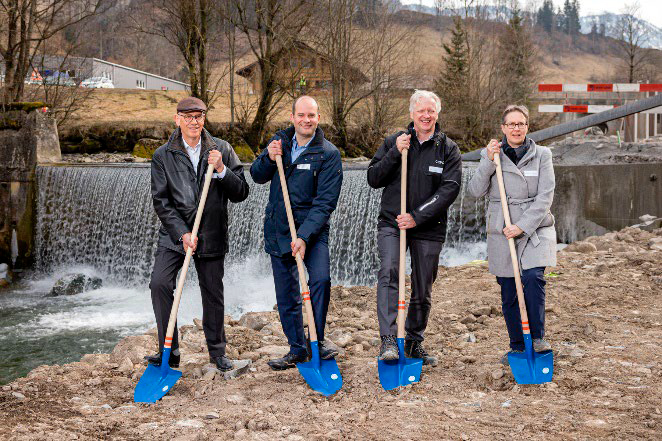
Within a year, some of this water will be used to produce clean, renewable electricity. At today's ground-breaking ceremony in Flühli, government councilor Fabian Peter, head of the building, environment and economic department, expressed his delight: "With the new construction of this power plant, CKW is making another important contribution to achieving the energy and climate policy goals in the canton of Lucerne. »
Expansion of renewable energies is urgently needed In his speech to more than 70 invited guests, CKW CEO Martin Schwab was primarily pleased that the power plant is finally being built. Because it was a long and rocky road. Schwab positively emphasized the great commitment in Entlebuch. "The region is a pioneer in using its own local energies." At the same time, Schwab warned: “We urgently need to expand the production of renewable energy in Switzerland. The corona pandemic and the war in Ukraine clearly show how dangerous strong dependencies on foreign countries can be, »said Schwab. Today things are progressing much too slowly in Switzerland. “This is primarily due to the long approval process. The Waldemme power plant is the best example of this: it took more than 17 years from the first plans to the groundbreaking.»
"We want to move forward and make a significant contribution to the energy transition in Switzerland – in hydropower, wind power, solar energy and other renewable technologies. But the resistance is often great. This is paradoxical, as we all want the energy transition and need more renewable energies for it."
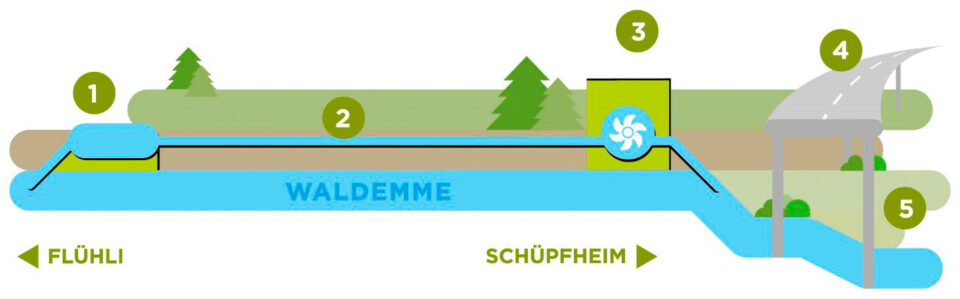
Electricity for 1500 households The roughly one-year construction phase begins with the ground-breaking ceremony. The water intake is at the hamlet of Matzenbach in Flühli. From this location, part of the water from the Waldemme is routed via a 2.1-kilometer-long underground pressure line to the power plant headquarters, where ecological electricity is produced. The power plant control center is located directly in front of the Lammschlucht at the Chrutacher Bridge. Immediately afterwards, the water is fed back into the natural course of the Waldemme and flows through the Lamm Gorge. The power plant has an output of 1.4 megawatts and produces an average of 6.5 GWh of electricity. This means that clean electricity can be generated from mid-2023, which will cover the annual needs of around 1,500 average four-person households. CKW is investing CHF 12.4 million in the power plant.
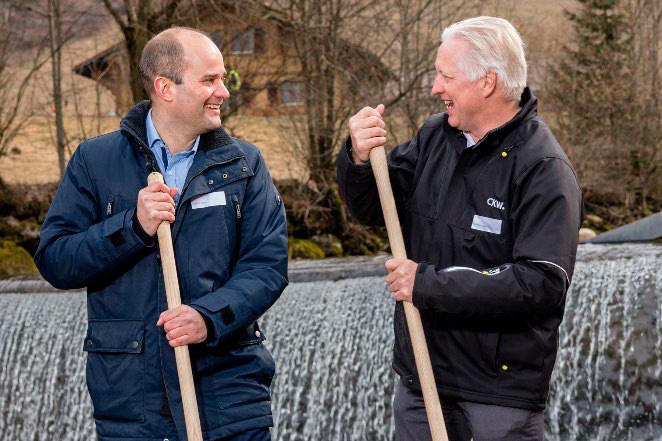
In the hamlet of Matzenbach, the water intake (1) takes part of the water from the Waldemme. In the approximately two-kilometer-long underground pressure line (2), the water is routed to the power plant center (3) at the Chrutacher Bridge (4), where it drives a turbine and generates electricity. Directly at the headquarters, the water is fed back into the natural course of the Waldemme and flows through the Lamm Gorge (5), which is untouched by the project. Breaking ground at the Waldemme: (from left) Hans Lipp, Flühli municipal mayor, Fabian Peter, member of the cantonal government and head of the building, environmental and economic departments of the canton of Lucerne, Martin Schwab, CEO of CKW and Hella Schnider-Kretzmähr, Flühli municipal president. Happy about the start of construction: Fabian Peter, member of the government and head of the building, environment and economic department of the canton of Lucerne, and Martin Schwab, CEO of CKW.
About CKW: The CKW Group is a leading Swiss provider of integrated energy and building technology solutions. For more than 125 years, the company has been supplying electricity to over 200,000 end customers in the cantons of Lucerne, Schwyz and Uri. In addition, there are innovative products and services throughout Switzerland in the fields of connectivity & IT infrastructure, electrical engineering, energy technology, IT & communication and security. The CKW Group employs over 2,100 people. With around 350 apprentices in 14 professions, it is the largest private-sector training company in Central Switzerland. In the 2020/21 financial year, CKW generated sales of CHF 916 million. With 81 percent of the shares, Axpo Holding AG is the majority shareholder of CKW. Further information at www.ckw.ch
The government council of the canton of Solothurn has approved the land use planning for the Attisholz area in Riedholz. The decision ensures the further development of the area in the next 25 years, according to a media release from the Schlierem-based construction company Halter AG . On the Halter project page , it says about the project that cellulose has been industrially produced on the site for 130 years. Since the end of 2016, Halter AG has been working with the municipality of Riedholz and the canton of Solothurn to redesign the area.
The usage planning that has now been approved was drawn up from 2018 to 2019 in a planning group of the municipality, the canton and Halter AG. After the preliminary examination, the participation procedure and the condition of the land use planning from 2020 to 2021, the municipality of Riedholz transferred the dossier to the canton of Solothurn in June 2021, according to the holder's notification. The decision of the government council now creates the planning law basis for a new zoning plan, as well as a zoning and development plan, in order to develop a living space for living, working and leisure out of the area.
It is important that "the population stands behind the project and that the effects on the community in social, economic and ecological terms are acceptable," said Sandra Morstein, Mayor of Riedholz. "That is why great importance was attached to informing and participating in the population as well as trusting and constructive cooperation with the canton and Halter AG in the planning and development of common objectives."
The results of a study by landscape architects on open space will be available in February. The planning of the infrastructure for public transport and community buildings such as schools and day-care centers is in preparation.
Generis AG will continue to run the economic development agency for the canton of Schaffhausen until 2024. The same applies to the office for the promotion of regional and location development. The government council decided this at its meeting on Tuesday.
The service contract currently runs until the end of 2022. After that, it can be extended for a further two years for the last time. At the beginning of 2015, Generis AG was awarded the contract to manage both facilities.
As stated in a communication from the government council, Generis AG has “so far fulfilled its mandate very well. The results achieved to date in the field of business development represent a real success story. ”That is why the service contract is now being extended.
The Canton of Zurich wants to work more closely with SBB on upcoming projects. According to a cantonal press release , both partners want to use synergies and save costs. For the canton of Zurich it has been shown that it makes sense to integrate the three cantonal projects to expand the bike and bus network into the major Brüttenertunnel project and to work on these projects together with the SBB.
"The Brüttenertunnel project offers the opportunity to hand in hand the most extensive bike project to date in the Canton of Zurich and to expand public transport in the Glattal region," said Economics Director Carmen Walker Späh as quoted in the press release. According to the overall traffic concept of the Canton of Zurich, the share of bicycle traffic in the total traffic volume is to be increased continuously to 8 percent by 2030.
The government council has therefore applied for a property loan of CHF 73.1 million from the cantonal council. The aim is to realize the pilot project of a fast bike route from Zurich-Oerlikon via Wallisellen and Dübendorf to the Zurich Oberland "barrier-free, coherent, safe and comfortable".
A main bicycle connection from the Im Lampitzäckern quarter in Dietlikon along the SBB route in the direction of Baltenswil, a main bicycle connection, is intended as a feeder to this rapid cycle route. It is also part of this synergy project. With the redesign of Bahnhofstrasse, the cycle route in Dietlikon and Wangen-Brüttisellen is to be continuously expanded to become the main connection and the network gap in the direction of Baltenswil is to be closed.
Finally, in the course of the construction work on the Brüttener Tunnel, the Baltensilerstrasse underpass in Bassersdorf will be removed. In addition, the canton is planning a bus lane in order to be able to prefer the bus service from Baltenswil to Bassersdorf train station.
The planning approval process for the Brüttener Tunnel and the three accompanying projects will run from 2023 to 2025. The accompanying projects will be handed over to the public in stages before the tunnel is due to go into operation at the end of 2034 at the earliest.
Wir verwenden Cookies zur Unterstützung und Verbesserung unserer Dienste. Mit der Nutzung dieser Website erklären Sie sich mit der Verwendung von Cookies einverstanden. Weitere Informationen finden Sie in unserer Datenschutzerklärung.