Tag: Rendite

  • Swiss Life Asset Managers increases dividend for property funds

    Swiss Life Asset Managers increases dividend for property funds

    The Swiss Life REF (CH) ESG Swiss Properties real estate fund closed the 2023/24 financial year with a profit of CHF 64.2 million, Swiss Life Asset Managers announced in a press release. The asset manager, which is part of the Swiss Life Group, intends to distribute CHF 58.3 million of this to investors. To this end, the dividend will be increased from CHF 2.60 for the previous financial year to CHF 2.70 per share.

    In the year under review, Swiss Life Asset Manager integrated 47 newly acquired properties into the fund. At the same time, the sale of seven properties generated a net capital gain of CHF 7.2 million for the fund. The value of the properties held over the entire reporting period increased by 0.4 per cent net year-on-year. Rental income was 4.5 per cent higher than in the previous year. The vacancy rate rose from 1.5 per cent to 1.6 per cent.

    At the end of the financial year on 30 September 2024, the fund comprised 201 portfolio properties with a total market value of CHF 3.21 billion. The net asset value per unit before distribution remained unchanged year-on-year at CHF 113.73.

  • Property funds and solar contracting: a response to the specific needs of property owners

    Property funds and solar contracting: a response to the specific needs of property owners

    How does solar contracting work?
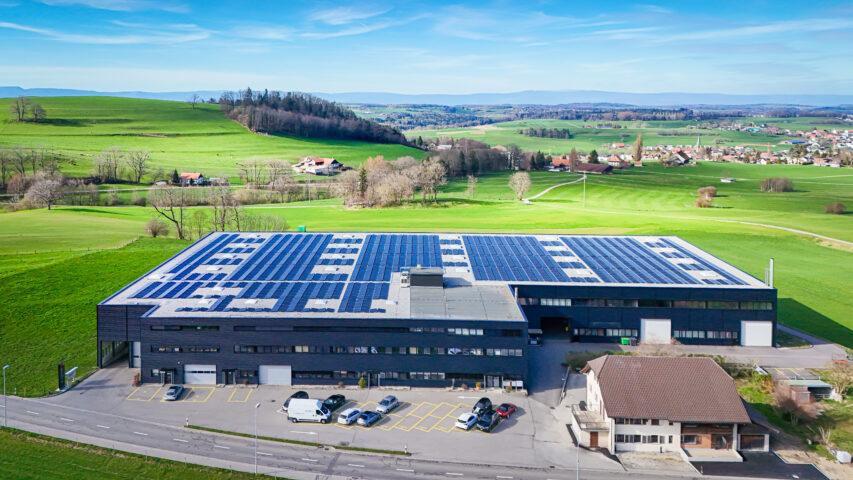
    Solar contracting is based on a simple principle: we install our own photovoltaic panels at your company’s site. Within this framework, we take over the complete planning and project realisation, as well as the financing and management of the system.

    This offer not only enables you to upgrade your property, but also fulfils the legal requirements and the expectations of your investors and tenants. It also enables the creation of new rental space.

    Your unused space as a capital investment
    As a property owner, you probably have areas that are suitable for the installation of photovoltaic panels. At Romande Energie, we offer installation on the following surfaces:

    • On a roof
      Turn unused space into a power plant – from 500m2.
    • On a car park
      Use your car park to generate electricity with a solar carport – from 2,000m2.
    • On a greenfield site
      Set up a ground-mounted solar power system on an unused plot of land – from 2,000m2.

    Stoneweg: a concrete example

    The Stoneweg Group, which specialises in real estate investment, turned to Romande Energie to equip several buildings with solar panels.

    We have realised several projects with Romande Energie and have always greatly appreciated their reliability and their solutions to specific challenges.” Diana Oblak, Managing Director at Stoneweg

    Click here for the interview

    What are the advantages of contracting?
    Contracting makes it possible

    • the creation of new rental stock and therefore an increase in your returns.
    • guarantee the conformity of your properties.
    • increase the value of your property.
    • reduce theCO2 emissions of your property portfolio.
    • Providing your tenants with clean and locally generated electricity at a competitive price.
    • participate in reducing the risk of electricity shortages at a national level.
    • participate in the fight against climate change.

    To make an appointment or for further information, please contact us at

    www.romande-energie.ch/solar

    0800 233 825 | solar@romande-energie.ch

  • Federal Council draws up new regulation for permissible net yield

    Federal Council draws up new regulation for permissible net yield

    Der Nationalrat hat der Landesregierung am Dienstag den entsprechenden Auftrag erteilt. Dies, indem er mit 130 zu 61 Stimmen bei 3 Enthaltungen eine Motion des Bündner Ständerats Stefan Engler mit dieser Forderung annahm.

    Der Mitte-Politiker argumentierte, Marktbeobachter gingen davon aus, dass der Referenzzinssatz weiter ansteigen werde. Kürzlich erhöhte ihn das Bundesamt für Wohnungswesen (BWO) auf 1,75 Prozent.

    Seit 1986 gelte der Grundsatz, dass ein Ertrag aus Mietobjekten dann zulässig sei, wenn dieser 0,5 Prozent über dem Referenzzins liege. Das Bundesgericht habe aber 2020 zwei Praxisänderungen vorgenommen. Unter anderem habe es bestimmt, dass der Ertrag den Referenzzinssatz neu um zwei Prozent übersteigen dürfe, wenn der Referenzzins zwei Prozent oder weniger betrage.

    Bei einem Anstieg des Referenzzinssatzes auf über 2 Prozent werde sich die Frage stellen, ob der bei der Berechnung der Nettorendite zulässige Zuschlag zum Referenzzins direkt wieder auf 0,5 Prozent zu reduzieren sei. Es sei besser, so Engler, wenn der Bundesrat diese Frage auf politischem Weg kläre, als diese für Mieter- und Vermieterschaft wichtige Frage den Gerichten zu überlassen.

    Rot-Grün dagegen
    Der Bundesrat war einverstanden mit der Annahme der Motion, welcher der Ständerat bereits im September zugestimmt hatte. «Gouverner, c’est prévoir», sagte Bundesrat Guy Parmelin am Dienstag im Rat. Regieren heisse Vorausschauen.

    Steigt der Referenzzinssatz um 0,25 Prozentpunkte, können die Vermieter die Mieten um 3 Prozent anheben. Voraussetzung dafür ist bei langjährigen Mietverhältnissen aber, dass auch die früheren Senkungen weitergegeben wurden.

    Eine rot-grüne Minderheit im Nationalrat argumentierte am Dienstag, im Text der Motion werde schon eine bestimmte Richtung für die Neuregelung vorgegeben. Dies in dem Sinne, dass die Interessen der Vermieter in den Vordergrund gestellt würden. Sie scheiterte aber mit ihrem Antrag, die Motion abzulehnen.