The Careum Tower was officially inaugurated in mid-November after around two and a half years of renovation work. According to a statement from the Careum Foundation, which is in charge of the project, the former nurses’ tower block of the University Hospital Zurich(USZ) has now become a modern working and meeting place for education and healthcare. According to the statement, this will create more space on 17 floors in Zurich for the planned expansion in the field of medicine. This was celebrated at the inauguration with the Director of Education of the Canton of Zurich, Silvia Steiner, and the Director of University Medicine Zurich, Beatrice Beck Schimmer, among others.
The Careum Foundation has concluded a 40-year lease agreement with the USZ with an option to extend. There are now 6000 square metres of floor space available with the possibility of 350 workstations. The foundation itself, which offers training and further education in the healthcare sector, intends to use three of the 17 floors itself. The Careum Publishing House and the Careum Centre for Health Literacy, for example, will move into rooms. The remaining space has been let to institutes of the University of Zurich Medical School.
“We are thus expanding our campus and creating additional space for networking and inspiration between disciplines and institutions. In keeping with the purpose of our foundation, we are utilising the potential in Zurich’s university district to further promote education and research in the healthcare sector and make a contribution to healthcare provision,” Careum Foundation President Hans Werner is quoted as saying.
According to documentation, the historical character played a central role in the renovation. For example, two floors were left in their original state. According to the press release, the responsible experts from Bhend & Schlauri Architects worked closely with the City of Zurich’s monument preservation authorities.
Bagni Popolari heralds the end of the interim use of the Bad zum Raben. On 25 January, the thermal baths on Kurplatz in Baden will celebrate the end of the “Acts of Attention” exhibition, the association announced in a press release. At the same time, a temporary outdoor pool with natural thermal water on the Limmat promenade will invite visitors to take a dip.
Bagni Popolari has been revitalising the previously closed Raben-Bad since 2017 with exhibitions, performances, music, readings, lectures and animated films, attracting thousands of visitors, according to the press release. However, the thermal baths now need to be thoroughly renovated in order to continue operating. Among other things, it needs solid pool technology, ventilation, new electrical installations and wheelchair-accessible toilets.
The Raben cooperative, which emerged from Bagni Popolari, is responsible for the renovation. It was founded in 2022 to acquire the bathing floor in the former Badegasthof zum Raben. The Raben cooperative estimates that the necessary renovations will cost around CHF 4.5 million.
1.5 million of this is to be raised through the sale of new cooperative shares and donations. The Raben-Genossenschaft intends to raise the remaining 3 million Swiss francs through donations from the public sector, foundations and sponsors as well as loans. “If everything goes well, Bagni Popolari will be able to celebrate the first vernissage in the renovated Bad zum Raben in 2027,” hopes the association.
The Urdorf municipal council outlined the key points of the Urdorf 2030 real estate strategy at a public event in the Zentrumhalle on August 29. As part of their real estate strategy, the municipal council and administration presented ten publicly owned sites spread across the municipal area, according to a detailed press release. The structural renovations, new buildings and extensions set out in the strategy could cost up to CHF 110 million over the coming years and decades.
The strategy is about medium to long-term planning security for the municipality, according to property director Urs Rüegg. The real estate strategy does not yet contain any concrete projects. These will be presented to the population individually at a later date.
In the communication, the planning areas are listed individually, from schools and kindergartens to the fire department or the municipal administration. Their consolidation in a single large municipal building in the center was rejected. The municipal council and planners set two time horizons for concrete planning and implementation: from 2025 to 2029 and from 2030 to 2033.
Municipal president Sandra Rottensteiner said that the input from the population would continue to be taken on board and would be appropriately incorporated into the finalization of the real estate strategy. The municipality conducted an online consultation from December 15, 2023 to January 15, 2024 to record the needs relating to municipal properties. A total of 444 people took part.
The remodelling and renovation of the offices and meeting rooms at the Halter construction company’s Bern site have been completed. They were realised by Integral design-build AG, part of the Halter Group in Schlieren, within six months. The keys were handed over last week, according to Integral’s LinkedIn page. “By using recyclable materials such as wood, glass and metal, we have created a space that not only minimises our ecological footprint, but also reflects our values of sustainability and aesthetics,” it continues.
The Halter site in Bern is growing and with it the “need for a larger and more inspiring working environment”, according to a Halter press release. Since the beginning of March this year, an additional 600 square metres of the former Denner site have been rented at the location in the House of Religions realised by Halter. The conversion phase, including dismantling, began in November 2023 and was successfully completed in July 2024. The expansion has increased capacity from 40 to 58 workstations. There are now also additional touchdown workstations and meeting rooms with modern equipment. The move has been successfully completed and the premises have already been filled with life.
A particular highlight of the remodelling is the impressive staircase, which connects the two floors and creates an open and dynamic working atmosphere, according to the Halter press release.
The Halter Group comprises a total of ten companies. The head office is in Schlieren, with further locations in Münchenstein BL, Bern, Kriens LU, Lausanne, St. Gallen and Geneva.
There are around 38,000 sites in Switzerland containing environmentally hazardous substances, of which around 4,000 need to be remediated. The new Contaminated Sites Ordinance, which comes into force on 1 June 2024, allows treated excavated material to be reinstalled at the remediation site. This is ecologically more favourable than the previous practice, which required large-scale material transport and treatment. The reinstallation must ensure that no further remediation is necessary and the site is monitored in the long term.
Chemical Risk Reduction Ordinance: adjustments for refrigerants and batteries A revised Chemical Risk Reduction Ordinance, which is based on EU standards and the latest technical developments, will come into force on 1 January 2025. This will restrict particularly climate-damaging refrigerants in new systems and appliances in order to achieve the goals of the Montreal Protocol and protect the ozone layer. From 1 July 2024, the ordinance will also regulate the return and disposal of significantly damaged batteries and the reimbursement of the advance disposal fee for exports. These amendments offer companies more legal certainty and contribute to sustainable disposal.
Extension of the transitional provisions in the programme agreements Since 2008, the Confederation and cantons have jointly defined environmental targets and corresponding subsidies in programme agreements. For the period 2025-2028, the transitional provisions of the Water Protection and Forestry Ordinance will be extended by four years in order to continue and finalise projects that have already been started. These changes will come into force on 1 January 2025 and ensure the continuity of important environmental measures.
The amendments adopted by the Federal Council strengthen environmental protection and optimise the regulatory framework. These measures emphasise Switzerland’s commitment to sustainable development and efficient resource management, while providing greater clarity and certainty for the industries concerned.
The plan to modernise Zurich District Prison to make it fit for purpose has reached an important milestone. A project led by RW+ Gesellschaft von Architekten mbH from Berlin won the competition to redesign the prison and thus improve the conditions of detention.
Zurich District Prison, located in District 4 and right next to the largest court in the Canton of Zurich, the District Court, is about to undergo a transformation. After comprehensive studies and the realisation that the current structures no longer met modern standards, the decision was made to build a new building.
The need for a new building became apparent when guidelines regarding cell size, lighting and the number of ancillary rooms were met. The winning project makes reference to the T-shape of the building and creates a harmonious link between the various buildings in the district complex. Particularly noteworthy is the clever unbundling of routes for inmates, staff and visitors, as well as the secure accessibility to neighbouring judicial buildings. One significant change is the reduction in cell places from 153 to a maximum of 90, which underlines the focus on resocialisation and improved prison conditions.
The selected concept is to be developed into an approvable construction project by 2026 and then submitted to the cantonal government and cantonal council for approval. If approved and in the absence of any appeals, construction work could begin in 2028.
The insurance group Helvetia , based in St.Gallen, has put a new website online for real estate owners. With Helvetia ImmoWorld , the company combines real estate services with its expertise in insurance and pension issues, according to a press release . To this end, it works together with the mortgage and real estate company MoneyPark , based in Pfäffikon SZ, and other partners.
The real estate platform takes a holistic approach. It is intended to cover all phases of real estate ownership, from saving to searching and financing to securing, maintaining value and selling.
Users can search for real estate via a search portal that combines properties from Helvetia and MoneyPark with offers from other portals. A calculator determines when a renovation makes sense. The value of a property can be tracked online in your own user account. In addition, registered users can monitor local construction projects and the prices that have been paid for properties in their area in recent years.
In addition, Helvetia ImmoWorld provides access to verified prospective buyers and craftsmen as well as information and advice on all aspects of value retention, tax savings, liquidity requirements, pension provision and insurance cover.
"We are convinced that it is worthwhile for our customers to take a holistic view of insurance, pension provision and property ownership," Ralph Jeitziner, Head of Sales Switzerland, is quoted as saying in the media release. With the new platform, Helvetia is strategically developing its Home ecosystem.
Die Verantwortlichen haben sich entschieden, die Vorbereitungen für die Immo Messe Schweiz 2022 abzubrechen. Auf Anfrage der Messeleitung hat ein erheblicher Teil der Aussteller die Absage der Messe einer Durchführung mit 2G oder 2G+ oder weiterem Hinausschieben des Durchführungsentscheids vorgezogen. «Dafür haben wir Verständnis und erachten den gemeinsam mit unseren Ausstellern gefällten Entscheid als sinnvoll. Die Immo Messe Schweiz steht für ein kompetentes Angebot von der Planung über den Bau bis zur Sanierung von Immobilien sowie ein inspirierendes wie informatives Messeerlebnis für Aussteller, Besucherinnen und Besucher. Unter den gegebenen Umständen hätten wir das nicht gewährleisten können», erklärt Messeleiterin Olga Pelliccione. Auch sei der Zeitpunkt der Absage richtig gewählt: «Alle Beteiligten haben sich für die Durchführung eingesetzt. Jedoch ist es aufgrund der knappen Vorbereitungszeit nicht mehr möglich, länger auf Klarheit bezüglich Schutzmassnahmen und der Akzeptanz ebendieser beim Messepublikum zu warten».
Zuversichtlich in den Frühling Die Absage der Immo Messe Schweiz folgt jener der Tier&Technik 2022, die Ende Februar hätte stattfinden sollen. «Die aktuellen Entwicklungen und die Prognosen der Expertinnen und Experten stimmen uns zuversichtlich. Wir sind optimistisch, dass der Absage der Immo Messe keine weiteren mehr folgen müssen», erwartet Katrin Meyerhans, Leiterin Bereich Messen der Olma Messen St.Gallen. Die Vorbereitungen für die 44. OFFA Frühlings- und Trendmesse mit der 37. OFFA-Pferdemesse laufen deshalb planmässig weiter. Zahlreiche Aussteller und Partner sind an Bord und ein Grossteil des Programms steht. Die OFFA findet vom 20. bis 24. April 2022 statt.
In three consecutive winters, the Solothurn outdoor pool is transformed into a construction site. In the first winter, 2019/20, the sports pool at Badi Solothurn was renovated. In the second and third winter, it is the turn of the outdoor swimming pool to be built.
The two stages of renovation of the buildings were preceded by a municipal council decision, a municipal assembly decision and a referendum. In the latter case, the people approved the restructuring loan of 7.8 million francs in February 2020 with 86.7 percent yes-votes.
The renovation is intended to remedy safety deficiencies, the swimming pool is to be made more accessible, processes are to be optimized and visitor flows are to be unbundled, and there should be more showers and toilets. Overall, the outdoor pool should offer guests more comfort after the renovation. Since it is a listed building, the visible changes must be subtle.
With the start of the 2021 bathing season in mid-May, the first phase of renovation in the Solothurn outdoor pool was completed. In this first phase of renovation, underground technical work was the main task. The building structure was repaired and safety deficiencies were corrected. In addition, the northern parts of the extension from 1964, where the entrance area and cloakrooms are located, were renewed in this phase. The construction of new showers and a new cloakroom area also started, which will continue in the second stage.
The second stage of the building construction will begin this year after the end of the bathing season in September 2021. Then the southern part of the extension building with a restaurant, kiosk, cloakrooms, showers and toilets will be renewed. A new lift will enable people with walking difficulties to access the restaurant.
Some preparation and follow-up work may overlap with the end or the start of the bathing season. The outdoor swimming pool should always be possible. The renovated Solothurn outdoor pool is due to go into operation in mid-May 2022.
Specifically, Invita will be responsible for purchasing loose furnishings for the 146 rooms and suites and redesigning the public areas. In the spa and fitness area, the Baulink subsidiary even received the entire specialist coordination contract. She also coordinates the redesign of the public areas, which include the catering area as well as conference and meeting rooms.
The Technikumstrasse campus of the ZHAW in Winterthur will be comprehensively renewed within 15 years, explains the building department of the Canton of Zurich in a message . New buildings and more open space are to be created in four stages. At the same time, the Eulach will be renatured in the area of the technical center. In the first phase, two new laboratory buildings are to be built and a public park is to be set up on the Eulach.
The corresponding design plan was published from April 6 to June 8, 2020. 31 objections were received against him, mainly in questions of urban integration, the scope, development and nature conservation, informs the building management. Another 18 objections related to the renaturation of the Eulach and the definition of the water area.
The design plan and the water area have been revised based on the objections and have now been set, the message continues. Both documents and the reports on the objections have been publicly available for 30 days since February 26 and can be viewed on the Internet . If no legal remedies are taken, they will come into force at the end of March this year. Then the city of Winterthur could issue the building permit for the first stage.
In 2019, the federal and cantonal building program paid out around CHF 265 million in subsidies, a quarter more than in the previous year. This emerges from the 2019 annual report of the building program. This program is an important pillar of Swiss energy and climate policy. It is based on Article 34 of the CO2 Act .
According to a press release from the building program, applicants received a total of around CHF 265 million in funding in 2019 (2018: CHF 211 million). Most of the funding last year went to thermal insulation projects with CHF 133 million. The greatest growth was recorded in subsidies for system renovations; they rose by 70 percent to 60 million francs. Solar and ventilation systems were funded with 35 million francs. 4,100 fossil fuel systems have been replaced with renewable energy heating systems, most commonly a heat pump.
According to the announcement, the measures implemented in 2019 thanks to subsidies will save 5.4 billion kilowatt hours of electricity and 1.2 million tons of CO2 over their entire service life. But the renovation rate is too low to achieve the Swiss energy and climate targets for buildings. In order to offer a greater incentive, higher funding rates have been granted since 2019. This has reduced the effect achieved: While in 2018 159 francs were used per ton of CO2 saved, it was 205 francs in 2019. The increase in the more cost-intensive system renovations also reduced the effect per Swiss franc granted.
The employment effect of the building program is positive: it is 2100 full-time equivalents and around 82 million francs of additional domestic added value.
Bringing building culture to life is the maxim of the Foundation for Monument Holidays. From 2021, for example, the renovation work on a former rectory in Valais, which is being converted into a holiday apartment, is to begin. The former rectory – called "Kaplanei" – is located in the Valais village of 400 people, Ernen. It was built in 1776 and used as a rectory until 1952. Since then, the property has been largely empty and is becoming increasingly dilapidated. That will now change because the Foundation Holidays in Monument was able to take over the building under construction law at the end of 2018.
The chaplaincy suffered from the long vacancy, says Nancy Wolf, who is responsible for marketing and communication at the foundation. Although the owners, in cooperation with the preservation of monuments, restored the outer facade, including the windows and the roof, there are neither modern kitchen facilities nor up-to-date sanitary and heating installations.
Building with its own house chapel The plan is to concentrate on the maintenance of the existing substance during the extensive renovation work – this mainly includes the repair of the interior. Only the fixtures in the kitchen and bathroom should be implemented cautiously in a contemporary design language. The well-proportioned pre-protection house is particularly impressive due to the alternation of wood and stone on its eaves and the doors and windows framed with red tuff stone. Those responsible for the project emphasize that they radiate wealth and dignity. Characteristic of this type of building, the rear part of the house with the kitchen was made of stone. Inside there is also its own house chapel. When entering the reception room, the benefice's parlor, one notices the neatly worked, strongly curved paneling with the deep bevelled edges, of which there are not many today, can be read in the project description. The cube-shaped stove shows Saint George on a horse, the patron saint of the church and the parish, as well as Saint Catherine with the wheel.
H out with a manorial character On the first and second floors you can find religious inscriptions in Latin, with which the residents probably wanted to give practical instructions on how to live, the preservationists suspect. One room on the upper floor has a vaulted plaster ceiling. In the middle is a painting. Painted, tulip-shaped flowers on the consoles and the arched portals to the cellar give the house its stately character. Future vacation home owners will soon be able to marvel at these treasures. ■
Building worthy of protection: medical practice withresidential building in Littau The original building – a residential building with an integrated doctor’s practice – was built by the Lucerne architect Josef Gasser in 1959. He was inspired by the well-known American architect Frank Lloyd Wright: In particular, by the prairie style influenced by Wright, which refers to the broad, flat landscape in the American Midwest. Accordingly, the architecture is characterized by an open room design, a horizontal, two-dimensional orientation and the use of natural materials. In cooperation with the Monument Preservation of the Canton of Lucerne, a prudent way of dealing with the building worthy of protection was found.
Clinker brick building inspired by Frank Lloyd Wright is being gently renovated Little was changed during the renovation of the external appearance of the existing clinker building. Interventions in the external appearance of the house were only carried out in the direction of the garden, in which the foundation had the extension built. The room layout and use was adapted for the necessary communal, administration, practice and care rooms. Work rooms, guest rooms and a “room of silence” were created on the existing upper floor. The whole house is now accessible with a lift.
Pavilion-like wooden structure for inpatient hospice A single-storey wooden pavilion with 12 rooms was created in the inner courtyard. Each room has its own wet room and a view of the garden. The two buildings are connected by a corridor that surrounds the new inner courtyard. The pavilion has a basement and is connected to the existing building underground. For a harmonious appearance, the new building was realized with a clinker brick and wooden facade and a roof edge made of pre-patinated copper.
Renggli AG supported the Central Switzerland Hospice Foundation as general planner. As part of the planning team, she helped design the architecture and coordinated the demanding specialist areas and partners involved. Renggli AG also acted as general contractor in the project. ■
So soll der Aussenbereich des Grand Hôtel & Centre Thermal nach dem Umbau aussehen.
Ein Projektbild des geplanten Neubaus.
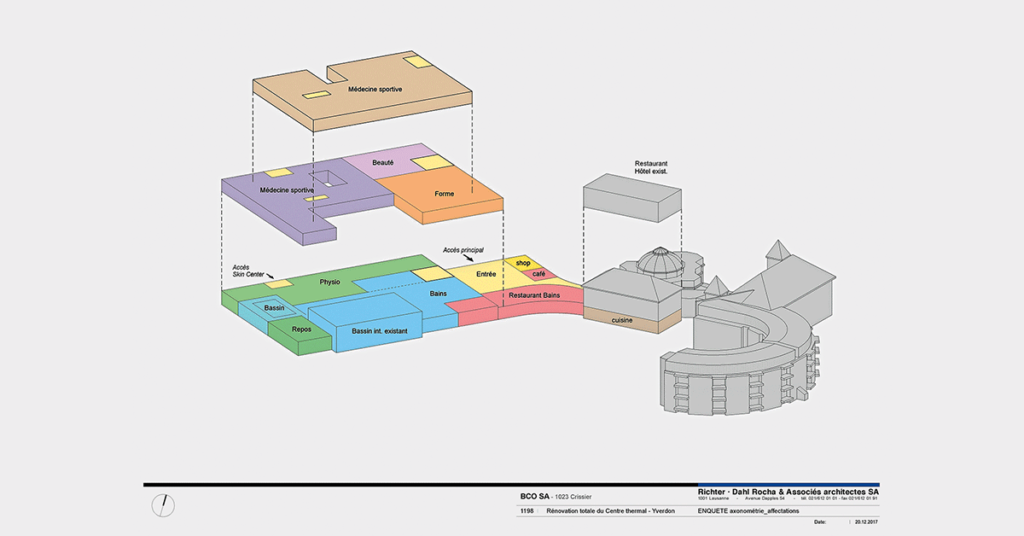
Seit Herbst 2019 wird das historische Hotel mit 116 Zimmern und Suiten während drei Jahren umgebaut. Das Gesamtbudget von rund 32 Millionen Franken enthält die Kosten für die vollständige Renovierung der Innenräume und des Aussenbereiches sowie des Thermalbades und des Grand Hôtels. Im Grand Hôtel werden die Zimmer und Bäder, die Küche und der Aussenbereich inklusive Schwimmbad renoviert. Der Eingang zu den Thermalbädern wird neu ausgestaltet und mit Geschäftsflächen und Restaurants erweitert. Die Umkleidekabinen werden renoviert.
Ein neues Café wird nur von den Bädern aus zugänglich sein. Die Zone um die Aussenschwimmbecken wird mit einem 350 m2 grossen Wellnessbereich mit Hamam und Sauna ergänzt. Der Fitnessbereich umfasst neu 700 m2. Während der gesamten Bauzeit wird das Thermalbad den normalen Betrieb aufrechterhalten. BCO SA, eine Tochter der BOAS-Gruppe, leitet die Bauarbeiten; das Architekturbüro Richter Dahl Rocha mit Sitz in Lausanne hat das Projekt ausgearbeitet.
Das Thermalbad von Yverdon-les-Bains besteht aktuell aus verschiedenen, zum Teil dreistöckigen Gebäuden, die untereinander verbunden sind. Im Aussenbereich stehen zwei grosse Schwimmbecken zur Verfügung. Das 4-Sterne-Superior-Hotel liegt inmitten eines prächtigen Parks mit altem Baumbestand. Aufgrund seiner langjährigen Geschichte strahlen die verschiedenen Räumlichkeiten des Grand Hôtels jeweils ihren eigenen, ganz besonderen Charme aus. So zum Beispiel die sogenannte Rotunde (kreisförmiger Bauteil), in der sich das Restaurant und die Lounge-Bar befinden oder der vor kurzem renovierte «Belle Epoque»-Saal und insbesondere auch das zum Hotel gehörende Schloss. Über einen Glastunnel ist das Hotel mit den Thermalbädern verbunden.
Neues Seedorf und neue Einrichtungen Der erste Schritt des gross angelegten Renovationsprojektes ist der Bau des Seedorfes im Park vor dem Hotel – am Ufer eines neu angelegten Weihers. Drei Holzbrücken führen die Besucher übers Wasser zu den Häusern, die verschiedene Wellnessbereiche wie Hamam, Sauna und Ruheräume beherbergen. Ein Barfussweg wird ebenfalls entstehen. Die bereits heute für die Physiotherapie und Arztpraxen genutzten Räumlichkeiten werden durch zwei Einheiten ergänzt: Entstehen soll ein Zentrum für Sportmedizin mit einem separaten Eingang. Weiter ist vorgesehen, die medizinischen Infrastrukturen räumlich zu konzentrieren, sodass die Patienten über eine grössere Privatsphäre verfügen. Durch die Verlegung des Thermalbadeingangs entsteht ein attraktiver, lebendiger Raum, durch den der Gast vom Hotel direkt zur Bäderzone gelangt.
Dieser Bereich umfasst 900 m2 und umfasst eine Empfangshalle, eine Boutique, ein Restaurant und ein Café. Der bislang für den Übergang genutzte, wenig ansprechende Glastunnel wird abgebaut. Renoviert werden zudem Küche und Restaurationsbereich. Die Fassaden und Dächer der Thermalbad-Gebäude werden abgerissen. Stattdessen wird einer äusseren Einfassung Platz gemacht, die den ganzen Komplex umfasst und vereinheitlicht. Die gesamte Fläche wird um eine Etage aufgestockt. Damit entsteht Raum für moderne, besser durchdachte, architektonisch homogen und stilvoll integrierte Inf- rastrukturen. Auch die Infrastruktur des Thermalzentrums wird optimiert: Das Hallenbad wird komplett renoviert und um ein neues Schwimmbad mit Spielbereich erweitert.
Infrastruktur des Neubaus in der Übersicht: Erdgeschoss Neuer Eingang, 600 m2 Boutiquen, Café / Restaurant, 360 m2 Bäder-Restaurant Bereich Physiotherapie (960 m2) mit unabhängigem Rehabilitationsbecken Neue Umkleideräume und Duschen Neues Innen-Schwimmbecken (Unterricht und Erholung) Inneres Becken vollständig renoviert Zwei Aussen-Schwimmbecken
Erste Etage Fitness-Raum, 700 m2 Schönheitspflege, 340 m2 Sportmedizinisches Zentrum (1160 m2) mit Anbindung an den Physiotherapiebereich und neuem separatem Eingang
Über BOAS Swiss Hotels Boas Swiss Hotels ist eine private Hotelgruppe mit Sitz in Crissier / Lausanne. Zur Gruppe gehören zehn Beherbergungsbetriebe in den Kantonen Wallis, Waadt und Genf. Die Hotels gehören mehrheitlich zur Kategorie der 3- und 4-Sterne-Superior-Betriebe. ■
At the beginning of the year, the Grand Hotel Geneva changed operators: Fairmont Hotels & Resorts, one of the luxury brands from the Accor Group, is taking over from the Kempinski Group. At the same time, the owner, Le Palace Genève SA, announced the extensive renovation of the hotel.
The Geneva 5-star hotel directly on the lake with a view of Mont Blanc is being remodeled by the French star architect Jean Nouvel. With his architecture office, he secured the contract in the context of an international architecture competition. Brigitte Jucker-Diserens' Geneva partner office is coordinating the project. The KKL Luzern, the Lyon Opera, the Galerie Lafayette in Berlin and the national museum in Doha all came from Nouvel's hands. He was awarded the Pritzker Prize in 2008 and has so far created over 200 structures.
Targeting the highest energy efficiency standards The renovation work should begin at the end of 2020 / beginning of 2021, once all permits have been received. One focus of the renovation is on the facade. It should be perfectly integrated into the environment and should be based on the design and materials of the other houses in the bay. The inner courtyard, the public areas and the restaurants are also being renovated. In addition, the hotel should meet the highest energy efficiency standards after the renovation. It is currently being clarified whether a thermal heating solution can be implemented. Then the hotel would be heated and cooled with water from Lake Geneva. This focus on sustainability is in line with the philosophy of the Fairmont brand.
The hotel has 412 rooms, including 33 suites and 14 apartments; three restaurants, a lounge and bar with a view of the lake, a heated indoor pool and a spa and fitness center. The number of rooms will be unchanged after the renovation, as the press officer at Fairmont Hotels & Resort, Philippe Eberhard, announced. The centrally located hotel will remain open during the renovation. According to Eberhard, the costs are likely to amount to tens of millions of francs.
Fairmont's portfolio currently includes 77 hotels in 29 countries, including the GrandHotel Geneva. The Fairmont Le Montreux Palace is also located on Lake Geneva. ■
Im ersten Halbjahr 2021 soll im historischen Gebäude des Märthofs in Basel das Boutique-Hotel Märthof eröffnen. Die Eigentümerin, die Coop Immobilien AG, hat das Architekturbüro Burckhardt + Partner mit der umfassenden Renovation beauftragt. Geführt wird das Hotel nach der Eröffnung von der zu Coop gehörenden Bâle Hotelgruppe. Sie betreibt bereits die Hotels Pullman Basel Europa an der Clarastrasse sowie das Victoria am Centralbahnplatz und das Hotel Baslertor in Basel-Muttenz.
Das Gebäude des Märthofs entstammt dem 19. Jahrhundert und bestand ursprünglich aus fünf einzelnen Häusern, die 1981 zu einem Gebäudekomplex zusammengeführt wurden. Die freiwillige Denkmalpflege Basel wehrte sich Anfang der 70er-Jahre gegen den geplanten Warenhaus-Neubau, der anstelle des alten Gebäudes vorgesehen war. Der Abbruch wurde 1976 in einer Volksabstimmung abgelehnt. Nun soll ein Hotel der oberen 4-Sterne-Kategorie entstehen, wobei die Fassade mit einem neuen Anstrich in ihrer jetzigen Form erhalten bleibt. Das Mauerwerk selber bleibt unverändert – auch die Natursteinpartien werden nur gereinigt.
Laut Coop-Mediensprecherin Rebecca Veiga sollen im neuen Boutique-Hotel die Stilepochen der ehemals fünf bestehenden Gebäude unverkrampft und spielerisch vermischt werden. «Verspielte Motive des Neubarocks und die funktionale Gestaltung der Geschäftsfassade aus dem Jahre 1927 treffen im Inneren des Gebäudes auf die lineare 80er-Jahre-Struktur», sagt Veiga.
Offene Übergänge und eine freundliche Atmosphäre Auf die insgesamt 68 geplanten Zimmer, davon acht Suiten und acht Juniorsuiten, werden Stehleuchten, Wandleuchten, Sessel und weiteres Mobiliar individuell verteilt – kein Zimmer wird exakt wie das andere aussehen. Die Zimmer erhalten unterschiedliche Farbschemen und widerspiegeln die Geschichte vom jeweiligen Gebäudeteil, in dem sie sich befinden. Die Farben sind abwechslungsreich und sollen nicht polarisieren – sodass sie das ganze Jahr hindurch auf die Gäste angenehm wirken.
Des Weiteren sind ein Fitnessraum, eine Bibliothek, ein Res- taurant sowie eine Bar auf der Dachterrasse im 6. Stock mit 55 Sitzplätzen vorgesehen – und eine weitere im Erdgeschoss. Alle funktionalen Räumlichkeiten sind analog einer starken Wirbelsäule um den Erschliessungskern des Hauses angeordnet und stossen von innen nach allen drei Aussenseiten. Die Übergänge der unterschiedlichen Nutzungsflächen im Erdgeschoss sind offen gestaltet, sodass es als Fläche ohne Unterbrüche wahrgenommen wird.
Eine helle und freundliche Atmosphäre empfängt den Gast im Standardzimmer. Der Raum wird mit Ausnahme der abgeschlossenen Dusche und einem separaten WC grosszügig offen gestaltet. Nebst der eingebauten Schrankzeile im Eingang sind alle Möbelstücke freistehend. Sanfte Rundungen gemäss dem Gesamtkonzept des Hauses werden auch im Zimmer durchdekliniert. Die Aussenbestuhlung und die grossen Fenster verbinden das Gebäude mit dem Marktplatz. «Die einmalige Lage und das lebendige Geschehen am Marktplatz soll nach innen spielen und umgekehrt», sagt Veiga. Das Boutique-Hotel will internationale wie auch lokale Gäste ansprechen und durch Restaurant und Bar entlang der Eisengasse als Treffpunkt für die lokale Bevölkerung und die Hotelgäste dienen. ■
Overall, the construction industry barely moved in 2019. According to the provisional figures from the Federal Statistical Office ( BFS ), an increase in construction investments in civil engineering of 3.9 percent offset a decline in building construction of 0.9 percent.
There was a change from new buildings to renovations and expansions. Investments in new civil engineering buildings fell by 6.9 percent, while investments in conversions and expansions rose by 13.2 percent. In building construction, too, investments in renovations and extensions rose by 1.6 percent, while investments in new buildings fell by 2.0 percent.
This switch to renovations was particularly pronounced among public clients: Last year they invested 8.8 percent more in renovations and extensions and 7.2 percent less in new buildings. Private clients invested 2.2 percent more in conversions and expansions than in 2018, but 1.4 percent less in new buildings.
Wir verwenden Cookies zur Unterstützung und Verbesserung unserer Dienste. Mit der Nutzung dieser Website erklären Sie sich mit der Verwendung von Cookies einverstanden. Weitere Informationen finden Sie in unserer Datenschutzerklärung.