Tag: Renovierung

  • Aircraft manufacturing headquarters to be extensively modernised and condensed

    Aircraft manufacturing headquarters to be extensively modernised and condensed

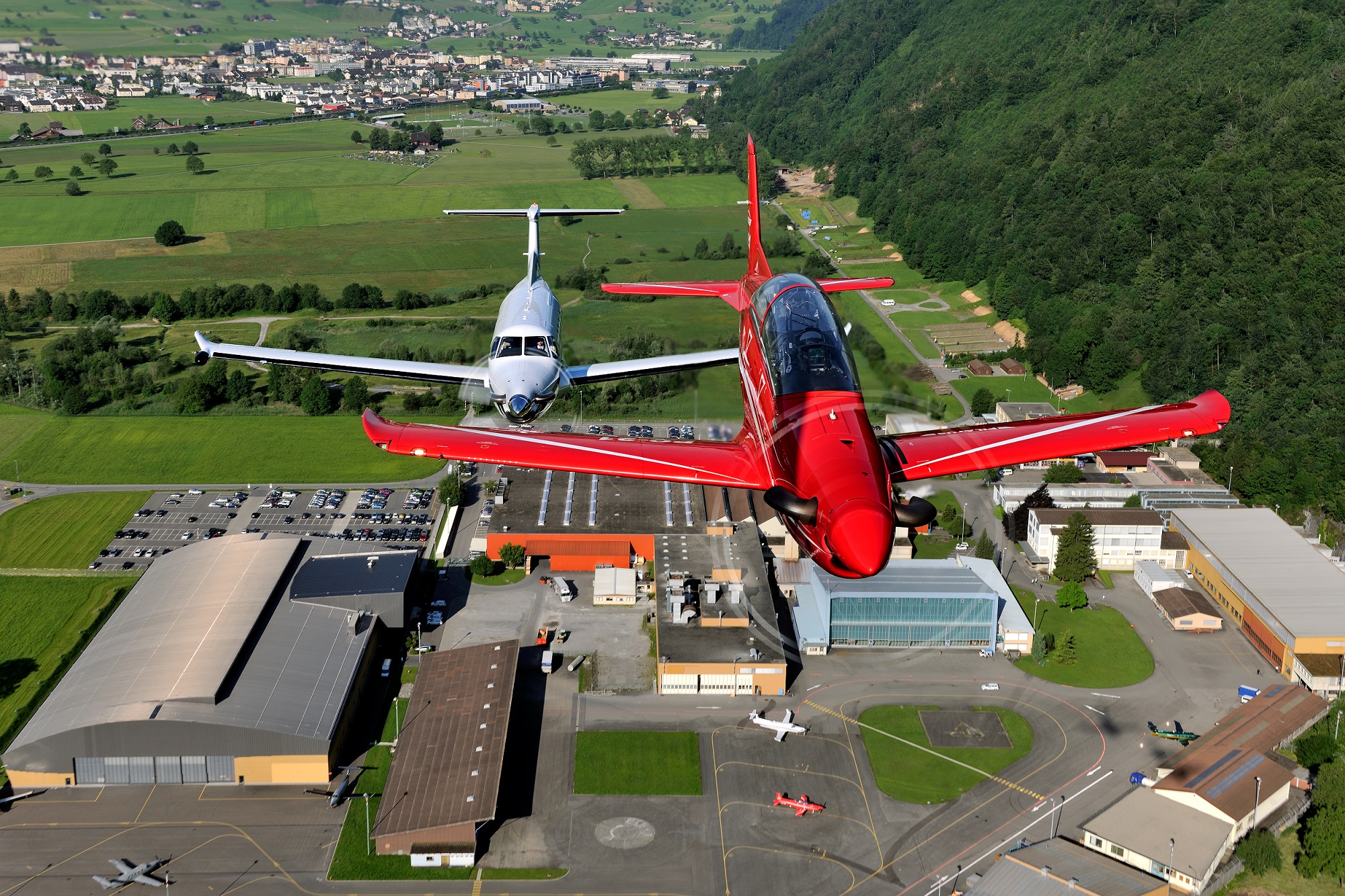
    The aircraft manufacturer Pilatus is planning to modernise its headquarters in Stans. According to a press release, the buildings, some of which are very outdated and energy inefficient, are to be comprehensively reconstructed. The production and administration areas will also be densified with new buildings. The architectural structure will be adapted to the landscape conditions. The vertical construction method will make better use of the space without the buildings exceeding heights of 32, 36 or 56 metres.

    According to the company, the buildings will follow the principles of sustainability and comply with international standards (LEED). Recycled concrete and local timber will be used. All buildings are subject to high energy standards. Large-scale photovoltaic systems will ensure that the building produces its own electricity.

    With this comprehensive renovation, Pilatus is showing its commitment to the Stans site and to the well-being of its 2,500 employees. Their environmentally friendly journey to work by public transport will be subsidised with financial support of up to CHF 1,000 per year, according to the press release.

    On 26 November 2025, the population of Stans will be able to decide on an amendment to the land use plan.

  • Digital solution makes building renovations easier for owners

    Digital solution makes building renovations easier for owners

    HEV cooperates with Scandens. Founded in 2021 as a spin-off of the Swiss Federal Institute of Technology in Zurich(ETH), the company launched software around a year and a half ago that makes it easier to plan and implement energy-efficient building renovations. Thanks to the cooperation with HEV Zurich, the Scandens software is now also available to private homeowners for the first time.

    Using the Scandens internet application, which is based on artificial intelligence, they can check whether and which renovation measures make economic and ecological sense. According to the company, the machine learning algorithms used were developed at ETH Zurich and the Massachusetts Institute of Technology. The software combines them with the latest energy modelling techniques for digital twins and official planning standards.

    According to a press release from Scandens, the software displays over 500 renovation combinations and creates a plan that serves as the basis for implementation. “Our mission is to increase renovation rates in Switzerland and actively support owners in increasing the value of their properties,” Scandens co-founder Diego Sigrist is quoted as saying.

    According to HEV Director Albert Leiser, the association wants to provide “a future-oriented and practical solution” with this offer: “With Scandens, we can offer our members a very well-founded digital planning aid that saves time and promotes sustainable decisions.”

  • Museum Langmatt in Baden to be completely renovated by 2026

    Museum Langmatt in Baden to be completely renovated by 2026

    ERNE is involved in the complete renovation of the Langmatt Museum in Baden. Specifically, the construction company from Laufenburg is to take on part of the renovation of the villa. “The work includes the demolition of entire rooms inside the building and the subsequent reconstruction of floor slabs, walls and ceilings, the renewal of the sewerage system and the partial demolition of the exterior façade, including façade renovation,” explains ERNE in a post on LinkedIn. ERNE also moved benches and steel supports for the construction of a new glass pavilion.

    The overall refurbishment of the villa and the surrounding public park will take place this year and next. Meanwhile, the museum’s private collection of French Impressionism in Europe will be sent on a European tour. The Langmatt Museum is due to reopen in spring 2026.

  • Sustainable circular economy in the construction industry

    Sustainable circular economy in the construction industry

    One of the key challenges facing the construction industry is the reduction of CO2 emissions. By decarbonising processes and procedures in the gravel, concrete and recycling industry, companies can make an important contribution to sustainability. The autumn event offers an industry roadmap to help companies identify and implement sensible measures to reduce emissions.

    Optimising concrete as a building material for sustainable construction projects
    Concrete is still one of the most widely used building materials in the world. However, sustainability also plays a decisive role here. The autumn event will show how the sustainability properties of concrete can be optimised and used in a targeted manner. At the end of a building project, the question arises as to how materials can be reused. Options such as renovation, refurbishment or recycling offer sustainable solutions, which will be discussed at the event.

    Pollutant control and separation as the basis of the circular economy
    A successful circular economy requires the targeted separation and control of pollutants. This begins with the planning of a construction project and continues with material treatment and disposal. At the autumn event, the key aspects of pollutant separation will be explained, which are essential for achieving sustainable results in dismantling projects.

    Dealing with persistent substances such as PFAS
    Per- and polyfluorinated alkyl compounds (PFAS) are a group of persistent substances that are increasingly becoming the focus of environmental research. These substances are ubiquitous and pose a particular challenge in the circular economy. The autumn event will provide insights into the possibilities and limitations of dealing with PFAS and highlight solutions that can be implemented in practice.

    Innovative decarbonisation projects in practice
    A highlight of the autumn event is the presentation of the world’s largest electric melting furnace for rock wool. This innovative project shows how decarbonisation is implemented in practice and what potential lies in the production of stone wool. Experts will gain practical insights into the technical developments and their contribution to a sustainable circular economy.

  • Neuchâtel equips three historic buildings with 33,300 solar roof tiles

    Neuchâtel equips three historic buildings with 33,300 solar roof tiles

    According to a press release, roof surfaces on three listed buildings in the city of Neuchâtel will be used for sustainable energy generation in future. The city’s Collège des Parcs and the cantonal school and university buildings Beaux-Arts and A.-L. Breguet will be equipped with a total of 33,300 solar tiles from Freesuns. The renovation project is supported by the CSEM research and development centre. For the city and canton, it represents a further step towards the energy transition.

    According to the press release, the college can generate 150,000 kilowatt hours of electricity itself each year, which is equivalent to the consumption of 50 Swiss households. The installed capacity on the cantonal buildings is 130 kilowatts peak for A.-L. Breguet and 95 kilowatts peak for Beaux-Arts.

    Architectural conditions required special solutions: At the Collège des Parcs, the tiles had to be installed in such a way that they followed the curved lines of the roof without damaging it.

    The conversion of historic buildings to solar energy could provide an inspiring model for other cantons and municipalities. The tiles could “enable the balance between cultural preservation and sustainable development”, Deborah Learoyd, General Manager at Freesuns, is quoted as saying.

    The renovation projects are “an example of how we can combine roof tiles, photovoltaics, energy transition and preservation of architectural heritage”, Matthieu Despeisse, Group Leader Solar Modules at CSEM, is quoted as saying.

    The work should be completed between September and November 2024. CSEM and Freesuns are considering continuing their collaboration.

  • St.Jakob-Park stadium co-operative takes stock of its finances

    St.Jakob-Park stadium co-operative takes stock of its finances

    The St. Jakob Stadium Cooperative(GSS) has provided information on its financial situation at a general meeting. According to a press release, CHF 3 million must be raised annually for maintenance and urgent renovation costs. The current infrastructure of the stadium, which has been in operation since 2001 and is the headquarters of FC Basel, is no longer up to date. A necessary renovation should therefore reduce costs in the long term and contribute to the economical and sustainable operation of the stadium for the benefit of FC Basel, according to the press release. In order to acquire the necessary capital, equity and borrowed funds are to be raised. The GSS is currently examining how external funds can be raised through sponsorship, donations, crowdfunding and marketing the name. It is also appealing for support from the relevant cantonal authorities.

    “The Joggeli is a landmark of the region. It is an institution of public interest that needs to be maintained and cared for,” Mathieu Jaus, Managing Director of GSS, is quoted as saying in the press release. “A modern infrastructure is an important piece of the puzzle for sporting success, the enjoyment of the fans, but also for the appeal of the stadium. We believe in this and want to ensure this together with all our partners and the region.”

  • UBS and Wincasa launch new property advisory service

    UBS and Wincasa launch new property advisory service

    UBS and property service provider Wincasa are offering owners of investment properties a new advisory solution. According to a press release, both companies want to use this offer to support owners in the renovation and energy-efficient refurbishment of their properties. The expertise of the Zurich-based financial institution UBS and the real estate company belonging to the Implenia Group will make the renovation of investment properties easier and more seamless, according to the press release. In particular, the focus is on greenhouse gas emissions. The real estate sector is the second-largest emitter in Switzerland with around 25 per cent.

    In a consultation with UBS and Wincasa, the needs of owners of investment properties are discussed and a modular offer is drawn up. UBS experts determine the financial feasibility of planned projects.

    “We are delighted to be launching this comprehensive advisory solution for the energy-efficient refurbishment of investment properties in the Swiss market together with Wincasa,” said Alain Conte, Head of Corporate & Real Estate Banking Switzerland at UBS, in the press release. “With this new offering, we want to give an additional boost to sustainable thinking in the property sector.” “Wincasa and Implenia have extensive expertise and experience in advising, planning and implementing renovation projects, particularly in the energy-efficient refurbishment of older existing properties. We will bring this expertise to the new offering and thus create added value for UBS customers,” adds Jens Vollmar, Chairman of the Board of Directors of Wincasa and Head Division Buildings at Implenia.

  • ETH researches natural thermal insulators

    ETH researches natural thermal insulators

    Researchers at the Swiss Federal Institute of Technology in Zurich(ETH) have tested natural insulating materials in a project. According to an article, the group led by Guillaume Habert, Professor of Sustainable Construction, and Bruno Sudret, Professor of Risk, Safety and Quantification of Uncertainties, have found new approaches to this. They analysed six buildings in need of renovation that were built between 1911 and 1988. In addition to the core issue of replacing fossil-fuelled heating systems with sustainable ones such as heat pumps or solar-powered ones, the main focus of the investigations was on thermal insulation. Various traditional insulation materials such as EPS, glass wool, rock wool and cellulose fibres were compared with natural materials such as straw and hemp.

    “The CO2 emissions from the production of conventional insulation materials are sometimes very high, and their use in building renovations partially cancels out the positive effect achieved by reducing energy consumption,” Guillaume Habert is quoted as saying in the article. “Building materials made from renewable raw materials cause significantly fewer greenhouse gases. They also have the advantage that they bind CO2 from the atmosphere as they grow and this is then stored in the building in the long term.”

    Both heating conversions and appropriate thermal insulation with natural materials can reduce greenhouse gas emissions by 87 per cent, according to the study.

    The study was conducted in collaboration with the University of Applied Sciences Western Switzerland(HES-SO) in Yverdon-les-Bains VD and the Chalmers University of Technology in Gothenburg.

  • This wall paint cleans itself and breaks down harmful substances

    This wall paint cleans itself and breaks down harmful substances

    Researchers at the Vienna University of Technology have developed a wall paint that cleans itself through exposure to sunlight and can chemically break down pollutants from the air. It is common knowledge that wall paints get dirty quickly and need to be replaced regularly. In addition, we are still struggling with air pollutants in our interiors. The need to renew paint regularly is at odds with sustainable living and environmental principles. The research team from the Vienna University of Technology and the Università Politecnica delle Marche in Italy has developed a solution to this problem: A wall paint that cleans itself under the influence of sunlight and can also break down air pollutants.

    Nano titanium oxide particles enable new breakthroughs
    Many people dream of a wall paint that cleans itself. This dream could now finally become a reality. The key to this groundbreaking innovation lies in the integration of specially modified titanium oxide nanoparticles into the paint. These tiny particles utilise the catalytic power of light to not only attract pollutants from the air, but also effectively break them down. This not only keeps the air cleaner, but the wall colour also retains its beauty and purity over a longer period of time. “For years, people have been trying to use special wall paints to purify the air,” explains Prof Günther Rupprechter from the Institute of Materials Chemistry at TU Wien. “Titanium oxide nanoparticles are particularly promising here, as they can bind and break down a variety of pollutants.” The pollutants that can be removed include household chemicals or emissions from building materials and furniture. Until now, conventional titanium oxide particles had to be activated with UV light in order to develop their cleaning effect – a requirement that is difficult to fulfil indoors. The research team has succeeded in modifying the particles so that they can already be activated by the broader spectrum of visible sunlight. This was achieved by adding phosphorus, nitrogen and carbon to the titanium oxide particles, which enables them to break down pollutants even without direct UV irradiation.

  • Romande Energie invests in the start-up Popety.io

    Romande Energie invests in the start-up Popety.io

    Romande Energie Group is investing in the start-up Popety.io from Plan-les-Ouates, which is active in property acquisition. The Group sees itself as an important player in the decarbonisation of French-speaking Switzerland. According to a press release, this commitment is intended to strengthen the BRM (Building Relationship Management) data processing tool that Romande Energie launched in March 2023 to support the renovation of its property portfolio.

    In a spirit of partnership and support for start-ups, energy supplier Romande Energie is acquiring a 6.45 per cent stake in the start-up Popety.io, which already counts Vaudoise Insurance among its investors. Through its Romande Energie Ventures unit, the Group analyses the market and invests in start-ups that also pursue the goal of contributing to the decarbonisation of French-speaking Switzerland. “We are convinced that data will simplify the decarbonisation of buildings. We are delighted to be driving these developments forward together with Popety.io,” said Géraud de Laval, Head of Strategy & Innovation – Real Estate at Romande Energie Ventures.

    Popety.io can now “count on the expertise of a committed energy provider like Romande Energie to accelerate the renovation of the building stock and accompany us in the development of our start-up”, founder and CEO Thibault Clément is quoted as saying.

    According to the press release, there are hundreds of thousands of buildings in Switzerland that are in need of renovation. Between 30 and 40 per cent of greenhouse gases come from buildings. The renovation rate of the Swiss building stock must therefore be drastically increased in order to fulfil the Energy Strategy 2050 and the Climate Act recently adopted by the Swiss people.

  • Holcim acquires German company Cooper Standard

    Holcim acquires German company Cooper Standard

    Holcim has completed the acquisition of Cooper Standard Technical Rubber GmbH in Mannheim, Germany, according to its media release. Its highly durable technical rubber products are used for roofing systems. The company reportedly has an innovative research and development department, a state-of-the-art production facility and an experienced team of 130 employees.

    This acquisition is expected to drive further growth of Holcim’s roofing business across Europe. “By expanding our range of roofing systems, we can play a greater role in providing innovative and sustainable solutions for energy-efficient buildings and contribute to the European Union’s Green Deal,” Jamie Gentoso, Global Head, Solutions & Products, is quoted as saying.

    Holcim sees the German firm’s “innovation-driven approach” as an “excellent complement” to its existing umbrella business. With its strategic location in the Rhine-Neckar region, it complements other recent roofing and insulation acquisitions, he said.

    The business will be expanded under the new name Holcim Technical Solutions & Products GmbH. As part of its “Strategy 2025 – Accelerating Green Growth”, Holcim aims to expand the Solutions & Products business to 30 percent of Group net sales by 2025 “and move into the most attractive segments of construction – from roofing systems to insulation and renovation”.

  • Energie 360° begins renovation of its headquarters

    Energie 360° begins renovation of its headquarters

    Energie 360° can begin the conversion of its headquarters in Zurich Altstetten. The energy provider, which is majority-owned by the city of Zurich, is investing almost 28 million Swiss francs in the redesign and expansion of its offices into an open office landscape, the construction of a large-scale photovoltaic system and the optimisation of the building services, according to a media release.

    According to the release, Energie 360° received the building permit in January. The construction site can now be set up from the end of March. The renovation work should be completed by late autumn 2024. In the meantime, the employees will move their workplaces to a temporary headquarters in Zurich Altstetten.

    The building is already fully supplied with renewable energy and is energy-optimised. In the course of the conversion, it will receive additional solar panels designed by Jessenvollenweider Architektur from Basel. The office is reportedly a pioneer in the field of photovoltaic systems. In future, the modules will produce around half of Energie 360°’s electricity requirements.

    “The additional photovoltaic systems on the façade and the extension on the roof turn the headquarters into a green power plant with an exemplary function and a strong external impact,” Jörg Wild, CEO of Energie 360°, is quoted as saying in the media release.

    The company wants to offer its customers exclusively renewable energy by 2040. As a sustainable energy and mobility service provider, it therefore also has its own energy consumption in mind.

  • Mandarin Oriental Palace is newly opened

    Mandarin Oriental Palace is newly opened

    The five-star hotel Mandarin Oriental Palace from the Belle Epoque has been open again since the end of September. It was closed for five years. After three years of extensive renovation work, guests can now stay again in this exclusive house on the shore of Lake Lucerne.

    According to a press release , the mezzo-soprano Cecilia Bartoli attended the ceremonial reopening, as did the general manager of the hotel, Christian Wildhaber, and the Chinese ambassador, Shi Ting Wang. Also present were Lucerne City Councilor Franziska Bitzi and high-ranking representatives of the Hong Kong-based Mandarin Oriental Hotel Group , which operates the hotel.

    The owner is the Chinese entrepreneur Yunfeng Gao. The representative house, built in 1906, is also intended to attract the important group of Asian travelers. According to the operators, the hotel is "well on the way to becoming Lucerne's most exclusive place".

    The Mandarin Oriental Palace was renovated and furnished by Iwan Bühler Architects from Lucerne and the London interior architects Jestico Whiles in coordination with the monument protection. It features 136 guest rooms, including 48 of the city's largest suites, as well as a spa and function rooms. It also houses four restaurants and bars under the direction of Michelin-starred chef Gilad Peled.

  • Dutch central bank builds with new strength

    Dutch central bank builds with new strength

    The Dutch Central Bank uses CO2-neutral concrete in the renovation of its Amsterdam headquarters. This is made possible thanks to a collaboration between the Dutch New Horizon Urban Mining BV and the Swiss start-up neustark , according to a LinkedIn announcement .

    New Horizon’s technology makes it possible to reduce the carbon footprint of concrete by 75 percent, they say. For this, cement is obtained from concrete recycling material. The remaining footprint is offset by neustark. The start-up has developed a technology with which CO2 from the atmosphere can be permanently stored in recycled concrete. For this purpose, liquid CO2 is introduced into demolition material.

    Neustark is a spin-off from the Swiss Federal Institute of Technology in Zurich ( ETH ) based in Bern. The company works with Holcim , among others, to drive innovation and sustainability in the construction sector. As part of the collaboration, neustark is investigating the CO2 conversion potential of Holcim’s recycled demolition concrete. Holcim, in turn, optimizes the concrete produced by neustark.

  • Hächler donates to the old Rütibuck scout home

    Hächler donates to the old Rütibuck scout home

    The Wettinger construction company Hächler is providing the Pfadi Hochwacht Baden home association with CHF 10,000 as a contribution to the renovation of the old Rütibuck scout home. According to a press release , the Hächler Group supports a non-profit organization every year. The donation of 10,000 francs replaces the usual gifts to business partners at Christmas and the turn of the year.

    Who Hächler gives the donation to is never an easy decision, says the media release. There are many institutions that are worth supporting. This year Hächler chose the home club Pfadi Hochwacht Baden. He is the bearer of the old Rütibuck scout home in Baden. This was used by the scout department between 1932 and 1973. They then moved into the new youth center and the old scout home has since been available to children and youth organizations, school groups and sports clubs for weekly camps, training weekends or festivities.

    This winter, the old Rütibuck scout home will be renovated and the outer shell will be subjected to an urgently needed energetic renovation, according to the Hächler announcement. That includes the renovation of the statics, the insulation of the outer walls, replacement of the old windows with triple-glazed wooden windows. The house will also have central heating and there will be a “gentle renovation inside” with adjustment and refreshment work such as painting and modernization of toilets and showers.

    The donation to the old scout home is also the cover story of the company newspaper “ Der Hächler ”. An interview with Stefan Zantop, founding member of the Pfadi Hochwacht Baden home association, is printed there. And there are tips on donations or active help with the renovation.

  • St.Gallen gets a new hotel

    St.Gallen gets a new hotel

    HRS Real Estate AG will start work on the renovation of the Villa Wiesental and a new hotel building on April 26, according to a media release . The building permit was recently received by HRS and the City of St.Gallen Pension Fund. Since the symbolic groundbreaking ceremony will not take place due to the corona situation, the initiators are planning a ceremonial laying of the foundation stone for June.

    The combination of Villa Wiesental renovation and new hotel building is an "excellent urban development solution", according to HRS Real Estate. Both the historical building and the urban development in the Bahnhof Nord district are taken into account. After the renovation, the Pension Fund Stadt St.Gallen would like to offer representative office space in the Villa Wiesental.

    After the planned construction period of two years, the new hotel will be operated by Hotel Wiesental St.Gallen AG. It will have around 100 rooms. Both the hotel's parking area and the publicly accessible ground floor should contribute to the revitalization and upgrading of the quarter.

  • La Margna becomes the Grace Hotel St. Moritz

    La Margna becomes the Grace Hotel St. Moritz

    The renovation work has been underway since September 2016: In St. Moritz, the former Hotel La Margna on Via Serlas is becoming the Grace Hotel. The owner is the internationally active Grace Hotel Group. She has the building carefully renovated and expanded with an annex. The opening was originally planned for 2017, was then postponed to autumn 2019 and is now to take place in 2022. The reason for the delay: the project was modified and expanded again after construction began. The number of hotel rooms was increased by a third to 56, as a correspondingly high demand is expected.

    Upon completion, the hotel will include the historic “La Margna Wing” and the modern, newly built “Grace Wing”. In the "Grace Wing" an underground car park, a spa area as well as hotel rooms and suites are being built. In the “La Margna Wing”, the rooms on the upper floors are being completely renovated. The rooms on the lower floors are being restored so that the historical building fabric is preserved. Here guests will discover vaults, arches and other architectural features of Art Nouveau.

    Art Nouveau meets modernity
    The former Hotel Margna was built in 1906 and 1907 according to plans by the architect Nicolaus Hartmann in the Engadin style. In 1911 the east wing was increased by three storeys. After that, renovations and renovations took place again and again, but the external appearance was never significantly changed. The striking facade is to be retained even after the current renovation.

    The drafts for the project come from the pen of the architect Nikolas Travasaros from Divercity Architects. For him, the main challenge was to freshen up the original architecture and at the same time create a modern extension for additional rooms and a spa. In addition to taking into account the strict building regulations and the given restrictions due to the sloping terrain, Travasaros had to plan hotel rooms that can also be converted into long-term apartments.

    His plans combine old and new by expanding the base of the existing building. The extension follows the natural gradient and fits seamlessly into the landscape. The new wing is deliberately kept discreet and does not overshadow the traditional architecture and the breathtaking alpine surroundings. Panoramic windows and adaptable, open interiors create a feeling of light and space.

    Blarer & Reber Architects in Samedan are responsible for the planning and implementation on site. The preservation of monuments in Graubünden was included in the project development so that the greatest possible preservation of the historically valuable building fabric is guaranteed. The STW AG for spatial planning based in Chur was also included in the project team.

    All rooms and suites of the boutique hotel Grace St. Moritz will offer lake or panoramic views. Three restaurants and a spacious spa area with swimming pool as well as a fitness center on over 800 square meters are planned. The hotel has a private car park and is just a 2-minute walk from the train station and the bus stop. A ski shop and ski room are also planned. Serviced apartments are also to be offered for sale in both wings. ■