Tag: ressourcen

  • Conserving resources and extending building life cycles

    Conserving resources and extending building life cycles

    ETH professors Catherine De Wolf and Maria Conen are advocating a radical change in the construction industry. Instead of sacrificing old, energy-inefficient buildings, they advocate their preservation, renovation and expansion. In addition to ecological aspects, the focus is on social and cultural factors. Buildings harbor identities and histories, the preservation of which is essential for city life. Sustainability thus becomes a link between the environment, society and architecture.

    Reuse of building materials
    A good example is the reuse of glass elements from the external escalators of the Centre Pompidou in Paris as office partitions. The time-consuming dismantling, sorting and reintegration is cost-intensive, but offers enormous ecological benefits through significant CO₂ savings and the avoidance of waste.

    Building materials such as wood and concrete have great, previously untapped potential for reuse. While wood is often simply burned, concrete slabs could be cut out and used as wall elements. Although steel beams are recycled, they are usually melted down in an energy-intensive process instead of being reused in a stable form. The challenges lie in technical feasibility, costs and complex planning.

    Digitalization and material passports for optimization
    Digital tools such as material passports should make it easier to gain an overview of the origin, composition and useful life of components in the future. This will make reuse and dismantling more efficient and transparent. The harmonization of such standards is the subject of research in order to create binding solutions in the industry.

    Legal and standardization barriers
    Another stumbling block is today’s prevailing standards, which are primarily designed for new buildings and take insufficient account of conversions and the context of existing buildings. This makes renovations and work on existing buildings more difficult from an energy perspective. Laws and regulations must be made more flexible in future in order to promote circular construction methods.

    Circular economy as a pioneer for CO₂ reduction
    The construction industry is responsible for around 50 percent of resource depletion and considerable amounts of CO₂ emissions. The circular economy significantly reduces these by cutting material costs, waste and energy consumption through reuse and modular construction. Deconstructability through bolted or plugged rather than glued connections is key here.

    Challenges and future prospects
    The biggest challenge lies in the effort involved in dismantling and reusing materials and finding buyers for reused materials. The lack of comprehensive market structures makes widespread implementation difficult. This is where initiatives such as digital marketplaces and the involvement of specialized engineering expertise come in.

    Modular construction and flexible usage concepts, such as the use of less well-insulated buildings as museums, show viable prospects for the future. The young generation of students and researchers at ETH and other institutes in particular are driving innovation, which gives hope for a more sustainable construction industry.

  • Zurich Metropolitan Area Cooperation Program 2025-2028

    Zurich Metropolitan Area Cooperation Program 2025-2028

    The cooperation programs of the Zurich Metropolitan Area Association serve the targeted development of projects with regional added value. Three programs have been successfully implemented since the association was founded in 2009. The focus is on growth, digitalization and demographic change. The current fourth call for proposals runs under the leitmotifs “Positive climate for innovation” and “Intelligent use of scarce resources” and thus picks up on the new Vision 2040/50 and the 2027 utilization strategy.

    The program is open to projects that focus on one of these topics or projects that combine both aspects. The selective, two-stage procedure ensures that the concepts submitted are practical, scalable and can be implemented in partnership with the member cantons, cities and municipalities. The submission threshold is deliberately kept low. In stage 1, a brief outline of the idea and organization is sufficient; in stage 2, the project is developed further and in more detail.

    Advantages and special features
    The program creates an innovative forum for supra-regional exchange between science, politics, business and society. The professional networking promotes sustainable solutions and strengthens the competitiveness of the metropolitan area as a leading location for research and development. Cantons, cities and municipalities benefit even if individual projects do not affect everyone equally. Diversity and innovative approaches remain the benchmark for the structural and functional area.

    Practical implementation and strategic impact
    With each program, the Zurich Metropolitan Conference provides new impetus for change in work, mobility and the use of resources. The current focus supports projects that contribute to greater innovative strength, digital transformation and sustainable development. Regional and cross-sector solutions are intended to further strengthen the Zurich metropolitan area as an attractive place to live and do business.

  • Upcycling project transforms leftover material into office furniture

    Upcycling project transforms leftover material into office furniture

    Restemöbel has completed a major interior fit-out project for the photovoltaic company Planeco, headquartered in Münchenstein BL, in the Alte Papieri Arlesheim. In collaboration with the Basel-based construction office in situ, restemöbel has, according to its press release, turned leftover material into high-quality furniture on a large scale for the first time.

    Among other things, restemöbel has planned and manufactured lockers that consist of 100 per cent residual material, apart from the fittings. The company utilises waste that is generated during production in joineries and various ancillary trades in the Lörrach area and is usually thrown away or incinerated.

    “To change this, we invented restemöbel in the summer of 2019: small, fine furniture that is made almost exclusively from leftover materials,” says the company in its self-presentation. “In this way, we are trying to do something about wasting resources and energy and at the same time make the world a little more beautiful.”

    Restemöbel is currently still a project by Florian Oeschger from Basel and Markus Schier, who is based on the German side of the Rhine in Rheinweiler. It is supported by Oe Moebel GmbH, based in Basel, as well as the Florian Oeschger furniture workshop and Markus Schier wood workshop in Rheinfelden, Germany. The two, who have been partners since 2022, have announced that they plan to rebrand restemöbel in Basel in the near future.

  • Swiss Cultural Message 2025–28 for building culture

    Swiss Cultural Message 2025–28 for building culture

    The draft Cultural Message 2025-28 places building culture at the centre of sustainable spatial development. In the face of climate change, resource scarcity and the loss of biodiversity, the design of living space is gaining strategic importance. With its holistic approach, Baukultur provides answers to key challenges and enables a sustainable future.

    Design as a social mission
    Baukultur encompasses all spatially effective activities from monument preservation and urban planning to the design of contemporary buildings. Well-designed buildings, settlements and infrastructure promote the well-being of the population, strengthen the cultural heritage and combine ecological, social, economic and cultural values. This integrative quality makes Baukultur a decisive instrument for the transformation of cities and regions.

    Forward-looking impetus from Davos
    The international Davos Baukultur process and the latest declarations by European culture ministers confirm the need for a holistic understanding of Baukultur. Switzerland is taking up this impetus and is planning to enshrine Baukultur in the Nature and Cultural Heritage Protection Act, an important step towards strengthening the federal government’s role model function and making targeted use of existing funding instruments.

    Circular economy and innovation as guidelines
    Future building culture must be consistently geared towards the circular economy and sufficiency. New standards such as life cycle limits for emissions, the conscious use of resources and a culture of remodelling form the foundation. In addition, a culture of innovation is needed that promotes new materials, technologies and processes.

    Recommendations for coherent implementation
    The signatory organisations have made specific demands. The environmental sector should be more closely integrated, municipalities and cities should be included in advisory and training programmes and effective construction taxation should be taken into account when adjusting subsidies. In addition, a consistent application of the concept of Baukultur is required, for example in the Swiss Culture Awards or in the work of Pro Helvetia. The Swiss Building Culture Round Table offers itself as a national platform for coordination with international initiatives.

  • Guide to sustainable building published

    Guide to sustainable building published

    The Rotkreuz-based Charta Kreislauforientiertes Bauen has published guidelines for sustainable and circular economy-orientated construction. According to a press release, the guidelines are intended to provide a practical basis for reducing non-renewable primary raw materials, lowering grey greenhouse gas emissions and improving the circularity of construction projects. The guideline is aimed at all partner organisations of the charter and also at interested building owners and investors. In addition to specific material instructions, the guidelines also take into account national and international environmental targets.

    Clear key indicators such as the Circularity Index Construction (CIC) are used to ensure transparency and comprehensible measurements of success. These enable the origin of materials to be recorded and grey greenhouse gas emissions to be measured.

    “The guidelines are more than just a guide – they are a practical tool that enables the Charter partner organisations to implement circular strategies in construction projects in a targeted and measurable way,” says Philipp Cescato, Charter Manager of the Circular Construction Charter, in the press release. “We create transparency and comparability with clearly defined indicators.”

    The Circular Construction Charter is run by Switzerland Innovation Park Central.

  • Opening of the “STEP2” NEST unit

    Opening of the “STEP2” NEST unit

    On 29 August 2024, the latest building module “STEP2” was officially opened in Empa’s NEST research and innovation building. This two-storey module in the south-east of NEST brings together a large number of innovations, all of which are aimed at significantly reducing material and energy consumption in the construction industry and promoting resource-saving construction methods.

    In Switzerland, the construction sector is responsible for the majority of raw material consumption, waste generation and a third of CO2 emissions. With the NEST building, Empa, together with over 150 partners, is pursuing the goal of developing new technologies and materials to the point where they are ready for the market. The “STEP2” unit is the latest example of how this vision is being turned into reality.

    From the digital staircase to the adaptive façade
    When you enter the “STEP2” unit, the innovative ribbed filigree ceiling immediately catches the eye. This was developed by an interdisciplinary team and enables spans of up to 14 metres, ideal for office and high-rise construction. Thanks to digital planning methods and 3D-printed formwork, it was possible to reduce the amount of material used by 40% without compromising on stability. The ceiling also fulfils important functions in terms of room acoustics and as a thermal storage mass.

    Another technological masterpiece is the curved “Cadenza” concrete staircase, which forms the centrepiece of the building. It was realised using computer-aided design and 3D printing technologies, which enabled an extremely material-efficient construction method. This staircase is an impressive example of how digital manufacturing technologies can contribute to innovative and sustainable design solutions in the construction industry.

    Holistic energy concept and innovative materials
    The “STEP2” unit is based on an integrated energy and comfort concept that was developed in collaboration with leading engineers. The innovative double skin façade, which is equipped with modern shading technology and controlled natural ventilation, plays a central role in the building’s energy efficiency. This façade also serves as a test platform so that new technologies can be easily integrated in the future.

    STEP2″ also focusses on innovation and sustainability when it comes to the materials used. For example, wall and floor panels were made from recycled waste materials such as denim fibres, paper cups and coffee grounds. These materials not only reduce the need for new raw materials, but also help to reduce greenhouse gas emissions.

    Co-creation and market readiness
    The “STEP2” unit was developed using a co-creation approach in which all partners involved worked closely together from the outset. This approach made it possible to develop marketable solutions that have a real future in the construction industry. For BASF, the main partner in the project, “STEP2” provides the ideal environment to translate its chemical expertise into concrete, sustainable construction solutions.

    “STEP2” is more than just a building module – it is a real innovation environment that demonstrates how research and industry can successfully work together to bring sustainable technologies to market. In future, the unit will serve as a workplace and innovation workshop to achieve further progress in sustainable construction.

  • Sustainability and quality of life in harmony

    Sustainability and quality of life in harmony

    In a new study published in the “Journal of Cleaner Production”, Empa researchers show that a good life is possible for more than ten billion people within planetary boundaries. Using a technical approach and the so-called donut model, they have calculated that humanity can live sustainably without sacrificing an adequate standard of living. Hauke Schlesier and Harald Desing from Empa’s “Technology and Society” laboratory and Malte Schäfer from the Technical University of Braunschweig have demonstrated this potential.

    The donut as a model for sustainability
    The donut model, consisting of two concentric circles, serves as the basis for the study. The outer circle represents planetary boundaries such as biodiversity, climate and land use. The inner circle symbolises basic human needs. The space between the circles, the donut, represents the sustainable use of natural resources in order to achieve an adequate standard of living. This theoretical basis has now been empirically confirmed.

    Using resources efficiently
    The study shows that an ecological life is possible for more than ten billion people, but far-reaching changes are necessary. There is an urgent need for action, particularly in the energy system and in agriculture. The complete abandonment of fossil fuels and a switch to a plant-based diet are crucial. The sustainable use of phosphorus and nitrogen and the avoidance of land use changes are further key measures.

    A balanced standard of living
    A key component of the transformation is the equalisation of living standards. While the global South would benefit from a significant increase in living standards, resource consumption in the global North would have to be reduced. This applies in particular to living space and individual mobility without compromising well-being. Public transport and healthcare could be expanded without significantly harming the environment.

    Narrow scope for sustainability
    The researchers emphasise that although the donut of sustainable living exists, it is very narrow. However, technological progress and the shift towards a circular economy offer potential for additional ecological leeway. “Our model is based on the current state of technology. Future innovations could expand the donut,” explains Schlesier.

    Empa’s study provides powerful proof that sustainability and quality of life are compatible. It shows the way to an ecologically and socially just life for all people on our planet.

  • Vaud plans electricity autonomy by 2035

    Vaud plans electricity autonomy by 2035

    The study presented by Isabelle Moret, Head of the Department of Economy, Innovation, Employment and Heritage (DEIEP), shows encouraging results on the photovoltaic potential of the roofs and façades of Vaud cantonal buildings. In the presence of Pierre de Almeida, Director General of Real Estate and Heritage, and Camille Orthlieb, Head of Sustainable Construction at the DGIP, it became clear that the cantonal administration can achieve electrical autonomy by 2035 by producing the equivalent of 23 GWh of electricity annually.

    Comprehensive photovoltaic installation
    Since the early 2000s, almost 19,800 m² of solar panels have been installed on the roofs of the cantonal administration’s buildings. This area is to be increased to around 100,000 m² by 2035. All new buildings will be equipped with photovoltaic systems so that they produce as much or even more energy than they consume. At the same time, a building refurbishment programme aims to reduce electricity consumption by around 30 % through energy optimisation.

    Responsibility and leading by example
    Isabelle Moret emphasises the importance of these measures: “Thanks to the efforts of our teams for the massive expansion of photovoltaic systems, we should achieve electrical autonomy by 2035. The Vaudois state is thus demonstrating its responsibility towards the challenges of sustainability and serving as a role model for energy consumption in the property sector.”

    Financing and project coordination
    Over CHF 18 million will be made available for the implementation of this project in order to finance both the expansion of the solar installations and the reduction in electricity consumption. Implementation requires close collaboration between the Directorate-General for Property and Cultural Heritage (DGIP), the Department for the Preservation of Historical Monuments, the Directorate for Energy (DGE-DIREN) and the Directorate for Resources and Natural Heritage (DGE-DIRNA).

    Future prospects
    In addition to the cantonal administration, the University of Lausanne (UNIL) and the Lausanne University Hospital (CHUV) are also evaluating their photovoltaic potential in order to increase their energy independence. These measures emphasise the canton of Vaud’s commitment to driving forward the energy transition and achieving long-term sustainability goals.

  • New investor for sustainable construction start-ups

    New investor for sustainable construction start-ups

    Buildify.earth was founded with the vision of supporting sustainable innovation in the construction industry. The investment company is particularly involved in the early development phases of start-ups and offers not only capital but also access to an extensive network. This network has been established over the years as part of the development of Switzerland Innovation Park Central, NEST and other organisations and is a valuable asset for the supported companies.

    Strategic partnerships and long-term goals
    Eight years ago, planning began for the location of the Innovation Park in Central Switzerland, which opened its doors in Rotkreuz in 2019 and has officially been part of Switzerland Innovation since 2021. The park now has over 100 members, including well-known players in the Swiss construction industry and research institutions. This network provides direct access to decision-makers and a platform for start-ups to forge important collaborations in a traditionally risk-averse industry.

    Provision of funding and resources
    The funds provided by private investors, the Zuger Kantonalbank and the park itself, which amount to a single-digit million sum, will enable buildify.earth to make significant initial investments, which are to be announced soon. The investment pipeline is richly filled, including 40 startups that are already members of the park. Buildify.earth AG takes a flexible role as a co-investor that can act quickly and act as a catalyst for further investments.

    Long-term planning and open doors for further investors
    Reto Largo and Sem Mattli, the heads of buildify.earth, are not only looking for promising start-ups, but also for further investors to strengthen the capital of the company’s evergreen structure. This structure fits well with the long innovation cycles in the construction sector and allows a portion of the proceeds to be reinvested while seeking attractive returns for investors. This is just the beginning of a long-term strategy aimed at making substantial investments in promising start-ups and actively shaping the future of the sustainable construction industry.

  • Disposal security thanks to long-term landfill planning

    Disposal security thanks to long-term landfill planning

    The sustainable organisation of waste management and the careful use of resources are playing an increasingly important role in today’s society. In the canton of Zurich, this is clearly demonstrated by targeted efforts to promote the circular economy, which has led to a significant reduction in the amount of waste that ends up in landfill sites. Nevertheless, there is waste that cannot be integrated into the material cycle and therefore requires safe disposal.

    The canton’s Building Department has identified 23 new, suitable sites for landfills in an extensive and broadly supported process. These sites serve as the basis for a partial revision of the cantonal structure plan and make a significant contribution to securing waste disposal in the long term. The aim is to precisely determine future landfill volume requirements and at the same time select sites in such a way that transport routes for disposal are optimised and environmental impact is minimised.

    Particular attention is being paid to reducing waste from construction activities, which accounts for the largest proportion of landfill volumes. Significant volume reductions can be achieved through measures such as sorting construction waste and cleaning contaminated excavated material. From 2030, a significant reduction in the annual landfill volume is expected compared to today. Over a period of 40 years, it is estimated that a total of around 17 landfill sites will be required, strategically distributed across the canton to further improve the efficiency and sustainability of waste disposal.

    This long-term planning and commitment to a sustainable circular economy show how responsible behaviour and innovative solutions can ensure safe and environmentally friendly waste disposal.

  • Local wood as the key to CO2 reduction

    Local wood as the key to CO2 reduction

    Switzerland, with a forested land area of around 30 per cent, has a valuable natural resource pool, the forest. In addition to its ecological importance for flora and fauna, the forest is also an important carbon store. During its growth, a tree absorbs CO2 and binds the carbon in the wood. By using wood in buildings or other components, the carbon can be sequestered over long periods of time, which helps to reduce greenhouse gases and minimise global warming.

    Martin Ziegler, Head of the Office for Forests and Game in the Canton of Zug, emphasises the need for demand for regional wood in order to fulfil the various tasks of the forest. Maintaining the forest is time-consuming and costly, so it is crucial that the wood produced finds local buyers.

    A website initiated by the cantonal forestry offices of Central Switzerland, Lignum Zentralschweiz and WaldSchweiz, aims to illustrate the links between forest management and the utilisation of wood. The website waldnutzen.ch presents six projects from the region and shows how the local wood cycle works.

    One example of the sustainable use of local wood is the “House of Wood” in Sursee, for which the builder Pirmin Jung deliberately chose to use local wood. The “Wood Tower” near the Goldau Animal and Nature Park in the canton of Schwyz also shows how wood from the region is used for sustainable construction projects.

    The canton of Uri recognised the potential of its forests early on and implemented measures to promote the forestry and timber industry as part of its government programme. The “Holzkreislauf Uri” project brings together all players in the value chain to promote the sustainable use of wood in the canton.

    Close cooperation between various interest groups, such as the Lucerne University of Applied Sciences and Arts, the cantonal forestry offices and the timber industry, is crucial to the success of such projects. The joint efforts promote the sustainable use of wood and support the reduction of CO2 in the atmosphere.

  • AQUA4D has been treating water for 20 years

    AQUA4D has been treating water for 20 years

    The Valais-based water treatment specialist Planet Horizons Technologies is presenting the seventh generation of its AQUA4D water management system to mark the 20th anniversary of its launch, according to a press release. AQUA4D was first launched in September 2004 by the company based at the Ecoparc de Daval in Sierre in the canton of Valais. The latest product generation is the result of extensive research and innovation aimed at optimising water management in various sectors, according to the press release.

    “From Daval Ecopark, we continue to develop, test and assemble our products dedicated to the protection of water pipes in Switzerland and the optimisation of irrigation around the world,” the press release continues. “Thanks to in-house manufacturing at our Swiss headquarters, we can fully control our production processes and ensure optimal quality and efficiency,” said Nicolas Masserey, Production Manager at AQUA4D.

    Planet Horizons Technologies has equipped more than 100 public buildings in Switzerland with its sustainable AQUA4D water treatment system. The innovative technology can also be used to improve the water quality of hospitals and schools. The technology utilises electromagnetism using a patented method to remove limescale deposits and protect against corrosion and bacteria. The system can be used primarily in old buildings with long-standing pipework and in areas with high levels of limescale in the water. This not only improves the quality of drinking water, but also reduces maintenance and servicing costs.

    With experience from more than 5,000 systems installed in 45 countries, the company says it is also finding increasing favour in Switzerland.

  • Solar industry wants to reuse used photovoltaics

    Solar industry wants to reuse used photovoltaics

    SENS eRecycling, the industry association Swissolar and the Biel-based Department of Engineering & Information Technology at Bern University of Applied Sciences are working with other partners to promote the circular economy in the solar industry. As part of the Swiss PV Circle project, they want to extend the lifespan of photovoltaics by creating business models for the reuse of used modules, according to a press release.

    The project is based on the observation that photovoltaic modules still have 90 per cent of their original output even after 20 years. Nevertheless, they are often discarded because they are either damaged or the operators want to upgrade to more powerful models.

    The partners want to collect data on the modules used in Switzerland and make this available to all stakeholders via a digital platform. The development of business models also involves ensuring an infrastructure for the dismantling, storage and testing of used modules, including their labelling. It should also be possible to track the modules throughout their entire service life.

    The module manufacturers Meyer Burger Technology and 3S Swiss Solar Solutions in Thun, Helion Energy in Cham ZG as an installer and operator of systems, the energy supplier CKW as well as KWB Planreal in Widnau SG and Reiling PV-Recyling GmbH & Co. KG from Münster in North Rhine-Westphalia, two specialists in the recycling of photovoltaic systems, are also participating in Swiss PV Circle.

  • Cantonal properties in Riehen win sustainability award

    Cantonal properties in Riehen win sustainability award

    The properties of the Canton of Basel-Stadt at Hirtenweg 16 to 28 in Riehen have won this year’s international prize for sustainable architecture, the cantonal finance department informs in a statement. Every year, the Faculty of Architecture of the University of Ferrara and the building materials company Fassa Bortolo award the prize to projects “that are geared to the needs of people and serve as role models in the careful use of natural resources”, it continues. In this year’s competition, the cantonal properties prevailed over numerous other projects from all over the world.

    The international jury was particularly impressed by two aspects of the properties in Riehen. One was the socially acceptable densification of living space. Of the five buildings already on the plot, the canton renovated three. The remaining two were demolished and replaced by three new buildings. This almost doubled the number of flats from 32 to 63.

    On the other hand, the resource-saving solid wood construction method was the decisive factor in the project realised by the project team Harry Gugger Studio AG, Erne AG Holzbau and Fontana Landschaftsarchitektur. The wooden modules were prefabricated in a production hall and then assembled on site within a very short time. During the entire construction work, the residents of the properties were able to stay on site. Residents of the deconstructed buildings moved into an already completed new building before their old house was demolished.

  • Recycling construction waste instead of landfilling it

    Recycling construction waste instead of landfilling it

    In the canton of Zurich, around 1 million tonnes of waste end up in a landfill each year. Most of this comes from construction activities – even though a large proportion of all construction waste is already used as recycled building material, for example in road and earth construction or for the production of recycled concrete. Landfill capacities in the canton of Zurich are scarce, and the construction of new landfills is becoming increasingly costly and difficult. The Department of Construction therefore wants to adapt the specifications for the treatment and recycling of construction waste with the aim of ensuring that in future even more waste is returned to the material cycle and does not end up in a landfill. This will also conserve natural resources.

    Recycling up to 100,000 tonnes of additional waste per year

    By far the largest part of the waste produced during the construction of buildings, roads and infrastructure is excavated material, i.e. soil and rock. If this is contaminated by pollutants, it must first be treated in a soil washing plant or a thermal plant before it can be recycled as construction material. Up to now, the Department of Construction has stipulated that at least 50 per cent of excavated and excavated material with low and low levels of pollution must be treated during excavation work. This quota is now to be increased to 75 per cent. This would mean that between 80,000 and 100,000 tonnes of polluted construction waste could be treated each year and returned to the material cycle as recycled construction materials.

    Dismantling material only in exceptional cases directly to landfill

    The demolition or conversion of existing buildings also generates around 2.5 million tonnes of construction waste per year in the Canton of Zurich. Of this, about 90,000 tonnes are deposited directly in a landfill. In future, only those demolition materials that are explicitly listed will be allowed to go directly from the construction site to a landfill. This list includes materials for which no recycling process exists to date, such as ceramics, porcelain or expanded clay. All other deconstruction materials must first be taken to a sorting or processing plant. This new regulation is intended to ensure that demolition materials are reprocessed into new building materials wherever possible.

    The specifications for the recycling of construction waste are laid down in a guideline (“Treatment rule for contaminated construction waste, bullet trap material and demolition materials”), which must be applied to construction projects in the canton of Zurich. The Construction Directorate has submitted the adaptation of this guideline to the stakeholders concerned for comment by the end of September.

  • Ipsach lake water plant wins innovation prize from InfraWatt

    Ipsach lake water plant wins innovation prize from InfraWatt

    Every year, InfraWatt awards an innovation prize for the implementation of exemplary energy systems. This year the prize went to Energie Service Biel/Bienne(ESB), the association for the use of energy from wastewater, waste, waste heat and drinking water informs in a press release. The Biel-based energy company received the award for its Ipsach lake water plant project: energy recovery in the reverse osmosis stage.

    In the project to replace the existing lake water plant, ESB wants to halve the already low trace substance content of the drinking water again. To achieve this, the company is using the process technology of reverse osmosis. Here, undesirable substances are removed from the water by forcing it through a semi-permeable membrane under high pressure.

    At the Ipsach lake power plant, ESB does not use any chemical additives, so-called antiscalants. In addition, the pressure of the discarded water is transferred to the water fed into the plant via a hydraulic energy recovery system. This will save about 740 megawatt hours annually, or 36 per cent of the plant’s total electricity consumption, the statement said.

    “The jury was impressed by the innovative character of the project and the efforts to ensure that new standards are set in terms of both drinking water quality and energy efficiency,” writes InfraWatt. The Yverdon-les-Bains-based association, founded in 2010 by the professional associations SVGW, VFS, VBSA and VSA, also attests to the project’s exemplary function for other water utilities.

  • Spatial planning, the measure of all things?

    Spatial planning, the measure of all things?

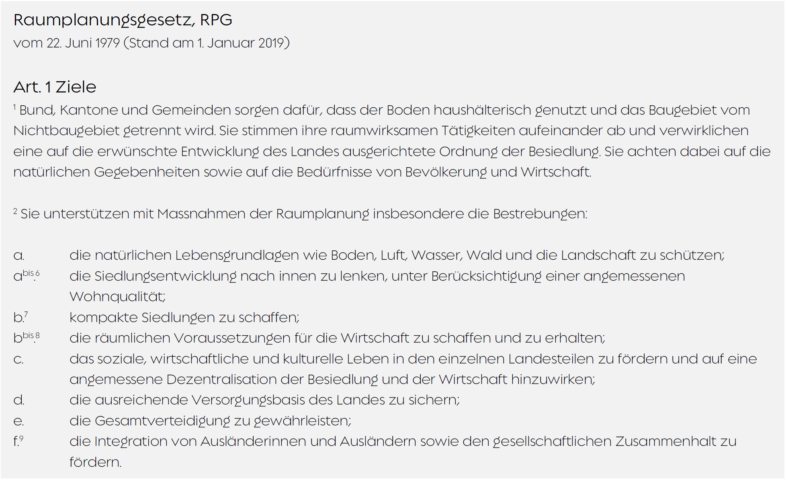
    Source: Swiss Confederation

    In reality, however, the cantonal and municipal planning instruments are incomplete, rigid, purely quantitative and do not pursue a three-dimensionally developed picture of the future. The consequences are well known: Inconsistent cityscapes, insufficient densification potential, growing traffic volumes, uncoordinated infrastructural facilities and, finally, a dissatisfied population.

    Forward-looking spatial planning with new concepts is indispensable, because the current sluggish planning instruments of spatial planning are obviously at odds with the dynamic process of urban planning and to date fail to achieve the goals defined in the RPG.

    With the use of the already existing GIS data, the potential impacts on all relevant topics such as interior densification, land use, transport, energy consumption, greenhouse gas emissions and many others could be visualised, evaluated and communicated in a participatory manner throughout Switzerland on the basis of qualitative future scenarios – and beyond the cantonal borders.

    Buildings in the context of spatial planning
    Spatial planning also creates the framework conditions for the development of neighbourhoods and ultimately of the building stock. When we talk about sustainable buildings, it is not enough to look at them in isolation and focus solely on their substance. Buildings are to be understood in their context and thus in consideration of their contribution to the reduction of traffic volume, to densification and to social integration. Following this logic, the two standards SNBS Building Construction for Building and SSREI for Existing Buildings have been developed in Switzerland. In terms of their content, both are unique in an international comparison.

    Source www.ssrei.ch

  • Kuratle Group and Raurica Wald build timber factory in Aargau

    Kuratle Group and Raurica Wald build timber factory in Aargau

    A sustainable production facility for wood processing is to be built on the former premises of the CPH Group in Full-Reuenthal, the Lucerne-based chemical and paper holding company informs in a statement. It has sold a plot of land on the site, which it used until 2002, to Full Property AG. The company is owned by the wood-processing Kuratle Group from Leibstadt AG and the Basel-based Raurica Wald AG, which specialises in investments in the forestry and timber industry.

    The new plant will process local roundwood into construction timber using energy from renewable sources. Until now, such timber construction materials have been imported, the statement said. “We are pleased that innovative companies that contribute to climate protection with a sustainable business concept are operating on our former company site,” Peter Schildknecht, CEO of the CPH Group, is quoted there. Several companies, including two recycling firms, have already set up shop on the former CPH production site, which covers an area of around 30 football pitches.

  • Swisspor and Madaster promote circular insulating materials

    Swisspor and Madaster promote circular insulating materials

    According to the press release , the insulation specialist Swisspor AG and Madaster Services Schweiz AG will be working together in the future. The aim is to promote the use of circular insulating materials in construction. With its product and recycling expertise in the field of insulation and sealing, Swisspor, based in Steinhausen, will open up the transition to resource-saving construction, according to the statement.

    Madaster is working on so-called material passports for new and existing buildings. This gives construction waste an identity and can be cataloged and reused as resources to avoid waste. The Madaster service is offered in Switzerland by Madaster Services Switzerland AG in Zurich.

    With Swisspor, the Madaster network will be supplemented with many years of expertise in the development, manufacture and recycling of building products in the field of insulation and sealing, Marloes Fischer, Managing Director of Madaster Services Schweiz AG, is quoted as saying. “Together we can make the medium to long-term increasing volume of insulating materials from demolition and renovation transparent. The goal must be to use as much recyclate as possible for new products.”

    “Swisspor is doing everything it can to increase the recycling rate of insulating and sealing materials,” says Marco Dalla Bona, Managing Director of Swisspor AG. With the Madaster material register, “built-in materials can be traced and later assigned to a new group of uses. If the sector manages to recycle 100 percent recyclable products, we will reduce the use of primary resources to a minimum,” Dalla Bona continues.

  • Zürichholz increases share capital

    Zürichholz increases share capital

    Zürichholz issues shares worth 3 million Swiss francs. As the wood marketer writes in a press release , the capital increase creates “a high-yield, sustainable investment opportunity” for qualified investors from the Swiss forest, wood and CO2 industries”. The company, which specializes in logs and energy wood, reached a new growth stage in 2019 after a consolidation phase. With the additional share capital, the company intends to continue growing in the forward-looking business areas of hardwood processing and biochar production.

    Since the groundbreaking ceremony in November 2021, Zürichholz has been building a new operations center in Illnau ZH for around 12 million francs, which is scheduled to go into operation at the end of 2022. This includes a pyrolysis plant for the production of biochar, a garage and workshop for the vehicle fleet, a wood chip hall to increase the capacity of the Aubrugg wood-fired power plant, offices for Zurich wood with rental capacity for third parties and a heating center for the Illnau heating network.

    The increasing demand for wood is reflected in a “very pleasing” balance sheet for the 2021 financial year. The company expects sales to jump from 15 million Swiss francs to 20 million in the medium term.

    The canton and city of Zurich are among the approximately 300 shareholders as large forest owners, which gives the share “additional stability and potential”. The issue price is CHF 1,400 per share with 2 to 1 subscription rights. Trading in subscription rights is excluded. The long-term dividend yield of nominally 5 percent should be maintained.

    Wood is becoming increasingly popular from a climate point of view. This applies to construction and industry, in energy production and as pyrolysis wood in bioenergy. Timber stocks are not only financially worthwhile. An investment in the forest and timber industry also pays off with a view to “climate management and net zero obligations of companies and the public sector,” it says. Due to its high CO2-reducing effect, wood is considered one of the leading negative emission technologies ( NET ) because it can absorb greenhouse gases from the atmosphere and thus minimize them.

  • Limeco does not need to lower the price of municipal waste immediately

    Limeco does not need to lower the price of municipal waste immediately

    Limeco has achieved an interim success in the dispute with the price watchdog. As the company reports , the Federal Administrative Court has granted suspensive effect to the complaint made by the operator of the waste incineration plant in Dietikon. The St.Gallen judges are thus opposing the price watchdog, who wanted to deny the complaint this suspensive effect.

    In addition, as requested by Limeco, the judges also require the specialist authorities to be involved in the decision. These are the Office for Waste, Water, Energy and Air of the Canton of Zurich , the Federal Office for the Environment and the Federal Competition Commission .

    In an order in September , the price watchdog stated that “Limeco's price for the incineration of municipal waste was abusively too high”. He wanted to oblige Limeco as early as January 1, 2021, to lower the price that the municipalities would have to pay for the consignment to 102 francs per ton.

    Limeco then filed a complaint with the Federal Administrative Court in October. Limeco argued that the transfer prices corresponded to the requirements of the federal government and the canton of Zurich. They are appropriate and are necessary for “sustainable, cost-covering and polluter-friendly disposal of municipal waste”. The price watchdog made some false assumptions.

    The price monitor can comment on Limeco's complaint until mid-February.