Tag: Rückbaumaterialien

  • Circular building with reeds

    Circular building with reeds

    The residential building by Marina Rosa and Jacobus van Hoorne, designed by Gilbert Berthold, architect and research assistant at BFH, deliberately stands out in a single-family housing estate on Lake Neusiedl. It combines a consistent timber construction with a striking thatched roof and thus relies on local, renewable raw materials with a low ecological footprint. The numerous awards, from the client prize of the Central Association of Austrian Architects to the architecture prize of the province of Burgenland and the newcomer prize “House of the Year”, underline the exemplary character of the project.

    Reeds as a high-performance building material
    Jacobus van Hoorne, originally a particle physicist at CERN, took over his father’s reed cutting and thatching business and developed it into an innovation laboratory. Together with Berthold, he developed a roof structure that met strict fire protection requirements and was officially approved through real fire tests. A milestone for reed in new buildings, even in densely populated areas. The gently curved roof surfaces follow the material logic. Each additional degree of inclination extends the service life of the roof, the construction makes the qualities of the natural material visible and legible.

    Geometry, material and space as a unit
    The floor plan of the house follows an S-shape resulting from the rotation of the central living space. At its heart is a two-storey, light-flooded atrium that opens onto the garden and is closely linked to the outside space via terraces. Compactly organized functional spaces create scope for spacious recreation areas. The interplay between the thatched roof and the natural oak façade connects the building and the landscape. The roof becomes a design-defining element and a contemporary interpretation of traditional craftsmanship.

    Real-life laboratory for bio-based materials
    For Gilbert Berthold, the project marked the start of his self-employment and at the same time a real testing ground for sustainable construction. Today, the house serves as a home, study object and exhibition space all in one. It provides data on energy efficiency, indoor climate and the long-term behavior of bio-based building materials. In the context of the BFH, it fits in with research into plant-based materials such as straw, flax, hemp and mycelium and shows that reeds can be used not only as an insulating material, but also in a leading architectural role.

    Symbol of a regenerative building culture
    The project illustrates how circular building with regional resources can already be implemented today. It shows students and professionals that regenerative architecture is not a vision of the future, but a built reality. With reeds as a strong symbol for a building culture that rethinks nature, technology and society.
  • Automated production for sustainable energy use

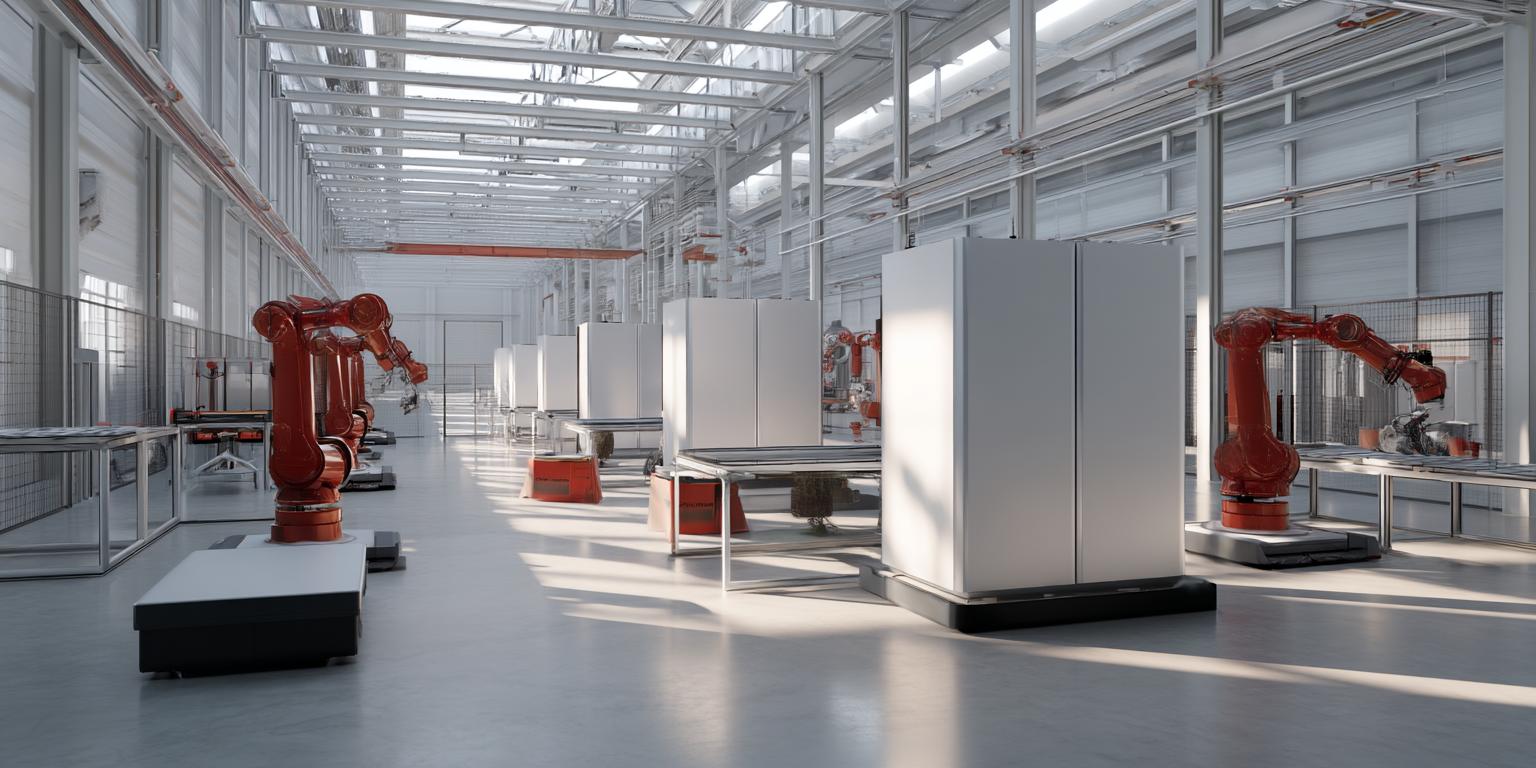
    Automated production for sustainable energy use

    Libattion AG, based in Opfikon, has opened a new plant in Biberist for processing used batteries from electric cars. Here, the batteries are used to produce modular stationary energy storage units. According to the company, this is Europe’s largest plant of its kind. The production facility was set up on the site also used by battery recycling company Librec.

    The new facility has a high degree of automation. “Our new production hall enables us to respond flexibly to market requirements and make an important contribution to conserving resources in Europe,” said Stefan Bahamonde, CEO and co-founder of Libattion, in the press release. “By automating our production, we can not only operate efficiently, but also economically and adapt our capacities precisely to demand.”

    In 2022, Libattion produced stationary storage systems with a total capacity of 7 megawatt hours; last year, the company already achieved a total capacity of 27 megawatt hours. The company aims to increase its total capacity to 500 megawatt hours by 2026. Libattion’s storage systems have a modular design and can have capacities ranging from 97 kilowatt hours to 60 megawatt hours. Safety is the top priority, explains Bahamonde: “Thanks to automated production and strict quality controls, we can guarantee the highest safety standards for every storage system”.

  • Resource-conserving use of demolition materials in road construction

    Resource-conserving use of demolition materials in road construction

    Strabag has been using crushing technology from the manufacturer Gipo to process mineral demolition materials since July. The mobile stone crushing plant Gipo-P100 GIGA produces high-quality aggregates from mineral demolition materials for road construction and concrete production at the Bürglen gravel plant, the construction company writes in a press release.

    The Bürglen gravel plant has a mixed gravel deposit consisting of processed gravel as well as primary and secondary gravel material. Storage and landfill require space. Recycling, on the other hand, means that excavation materials can be reused for future construction projects while conserving resources.

    An excavator fills the hopper of the 74-tonne crushing plant with unsorted demolition material. The material passes through several crushing stages on a conveyor belt, is screened and separated from construction waste until the end product has the required grain size. This is then supplied to the concrete plants, which use the recovered concrete for road construction.

    The technical manager of the Bürglen gravel plant, Franco Martinelli, quoted in the press release, describes the performance of the new crusher using the example of a construction site in Flawil SG. There was an urgent and short-term need for 3000 cubic metres of crushed, unbound 0/45 mixture. “With the crusher, we processed the required material within three days and transported it directly to the construction site. Without our Gipo-P100 GIGA, we would have had no chance of supplying our operatives,” they say.

    Strabag is also planning to use the crusher directly on construction sites for major demolition and dismantling work in the long term.